Publisher’s note: This is the first of two stories investigating the toxic storm water runoff on the West Slope of El Dorado County.
By Joann Eisenbrandt
Last year’s El Nino winter brought much-needed rain to El Dorado County’s West Slope. But it brought something else as well. It brought allegations of repeated mismanagement and lack of timely corrective action by El Dorado County to control toxic storm water runoff from properties near the El Dorado Trail between Missouri Flat Road and Highway 49 just south of Placerville.
With the 2016-17 rainy season already starting, some are asking if last winter’s issues have been adequately addressed or if more needs to be done now, before another winter arrives in earnest.
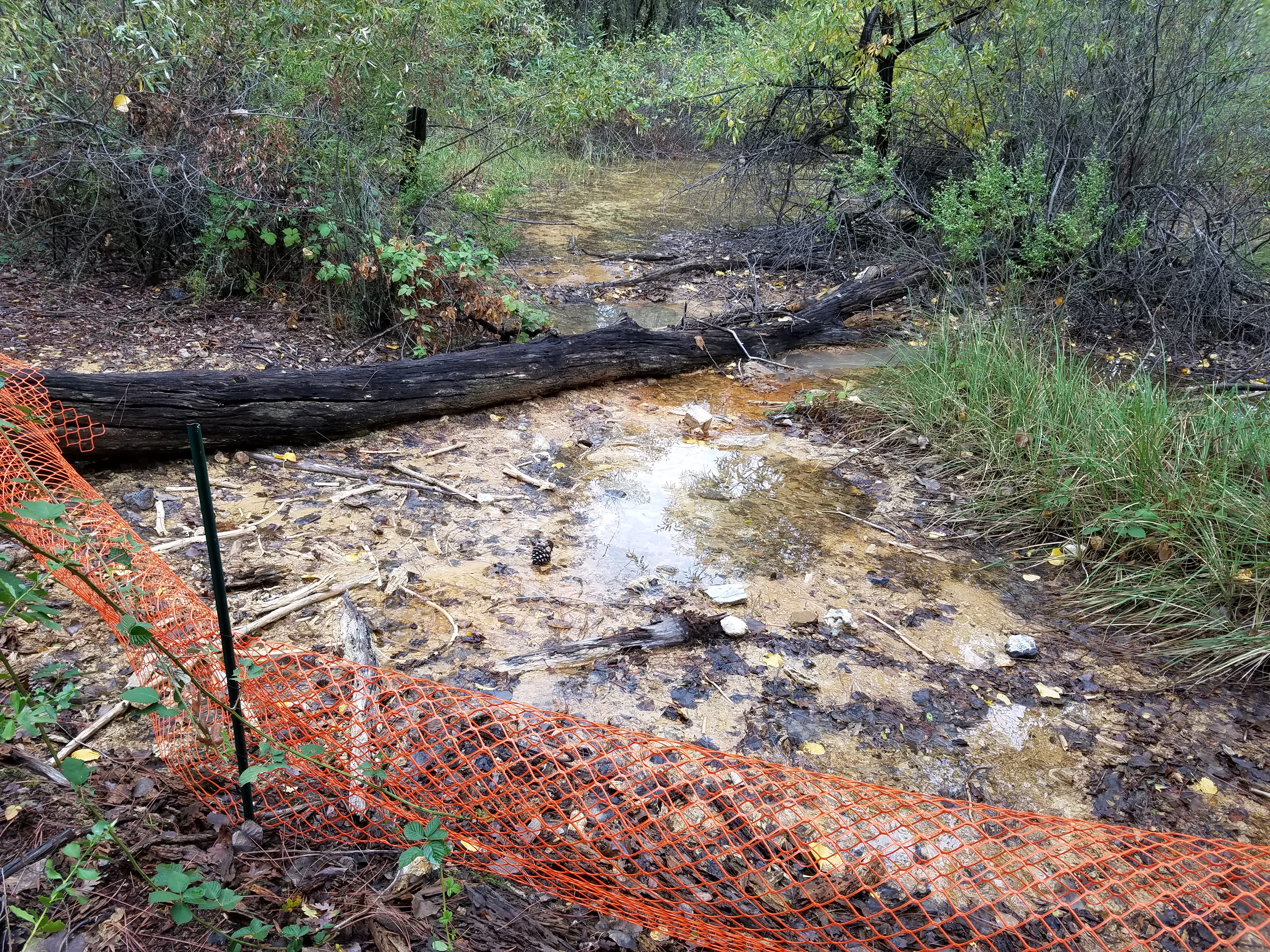
The temporary fencing that exists today was put up along the El Dorado Trail by county Environmental Management. Photo/Provided
Storm water runoff has high pH
The El Dorado Trail is a popular, highly-used biking and walking trail for adults and children situated in an area surrounded by dense vegetation and populated by a variety of native wildlife and aquatic species. Tributaries in the area drain into nearby Weber Creek and from there into the American River.
In March 2011, a hazardous materials spill report received from a local citizen by the California Department of Fish and Game (now Fish and Wildlife) stated that the tributary near property owned by Michael Lindeman adjacent to the trail contained lime waste materials. The Lindeman property as well as the material recovery facility (MRF) property next to it owned by Waste Connections was the former site of the Diamond Lime Plant.
The report said there was “white milky water and dead mammals in two tributaries of Weber Creek.”
Carol Oz, environmental specialist with Fish and Wildlife who responded to that report, said her agency’s concern was with state water quality as it relates to aquatic organisms.
Public health or water quality issues related to storm water discharge would be in the hands of the county or the State Water Quality Control Board.
The early rains in January 2016 again raised concerns about the safety of those using the trail and the impacts of the storm water runoff around it on the surrounding ecosystem.
George Turnboo, a member of El Dorado County’s Solid Waste Advisory board, was walking along the El Dorado Trail in January and noticed significant storm water discharge bubbling up. He told Lake Tahoe News his hands started burning after contact with it. He called Don Nizolek, also a member of the Solid Waste Advisory board. He is an environmental engineer qualified to do storm water testing. They tested the runoff using professional-grade pH testing strips.
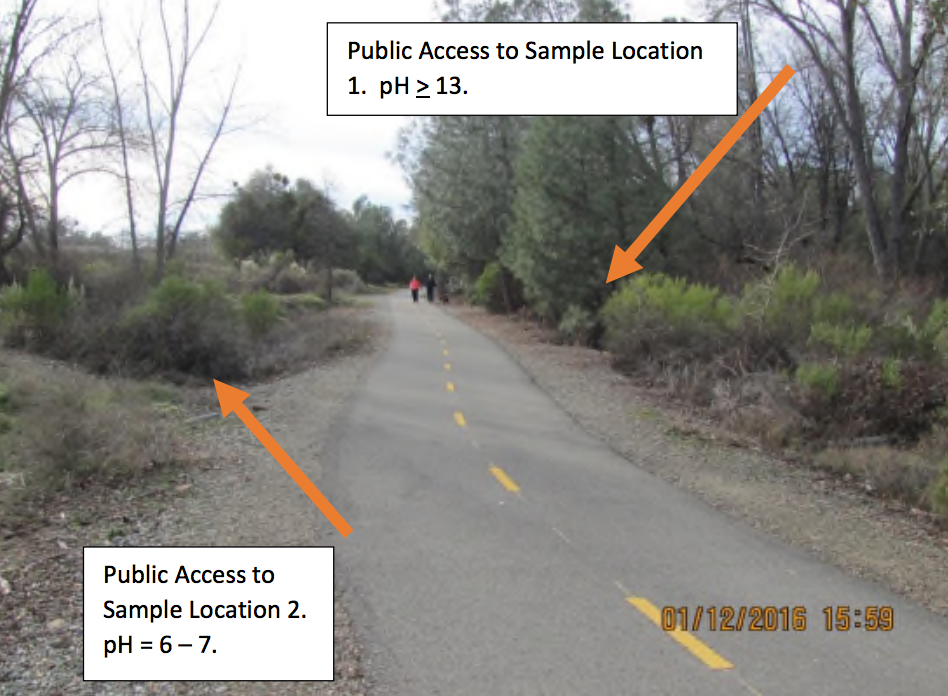
The hazardous water is just off the popular multi-use El Dorado Trail in Placerville. Photo/Provided
“We pulled a reading of 13.5 (pH). We did a 32-page report and sent it to Greg Stanton, the director of county Environmental Management,” Turnboo told Lake Tahoe News.
The pH (potential hydrogen) scale goes from 0 to 14, and is a measure of the acidity or alkalinity of a solution. A reading of 7 is neutral. More than 7 is alkaline (a base) and less than 7 is acidic.
Save Our County, a local nonprofit land use watchdog group, posted a video of the storm water runoff on its website. It included explanations about the area’s history and previous concerns over storm water runoff. Turnboo did a live pH test on the video that registered a reading of 13.5 on a pH test strip.
Cheryl Bly-Chester, professional engineer who is an environmental engineering consultant and owner of Rosewood Environmental Engineering, narrated a large portion of the video.
Bly-Chester explained that anything with a pH of 10 will burn your skin and anything above a 12.5 pH is a corrosive hazard. She added that the amount of burning depends on the concentration of the corrosive materials and the length of exposure. According to the EPA (Environmental Protection Agency), samples must be tested within 15 minutes of being taken as the longer a lime-based sample is exposed to air the more the pH level goes down.
Bly-Chester reported the storm water discharge to Fish and Wildlife, the state Water Board and to county Storm Water Management who then reported it to Environmental Management.
On Jan. 12, 2016, Fish and Wildlife personnel were present when county Environmental Management staff took samples in the area and verified a pH reading of 12.8 at a location on the north side of the trail near the end of Stage Court. Additional samples were taken the next day with a confirmed field test pH reading of 12.7.
Bly-Chester called Greg Stanton expressing concern that county staff had left the site after their initial testing without posting any warning signs or putting up any type of physical barriers to access.
Testing was done on Jan. 12 and a number of following days. A citizen report to the state Office of Emergency Services on Jan. 28 prompted additional testing at a location one-eighth mile away from the original site. A warning sign and caution tape were posted on Jan. 15, and temporary fencing was installed at the original site on Jan. 26.
Turnboo spoke at the Jan. 26 El Dorado County Board of Supervisors meeting and handed the board a copy of his 32-page report. Sue Taylor of Save Our County also spoke, telling them, “The buck stops with you.”
A press release was posted on the county website on Jan. 29 telling residents to “avoid contact with storm water in the vicinity of the El Dorado Trail near the end of Stage Court due to high alkaline levels.”
Two more press releases followed.
The current situation
Turnboo walked along this same area of the El Dorado Trail the last week of October. He told Lake Tahoe News, “All that milky material (from last winter) was dried up, but now it’s come back. (The runoff) is still as milky as before and is leaching out of the ground. Human safety is more important to me than anything else, especially when you are talking about little kids walking along that trail.”
Permanent fencing to restrict access to the area below the trail where the high pH runoff was found in January has still not been installed.
Stanton told Lake Tahoe News, “The signage was removed by unknown persons last winter. We welded signs onto posts at the end of last season. The fencing is scheduled to go up in the next couple of weeks. We were waiting to see the progress of the Water Board with the property owner. Once the issue is abated on that property, there will be no need for a fence.”
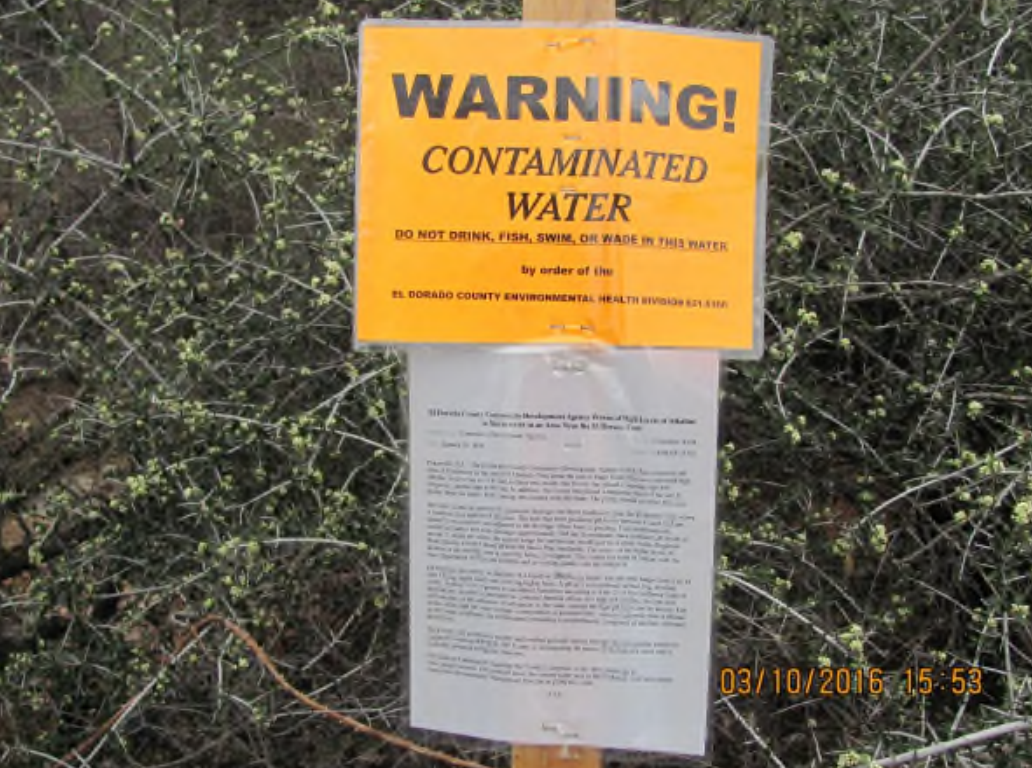
Proper and permanent signage has been an issue. Photo/Provided
What lies beneath?
Much of the area between Missouri Flat Road and Highway 49 has been the location of heavy industrial and commercial uses, including auto dismantling, orchards using pesticides, a railroad, railroad depot, engine house and railroad maintenance facility, as well as lumber mills and sawmills.
Beginning in 1927 and ending in 1977, the Diamond Lime Plant processed limestone from local quarries for road building, agricultural and industrial uses. Lime rocks were crushed and mineral piles were stored on the property alongside lime kilns and sludge settling ponds. A railroad ran parallel to the site to ship out the finished products and an aerial tramway carrying cars full of limestone ran from a nearby quarry to the plant for processing. In 1977, the plant ceased operation and the site was abandoned. Remnants of the material processed there and the sludge ponds underneath were covered over, but not fully cleaned up.
Leonard Bartley was vice president of operations for the Diamond Springs Lime Company, the plant’s official name. The Heller Foundation was the plant’s parent company. Bartley worked at the plant from 1964 until its closing in 1977. He confirmed that there were settling ponds on the property, both on the current Lindeman property and in the area where the MRF now sits. They were used to settle out the lime and they remained on the property after the plant closed. There was also a large oil tank full of bunker seed oil that was used to light the kilns. It was so large, he told Lake Tahoe News, that four or five railcars could have fit into it. The oil tank was still there when the plant closed down. Some remediation was done and the kilns were removed, but a large amount of materials were “just left lying there.”
How dangerous is it?
There is disagreement on where the current high pH runoff is originating from, what areas it is impacting and how toxic to humans and animals it really is.
Barbara Houghton, county environmental health manager, told Lake Tahoe News last summer, “Weber Creek has not been impacted. It’s the drainage where the high pH is. It is only by the bike path where there is an impact. Today it is dry. I would be more concerned about rattlesnakes, ticks or poison oak.”
According to El Dorado County Public Health Officer Nancy Williams, “As a highly alkaline substance, solid calcium hydroxide (created when calcium oxide [lime] is mixed with water) is considered to be a moderately caustic irritant to exposed skin. However, because calcium hydroxide barely dissolves in water, casual contact with the pooled water next to the El Dorado Trail is not likely to produce any harmful effects. While a pH of 12.5 or greater is considered hazardous as defined by state regulations … the type of substance(s) in the water and the concentration of these substances must also be known in order to determine the degree of hazard.”
Bly-Chester believes the county’s press releases have not accurately reflected the dangers of the runoff. She told Lake Tahoe News, “As the temperature of the water gets colder, more reaction can happen and the pH can go up higher … in the middle of winter in the morning, it is probably even more hazardous … with high bases it seeps into your skin and starts reacting with your skin and you don’t know it until it’s fairly deep in your skin.”
Asked if the workers at the Diamond Lime Plant had any problems dealing with the materials they processed, Leonard Bartley said, “We had regular safety meetings on it. People there knew how to handle that stuff. People got little burns, but nothing serious. You knew not to get into it or get it on your clothes. It was hot lime. If you did (fall in), all they’d find are the fillings in your teeth.”
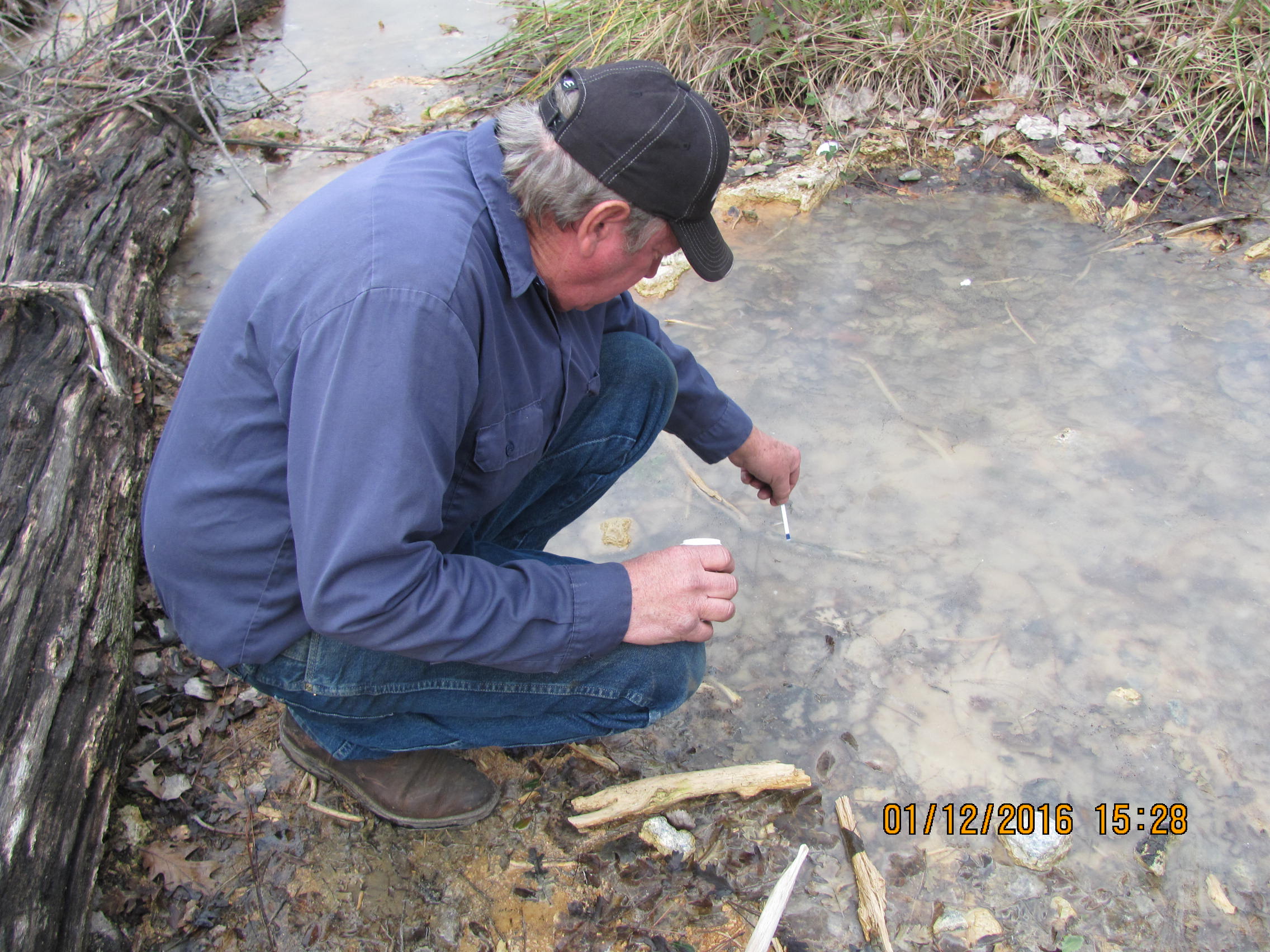
El Dorado County’s Solid Waste Advisory board member George Turnboo tests the toxicity of storm
water runoff in Placerville. Photo/Provided
Where does the buck stop?
When asked by Lake Tahoe News if Environmental Management was planning any ongoing monitoring of storm water runoff along the El Dorado Trail as this rainy season progresses, Greg Stanton said, “Environmental Management is not. We are an emergency response agency, not involved in ongoing monitoring. Storm water issues are handled by Long Range Planning, but this is really a Water Board case.”
With many federal, state and local agencies having some degree of regulatory power over water quality and storm water management, untangling the hierarchy of public responsibility can be difficult.
At the federal level, water quality is controlled by the EPA under the Clean Water Act. A 1987 amendment to that act expanded the National Pollutant Discharge Elimination System (NPDES) to cover storm water discharges. The county as well as businesses like the MRF that discharge pollutants from a point source like a pipe or a man-made ditch into U.S. waters are required to have a NPDES permit showing that they have complied with the Clean Water Act and have regulations in place to deal effectively with controlling pollutants in storm water runoff.
In California, the State Water Resources Control Board (SWRCB) and the nine regional branches beneath it, manage water quality issues, including the NPDES permit system, for the EPA.
On El Dorado County’s West Slope, the Central Valley Regional Water Quality Control Board is the agency with authority. At the Lake, it is Lahontan.
The county regulatory umbrella
County agencies with responsibility include Environmental Management, Long Range Planning, Development Services, Transportation and Public Health. They all sit under the umbrella of the Community Development Agency except for Public Health, which is part of the Health and Human Services Agency.
The county adopted a Storm Water Quality Ordinance in 2015 which established a Storm Water Management Plan (SWMP) overseen by Long Range Planning. The SWMP outlines how the county will comply with the requirements of the NPDES permit.
There is also a county Grading, Erosion and Sediment Control Ordinance, overseen by the Transportation division. It details the requirements for grading permits and related mitigation measures for any construction activities that could potentially impact storm water runoff and water quality.
Long Range Planning, Development Services and Transportation are also involved with projects that require preparation of an environmental impact report (EIR) under the California Environmental Quality Act (CEQA) and deal with mitigation measures required to offset potential environmental impacts.
Environmental Management includes divisions dealing with hazardous materials, environmental health, solid waste and solid waste franchises in the county. The Hazardous Materials division deals with emergency response and spills and has a 24-hour emergency response program for hazards, including water pollution, reported by citizens.
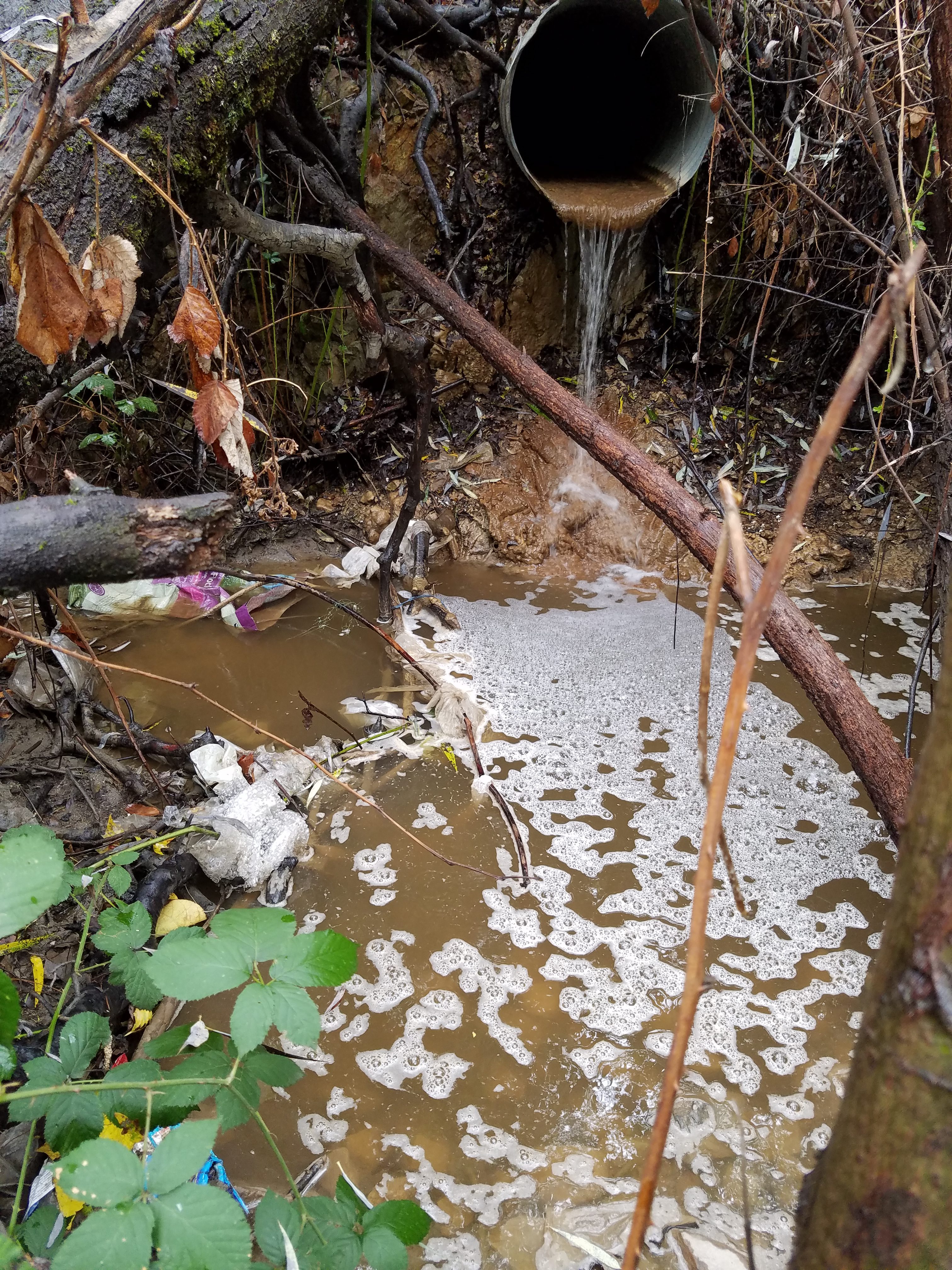
October rains brought the caustic water problem on the West Slope to the surface again. Photo/Provided
Too many cooks?
Brendan Ferry, principal planner and storm water program manager in the Long Range Planning division, agrees that water quality is a multi-agency issue.
“We have played a role, and Transportation has played a role, and Environmental Management has played a role,” he told Lake Tahoe News. “We all work within the same Community Development Agency. It’s not cut and dried. (The former Diamond Lime Plant) is a complex historical site with lots of moving parts.”
There is an enforcement response plan for storm water quality which outlines the roles and responsibilities of the various departments with regard to response and enforcement of storm water issues depending on whether they require an emergency or non-emergency response. According to Ferry, multiple county agencies might respond to the same toxic storm water discharge report.
A decadeslong problem
The Diamond Line Plant closed in 1977. There has been a clearly documented awareness for many years of the legacy of hazardous materials it left behind. Why, then, is high-pH storm water runoff still occurring in the areas around it in November 2016?
In February 2016, the Water Board issued an order to Michael Lindeman identifying his property as “a source of high pH waters leaching from the former lime rock processing facility found to be polluting soil and groundwater beneath the site, and leaching into unnamed waterways in the vicinity of the site.”
He was to prepare a technical report documenting the historic uses of the site, its current status and thoroughly identify remaining hazardous surface and subsurface materials and outline a program to clean them up. But this was far from the first time a public agency had become involved.
In 2008, Youngdahl Consulting, a geotechnical engineering firm, prepared an environmental site assessment (ESA) for Lindeman and his development partners in preparation for the planned construction of the Diamond Dorado Retail Center on his property. It was to include a mix of small and big-box retailers such as Home Depot or Target. An ESA is prepared prior to the county purchasing any property or accepting easements related to a development project to identify recognized environmental conditions that might affect the property or its value.
The Youngdahl report concluded that the surface water, storm water runoff, and groundwater quality on and around the property “may be compromised by pollutant loading,” and recommended that additional subsurface exploration take place before any grading operations began.
Finding the best solution
In March 2011, the California Department of Fish and Wildlife received the Hazardous Materials Spill Report that referenced milky water and dead wildlife in Weber Creek. Staff took photos of the site documenting the discharge. Testing showed pH levels ranging from 8.5 to 11.2. A Fish and Wildlife code violation case was filed with the county District Attorney’s Office. Lindeman was given a notice to appear in El Dorado County Superior Court in November 2011. He didn’t show up and a warrant was issued, but the warrant was recalled and the misdemeanor criminal case dismissed in early December 2011.
Assistant District Attorney Jim Clinchard explained that his office believed there was not enough evidence to prove the case and that based on ethical standards it had to be dismissed.
“Part of our proof problem in (the Lindeman) case was that the whole area was contaminated. How do you prove specifically where the problem came from when rain comes and washes lime from a number of properties? How could we say where it came from? There was lime on all these properties,” Clinchard said.
The same rationale would apply, he added, for any subsequent referrals by outside agencies for action by the District Attorney’s Office.
Clinchard said that in this type of case the administrative process is a better solution. “A criminal case,” he told Lake Tahoe News, “only has so much power over a defendant to fix a problem. Even if a defendant pleads guilty and pays a fine, it doesn’t fix the problem.”
He pointed to the county regulations such as the grading and storm water ordinances, and the enforcement mechanisms available to the state Water Board as better solutions.
More actions and reactions
Fish and Wildlife recommended that the Lindeman property site be stabilized to prevent further runoff. A corrective action plan was created by Lindeman and approved by Fish and Wildlife. In July 2012, Carol Oz met at the site with representatives from the Water Board and El Dorado County to review the plan’s progress. The visit revealed that extensive grading of the site had taken place without a grading permit from the county or notification to Fish and Wildlife. A stream and wetland on the property had been destroyed and soil had been put into the streambed of a tributary to Weber Creek. Monofilament erosion control netting that is hazardous to wildlife was being used.
Filing for a grading permit with the county’s Transportation Division triggers county inspection of the site and a review of the grading plans. A grading permit is required when grading would create “a condition which could adversely affect the water quality of any water body or watercourse.”
An applicant for a grading permit also files a notice of intent with the Water Board that he will comply with the NPDES permit requirements for storm water discharges associated with construction activity.
A second violation notice was sent by Oz to the county District Attorney’s Office. It indicated that the county and the Water Board had also observed the non-compliance at the site and were preparing documentation to submit to the DA’s Office. The potential costs for which Lindeman could be responsible were listed at $92,500.
A follow-up visit in February 2013 by Oz and a representative of the Water Board showed that the approved corrective action plan was still not being followed. Water Board staff observed lime waste in the graded cap material at the Lindeman property.
As the Water Board’s February 2016 order to Lindeman later explained it, “The capping material (obtained off site) is highly permeable and therefore, impacts from the lime waste through surface leaching are probable, as indicated by the continued high pH.”
A letter from Fish and Wildlife region manager Tina Bartlett to Lindeman stated, “…the department is forwarding this notice of violation to the District Attorney’s Office for civil or criminal prosecution.”
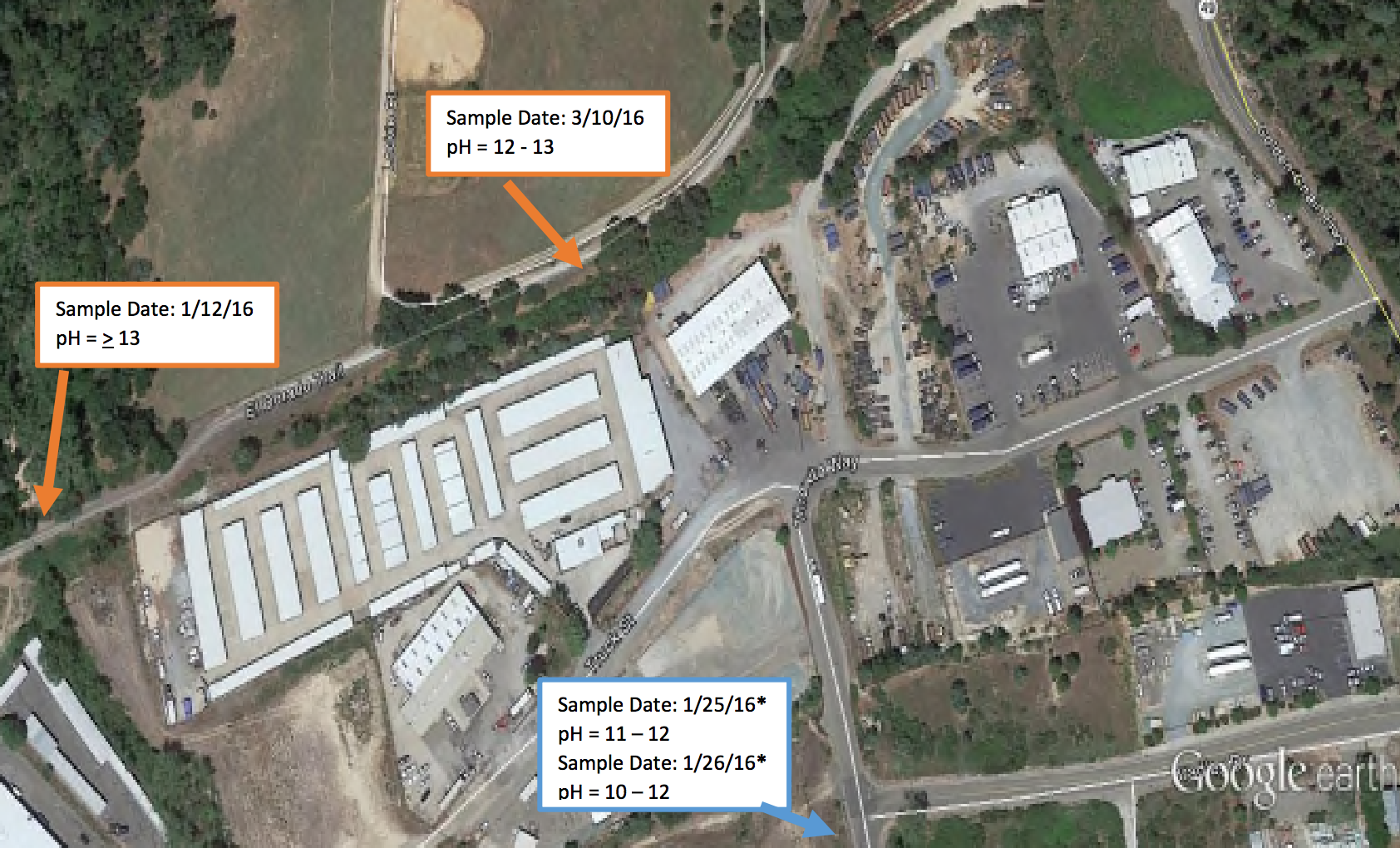
Testing of the hazardous water is done in close proximity to populated areas. Photo/Provided
The grand jury is not pleased
The 2013-14 El Dorado County Grand Jury investigated the allegations of illegal grading on the Lindeman property and the failure by the county to take effective enforcement action.
The report referenced Fish and Wildlife code violations, the failure of Lindeman to follow the approved corrective action plan, grading conducted without a county grading permit and failure to comply with a Transportation division stop work order.
“The physical manifestations of the lime plant are long gone,” their report concluded. “However, the last vestige of the Diamond Lime Plan may be the lime waste that today continues to contaminate the property, surrounding area and adjacent waterways.”
The grand jury report added that in addition to criminal action by the District Attorney’s Office, enforcement action can be taken under the county’s Grading Ordinance and county employees or contractors can enter the property as the ordinance states “to abate hazards to public health and safety.”
Assistant District Attorney Clinchard agrees. “If it appears there is illegal grading, the county can go in or hire a contractor to fix it and then bill the landowner. If he doesn’t pay, they can lien the property.”
The grand jury concluded, “Both county staff and officials reported that they perceived it to be the will of the Board of Supervisors that the ordinance not be enforced. They stated that El Dorado County is a property rights county, the will of the Board of Supervisors is that property owners not be burdened by strict compliance with requirements perceived to be onerous for some property owners.”
In its response to the report, the county agreed that the illegal grading had “spread toxic limestone waste over the site causing dangerously high levels of pH in surrounding tributaries.” It disagreed with the grand jury’s contention that, “nobody is doing anything to stop it. Not the owner, not the county and not the state.”
The county response noted that the Transportation division issued a stop work notice and that they “followed the actions prescribed in the Grading Ordinance and forwarded the complaint to the appropriate agency for follow up and enforcement.”
The grand jury recommended that the county not allow Lindeman’s Diamond Dorado project to continue without ensuring that “all the environmental issues and mitigations have been resolved.”
The Diamond Dorado project had been approved by the Board of Supervisors in 2012, but the development agreement was rescinded by the county this year due to changes in the partnership and funding mechanisms, and lack of substantive forward progress on the project by the proponents.
Currently, all the requirements of the Water Board’s February 2016 order to Lindeman have still not been fulfilled. According to Walter Floyd, engineering geologist with the Water Board, the work plan presented by Lindeman was conditionally approved at the end of September 2016, with a report presenting the investigation results expected at the end of this month.