Nev. field trials for skill-based games draw near

By Thomas Moore, Las Vegas Sun

Nevada will soon begin testing skill-based games in casinos, one of Nevada’s main gaming regulators said last week.

Manufacturer GameCo boasts that its products are the first skill-based games to be approved by any gaming regulator in the United States and are now operating in Atlantic City casinos. And field testing could begin soon on very similar games in Nevada, said A.G. Burnett, chairman of the Nevada Gaming Board.

“If I could guess, I would say in a couple of months we could see something on a field trial,” Burnett said. “Maybe sooner. But it depends. I’ve been in communication with our lab guys and dialoguing with the independent test labs in terms with where they’re at. They are in the system, but we all are aggressive and want to get to field trials as soon as possible.”

Read the whole story


20 nonprofits receive cash from ACC tournament

The slew of South Shore nonprofits received checks Nov. 10 from proceeds from the 2016 American Century Championship.

Each year the celebrity golf tournament organizers distribute money back to the community. This year $51,984 went to 20 organizations.

Grants ranging from $500 to $5,500 were awarded to: Assistance League of Sierra Foothills, Barton Foundation, BATS Bringing Art to Schools, Big Brothers Big Sisters of El Dorado County, Boys & Girls Club of Lake Tahoe, Christmas Cheer, Kahle Community Center, Kelly Ridge, Kiwanis Community Organization Inc. (Coats for Kids), Lake Tahoe Educational Fund, Live Violence Free, Saint Joseph Community Land Trust, South Lake Tahoe Cancer League, Suicide Prevention Network, Tahoe Arts Project, Tahoe Magic, Tahoe Regional Young Professionals, Tahoe Senior Plaza, Tahoe Turning Point and Tahoe Youth & Family Services.


Barton may be part of Tahoe ambulance team

By Kathryn Reed

El Dorado County is looking at redefining how medical care is provided to those who call 911 for an ambulance.

Paramedicine is a growing service throughout the United States, and is a model being looked at locally. Potentially nurses could be riding in an ambulance. They would have the ultimate say over whether someone goes to the hospital. But at the same time they could provide a higher level of care to the patient compared to what the paramedic or emergency medical technician who currently rides in the ambulance can do.

This is also designed to cut down on the “frequent fliers” using the ambulance to get to the hospital – often times for prescription meds.

The Affordable Care Act has created a conundrum – more people have medical insurance, but the reimbursements don’t cover the cost of doing business.

“Seventy percent of El Dorado County ambulance drives are Medi-Cal or Medicare. They don’t cover all of it. The feds pay a flat amount, which is far less than what an ambulance trip costs,” El Dorado CAO Don Ashton told Lake Tahoe News.

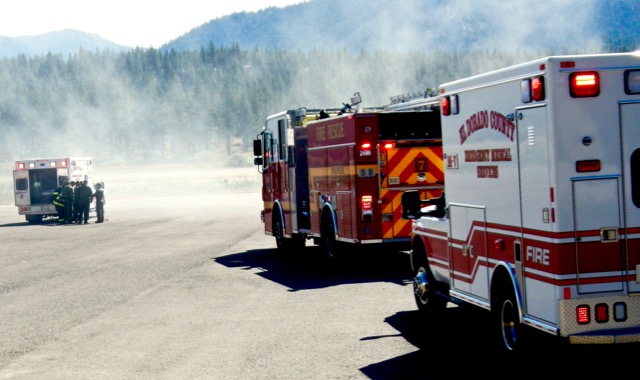
Ambulance service in El Dorado County is likely to change in the coming years. Photo/LTN file

Ambulance service in El Dorado County is likely to change in the coming years. Photo/LTN file

California law mandates counties provide ambulance service. El Dorado has joint power authorities on both sides of the Sierra to handle the respective service. The West Slope contract expires in 2018, the Tahoe one in 2019. It’s possible the West Slope contract could be extended one year to be aligned with the Cal-Tahoe JPA.

“We are trying to get a structure in place that is more sustainable in the long term,” Ashton said. “Once contracts expire, we have several options regarding ambulances.”

One idea is to privatize them. While that is on the table for the team to investigate, it is not the option Ashton favors. (It didn’t work well in Tahoe in the 1980s.) He envisions ambulance service in the county being more coordinated. This could help with inter-facility transfers and coverage. It’s possible the current JPA structures would no longer exist or they could be redefined or even combined into one.

Barton Memorial Hospital in South Lake Tahoe and Marshall Hospital in Placerville could be partners in the JPA. Both medical facilities have expressed interest. For this to happen state law would need to be changed. The county is working on that, with reps from the hospitals having written letters to state lawmakers in support of changing legislation to allow their entities to be included in the ambulance JPA model.

“Barton Health values care team coordination and supports endeavors where we can collaborate with other community partners to deliver consistently exceptional care,” Mindi Befu, spokeswoman for Barton Health, told Lake Tahoe News. “Barton Health is exploring options to have a representative on the JPA board of directors to provide a hospital perspective and assist with oversight in the delivery of emergency medical services. Barton does not plan to operate ambulance services; however, we will continue to work with El Dorado County, the city of South Lake Tahoe, and their partners and contractors to deliver comprehensive, high-quality patient care.”

She said this is not being looked at as a revenue stream. But their involvement has the potential to save everyone money.

Finances are driving the desire to come up with a new model for providing ambulance service. Call volumes are increasing, reimbursements are decreasing and overall expenses are more each year. A team is meeting about once a month to come up with a plan that provides care to residents in a timely, cost-efficient manner. The goal is to be able to roll out whatever the new plan is as soon as the JPA contracts expire.

Others who are part of the reconfiguration discussions said it is possible the hospitals could save money by being in the JPA if they provide the higher level of medical care in field. This is because that would be less expensive than having a patient arrive in the emergency room who doesn’t need to be there and then the government or private insurance company not fully reimbursing the facility for the care given.

Corey McLeod, doctor and director of emergency medical services for Barton, has been instrumental in working with the county as it rejiggers ambulance service.

The Tahoe JPA has already changed, with North Tahoe Fire Protection District joining it this fall. That department folded into Meeks Bay a couple years ago, so it’s boundaries are from the West Shore to Kings Beach. This is the department where Tim Alameda came from. He is the newly hired fire chief of Lake Valley Fire Protection District. The other JPA member is South Lake Tahoe Fire Department. Lake Valley and South Lake each have two members, with North Tahoe having one.

Having an uneven board for the past couple years has made progress for the Cal-Tahoe JPA difficult. Whatever the future configuration is, many who are involved want to keep an odd number on the board.

Having Barton involved is met with differing opinions from the local fire chiefs. Alameda, while he admits to still getting up to speed on things, sees Barton as a welcome addition.

South Tahoe Fire Chief Jeff Meston wasn’t so warm to the idea.

“It seems like it isn’t a good idea on the surface; it would perhaps give them too much control on how we do business with taxpayer funds, compared to how they do business. It just doesn’t seem like a prudent move to me,” Meston told Lake Tahoe News.


Opinion: CalPERS makes workers rich at taxpayers expense

By Larry Weitzman

Some CalPERS pensions are more “reasonable” than others. In El Dorado County, miscellaneous employees (all employees other than public safety employees) after 30 years receive an annual retirement pension of 60 percent (2 percent for a year of service) of their highest salary and public safety employees after 30 years of service receive as an annual pension payment of 90 percent of the highest annual salary.

EDC is one of the lower CalPERS pension paying agencies in California as many other counties and agencies for miscellaneous employees pay pension retirements of 2.5 or 2.7 percent per year of employment. Sutter County, because and at the insistence of Larry Combs raised its pension rate in 2005 from 2 percent to 2.7 percent giving Combs a more than 30 percent increase in his pension benefits. (The highest of any Sutter County miscellaneous employee. Can you say self-serving?)

Larry Weitzman

Larry Weitzman

What this all means is that someone who is a public safety employee and who works 25 to 30 years and starts working for an agency in their early to mid-20s will earn more in total compensation during their retirement than they earned while employed in their actual job. That is true for most early employed career government employees who work for 30 or so years and receive pension benefits of 75 to 90 percent (2.5-3 percent annual benefits) of their highest salary.

To confirm my facts, I contacted an expert, Robert Fellner of the Nevada Public Policy Institute, who gave me this simple example of a 30-year career employee with a 2.5 percent annual pension benefit who starts work at 25 earning $30,000 annually and retires at age 55 earning $100,000 a year. That person would receive an annual pension of $75,000 (plus health benies) for life. By actuarial standards that person will likely live for at least another 26-29 (men/women) years. During that period the annuitant will also get cost of living increases from 2-4 percent annually.

Many government employees start low and work their way up in salary, say from $30,000 to $100,000. But their average annual earnings over that 30-years of working is about $60,000, meaning their total working year earnings are $1.8 million. In retirement, that same person will earn by age 80 after 25 years of retirement (an actuarial certainty) a total of $1.875 million without COLA increases. With a minimum of a 2 percent COLA annually during retirement, the total retirement received would be about $2.35 million.

For public safety employees, the riches are even greater. In 30 years, they receive a 90 percent pension based on their highest annual salary. Their total pension benefits based on current actuaries will be 150 percent of what they actually made while working. Then you can add on the COLA benefit. If a government employee started working at 22 upon completing four years of college, they can retire at age 52 with benefits ranging from 60 percent (as in EDC) to 90 percent of their highest salary plus COLA. The same person in the Social Security system needs to wait another 15 years to retire and then his benefits might be about 25 to 30 percent of his highest salary and of his total work wages. And we all know Social Security can’t sustain itself. How can CalPERS do so paying two to four time the benefits?

Can you say look to the taxpayers?

According to Fellner, two states have had massive public pension reform, Utah and Arizona. We need to do the same. More on that in a later column.

In a somewhat related subject, as reported in Lake Tahoe News earlier this month, ex-BOS members, Briggs and Santiago, lost their lawsuit for back wages. I wrote a column about this case in February in which I stated Briggs and Santiago had no case as all the raises they claimed that were not paid were barred by the California State Constitution Article XI, Sections 1 and 4 which says all compensation for county Board of Supervisors must be set by an ordinance, not by a resolution. Unfortunately for the ex-supervisors the raises they claim were set by resolution and therefore not applicable to members of the BOS. It was that simple of a case, other facts were irrelevant. As I said then it was a cut and dry matter of constitutional law. It was over before the case even started.

In its 26-page decision, the court went over all the contentions of B and S and then, in the last two pages, said the facts of the case cannot “escape“ the California Constitution. Therefore, B and S lose, period, end of story. In reality, it was a simple case, which in fact was no case.

As a bit of irony Briggs and Santiago claim to be champions of EDC, its residents and taxpayers. But when it came to lining their own pockets, EDC taxpayers be damned. They had no case for back pay. Maybe they thought they could get a quick settlement, but their own greed has already cost EDC over $62,000 successfully fighting their wonton lust for OPM (other peoples’ money). The total legal bill will probably reach or exceed $100,000. Fifty thousand dollars of that money would fund an entire senior nutrition program for a year. If either Briggs and/or Santiago try again to become a county supervisor, you will know that their own well-being comes before that El Dorado County.

But there is still a rub that needs to be resolved and as mentioned in my prior column, what about the Terri Daly declaration under penalty of perjury filed on behalf of B and S in their failed lawsuit? By filing the declaration, Daly clearly violated the promises she made in paragraph 4 (a) of her severance agreement with EDC in which she was paid $153,000 based in part on her written and binding promises which were “to assist the county in regards to matters in which she was involved during her employment including but not limited to assistance in connection with any actual or threatened claims, complaints, litigation or lawsuits in which the county and/or Daly, in her official capacity, are named as subjects or defendants …”

EDC is entitled to a return of the $153,000. EDC must demand return of the money paid to Daly and if not returned, file a lawsuit. It’s a slam dunk. EDC is hard up for money and here is a chance to recover one sixth of a million dollars. You can bet the BOS won’t lift a finger while EDC pot holes go unfilled breaking our resident’s automobile suspensions. We have an election in about a year and a half. Choose your candidate carefully.

Larry Weitzman is a resident of Rescue.


Democrats take reins of Nevada Legislature

By Sean Whaley, Las Vegas Review-Journal

Tuesday’s Blue Wave in Nevada’s state legislative races is likely to give Republicans a case of the blues as their brief fling with majority control becomes only a memory.

GOP Gov. Brian Sandoval will now have to work with Democrats to push through his budget and legislative priorities in the 2017 legislative session. Sandoval has worked well with Democrats in past sessions, but much of the GOP agenda in the 2015 legislative session is likely DOA, including education savings accounts for parents to pay for tuition at private and religiously affiliated schools.

It was a complete reversal of 2014’s Red Wave when Republicans took control of both houses of the Legislature for the first time since 1985.

Read the whole story


Second lawsuit filed to stop Martis Valley West

The controversial Martis Valley West project is now being challenged by two lawsuits.

Sierra Watch, Mountain Area Preservation and the League to Save Lake Tahoe have joined forces to prevent the housing development in Truckee from going forward. The lawsuit was filed Nov. 10.

On a 4-1 vote this fall, the Placer County supervisors approved the 760-unit project. The conservation groups want a Placer County Superior Court judge to overturn the supervisors’ decision.

The developer is Mountainside Partners of Truckee, with the land belonging to Sierra Pacific Industries.

Houses would be built on a ridge bordering the Lake Tahoe Basin. The project is not in the basin, but it will impact the area. That is the overriding concern of litigants – that the impacts to Tahoe have not been addressed.

“The Martis Valley West proposal poses a direct threat to Lake Tahoe and its famous clarity. For years, our groups have attempted to collaborate with the developers and Placer County to find a solution that protects the Lake,” Darcie Goodman Collins, executive director of the League to Save Lake Tahoe, said in a statement. “Asking the courts to enforce the law is a last resort, but the developers have done nothing to address their project’s threats to Tahoe.”

The other lawsuit was filed in October by Davis-based nonprofit California Clean Energy Committee on grounds that environmental review was not sufficient.

— Lake Tahoe News staff report


Forecast: La Nina is here; may last through winter

By Associated Press

Government weather forecasters say La Nina is here.

La Nina, the flip side of El Nino, is caused by the cooling of the central Pacific Ocean that affects weather patterns worldwide.

Mike Halpert of the National Oceanic and Atmospheric Administration said Thursday he expects La Nina conditions to be weak and short-lived.

La Nina conditions often bring warmer weather, therefore more rain than snow, to the Sierra. Previous La Ninas have brought flooding to the Tahoe-Reno region.

In the United States, La Nina conditions usually means wetter winters in the northern Rockies, Pacific Northwest and Ohio Valley and warmer, drier conditions in the southern parts, including drought-stricken California.

NOAA says there’s a 55 percent chance La Nina will last through winter.


4 finalists selected for LTCC presidency

One insider and three outsiders are the finalists for the position of superintendent-president of Lake Tahoe Community College.

The public may meet the four on Nov. 17. At 9am each finalist will have one hour to make a statement and answer questions, with a lunch break taking place from 12:45-2:30pm. The forums will finish at approximately 3:30pm. A live stream will be provided on the college’s website.

LTCC’s board of trustees will interview the four on Nov. 18. A final selection will be announced Dec. 6.

Candidates are:

·      Jeff DeFranco, LTCC vice president of Administrative Services.

·      JoAnna Schilling, interim VP of Academic Affairs at Rio Hondo College in Whittier.

·      Bryan Reece, VP of Instruction at Crafton Hills College in Yucaipa.

·      Matt Wetstein, assistant superintendent-vice president of Instruction and Planning at San Joaquin Delta College in Stockton.

The opening was created when Kindred Murillo tendered her resignation earlier this year. She will be departing in February.


Funding available to remove dead trees

The Natural Resources Conservation Service has money to help California property owners remove dead trees.

NRCS will allocate $4 million for tree mortality projects. Funding is available through the NRCS Environmental Quality Incentives Program.

Landowners with dead trees on non-industrial private conifer forestlands in Amador, Calaveras, El Dorado, Fresno, Kern, Lake, Los Angeles, Madera, Mariposa, Nevada, Placer, Riverside, San Bernardino, San Diego, Tulare and Tuolumne counties may be eligible for financial assistance. The minimum size forestland property is 1 acre and at least 100 feet wide.

The Forest Tree Mortality Initiative is focused on removing dead trees on larger, severely damaged, private forestlands.

Eligible landowners should contact their local county NRCS service center for more information and to apply:
Amador — 209.223.6535; El Dorado — 530.295.5630; Nevada — 530.272.3417; and Placer — 530.885.6505.


Nev. can’t find escort services to assess tax

By Sean Whaley, Las Vegas Review-Journal

CARSON CITY — Escort services now fall under the state’s newly revised live entertainment tax, but identifying the businesses to begin collecting the revenue has been a challenge for state officials.

The difficulty in identifying the businesses, primarily in Clark County, is also putting a dent in the current two-year state budget to the tune of almost $20 million.

The Legislature in 2015 modified the tax, which is levied when various forms of live entertainment are provided to customers, and expanded it to cover escort services. The changes took effect Oct. 1, 2015.

Read the whole story