K’s Kitchen: Flavorful butternut squash lasagna

By Kathryn Reed

Cooking might be the last thing you want to do after Thanksgiving, but at some point turkey isn’t going to sound wonderful no matter how many different ways you reinvent it.

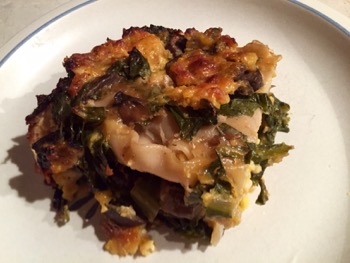
This recipe has a few moving parts, but it’s not difficult. What it is is delicious.

It’s one of those dishes that is perfect on a cold night. It would be ideal to serve to a group or if you want leftovers. This is one of those rare dishes where I thought it tasted best the night it was cooked instead of the next day.

The Gruyère cheese gives it a rich flavor. It complements the squash perfectly.

butternut squashButternut Squash Lasagna

3 C butternut squash, peeled and cubed

1 C plus 1 T vegetable broth, divided

8 garlic cloves, minced

½ tsp kosher salt

¼ tsp freshly ground black pepper

Dash of ground nutmeg

¾ C Gruyère cheese, shredded

¾ C part-skim mozzarella cheese, shredded

1 T olive oil

1 small onion, chopped

1 pound cremini mushrooms, sliced

1 bunch Swiss chard, trimmed and thinly sliced

3 T pine nuts, toasted and chopped

Cooking spray

6 lasagna noodles, cooked

¾ C part-skim ricotta cheese

¼ C finely grated fresh Parmigiano-Reggiano cheese

Preheat oven to 375 degrees. Cook lasagna noodles according to directions on package.

Combine squash, 1 cup broth, and garlic in a medium saucepan; bring to a boil. Reduce heat to medium; simmer until squash is tender. Remove from heat.

Place squash mixture in a blender or use an emulsion blender. Add salt, pepper, and nutmeg. Blend until smooth. Place blended squash mixture in a bowl; add Gruyère cheese and half of the mozzarella cheese, stirring until cheese melts and mixture is smooth.

Add oil to a large skillet over medium heat. Add onion and mushrooms until browned and liquid evaporates. Add chard and remaining broth. Cover until chard wilts. Place chard mixture in a bowl. Add pine nuts.

Spread half cup squash sauce in bottom of a broiler-safe 9 by 13-inch glass or ceramic baking dish coated with cooking spray. Arrange 3 noodles over sauce; top with half of chard mixture. Dollop ricotta cheese on top of chard. Spread half of remaining sauce over top. Arrange 3 noodles over sauce. Top with remaining chard mixture; top with remaining sauce. Sprinkle evenly with remaining mozzarella cheese and Parmigiano-Reggiano cheese. Cover with foil. Bake for 35 minutes. Uncover and bake an additional 10 minutes or until bubbly. Broil lasagna until cheese is golden brown. Remove from oven; let stand 10 minutes.


Great grades result in free ski days at Sierra

By Susan Wood

OK kids — get perfect grades and your success could lead to being graded at the Winter Olympic Games one day.

And you’ll be in good company.

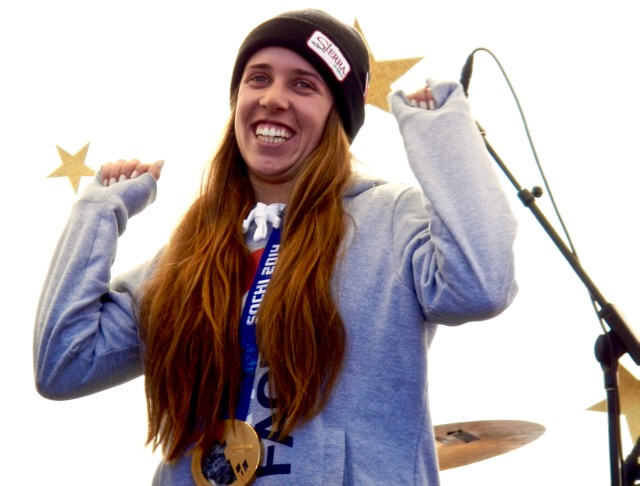
Gold medalist Maddie Bowman of Meyers, who told Lake Tahoe News she plans to compete in the Pyeongchang, South Korea, Olympics Games in 2018, started her skiing career at Sierra-at-Tahoe. She achieved a 4.0 grade point average and took full advantage of a program there that provides a free season pass for students of Lake Tahoe Unified School District. She used the program for seven years from middle school through high school.

The benefit started out in 1999 with the ski resort 12 miles west of Meyers giving away nine passes. Sierra now averages about 300 a year. A few years ago, the community-minded ski resort ended up with a record 377 doled out.

“I would attribute a lot of my career to my ski time at Sierra,” Bowman, 22, told Lake Tahoe News.

Maddie Bowman went from straight A student to Olympic gold medalist with Sierra-at-Tahoe's help. Photo/LTN file

Maddie Bowman went from straight A student to Olympic gold medalist with Sierra-at-Tahoe’s help. Photo/LTN file

The freestyle skier is known for her death-defying feats on skis in the superpipe. She won gold in the Winter X Games from 2013-16 and more of the metal at the 2014 Winter Olympics at Sochi in the halfpipe.

“I think the free pass did motivate me in school, and it was a nice reward,” Bowman said. “I struggled with English. I still do.”

After leaving South Tahoe High School, she’s attending her third year of college at Westminster University in Salt Lake City.

Although Bowman’s professional, competitive skiing career has taken her all over the world, her heart is anchored in Tahoe as reflected in numerous Facebook posts from all seasons.

But it’s Bowman sliding on the slopes that captured the hearts and minds of young and old – especially in Tahoe. The ski area hosted a huge party for Bowman and fellow Olympic “golden girls” Jamie Anderson and Hannah Teter.
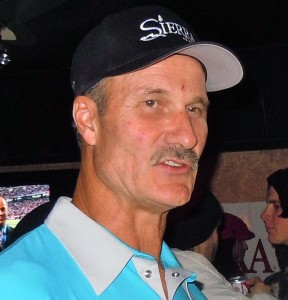
Screen Shot 2016-10-26 at 3.03.55 PMjohn rice


“It’s hard to put the whole experience into words. The skiing is amazing. There is all sorts of terrain for everyone, and you can get pretty creative with it,” Bowman said of her home resort. “Sierra was a second home to me. It’s like a big family up there, and the people and mountain teach you a lot – not only about skiing, but about life. I was lucky to grow up there.”

And there you have a spilling of the heart partly because of the unique influence of general manager extraordinaire John Rice.

The straight A season pass program began as a personal gesture from Rice to his sons, Ian and Brendan, when they were attending Meyers Elementary School in the fourth and fifth grades, respectively.

“They came home with A’s and B’s, and I asked them what it would take for them to get all A’s,” Rice said, adding: “…something their father only did one semester in all of school.”

Smart kids. They countered with asking what they would get.

“I told them: ‘Anything you want’,” Rice recalled.

“Anything in the world?” the boys tested their dad.

The prize was agreed upon – BMX bikes. And the boys consequently pulled in straight A’s.

Of course, they didn’t want the slap-together, inexpensive Walmart variety, Rice noted.

“They wanted Specialized, single-crank, aluminum 360 handlebar, high-end $600 bikes,” he quipped.

“I was amazed at how the extra motivation made them try that much harder, and I shared with their teachers that if any kids in their class got all A’s, Sierra would give them a season pass,” Rice dictated.

The word spread like wildfire after that first year. Soon, every teacher in the school participated. Then, calls came in from Tahoe Valley, Bijou and Sierra House, to which Sierra-at-Tahoe offered the same deal.

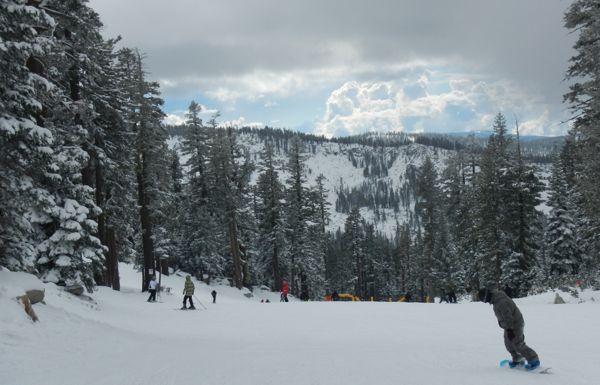
Sierra rewards about 300 students a year with free passes based on their grades. Photo/LTN file

Sierra rewards about 300 students a year with free passes based on their grades. Photo/LTN file

The program has been extended to private schools, home schools and others that fall under the education umbrella.

“The benefits of providing incentives for students was bigger than the (loss of ski pass) sales,” Rice said.

Through the years, the straight A program has even crossed the state line – with Zephyr Cove Elementary and Whittell High School joining in the quest.

The ski-pass program – which amounts to a value of up to about $300 — is so popular, Sierra-at-Tahoe was forced to draw boundaries as the requests expanded into Carson City, Reno and even to the San Francisco Bay Area.

“Sierra recognizes that not all students have the same resources to achieve the goal of straight A’s. In the past, we have given teachers day tickets for students who have made quantum leaps in their progress. Not all who earn free passes can afford to ski, but you better believe they come up and get their pass,” Rice continued. “The program has been successful beyond our dreams, and I have a stack of thank you cards and letters to prove it.”

A note of gratitude was offered from LTUSD, which embraces the program.

“The program encourages students to do their best work and shows them that hard work pays off,” district spokeswoman Shannon Chandler told LTN.

“A lot of our families are unable to afford (ski passes). Even if just one person in the family earns a ski pass from Sierra, it’s a huge help toward the purchase of passes for the whole family. The program also promotes parent involvement in their child’s academic career,” said Chandler, who added personally that she continues “to stay on” her children to strive for “that golden ticket.”

And while not every straight A student will have the successes on the mountain Bowman has had, time on the slopes will only make youngsters better skiers and boarders.

Note: Sierra-at-Tahoe opens today for the 2016-17 season.


Opinion: Why hand counting votes makes every vote count

By Lisa Margonelli

Just before the polls closed on Election Night, I met with 12 of my townspeople at our town hall in Maine, raised my right hand, and took an oath to uphold the federal and state constitutions.

We were then assigned to bipartisan pairs (Republican, Democrat, and unaffiliated) to spend the next two-and-a-half hours elbow to elbow, reading aloud each of the 350 ballots cast in our town of 419 registered voters (out of a total of 500 or so residents). With our identical red pens and tallies, along with our highly stylized reading and movements, we became the littlest moving parts in a great procedural democracy that has been part of the stable transfer of power for more than 200 years.

Fewer than 0.6 percent of U.S. ballots votes are counted by hand and those are from the small towns in Maine, New England, Michigan, Wisconsin, Minnesota, and Alaska that manage their own elections and cannot afford to invest in optical scanners.

Today, for federal elections in most of the country, voters use paper ballots that are optically scanned or electronic voting machines. After the 2000 crisis, when hanging chads on punch cards became an issue in the presidential election, Congress passed the 2002 Help America Vote Act providing money to buy new voting equipment for towns all across the country. But by 2020, those machines will be nearing the end of their lives, which the Presidential Commission on Election Administration described as an “impending crisis.”

With so much up in the air in American voting, we hand counters offer continuity—and may play a surprising role in the future by ensuring impartiality, transparency, and trust in an increasingly sophisticated and opaque system for casting and counting votes.

Our town hall is straight out of Norman Rockwell: A spare, single story northern New England clapboard building with a floor made of worn unfinished boards. It was originally built about 1850 for the town band, relocated once in the 1880s by 42 teams of oxen, and then moved to its present position in 1949, with residents building the foundation themselves to save money. In the same spirit, we all pitch in to count votes.

There are three overseers of this voting process: the registrar of voters, the warden, who opens and closes the polls and oversees the tally, and the town clerk, who was once in the merchant marine. In my town, all three positions happen to be held by women, each of whom is attentive to the precise procedures and to their greater purpose—which is not only to count the votes but also to reinforce the integrity of a process much older and larger than ourselves.

At 8pm on the recent Election Night, the warden declared the polls closed and the poll workers gathered up the remaining unused ballots and drew a red line across each one, rendering them useless. Then the old wooden ballot box was opened and the ballots were dumped on a large table in the center of the room. My fellow poll workers and I quickly unfolded the ballots, arranging them in piles of 50.

I found my partner, a neighbor who I know slightly. I am registered “unaffiliated.” I do not know his affiliation, and neither of us asked. Good fences, as they say, make good neighbors.

In Maine, the law requires that bipartisan pairs read the contents of every ballot in a way that is “verbal and concurrent.” In other words, we read in unison from the ballot: “For president: Donald Trump, for state representative, Chellie Pingree,” and so on, through to the uncontested candidates for registrar of probate, sheriff, and county commissioner. On our tally sheets, there were spaces for 23 options, including official candidates, official right-ins, and blanks. As we read, we made marks in red pen on our tally sheets, which are divided into vertical cells that can each hold five marks. Every five ballots, we compared tally sheets to confirm that we had the same count for each candidate. Every 10 ballots we did a verbal and concurrent report on our tally sheets. And so on until we completed all 50 ballots. Then we flipped the ballots over and did the same thing with the six ballot measures on the back of the sheets. By the end of the process we were hoarse.

Tallying is a chore. It works best when both partners use stylized movements and a slightly singsong cadence. I first did it in the 2014 election, and I’ve ended up with an ungainly routine where I run my left index finger down the ballot to provide a visual anchor while carefully tracking the rows on my tally sheet with my right hand. Still, it’s easy to accidentally mark the wrong cell, to forget to mark it, or to get mesmerized in the chicken scratch of the hatch marks. The process is designed to prevent both accidental mistakes and collusion. And of course, everyone is in the open and easily observed.

Going through so many ballots, I get a chance to see—anonymously of course—how my townspeople have voted. I’m always surprised: Few vote a straight ticket. Many pick and chose between parties and initiatives. Some write in candidates. This time a few rejected all of the ballot measures, which included money for schools and bridges, marijuana legalization, background checks for private gun sales, and a move to ranked choice voting, which would allow voters to chose their first and second choice candidates for state offices. (Ranked choice voting passed, which may be a wonderful thing for democracy but it will add significantly to the work of us hand counters.)

I find that participating in the count is a good way to cope with the aggravating stress of election night. Instead of hitting refresh on CNN and Fivethirtyeight.com to see the latest totals, I am speaking every voter’s will and turning it into a tally. I may find out that my neighbors feel very differently than I, but in the end, we’ll still be neighbors. The town hall will still be standing.

And when I look at individual ballots with their quirky un-ideological votes I know that they are deliberate—I can’t pretend that voter didn’t know what he or she was doing—and I wonder about my own inconsistencies. Still, by revealing our differences, the elaborate ritual of the count reaffirms the deep ideals that hold us together. I’m not surprised that our town has voter turnout of 83.5 percent, compared to national rate of 57 percent. (Maine’s laws also encourage voting: Voters can register to vote at the polls. No ID is required to vote once you’re registered. And people who’ve committed crimes retain their right to vote.)

Part of the reason the tallying process is so arduous is that it makes it easier to recheck each batch of 50 ballots. Hand counts are frequently contested, and have to be rechecked often. Before we left the town hall we separately totaled our tally sheets, cross-checked that they accounted for all ballots in all cells, and completed a final verbal and concurrent check to see that they agreed. We presented one sheet to the warden and wrapped the other around our ballots, secured both with a rubber band and tucked them in a metal box that was then locked and ready for a recount.

Ever since the first mechanical voting machines were introduced in the 1880s, voters have feared that their votes were getting lost. More recently, voters have feared that electronic voting machines might get hacked, or crash without backup. In response, some people have suggested that all ballots in the country should be hand-counted, with thousands of new precincts containing 1,000 voters each.

Are we due for a return to hand-counts? I talked with David Kimball, professor of political science at the University of Missouri-St. Louis, who has studied how votes get lost, either on the ballot or in the counting process.

“If you want to know exactly how many more votes A got than B, then machines are more reliable,” he said. Hand-counting national elections would be expensive and potentially inaccurate. But hand-counting does offer something to the institution of elections—albeit in small doses. Both scanned paper ballots and electronic voting machines (which Kimball cautions should provide paper receipts) need to be audited regularly. How do we assure everyone that these audits are transparent and fair? Hand counts.

The long life of hand counting, even in the face of modern improvements, suggests the deeper truth of elections, which is that we’re not merely counting votes today, but building trust and continuity into a larger system that we hope to carry far into the future.

Lisa Margonelli writes the Small Science column for Zócalo Public Square, where she is the science and humanities editor.


Mortgage debt a growing problem as people age

By Paula Span, New York Times

It was a modest house, a two-bedroom ranch in Arlington, Mass. Jerri and Richard Newman had to stretch to buy it for $169,000 in 1996, but with his job at Boston’s Museum of Fine Arts and her freelance editing, they figured they could swing it.

They took out a 30-year, fixed-rate mortgage. But their son developed mental health disabilities, including a bipolar disorder. To pay for his care, and help compensate for her interrupted career, the Newmans refinanced four times and took out a home-equity loan.

In an earlier era, the Newmans — he’s 65; she’s 62 — might now be contemplating retirement in a paid-for home. Instead, they’ve amassed so much mortgage debt, about $375,000, that they’re reluctantly considering selling. “We tried for years to catch up,” Jerri Newman said.

Amid the continuing fallout from the housing boom and bust, however, a growing proportion of older homeowners now carries mortgage debt. And the average amount keeps rising, according to two recent studies, which may portend lower standards of living for many retirees.

Read the whole story


California companies get billions in tax breaks

By Teri Sforza, Orange County Register

Businesses in California were given state tax breaks worth about $2.67 billion over the past two decades, with more than half the money going to two sectors of the economy – those trading in war and circus.

These tax breaks – denounced as “corporate welfare” or praised as “business incentives” – totaled $889.3 million for aerospace and military contractors, and $389.4 million for entertainment and media companies, according topublic data compiled by the nonprofit Good Jobs First.

The biggest breaks went to two aerospace defense giants, Lockheed Martin and Northrop Grumman. In 2014, the Legislature approved a controversial bill aimed specifically at Lockheed, a key subcontractor for Boeing on a bid to build next-generation bombers for the Air Force. The bill granted Lockheed a tax credit of 17.5 percent of wages paid to its workers, worth $420 million over the 15-year life of the deal.

Read the whole story


Scientists to map aquatic species in western U.S.

By Keith Ridler, AP

It sounds like a big fish story: a plan to create a biodiversity map identifying thousands of aquatic species in every river and stream in the western U.S.

But scientists say they’re steadily reeling in that whopper and by next summer will have the first Aquatic Environmental DNA Atlas available for the public. 
 
Boise-based U.S. Forest Service fisheries biologist Dan Isaak is leading the project and says such a map could help with land management decisions and deciding where to spend limited money and resources.

“It’s kind of the Holy Grail for biologists to know what a true biodiversity map looks like,” he said. “To have that formatted digitally so you can do lots of science with it will be transformative in terms of the quality of information we’ll have to conserve species.”

Isaak said annual surveys could provide snapshots so scientists can see how biodiversity and ecosystems change over time. Because of the project’s immense scale, he said, sample collecting likely will require help from many entities, including citizen scientists.

The map eventually will include everything from insects to salmon to river otters. It’s possible because of a new technology that can identify stream inhabitants by analyzing water samples containing DNA. The technology also can be used to identify invasive species.

That technology is evolving, said Michael Schwartz, the Forest Service’s director of the National Genomics Center for Wildlife and Fish Conservation in Missoula, Montana. Currently, he said, scientists can detect only one species at a time in a stream sample. He said the goal is to identify multiple species in a single test from one sample. A rough estimate for when that might be possible is about a year, he said.

The trove of information has the potential to be so vast that questions not presently imagined might arise.

“Any time science undertakes large projects like this, the payouts can be in directions you don’t expect,” Schwartz said.

Ultimately, he said, the publicly available information could be used by someone with an iPad or other device who could go to a section of river and see what species it contains.

The Aquatic Environmental DNA Atlas for the western U.S. has its genesis in a smaller-scale project called the Bull Trout Environmental DNA Atlas involving five states — Idaho, Montana, Nevada, Oregon and Washington — where the federally protected fish is found. That effort, Isaak said, has discovered bull trout in areas where they were thought not to exist.

Isaak also has been working on something called the Cold Water Climate Shield to identify streams that could serve as a refuge for cold water species, such as bull trout, if global warming continues. That map uses millions of temperature recordings going back decades and has expanded to include most of the western U.S. Stream temperatures in lower elevations have risen several degrees over the past 30 years, Isaak said. The DNA Atlas has been confirming the kind of species present as predicted by the Cold Water Climate Shield, Schwartz said.

What scientists ultimately hope to do is combine all the information from stream temperatures, DNA Atlas sampling, topography and weather patterns to get more insights into species distribution patterns and even how entire ecosystems function. 

“The data sets can be bigger because computers are bigger,” Isaak said.

Even for Isaak, who is called a visionary by his colleagues, the leaps in technology that make his ideas possible can be mind-boggling.

“It’s just been an ongoing revelation,” he said, recalling 15 years ago using pencil and paper to make streamside observations. “It still seems like magic to me that you can go take a water sample and you have instruments powerful enough to discern what species are present.”


Caltrans planning for 2017 construction season

While Caltrans is done with road work in the Lake Tahoe Basin for now, the transportation department will be back in 2017.

Next season will mark the start of Caltrans’ final major water quality project as part of the Lake Tahoe environmental improvement program. The project is on Highway 50 in South Lake Tahoe from the Y to Trout Creek. It’s expected to be completed in 2019.

Work also will begin in earnest next season on a Federal Highway Administration Central Federal Lands Highway Division project that will build a new bridge over the Truckee River in Tahoe City, replace the existing Fanny Bridge, and convert a portion of Highway 89 into a complete street design that will be relinquished to Placer County after construction.

The project, which will include three new roundabouts, is scheduled to be done in summer 2018. The $30.1 million construction contract, which also includes building the Dollar Hill shared-use path adjacent to Highway 28, was awarded to Martin Brothers Construction.

This season Caltrans and its contractors completed work on two projects on Highway 89 and made significant progress on a third this season.

Curbs, gutters, sidewalks and drainage systems were added to a five-mile stretch of Highway 89 from the Y intersection in South Lake Tahoe through Camp Richardson to Cascade Road. The roadway also was widened and repaved. 

Another project from Cascade Road over Emerald Bay to the Eagle Falls viaduct also recently wrapped up construction. 

Along the West Shore, all but about 10 percent of the work has been completed on a multi-year project rebuilding the highway from Tahoma to Tahoe City with curbs and gutters, drainage treatment facilities, new pavement and wider shoulders throughout.

In addition to Caltrans’ work on Highway 89, Placer County has completed its $50 million water quality and streetscape project on Highway 28 in Kings Beach. The work included new curbs and gutters, sidewalks, landscaping and street lighting. It also reduced the highway from four lanes to three and included construction of two roundabouts.


South Lake Tahoe needs to fill commission slots

South Lake Tahoe is looking for residents to serve on a variety of boards.

People are needed for two-year terms for the Airport Land Use Commission, Building/ADA Board of Appeals, Parks and Recreation Commission, and Planning Commission.

Completed applications must be returned to the City Clerk’s Office no later than 5pm Dec. 30. Applications are available online.


Snippets about Lake Tahoe

·       Here is the el-dorado-tahoe roadwork from Caltrans for next week.

·       Truckee Downtown Merchants Association is putting on Festival Fridays – Dec. 2-9-16 – where businesses will have special promotions and parking is free after 4pm.

·       Dirt Nasty will be at Whiskey Dicks in South Lake Tahoe on Dec. 28. Doors open at 9pm. Cost is $20.

·       Truckee-based Coffeebar is opening its fourth location, the newest being in the Village at Squaw Valley.

·       Warren Miller’s “Here There & Everywhere” will be shown at Harrah’s South Shore Room in Stateline on Dec. 2 and Dec. 3 at 7:30pm. The movie will be aired in Olympic Valley on Dec. 10 at 6pm.


Placer County to allow indoor-outdoor pot grows

By Lake Tahoe News

Following the passage of Propositions 64, Placer County supervisors are trying to keep pace.

The state recreational marijuana initiative allows people to grow a limited amount of pot indoors.

Supervisors voted 4-0 to allow limited cultivation inside and outside in the unincorporated areas of the county — which includes Lake Tahoe. Supervisor Jennifer Montgomery was not at the Nov. 22 meeting.

The ordinance will go into effect 30 days after the second reading, which is scheduled for Dec. 6.

The county is taking a two-phased approach to recreational marijuana. The first is to focus on allowing limited personal cannabis cultivation and banning commercial cannabis activities.

However, the supervisors did not entirely rule out the future possibility of commercial cultivation for medical cannabis.

At Supervisor Jim Holmes’ suggestion the board supported creating a cannabis working group made up of county staff from all relevant departments, as well as representatives from Placer’s cities and the medical cannabis industry – for their consideration. 

Staff is coming up with the tools needed to enforce the ordinance. 

They will return to the board in the coming months with detailed requirements for outdoor cultivation. 
The cost of starting up and implementing the county’s enforcement program in its first year is included in the current budget. Annual costs in the future are expected to be $609,000, including staff, vehicles and equipment.