Best start in 30 years to NorCal wet season

By Dale Kasler and Ryan Sabalow, Sacramento Bee

It’s only a beginning. But it’s a strong beginning, and it offers at least a rain gauge’s worth of hope to a state enduring its fifth year of drought.

The National Weather Service said Monday that the rainy season in the northern Sierra Nevada is off to its wettest start in 30 years. Mountain conditions are critically important to monitoring the drought because a major share of the state’s water supply is stored for months as snow.

Citing state data from a string of eight gauges scattered around the northern Sierra, the service said precipitation has come in at about twice the average for this time of year, making for the wettest kickoff to the water year in 30 years. The water year, as defined by climatologists and others, begins Oct. 1.

Read the whole story


Snippets about Lake Tahoe

·       The Bicycle Advisory Committee of the South Lake Tahoe Recreation Facilities Joint Powers Authority will meet Dec. 7, from 9-11am in the downstairs conference room at Lake Tahoe Airport.

·       Tahoe City Cross Country is now open.

·       A new little free library is being erected this week on Ski Run Boulevard near Bio Spirit in South Lake Tahoe. Drop off a book or take one for free.

·       Mercury Momentum brings “Dorothy in Wonderland the Musical” to Cargo Concert Hall inside the Whitney Peak Hotel in downtown Reno on Dec. 10, 11, 17 and 18 at 2pm and 7pm each day. For tickets and more info, go online. 

·       Tahoe for Standing Rock is having a benefit concert Dec. 3 from 1-6pm at the Tahoe Biltmore in Crystal Bay. For more info or tickets, go online. 


El Dorado County crews rescue missing couple

By Ellen Garrison, Sacramento Bee

A Yuba City couple missing in snowy El Dorado County since Sunday were found in their snowbound SUV by searchers on Monday afternoon.

Rory and Susan Holloter, both in their 60s, were ferried to safety on snowmobiles. Both were in good condition, said sheriff’s department department spokeswoman Sgt. Tasha Thompson.

They were brought back to a command center on Wentworth Springs Road late Monday afternoon where they were reunited with waiting family members.

Read the whole story


Community forest and open space grants available

The Nevada Division of Forestry is accepting applications for the Community Forest and Open Space Program competitive grant funding.

The CFP provides federal funding for the acquisition of private forest lands for public use. 

Tribal and local governments, land trust organizations and other qualified nonprofit conservation organizations may apply for CFP funds on behalf of interested private landowners. Each individual project may not exceed $400,000. Those interested in submitting a CFP application may view eligibility requirements and instructions online.  

The deadline to submit applications is 5pm Jan. 13.


For more info, contact Heather Giger at 775.684.2552 or hdgiger@forestry.nv.gov.


Christmas is in the air at El Dorado tree farms

By Kathryn Reed

CAMINO – One aroma above all says Christmas – the scent of a freshly cut evergreen.

It’s everywhere in the foothills of El Dorado County this time of year.

It didn’t matter that the temperature was dropping and snow was beginning to fall, it just added to the magic of the countless families eager to get their tree on Thanksgiving weekend.

Friends Sandy Baker and Kellie Kijanka used to live next door to each other. Their tradition was to get their trees together at Indian Rock Tree Farm in Camino each year. Now they live 120 miles apart – one in Davis, one in Foresthill – but they still meet at the tree farm. They’ve been doing so for 20 years.


One tree isn't always enough. Photo/Kathryn Reed

One tree isn’t always enough. Photo/Kathryn Reed

That’s one of the special things about Indian Rock, the people who return each year.

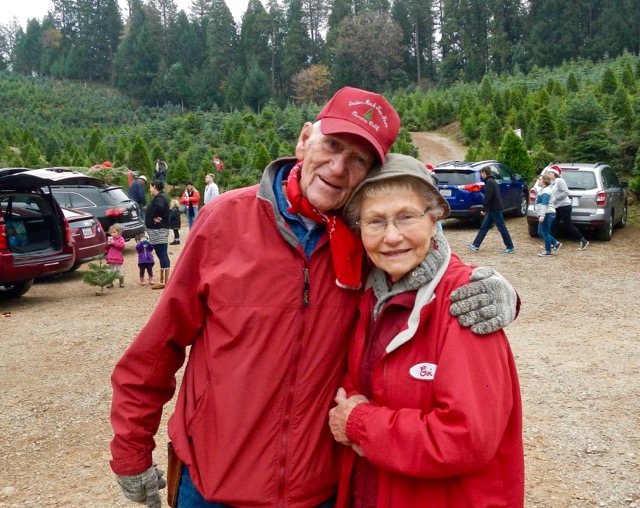
Larry and Geri Hyder bought the 33 acres – of which 15 acres are the tree farm – in 1961. They started selling trees in 1976. They have about 15 varieties.

“What we have here is magical. A lot of people all they are able to have is a flat lot. You are able to walk up the hill here. We call it the Sherwood Forest,” Geri Hyder said in reference to Robin Hood. “The main thing is we want to give people service.”           

Larry and Geri Hyder have been in the tree farm business for 40 years. Photo/Kathryn Reed

Larry and Geri Hyder have been in the tree farm business for 40 years. Photo/Kathryn Reed

Multiple generations work at the tree lot – from parking, to sales, to helping cut trees, to selling hot cocoa.

Customers are likely family, too. They seek out the Hyders to say hi, shake hands and give a hug.

A few years ago Indian Rock earned the state award for best tree farm.

On Saturday the lot was bustling with people. This was true of most of the tree farms in the area. Thanksgiving is their busiest weekend, with the next few weeks when they make all of their money for the year.     

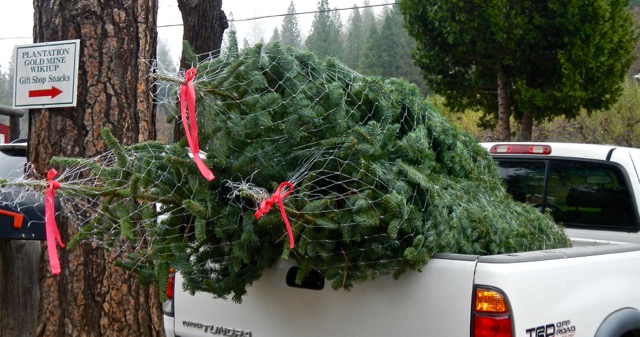
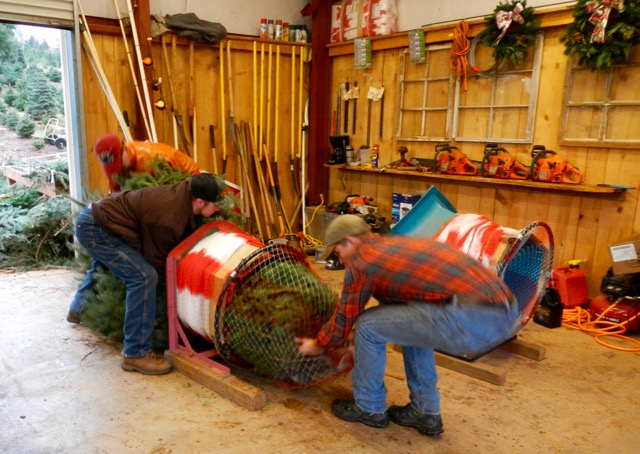
Binding a large tree for transport takes some effort. Photo/Kathryn Reed

Binding a large tree for transport takes some effort. Photo/Kathryn Reed

It’s a different kind of frenzy at Rapetti Farms. This is the second year they have sold trees via a membership formula. This means the general public cannot buy from them.

Owner Randall Rapetti told Lake Tahoe News they went this route to avoid the parking hassle, arguments, fights and people leaving without paying.

“We have formed almost like a membership base. They get postcards in the mail and they don’t have to compete for trees,” Rapetti said.

They have mostly Nordmann fir, with some noble fir. The whole farm will eventually be Nordmann, Rapetti said. They come from the Republic of Georgia.     

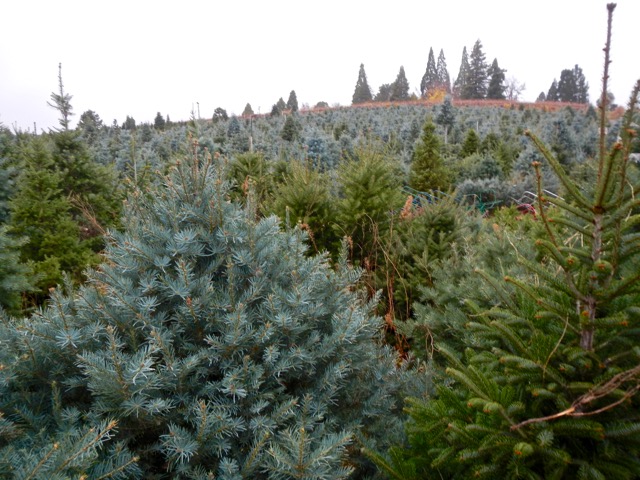
Christmas trees dot a large swath of the landscape in El Dorado County. Photo/Kathryn Reed

Christmas trees dot a large swath of the landscape in El Dorado County. Photo/Kathryn Reed

At the Hillside Tree Farm customers have 10 varietals to choose from, with Swift silver being the best seller.

“It’s a real family event. We may sell three or four trees at a time,” Peg Perron at Hillside told Lake Tahoe News.

Customers come from all over – the Bay Area, Reno, Redding – even people from Los Angeles headed south with an El Dorado County tree on board.

“I don’t think the economy has ever affected us,” Phyllis McGee told Lake Tahoe News. With her husband, Michael, they have been running the McGee Tree Farm in Placerville for 32 years. “Sometimes people like to do the simple things.”

People will sacrifice other things to ensure they have a Christmas tree.

And with trees from the northwest – where many stores get their trees – being more expensive this year, cutting a tree locally might be a lot more economical. Many of these farms will also cut the tree you select, so you don’t need to be experienced with a saw.


Opinion: Importance of diversity in the outdoors

By Erin Berger, Outside

You may have seen Ambreen Tariq’s selfies and peaceful tent shots in your feed, and you may have noticed that her account isn’t the usual outdoor-lifestyle Insta fare. The 33-year-old runs the Brown People Camping account, which has gained more than 2,000 followers since she started posting in August.

Tariq, who lives in D.C., uses the platform to share photos of her adventures, everywhere from Virginia’s Shenandoah National Park to New Mexico’s White Sands National Monument.

But just as important for her are the captions: Tariq talks about how her identities—as a woman, a person of color, an immigrant, and a Muslim—inform her experience outdoors.

We had a wide-ranging conversation with Tariq about why she created the account, how it’s been received, and why the outdoors community needs to be more welcoming toward newcomers or those who don’t fit the traditional mold of the outdoorsy type.

Read the whole story


Opinion: How Calif. became a very blue state

By Dan Walters, Sacramento Bee

Dan Walters

Dan Walters

Demography, it’s been said, is destiny – and the outcome of California’s election this month proves it again.

California’s political evolution over the last four decades, from a mostly red state to a purple state and finally to a very blue state, corresponds to its powerful demographic trends, driven largely by equally powerful economic forces.

During that period – spanning Jerry Brown’s two governorships and four others in between – the state’s economy moved from industrialism to a post-industrial mélange of technology, trade and services.

Read the whole story


Canoes — the quintessential vehicle for escape


By Mark Neuzil

A canoe is like a banjo—it makes everyone happy. Propelled with paddles, sleek, long, narrow, lightweight—mostly open—and fast: Every canoe I’ve owned makes me smile at its memory. I remember my oldest daughter, at age 10, mimicking the cry of a loon, and the loon crying back, while on a Boundary Waters trip. Or that one big fish that one time in that one hole whose location I’m never going to disclose because then it won’t be my memory alone.

Originally, canoes were made from trees nearby the rivers, lakes, and seas they traveled on. My personal canoe convoy mirrored the development of synthetic materials—fiberglass, aluminum, Royalex and multiple boats of Kevlar—that have been used in the construction of the ubiquitous craft since World War II. The canoe design—perfectly adapted to its place—predates the arrival of Europeans on American shores, but also includes the most modern materials through the space age and beyond. Improbably, the more the canoe’s materials change the more it seems to echo a simpler time.

Native Americans used two main canoe designs for water transportation. In the northeast and upper Midwest, the birch-bark canoe was the primary craft. A bark canoe was built right-side up—a wooden skeleton surrounded by bark, lashed together with roots, planked, ribbed, and sealed with pitch. In the south from the Gulf of Mexico and west to the Pacific Ocean, the dugout canoe served. A dugout was just that—a log partially hollowed with tools and fire, expanded with hot water and sharpened at the ends. Both were born of ecological necessity; the paper birch forests supplied the raw material in the northeast, while in the south and west that job went to cypress, redwood, cedar and other species.

Both types, but especially the bark canoes, could be tweaked to local tastes, whether practical, spiritual or artistic. Prior to European settlement, the basic canoe shape was so successful and well-engineered that the French, English, and Dutch explorers who showed up on these shores could not improve upon it; the most successful of them, the fur-trading voyageurs, co-opted the vehicle as their own freight-hauler. Both canoes ruled the waves for hundreds of years through the resettlement of the continent, before steam power in boats and trains shoved them aside.

Shortly after the Civil War, the canoe was repurposed not as a workboat, but as a way to escape from work. Increased leisure time and the professionalization of recreational hunting and fishing gave the canoe new duties. Magazines popped up describing the best ways and places to chase fish and game, or to simply get away from modern, industrial cities. There was an element of nostalgia, perhaps, in some of the best canoe literature, even as all the writers remarked on the solitude, the restfulness, the back-to-nature soul fulfillment of quiet days on the water.

But these new “sports”—as they were called—didn’t always paddle traditional canoes in their pursuit of happiness: Manufacturing advances and a scarcity of right-sized birch trees drove the development of new canoes built upside-down from strips of wood over molds, rather than right-side-up from bark.

Upstate New York and Maine, with their miles of navigable streams, became centers of American innovation using the new methods. In New York, builders such as J. Henry Rushton and authors such as George Washington Sears, under the pen name Nessmuk, popularized the longitudinal-wood strip crafts among hunters, anglers, and adventurers. The design originated in Canada and spread with the help of social organizations such as the American Canoe Association, which held events that included popular races. The idea of the canoe began to expand: Some had decks and looked a lot like today’s kayaks; others featured sails.

Though sold as a way to escape the pressures of the city, the canoe’s construction managed to mirror American manufacturing pretty closely. After the economic collapse of 1893, a cheaper building technique—wood overlaid with canvas and coated with a special waterproof sauce—gained popularity. Prices fell dramatically. While the Rushton Canoe Company charged $170 for a fully outfitted sailing canoe at the turn of the century, wood-and-canvas canoes made in Maine by the Old Town Canoe Company went for $30 to $40.

Canoes were not just about getting away from it all; they were also an escape from scolds. At the turn of the century there was a fad of young men and women paddling together on rivers such as the Charles, Detroit, Schuylkill, Potomac, and urban areas such as the Chain of Lakes in Minneapolis. Courting canoes, in which the bow paddler faced the stern—the better for the couple to gaze into each other’s eyes—kicked off a craze called canoedling in which the opportunities for intimacy were taken full advantage of, much to the chagrin of dry land preachers. Legislation and arrests inevitably followed, with one young man fined $20 for kissing his sweetie in a canoe on the Charles River in 1903. At that price, millions of dollars’ worth of smooches were exchanged on weekend evenings across the urban rivers of the nation.

The graceful forms of the wood-and-canvas canoes began to fade from the marketplace after the Second World War. Compared to the postwar synthetics, wood-and-canvas boats were expensive, heavy and needed fairly regular attention. The material that shoved them into dry dock was aluminum and the Grumman Aircraft Engineering Corporation of Long Island, N.Y., led the way. Aluminum boats, stamped out and riveted or welded, flooded the post-war market. Purists said there was no romance in a clanky metal boat, but Grumman paced the industry in sales from 1951 to 1976.

By the mid-1970s, fiberglass, various laminated plastics and Kevlar did to aluminum boats what aluminum did to wood-and-canvas—beat them by price, practicality, and performance. Even newer space-age material such as carbon fiber or coated nylon, which does not compete on price, creates boats that weigh less than a roller suitcase. By 2005, a manufacturing association estimated that 90,000 to 110,000 canoes were sold annually; soon cheap plastic kayaks surged in popularity, based on lower prices and ease of use.

Over the years my fleet has contained canoes made from almost all the synthetics. But in 2010, I started over, building a “stripper”—a 1927-era design of cedar strips, coated with lightweight fiberglass that, for me, combines the best of the old lines with a splash of modern technology. An Ojibwe from hundreds of years ago, somehow reborn in the present, would instantly recognize the shape of my boat and know what to do with it. As the writer Sigurd Olson noted, “When a man is part of his canoe, he is part of all that canoes have ever known.”

Mark Neuzil is professor of communication and journalism at the University of St. Thomas in St. Paul, Minn.. He is the co-author, along with Norman Sims, of “Canoes: A Natural History in North America” (University of Minnesota Press, 2016).

K’s Kitchen: Crispy tofu steaks

By Kathryn Reed

Protein is something everyone needs. As a vegetarian, there are times when I need to seek it out. This is because there are so many dishes I make that have little to no protein.

Tofu often gets a bad rap because it can be mushy and bland. It’s like a lot of food – blame the cook, not the ingredient.

The following recipe could be an appetizer or a main course.

The chili oil is going to give it a kick. Depending on how spicy you like things, I would start out light, then add more until you get the right bang. If it gets too oily, lemon juice and/or balsamic vinegar will balance it.

tofu-steakCrispy Tofu Steaks

3 T ginger, minced

1 bunch scallions, minced

1 T white wine vinegar

2 T chili oil

1 T lemon juice

1 T balsamic vinegar

1/3 C canola oil

Salt

1 large egg

1 C Panko

14 ounces firm tofu

Mix ginger, scallions, white wine vinegar, chili oil, lemon juice, balsamic vinegar and salt.

In a bowl beat the egg.

Heat canola oil in nonstick pan over moderate heat.

 Cut tofu into 1-inch thick slices. Dip in egg wash, then generously coat both sides with Panko. Turn once.

Serve with vinaigrette.


Water a factor in Nevada’s economic diversification

By Nicole Raz, Las Vegas Review-Journal

A company’s potential water use, in some cases, is the deciding factor in whether Nevada will provide tax incentives.

“We have discouraged a couple of companies (considering relocating for tax abatements) that we felt were water users of such significance, particularly in comparison to the jobs and quality of jobs,” said Steve Hill, director of the governor’s office of economic development.

As state officials work to attract tech and advanced manufacturing companies, they have to reconcile economic development with water conservation. Water is a limited resource in Nevada, and state officials weigh a potential company’s impact on the state’s water supply against potential job creation and other economic benefits.

Nevada gets the majority of its water supply from the Colorado River basin. The U.S. Bureau of Reclamation allocates 300,000 acre-feet of water per year from the basin to Nevada. Hill said that because of credits for recycling water, Nevada functionally ends up with an annual amount of 475,000 acre-feet.

Read the whole story