Partial recount of Nev. ballots confirms results

By Sandra Chereb, Las Vegas Review-Journal

A limited recount of presidential ballots cast in Nevada confirmed the results of the Nov. 8 election and eliminated the possibility of a statewide recount, the secretary of state’s office said Thursday.

The partial recount in 92 precincts, requested and paid for by independent candidate Roque “Rocky” De La Fuente, “yielded no change in the number of votes cast for him,” said Secretary of State Barbara Cegavske.

De La Fuente, who came in dead last in the presidential race in Nevada, said he requested the recount because he was concerned about the integrity of the vote.

Read the whole story


Haase developing Stanford program for the long haul

By Janie McCauley, AP

At the family home in South Lake Tahoe, Carol Haase sent her husband out to the shed to search for just the right pieces of wood.

The creative mother of five had begun planning yet another important project in a long list of them for her kids. Son Jerod Haase, in his first season as Stanford men’s basketball coach, had commissioned her to create a pair of wood-burning art pieces — including one for outside the Cardinal locker room at Maples Pavilion.
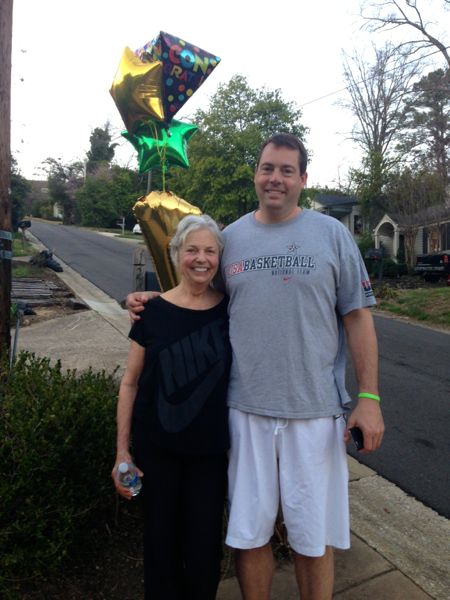
Jerod Haase, with mom Carol, still relies on her. Photo/Provided

Jerod Haase, with mom Carol, still relies on her. Photo/Provided

He requested three words: Invested. Tough. Selfless.

And he asked for another piece to hang in his office with a space for former players to sign it when they return to visit campus.

After coaching stops at alma mater Kansas, North Carolina and the University of Alabama at Birmingham, Haase is ready to put down roots on The Farm. He hopes to build a program that, eventually, contends year in and year out again like it did for decades before.

For him, that starts by thoughtfully incorporating the program’s past success while imparting his own philosophies on a new team.

“I’ve come to really believe in culture,” Haase said. “When I first became a head coach, we had a lot of conversations on the staff, ‘Is culture a real thing?’ or ‘How important is it?’ After my second year at UAB, I really jumped all in. The idea of, we have to develop a culture and know who we are because if we want to get to a certain spot and a certain level of success, there have to be some foundational pieces that we have.

“Our core values at UAB were different than they are here. When I got here, I knew they would be different. Stanford is a different place, this is going to be a different team. We’re going to have a different vision for our program.”

Those three words — invested, tough and selfless — are ones Haase hopes define Stanford for years to come.

“It took him a long time to pick the words,” said Carol, a former elementary and middle school art and English teacher who still fires clay work in her kiln.

The Cardinal, picked to place 10th in the Pac-12, are off to a 6-3 start and currently on their December break for final exams. Players are greeted by the reminder of the team’s philosophy with the wood burning every time they open the locker room door.

“That’s something we’re trying to do for life,” senior guard Marcus Allen said.

Haase is trying to move the program forward while leaning on its history. Former Stanford star Casey Jacobsen is a part-time practice player, and Haase has spoken a handful of times with Golden State Warriors assistant coach and former Cardinal center Jarron Collins since taking over in March. Collins hopes his demanding NBA schedule permits him to get to a practice one day soon.

“He sent out emails. He does a really good job of reaching out,” Collins said. “They sent out all their literature and bios on the coaches. They’ve set up an email service. He seems fiery, and that’s important. I’m excited for his start, and I hope he does well.”

Haase spoke to more than two dozen former players and successful longtime ex-Stanford coach Mike Montgomery. There was also input sought from current players, and even former coach Johnny Dawkins when they ran into each other on the recruiting trail.

The basketball has come along nicely, though Haase said it would be “baby steps” at first. Even with 10 of the top scorers returning , building cohesion was among Haase’s first priorities. Of course, Stanford had a strong opportunity to bond during a season-opening trip last month to Shanghai, where it beat Harvard. The Cardinal also went through a Navy Seals training course.

Haase took about four months choosing those three key words, saying, “I have pages and pages of notes of getting thoughts from everyone about what they think the program is, what it needs to be if we’re going to be successful, what is important.”

“If I’m lucky enough to be the coach here for 25 years, our core values, I would be shocked if they changed,” he said.

Haase is settling in at the university he once thought he’d attend . He walks his kids to school most days before strolling to his office. He continues to appreciate what Stanford offers, thrilled to have the full support of Hall of Fame women’s basketball coach Tara VanDerveer and Rose Bowl-winning football coach David Shaw.

All that effort has helped Haase quickly establish trust with his players.

“He knows what he wants,” Allen said. “He leads by example. Coach Haase brings a level of energy and just a level of being very personable, almost like he’s a player. He’s right there, he’s right in your ear telling you things.”


Outdoor industry to become serious political force

By Brad Rassler, Outside

Outdoor recreation is an economic colossus: its reach is massive, its wealth enormous, and its influence continues to grow as more boots hit the ground. You can see it in Joshua Tree’s crowded campgrounds or in Mount Tam’s trailhead parking lots; in the Appalachian Trail’s thru-hiking numbers or in REI’s record sales. 

In 2005, the Outdoor Industry Foundation commissioned the first of the economic studies to measure the industry’s heft. The initial report returned impressive statistics, but it was the follow-up study six years later that stirred the giant from its slumber: the outdoor recreation economy, all $646 billion of it, was nearly as much as Americans paid for pharmaceuticals and motor vehicle sales and parts, combined. 

Now, thanks to the passage of a bipartisan bill that sailed through the House and Senate last month, and was signed into law by President Obama on Dec. 8, the outdoor industry is primed for a gargantuan reveal. The Outdoor Recreation Jobs and Economic Impact Act of 2016, or REC Act, authorizes the Department of Commerce’s Bureau of Economic Analysis to assess outdoor recreation’s contribution to the nation’s gross domestic product, or GDP. 

Read the whole story


Benefit concert to help South Shore woman

Students in the music department at Lake Tahoe Community College are putting on a benefit concert Dec. 14 at 7pm in the Duke Theatre to support a fellow rocker dealing with cancer.

Students in music teacher Eric Hellberg’s fall quarter rock ensemble classes will take the stage, performing classic rock n’ roll hits, some gospel, country, and a little bit of heavy metal to help raise funds for the Angie Peart Cancer Fund. 

Peart, a repeat rock ensemble student and wife of LTCC reprographics/phone operator Bob Peart, has been battling an aggressive form of brain cancer since last year. All proceeds from the concert will go toward helping the Pearts to cover medical and hospital travel costs, and to LTCC’s music department.

Suggested donation is $10.

If you cannot attend the concert but would like to make a donation, contact LTCC Foundation Executive Director Nancy Harrison at 530.541.4660, ext. 245 or Harrison@ltcc.edu.


Vail Resorts posts quarterly net loss

Vail Resorts quarterly earnings report released today was worse than what analysts had predicted, but were not too surprising for the time of year. A slow start to the season is partially being blamed on the warm weather in November.

The net loss for the Broomfield, Colo.-based company was $62.6 million for the first fiscal quarter of 2017 compared to a net loss of $59.6 million in the same period in the prior year.

“Our first fiscal quarter historically operates at a loss given that our North American mountain resorts are not open for ski operations during the period. The quarter’s results are primarily driven by our summer activities, dining, retail/rental and lodging operations, administrative expenses and winter operating results from Perisher, (Australia),” CEO Rob Katz said in a Dec. 9 statement. “We were pleased with our results in the quarter, with strong summer visitation at our U.S. mountain resorts driving increased revenue and profitability with the official launch of Epic Discovery at Vail and Heavenly and continued strong summer results at Breckenridge and Park City.”

Season pass sales are surging. Through Dec. 4 they are up 16 percent for the number sold, which equates to a 20 percent increase in revenue compared to last ski season.

The ski behemoth bought Whistler in Canada this year. While that resort is not part of this season’s Epic Pass, it is expected to be for the 2017-18 season.

Vail owns Heavenly, Kirkwood and Northstar in the Lake Tahoe area.

— Lake Tahoe News staff report


Nev. lawmaker wants review of letter opposing online gaming

By Richard N. Velotta, Las Vegas Review-Journal

WASHINGTON — Nevada Rep. Dina Titus has sent a letter to Vice President-elect Mike Pence and the presidential transition team asking it to carefully review the online gaming industry before reaching a conclusion on a letter opposing online gaming sent last month by 10 attorneys general.

In a letter dated Dec. 6, Titus, D-Nev., said the letter signed by the 10 AGs, including Nevada’s Adam Laxalt, “contains several inaccuracies and unfair allegations.”

On Nov. 17, the 10 Republican AGs asked Pence to work toward the restoration of the Interstate Wire Act, a move that could lead to a ban on online poker and other Internet gaming.

Read the whole story


Snippets about Lake Tahoe

·      In an unusual twist, South Lake Tahoe is not going to recognize outgoing Councilmember JoAnn Conner on what should be her last day in office on Dec. 13. Instead, there will be a special meeting the day before at 1pm to certify the election and honor her for her four years of service. She came in fourth in the Nov. 8 election. The top two vote-getters – Brooke Laine and Jason Collin – will be sworn in on Tuesday.

·      Caltrans is hosting a community meeting on Dec. 15 to present design alternatives for a Highway 50 safety project in the Camino area. The meeting will be from 5:30-7:30pm at Camino Elementary School, 3060 Snows Road. A project presentation will take place at 5:45pm.

·      South Tahoe Refuse’s request for a 1.62 percent rate hike effective Jan. 1 is on the consent calendar of the Dec. 13 South Lake Tahoe City Council meeting.

·       Train, which has performed a couple times at the Harveys outdoor concerts, last year released the Christmas album, “Christmas in Tahoe.” Here is a video for the song “Shake Up Christmas” that was shot in Tahoe. 

·      Diamond Peak ski resort opens Dec. 15.


Feds give Tahoe $6.8 million to thin forests

By Kathryn Reed

Red dominates large segments of a map of Lake Tahoe. This signifies “wildfire ignition risk” zones.

These are areas most susceptible for a catastrophic wildfire because of the dense vegetation.

The California Tahoe Conservancy on Thursday accepted a $6.8 million grant to treat between 1,200 and 1,800 acres in the wildland urban interface. This the acreage that abuts where people are living and poses the greatest threat to communities.

The money comes from the Bureau of Land Management via the Southern Nevada Public Land Management Act.

While the CTC will be the overseer of the money, the land to be thinned includes multiple property owners, with the CTC lots accounting for 30 percent of the total.

“The next step is to work with the grant partners to start prioritization,” Milan Yeates with the CTC told the state board at its Dec. 8 meeting in South Lake Tahoe.

The work is expected to be done in the next six years. First, though, officials will decide for sure what gets treated. Preliminary mapping has already occurred.

“Prioritization of treatment areas will consider a range of topics including environmental review, terrain accessibility, slope and cost estimates,” the staff report says.

A concrete plan is necessary because this funding doesn’t cover the cost to treat all of the 3,000 acres that have been identified as needing to be thinned.

The plan is to treat the areas with the highest threat first. On the South Shore acreage near Stateline is being looked at. Some of this is where an arsonist set multiple fires this summer. (That person has never been caught and the investigation is ongoing.)

Almost all of Sugar Pine Point State Park is covered in red on the map Yeates showed – signifying its vulnerability. The Kings Beach-Highway 267 corridor is another problem area.

Patrick Wright, executive director of the CTC, pointed out in his report how a healthy, thinned forest can withstand a fire better than an overgrown, crowded stand of trees. This fall’s Emerald Fire along Highway 89 is an example of this because part of the burn had been treated.

Fire doesn’t burn as hot in a healthy forest, is less likely to crown, and in its wake leave trees still standing.


Letter: Putting angst into action

To the community,

She wasn’t crying, but she wasn’t exactly not crying, either. We were about to get an early season storm, a typical hot-to-cold pattern, and I had been looking out the window waiting on rain to become snow. 

My wife had gone to the grocery store, and I wanted to know what had upset the hot chocolate run. 

An elderly homeless couple had been rummaging through a dumpster in the parking lot. They were literally freezing, threadbare clothes wet and icing over. As my wife approached, the couple, conditioned for mistreatment, protested that they weren’t hurting or bothering anyone; they were just looking for anything they could use to keep warm. She offered them the little she had in her wallet and wished them luck facing the storm. As she walked away, they were crying.

That incident, from late fall of 2013, is why I decided I wanted to help those forming the warm room. I didn’t want to be at home drinking hot chocolate, excited about plunging mercury and snowflakes, while others were desperately searching for discards that they could use to stay warm. 

Scott Weavil, South Lake Tahoe


Libraries become unexpected sites of hate crimes

By Christopher Mele, New York Times

One of seven books about Islam or the Quran that were recently defaced at a public library in Evanston, Ill.
A librarian at the public library in Evanston, Ill., was recently preparing for a program titled “The Quran: Is It a ‘Good Book’?”

She gathered books to display for attendees and discovered that inside the cover of one, “The Koran for Dummies,” someone had written “lies cover to cover,” drawn a swastika and made a disparaging remark about the Prophet Muhammad.

The authorities say there has been a spate of hate crimes targeting libraries, their books or patrons — offenses officials said they had rarely seen before. These crimes coincide with a recent report by the FBI that attacks against American Muslims surged last year.

Read the whole story