Panning ‘Alice in Wonderland’

By Kathryn Reed

Just because it’s a classic doesn’t mean it’s a good book. Such is the case with “Alice in Wonderland.”

That was my opinion and that of the majority of the book club I’m in. A classic was chosen for the December book, and this children’s selection was the book of choice.

I’m not sure 92 pages have ever been so painful. As I was reading it, I kept thinking – no wonder I have never read this before.

I can handle talking animals just fine, after all, “Charlotte’s Web” is one of my all-time favorite books. But there is something about Alice that isn’t likable. This seems out of place in a children’s book, that the main character is not someone you are rooting for, so to speak.

I really didn’t like any of the characters. I didn’t even like the story. I’m still trying to figure how it has relevance today and why it’s still in circulation.

Alice is definitely adventurous. Precocious would be another word to describe her. All of that is good. The best part about this book is that a girl is the lead character – and that she is strong. Remember, this was written in 1865.

Each book club member rates the book on whether they liked it, would recommend it and its literary value. Most of us didn’t like it and would not recommend it. I argued it had literary value. Any book this old, that is still being talked about, and is read by adults and children has staying power for some reason. I just can’t figure out that reason.


Reverberations of death of Northstar ski instructor

By Jules Older, San Francisco Chronicle

It was the last place and he was the last person you’d associate with death.

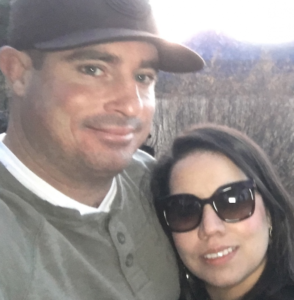
Dennis Baltimore and Jillian Torrez

Dennis Baltimore and Jillian Torrez

In the middle of the day, on a gentle beginner slope at the generally gentle Tahoe area ski resort of Northstar, a skilled ski instructor wearing a helmet and all his safety equipment died.

What apparently happened was this. To avoid a snowboarder who had lost control on an icy patch, the 35-year-old instructor veered off the groomed slope and skied into the woods. There, his skis may have hit a snow-covered rock, and he was tossed into a ditch. Despite the life-saving efforts of first responders, he succumbed to his injuries where he lay.

The instructor was Dennis Baltimore, only child of grieving parents, father of a 6-month-old daughter named Zoe, loving partner of Jillian Torrez.

Read the whole story


Tahoe Tails — Adoptable Pets in South Lake Tahoe

Delilah

Delilah

Delilah is a beautiful 10-year-old cat who arrived here with three other nice cats when their owner could no longer take care of them. Delilah and her brother, Eli, would like to go home together. Adoptions for the rest of December are sponsored.

Delilah is spayed, microchipped, tested for FIV, and vaccinated. She is at the El Dorado County Animal Services shelter in Meyers, along with many other dogs and cats who are waiting for their new homes. Go to the Tahoe animal shelter’s Facebook page to see photos and descriptions of all pets at the shelter.

Call 530.573.7925 for directions, hours, and other information on adopting a pet.

For spay-neuter assistance for South Tahoe residents, go online.

— Karen Kuentz


One final day on the slopes with my dad

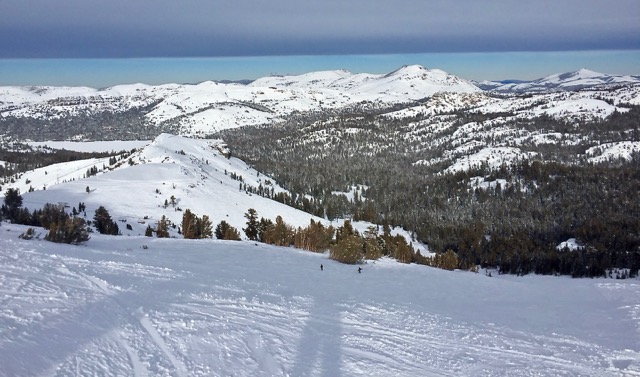
The view on Dec. 25 from the top of Happiness Is at Kirkwood. Photo/Kathryn Reed

The view on Dec. 25 from the top of Happiness Is at Kirkwood. Photo/Kathryn Reed

By Kathryn Reed

KIRKWOOD – It had been a number of years since I spent Christmas with my dad. But that’s just what I did yesterday.

Spending a holiday with a parent isn’t all that remarkable. Only in this case my dad died in April 2010.

Kirkwood Mountain Resort was always my dad’s favorite ski resort. As a kid I remember day trips to the mountain from our home in the Bay Area. The back bowl was his favorite. The wide-open expanse, surrounded in wilderness. He was happy to take lap after lap on the groomers, mostly blues, but he didn’t shy away from the blacks.

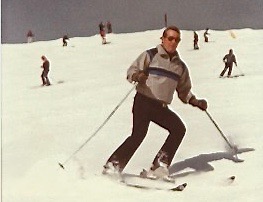
Don Reed at Sun Valley, Idaho, in 1982.

Don Reed in 1982.

My parents learned to ski when they were in their 40s. Being the youngest of four kids, I benefited the most from this new found sport by being taken on wonderful ski vacations that my two oldest sisters never experienced.

I grew up skiing at Northstar and Squaw. For years every February we rented a house right on the slopes of Squaw with two other families. Those are some of my most cherished childhood memories.

My dad’s last day on skis is still etched into my memory, but in a sad way. It was me, dad and my sister, Pam, at Sierra-at-Tahoe. Dad was having a hard time turning. He couldn’t tell his feet what to do. He kept falling.

Neuropathy won that day. This was one of the lingering effects of chemotherapy. He survived colon cancer, but not unscathed.

Dad had to be taken down in a toboggan by ski patrol.

My dad was a strong, prideful man. To see him in this weakened state was hard. I can only imagine what it did to his pride. It was good Pam was there; dad listened to her. And as a nurse practitioner she could explain to the ski patrol what was going on.

I took some of my dad’s ashes with me to Kirkwood on Sunday. We rode a couple lifts together. He was protected in my inside jacket pocket. We skied a run together off the Sunrise lift. Then it was time to say goodbye again. A little part of him is at the top of the Happiness Is run.

It was one of the best days I ever had skiing with my dad. And now my last day of skiing with him, while still sad, is mostly happy in knowing that his ashes are part of the mountain that brought so much joy to him while he was alive.


Opinion: Calif. losing its ability to speak Spanish

By Joe Mathews 

How are Californians going to save Spanish?

Yes, I know that a call to preserve the Spanish language might seem ludicrous in a state whose very name comes from a Spanish romance novel. Nearly half of us are either from the Spanish-speaking world, or trace our heritage there; an estimated 38 percent of Californians speak Spanish.
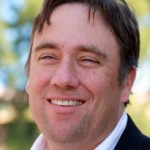
Joe Mathews

Joe Mathews

And, yes, my question about saving Spanish may seem daft now, as America’s deranged politics pit Trumpian xenophobia, with its fear of being overrun by foreigners and their languages, against liberal triumphalism about growing diversity. 

But the realities of immigration, education and language acquisition put the lie to the notion that Spanish has nowhere to go but up. To the contrary, there are clear signs that the Spanish language has already begun to decline. Which is why Californians should act now to preserve it.

Spanish is confronting the “Three Generation Death” law of non-English languages here. German, Italian, and Polish all but disappeared after three generations—a first, immigrant generation that learned some English, a second, U.S.-born bilingual generation that lost its proficiency in the non-English language over time, and a third generation that grew up speaking English only.

It’s possible that Spanish in 21st century California may prove to be a little more durable, given the geographic (and now digital) proximity of the Spanish-speaking world. But it’s far more likely that Spanish will simply become the latest tombstone in the language graveyard that is America.

Census statistics and Pew Research Center analysis tell the tale. While nearly 80 percent of all people who identify as Hispanic (and are age 5 and older) spoke Spanish in the previous decade, that number is expected to fall to about two-thirds by 2020. While 25 percent of Hispanics spoke only English at home in 2010, that figure is estimated to reach 34 percent in 2020. This reflects the law of the three generations. While 53 percent of first-generation Latino arrivals to this country are Spanish-dominant and 40 percent bilingual, about 80 percent of third-generation Latinos are English-dominant, and 15 percent are bilingual. 

Other trends also will hurt Spanish. Even before the U.S. elected a bigot threatening a border wall, immigration to the U.S. from Mexico was at net zero, and immigration from Latin America was in deep decline. That’s unlikely to change, given growing middle-class prosperity, lower birth rates and higher education levels south of the border.

Another part of this story is the unrivaled and growing power of English as our planet’s dominant tongue. It’s become the language of global commerce, culture and technology. It’s also wonderfully democratic, without the divisive gender distinctions of Romance languages, the tricky tones of Asian languages, or the complex grammatical constructions of German and Russian.

Californians should welcome the trend. Our more homegrown, more English-speaking population should be more cohesive. But English’s rise also poses important questions for California, because of our state’s special interest in Spanish.

The reasons for preserving Spanish here go beyond the desire to honor the heritage of Californians of Spanish-speaking ancestry. Spanish is at the heart of the history of California. First, we were a Spanish colony. Then in 1849, our state was founded in Spanish (an official language of our first constitutional convention that year), with a constitution that required laws to be printed in both languages.

Preserving Spanish would serve the present and the future as well. There’s money to be made if we can increase trade with the Spanish-speaking world. And it would be a huge step up for our education system to make Spanish a core requirement. Right now, you can graduate from a California high school without taking even one course in a foreign language. And the UC and Cal State systems require only two years of foreign language for admission. That borders on the criminally negligent, given all we know about the good that learning another language does for our brains. 

In November, California voters approved Proposition 58, but that modest measure merely removed bureaucratic barriers to teaching California students in languages other than English. Spanish needs more, including state requirements and investment so that instruction is available to all.

If we preserve Spanish, we’ll have a comparative advantage over the rest of the country, where the language doesn’t have the same history and is more likely to die out. Spanish could become a special force in California, distinguishing us and binding us together.

With that happy thought, I wish you Feliz Navidad y Prospero Año Nuevo. 

Joe Mathews writes the Connecting California column for Zócalo Public Square.


Stop unwanted calls, texts on cellphones

By Kim Komando, USA Today

You may find this surprising. Many of us remember when people’s names, addresses, and phone numbers were listed in the telephone book and distributed for free. All we ever worried about were junk mail, telemarketers, and the occasional prank call.

Times have changed. Phone books are now history. You can message anyone you know (or don’t) on Facebook, Twitter, or other means. And most important, your phone number is a gateway to your primary means of communication, entertainment and safety. Once your number is compromised, it’s far more intrusive than ever before.

Every year or so, a hoax burns like a wildfire through email inboxes and social networks warning that all cellphone numbers are about to go public. It also says there’s a deadline to register your cellphone, and, once registered, it only blocks your number for five years.

Read the whole story


Gaming group against Yucca Mountain project

By Richard N. Velotta, Las Vegas Review-Journal

Nevada will have an advocate in the American Gaming Association against any effort to revive the Yucca Mountain nuclear waste repository northwest of Las Vegas.

AGA President and CEO Geoff Freeman, in an end-of-the-year press conference call Tuesday, also said he is optimistic that the $240 billion commercial casino industry would be able to successfully lobby for legal, regulated sports wagering nationwide and that the association would work with the incoming administration to battle against illegal gambling.

Read the whole story


LTN subscriber wins Globetrotter tickets

Fred Gifford is the recipient of a pair of Harlem Globetrotter tickets. This is because he subscribes to Lake Tahoe News.

Being a subscriber has multiple advantages, including being able to post unlimited comments, receiving breaking news alerts, and having a chance to win things like these basketball tickets. Subscribers are also ensuring there are more local stories on Lake Tahoe News.

“I subscribe to the ‘News‘ as I find its reporting non-political, as well as unbiased, up-to-date on a more frequent basis, as well as over all good reading touching on most subjects pertinent to the Tahoe way of life,” Gifford said.

Subscriptions are $10/month or $100/year. To subscribe, go online or send a check to Lake Tahoe News, PO Box 13406, South Lake Tahoe, CA 96151.

This is what Gifford had to say about his experience seeing the Globetrotters in the past, “The first time I saw the Globetrotters was at the Cow Palace in South San Francisco. I was 9 years old. The second time I saw them I was in high school. Both times I was mesmerized by the fantastic moves and ball handling that went on. I don’t travel well anymore due to age and medical situations, but would give my left ear to get tickets so that I could give them to a couple of friends that have never seen them live. If they are as impressed with the whole Globetrotter show, I am sure they would share with me ,as well as others in a situation similar to mine. The fantastic crowd pleasing antics these guys provide just blew me away! Fulfillment by proxy and happy to listen to the tales related if the tickets are a go!”


Reid leaves Senate with few regrets

By Gary Martin, Las Vegas Review-Journal

WASHINGTON — Harry Reid didn’t start the partisan polarization that has stymied Congress in recent years. But he played a central role in sharpening the tone of discourse on Capitol Hill, dividing lawmakers and eroding the collegiality that once was a hallmark of the U.S. Senate.

In that atmosphere, Reid is stepping down from leadership and leaving the chamber with few regrets — and an armful of legislative victories from three decades of serving the Democratic caucus and his home state of Nevada.

His legacy includes the Affordable Care Act, a major Senate rule change on filibusters and success in blocking nuclear waste shipments to Yucca Mountain — to name just a few accomplishments.

At age 77, Reid remains irascible, unrepentant but humbled.

Read the whole story


Rooftop solar will make modest comeback in N. Nevada

By Michelle Rindels, AP

Exactly a year after a controversial rate hike dramatically hampered the number of new rooftop solar installations, Nevada utility regulators voted Thursday to allow about 1,200 customers to install solar systems and get older, more favorable rates when they sell back excess electricity.

The Public Utilities Commission of Nevada voted unanimously to allow a small portion of Northern Nevada residents to sign up for the attractive rates over the next three years. It’s a modest but promising step forward after months of acrimonious debate that pit rooftop solar companies against traditional utilities.

“We need to restart a conversation, work together,” said commissioner Joe Reynolds, who was appointed chairman by Gov. Brian Sandoval in September. As part of a reshuffling, the prior chairman was moved to a regular commissioner role and the architect of the controversial rate hike was not reappointed to the three-person panel.

“Nevada is at its best when we roll up our sleeves and figure out a way to solve challenges and think outside the box,” Reynolds said.

The newly admitted rooftop solar users will account for a small portion of the Sierra Pacific Power Company’s estimated 290,000 residential customers. About 2,100 customers in Northern Nevada have already enrolled in the so-called “net metering” program that pays them for their excess energy.

In a lengthy order explaining the policy, Reynolds wrote that allowing new rooftop solar installations at the attractive rates will support the state’s goal of diversifying its energy portfolio, and will reduce the average residential customer’s bill by 1 cent a month.

Rooftop solar proponents noted that the decision doesn’t apply to the larger customer base in southern Nevada or offer a long-term solution for the solar debate, but praised the decision.

“The commission took a small but important step toward re-aligning rates with the goals that state policymakers and the people of Nevada share: to see more homegrown solar powering their communities and their economy,” said Jessica Scott, regional director for the pro-solar nonprofit Vote Solar. “Today’s votes signal that Nevada is ready to lead on solar once again.”

Regulators said the rate hike last year aimed to end a subsidy that non-solar customers were paying for solar customers. Solar companies disputed that there was a cost-shift, arguing that regulators’ calculations didn’t factor in environmental and health benefits that solar panels bring to Nevadans.

“It’s a difficult issue because you’re getting smart folks — well-educated, well-intentioned — who just disagree on basic facts,” Reynolds said on Thursday.

Regulators this fall undid one of the most loathed portions of their ruling: applying the new, less-favorable rates to customers who had signed up for net metering under more lucrative conditions. About 32,000 customers with the systems were grandfathered into the better rates this fall, although future customers weren’t eligible.

Reynolds’ order described the unpopular 2015 ruling as “a promise better left unkept” and said regulators are free to try new approaches to addressing rooftop solar rates. But he also wrote that questions about how to price rooftop solar power are unresolved and it’s too early to make broad, binding decisions about net metering policy.