Not all Tahoe bears will hibernate in winter

By Sarah Hockensmith and Will Richardson, Tahoe In Depth

Have you ever seen a bear print in the snow? How about a bear walking through your neighborhood during the winter season? At such times, many might ask themselves “shouldn’t this bear be asleep right now?” Others might be compelled to ponder “do bears really even hibernate in the Tahoe region?” The most curious among you may go on to ask “what exactly is hibernation, anyway?” These are great questions, and commonly asked, partly because hibernation is complicated.

Here in the Sierra Nevada, we experience the complete four-season cycle during the calendar year, including winter. Animals that breed in the Tahoe region have adapted three main strategies to cope with these seasonal changes. The first strategy is migration, where animals come to Tahoe during the summer months to take advantage of abundant resources, the mild climate, and long periods of daylight hours.

During the winter, these animals, which include deer, many birds and bats, and even insects, must retreat to lower latitudes and lower elevations.

Staying through the winter

A second strategy is where animals have evolved to stay put in Tahoe and stay active, somehow managing to balance their energy output, withstanding the freezing temperatures, and maintaining the ability to find enough food in a snow-covered landscape. This strategy is for the hardiest creatures, but it works for a surprisingly large diversity of animals.

The last strategy that animals have adopted to get through seasonal periods of difficulty, and the strategy that is perhaps least intuitive, is the process in which an animal simply goes to sleep for a period of time to wait for better conditions. By reducing their metabolism and body temperature, animals are able to greatly reduce the “expense” side of their energy budget and make it through such periods. This tactic is commonly known as hibernation in the broad sense.

Among the scientists that study such things, the term “hibernation” has been applied somewhat strictly, reserved only for certain types of hibernation, and that has led to considerable confusion over the years. The experts hold competing ideas about hibernation strategies and patterns among bears and other animals, but some of the debate falls on very fine distinctions and technical definitions.

If food — including human garbage — is readily available, bears in the Tahoe area may forego hibernation. Photo/Will Richardson

If food — including human garbage — is readily available, bears in the Tahoe area may forego hibernation. Photo/Will Richardson

Types of hibernation

There are many terms that refer to different, often very precise, types of hibernation. For example, brumation is a type of hibernation among reptiles, but different metabolic processes are involved. Unlike mammals, reptiles are cold-blooded and cannot control their body temperature; thus, brumation allows reptiles to handle temperature extremes.

Aestivation is a type of hibernation utilized in the summer to protect an animal (e.g. insects and amphibians) from long hot or dry periods. The term “torpor” often refers to a type of short-term hibernation where a reduction of body temperature and metabolic rate occurs during an inactive part of a daily cycle. We can often get frost in mid-summer, so consider the dramatic metabolic swing a tiny hummingbird must undergo not to burn through their meager reserves getting through such a night.

For the average person, it is unnecessary to get hung up on the finer distinctions of these technical definitions, and there is much debate among the experts anyhow, so we at the Tahoe Institute for Natural Science prefer to focus on the broader concepts and implications of seasonal dormancy.

For some animals, seasonal dormancy is a “facultative response” — only occurring if the conditions demand it for survival. Some of our short-distance migrants are similar in this regard. In other species, hibernation has been locked in as an obligate part of the annual cycle, regardless of weather and resource availability.

Programmed to sleep

A local example on the obligate side of the dormancy spectrum is the Belding’s ground squirrel (Spermophilus beldingi), which experience a long hibernation period for eight to nine months. Even if there are ample grasses and warm temperatures to find food in the late summer and early fall, these squirrels go to sleep as soon as they have enough body fat to survive the winter, often in late August.

Winter a hardship for most animals

This brings us back to the initial question, “Do bears hibernate in the Tahoe region?” Again, winter in the Tahoe region is a time of hardship for most animals, including bears. Food is scarce and hard to find, temperatures are dipping below freezing for long periods of time, and snow is covering the ground, making travel and foraging energy intensive.

The American black bear (Ursus americanus), inhabits an enormous range across the North American continent and has evolved as a facultative hibernator. In Florida, you can find male black bears active year-round, but if you were to study populations in the coldest parts of Alaska, you would find that these bears are sleeping for up to sevent months out of each year.

Studies from the southern Sierra Nevada and elsewhere have demonstrated that onset of bear hibernation and denning behavior is driven by two factors. The first factor is whether the bear is pregnant. A pregnant female must den up for a period of time regardless of weather, and typically these family groups will remain in the den longer than individual bears given the same conditions.

The second factor determining when (or if) a bear decides to hibernate has to do with food availability. A large and readily accessible pine seed crop may keep bears active and feeding. Unfortunately, this applies to garbage as well as natural food sources, and if either are available throughout the winter, you are likely to find black bears awake and active.

Getting a wake-up call

Unlike deep hibernators, bears occasionally wake up and shift positions inside the den, helping to prevent sores and better conserve heat. During their dormancy they lower their body temperatures 8 to 12 degrees Fahrenheit, break down fat reserves for energy, and recycle wastes to eliminate the need for urination, defecation, or drinking water. Amazingly, they wake with almost no appreciable muscle atrophy and are capable of fine motor skills almost immediately.

Clearly, hibernation is a complicated subject. It has proven to be a successful strategy of saving energy during hard times and is utilized by many animals of the Sierra Nevada. “Do bears hibernate in the Tahoe region?” The answer is “yes and no, sort of. It depends.” When, if, and for how long an animal hibernates depends on whether that species is an obligate or facultative hibernator, may depend on the sex of that individual animal and how that relates to energy demands, and often depends on weather conditions and food availability from year to year.

Sarah Hockensmith is the outreach manager and Will Richardson is the co-founder and director of science and outreach for the Tahoe Institute of Natural Science. This article first appeared in Tahoe In Depth.



Opinion: Ocean may solve Calif.’s housing problem

By Joe Mathews

Why can’t we solve California’s devastating housing shortage?

Perhaps it’s because the proposed solutions—sprawling construction, denser construction, granny flats, affordable housing mandates, and regulation exemptions—are all built on the same flawed premise: that housing must exist solely on land. And California’s combination of strict regulation and anti-density NIMBYism makes it impossible to build enough housing on land to serve our population.

Joe Mathews

Joe Mathews

So, what if we build our housing future at sea?

If you haven’t heard yet of seasteading—that’s the ocean form of homesteading—you soon will.

Because where else does California have to go?

Floating cities are an ancient idea; Consider Plato’s dialogues on the lost city of Atlantis. And communities at sea are a durable cultural trope, from the Kevin Costner film “Waterworld” to the “BioShock” video games. In this season of joy, it’s worth noting that the world’s hardiest seasteader is Santa Claus himself, laboring tirelessly among the Arctic ice floes of the North Pole. Less mythically, a half-century ago, L. Ron Hubbard and other leaders of the Church of Scientology created the Sea Organization, or Sea Org, a training compound of ships that mostly stayed at sea, away from the prying eyes of the authorities.

More recently, seasteading has gained ground among libertarians, particularly those who drink from Silicon Valley’s dream-inducing waters. For a time, techies contemplated how to build cities far out to sea, in international waters, so they could live by their own laws.

At the forefront now is the non-profit Seasteading Institute, which envisions such communities enabling “the next generation of pioneers to peacefully test new ideas for how to live together.” In 2008, the institute received high-profile backing from PayPal founder Peter Thiel, who preached for ocean communities as an “escape from politics in all its forms.” More recently, the venture capitalist has publicly soured on the idea, and sought to escape political reality by backing Donald Trump.

In some sense, Thiel’s newfound skepticism is justified. Such experiments have yet to realize the vision of urban ocean realities—it’s costly and complicated to build a city on the sea. Among the Seasteading Institute’s findings: the open ocean may be too rough to support a city, but protected coastal waters look promising.

For California, that’s good news: we have 840 miles of coast. While seasteading may sound like science fiction, it’s no less Star Trekian than median housing prices that exceed seven figures in San Francisco, Marin and San Mateo counties, and approach $1 million for new homes in Orange County.

While previous visions of sea cities have incorporated futuristic aquafarms or novel modes of energy production, more modest cities—with the straightforward goal of providing housing for Californians—might be more viable. One might start with boats providing badly needed housing for the state’s homeless population. This idea recently got a boost when former San Francisco Mayor Art Agnos suggested turning the decommissioned USS Peleliu into a shelter for his city’s homeless.

Of course, California’s many land-based regulators and environmentalists would quickly raise objections to people living in coastal waters. So it’s vital to sell the idea not merely as a response to housing (since the housing crisis demonstrably doesn’t move Californians to action or reform) but as a far-sighted answer to the two problems our state’s leaders care most about: climate change and the drought.

A proponent of seasteading recently suggested to me that offshore housing could provide a financing base to change the economics of desalination. Plans to turn ocean water into drinking water have long been considered costly and inefficient. But manmade islands with desalination plants financed with the proceeds from off-shore housing sales on those same islands might change the economics; the reclaimed water could supply these sea cities, thus offering a live experiment for a more sustainable water future.

Seasteading also could mitigate climate change. Sea-based cities would provide a dry run—OK, a wet run—for the not-so-distant future, when rising sea levels inundate California’s greatest coastal cities, forcing millions of us to learn how to live on the ocean. In this way, cities on the sea would ease today’s housing problems—while furthering our climate change leadership and preparations for a watery future. 

It’s hard to overstate how much the ocean can teach us. There’s a great Golden State story from 1965 that I’ve always loved, about a California-born teenager named Robin Lee Graham who embarked on a five-year sailing voyage around the world, eventually publishing a book called “Dove” and becoming a celebrity.

“At sea,” Graham wrote, “I learned how little a person needs, not how much.”

That’s a lesson all of California could learn, if we’re willing to build a future just off the coast.

Joe Mathews writes the Connecting California column for Zócalo Public Square.


Chevys closes in SLT without warning to workers

Updated Dec. 27, 5:40pm:

By Kathryn Reed

More than 30 people in South Lake Tahoe were abruptly without jobs when Chevys didn’t open today.

Sara Barker, spokeswoman for the chain, told Lake Tahoe News no advance notice was given to the workers. Dec. 24 was the last day the restaurant on Highway 50 served food.

A few people were in the restaurant Dec. 26 cleaning and getting ready to vacate. The smell of old grease and cleaning supplies permeated the dark interior. A regional rep was sent up from Sacramento to oversee the closure.

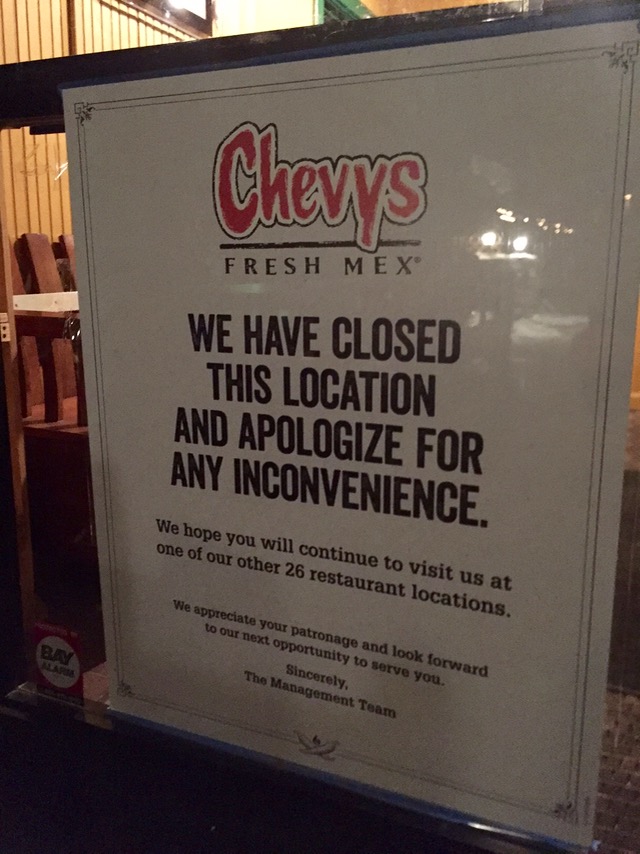
Chevys in South Lake Tahoe is closed. Photo/LTN

Chevys in South Lake Tahoe is closed. Photo/LTN

A sign on the door says the restaurant is closed. Scattered about the parking lot on Monday night were rack card size notices saying: “We have closed this location and apologize for any inconvenience.” Attached was a coupon for a free appetizer that expires in mid-January.

This was one of several underperforming locations that was closed by parent company Real Mex, which is based in Southern California.

“The Real Mex core business continues to improve and we’re preparing to integrate an acquisition into our existing business,” CEO Bryan Lockwood told Lake Tahoe News. “Although closing restaurants is never easy, the plan we have put in place strengthens the overall health of the company moving forward.”

Further details about the acquisition are not being disclosed.

Even though it was only a couple years ago that Chevys signed a 20-year lease, Barker said, “We have an amicable exit plan with the landlord.”

Before it was a Chevys for years it was a Carlos Murphy’s restaurant. Prior to that it was Lawrence’s Economy Store.

The future of the local employees remains to be seen.

“They were all offered positions elsewhere in our organization and a number of them have chosen to relocate,” Barker said.

The nearest Chevys is in Sacramento. Barker said they would not be entitled to relocation compensation. Most Chevys employ between 50 and 70 people; a mix of full- and part-timers, however, the South Lake Tahoe restaurant had closer to 30 workers.


CalPERS moves to slash investment forecast

By Dale Kasler, Sacramento Bee

The cost of that government pension is about to go up again, for California taxpayers as well as some public employees.

CalPERS moved to slash its official investment forecast Tuesday, a dramatic step that will translate into billions of dollars in higher annual pension contributions from the state, local governments and school districts.

Employees hired after January 2013, when a statewide pension reform law took effect, will also have to kick in more money. Older employees could see higher contributions, too, although that would be subject to contract bargaining.

Read the whole story


Calif. energy needs could boost Nev.

By Daniel Rothberg, Las Vegas Sun

As part of a final push for clean energy in the remaining weeks of the Obama administration, the Department of the Interior approved a 728-mile power line Dec. 13 that will move wind energy from Wyoming to Southern Nevada. That wind power, which the federal agency says is enough to supply 1.8 million homes, could then be sold to Western states, especially California.

California is a key market for many clean-energy projects — even beyond its borders — because of its high renewables portfolio standard. Last year, Gov. Jerry Brown signed a law requiring power providers to acquire 50 percent of their energy from renewable sources by 2030.

“California needs a lot of renewable energy and cost-effective renewable energy,” said Kara Choquette, a spokesperson for the wind-energy transmission project, known as TransWest Express. She explained that delivery of thousands of megawatts from a wind farm in Southern Wyoming to existing energy infrastructure in Nevada will optimally position sales of electricity to a variety of Western customers, similar to the Hoover Dam. Even if TransWest Express does not deliver its power to Nevada households, the state could benefit from an economic standpoint. The $3 billion project, crossing 140 miles of Nevada land in Lincoln and Clark counties, is projected to bring 250 construction jobs and generate $24 million in tax revenue.

Read the whole story


Snippets about Lake Tahoe

·       On Jan.6, Alpine Meadows will join 75 other resorts across the United States and Canada in hosting the Guinness World Records event for the largest ski and snowboard lesson ever taught.

·       Bridgeport Winter Recreation Area on the Humboldt-Toiyabe National Forest’s Bridgeport Ranger District is open for snowmobiling.

·       UberSki is now available in Lake Tahoe, which means these drivers can carry four people and their ski equipment.

·       Climate change and lake temperature in the Sierra Nevada: There’s no business like snow business is the subject of a talk by Steve Sadro. It will be Feb. 9 at 6pm at UC Davis Tahoe Environmental Research Center on the campus of Sierra Nevada College in Incline Village. Cost is $5.


Truckee housing project targets ‘missing middle’

By Sage Sauerbrey, Moonshine Ink 

A new player in the housing scene took a big step forward  when the Truckee Planning Commission recommended approval of the hotel-residential development known as Coburn Crossing, with amendments.

The project includes a 114-room Marriott Springhill Suites hotel and 138 residential units, to be built on the 10.35-acre property wedged between Interstate 80 and Donner Pass Road, to the east of the Truckee Cemetery.

The project will be reviewed for approval by the Truckee Town Council on Jan. 24. If approved, Triumph will be moving dirt by June, and plans to have the hotel and apartments open by March 2018, according to Steve Virostek, co-founder and principal of Triumph Partners.

Read the whole story


Tahoe Keys working with primary well off-line

By Kathryn Reed

Tahoe Keys property owners have been asked to scale back their water use while one of the wells is out of commission.

The motor on well No. 3 went out this month. It should be back in service soon, according to water officials. Pumps generally have a lifespan of seven years. This one has been in service since 1998.

This South Lake Tahoe neighborhood has its own water system that consists of three wells.

“In summer if it went down, we would have major issues and would probably have to borrow from (South Tahoe PUD),” Justin Phillips with the Tahoe Keys Water Department told Lake Tahoe News.

This is because so much more water is used in the summer. On an average summer day 1.6 million gallons of water is used in the Keys, which compares to 180,000 gallons in the winter. However, during holiday times like now, 350,000 gallons is the average.

Wells No. 1 and No. 2 also have issues. PCE or tetrachloroethylene has been detected in those wells. The chemical, which is common at dry cleaning plants, was first detected in South Lake Tahoe’s groundwater near the Y in 1989.

Carbon filters can reduce the level to non-detect. This is what the Keys is relying on to provide potable water to customers.


Calif. hopes $3B trial improves health of neediest

By Anna Gorman, KQED-TV

Riverside County plans to connect former inmates with health clinics and social services. Orange County hopes to get homeless residents into housing — and help them stay there. Placer County is opening a respite center where homeless patients can go after they leave the hospital.

Those are just some of the pilot projects in a $3 billion experimental effort officials hope will improve the health of California’s most vulnerable populations. The effort is a recognition that improving people’s health will take more than just getting them insured.

The state has approved plans in 18 counties intended to reduce unnecessary emergency room visits and hospital stays among these groups.

Read the whole story


Reno-Tahoe airport passenger count increases

By Associated Press

The Reno-Tahoe International Airport is keeping busy this year, with 50,000 more passengers passing through its gates than in 2015.

KTVN-TV reports that nearly 3.6 million passengers traveled through the Reno-Tahoe airport in 2016. Airport officials say an increased number of destinations helped boost passenger numbers.

Currently 125 flights fly out of Reno daily with about 16,000 passengers on board. During the recession, the airport cut 35 percent of its flights but since the economy has been recovering, flights to Atlanta, New York and Guadalajara, Mexico, have been added.

There are currently eight airlines offering flights to 23 destinations from Reno.

Reno-Tahoe Airport spokesman Brian Kulpin says the airport has added about 1,200 seats to the market in the past year.