By Joann Eisenbrandt
“Noise, by definition, is ‘unwanted sound.’”
This is how the Tahoe Regional Planning Agency’s 2015 Threshold Evaluation report characterizes it. The report goes on to note that vehicular traffic and “aircraft activity at the South Lake Tahoe airport have been identified as the predominant noise sources in the basin.”
El Dorado County opened the Lake Tahoe Airport in August 1959. It was annexed by South Lake Tahoe in 1983. From the beginning of city ownership, there have been vigorous debates over the environmental impacts of the airport versus its economic benefits. The “unwanted sound” of noisy aircraft operations in the skies above the lake’s clear blue waters has often been at center stage.
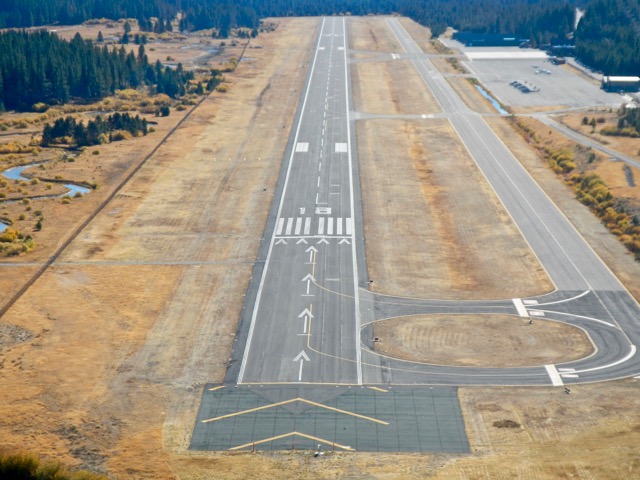
With Lake Tahoe Airport not being used as much, noise issues have diminished. Photo/Kathryn Reed
Airport Master Plan update under way
The city began an update to its Airport Master Plan in 2013. This plan outlines the preferred configuration of the physical facility and the number of flight operations and mix of aircraft using the airport over the next 20 years. When the 1992 Master Plan was put in place, the noise generated by scheduled commercial flights over residential neighborhoods was a key concern, as well as that created by business jets bringing celebrities and tourists to the lake in the summer for special events.
The environmental document required by CEQA (California Environmental Quality Act) that must accompany the master plan is being prepared, with the 30-day circulation and comment period for the draft document expected to take place in February. It will identify potential environmental impacts of the master plan, including noise, and outline ways in which they can be mitigated.
TRPA’s noise standards
In its Regional Plan, the Tahoe Regional Planning Agency sets maximum allowable noise levels in decibels for aircraft operations. The 1980 federal Compact that created the bi-state agency gives it this power. The TRPA noise standard for daytime aircraft arrivals and departures (8am to 8pm) is 80 dBA and the nighttime standard (8pm to 8am) is 77 dBA. Aircraft noise is measured in A-weighted decibels (dBA), a measurement that eliminates very high and very low frequency sounds in the same way they are perceived by the human ear.
These noise standards are also a part of Lake Tahoe Airport Master Plan. The airport monitors noise at six sites in the vicinity of the airport and logs all exceedances of these single-event noise standards. It is to provide TRPA with quarterly and yearly reports. Cumulative noise impacts (CNEL) over a 24-hour period from aircraft in the South Lake Tahoe Airport Transportation Corridor are also measured. The TRPA threshold standard for these noise events is 60 dBA.
Commercial air service and noise
When the city took over the airport in 1983, it agreed to finish the county’s incomplete Airport Master Plan. The airport facility had been deteriorating and annual enplanements had gone down from a high of 294,188 in 1978 to a low of 37,553 in 1982. AirCal was the existing commercial carrier, and the city chose to immediately increase the number of its flights into Tahoe. TRPA believed this was a violation of its noise and other environmental standards and filed a cease and desist order. The city sued TRPA saying it did not have jurisdiction over the airport; the California Attorney General’s Office sued the city and AirCal. More lawsuits followed.
After years of legal wrangling, the 1992 Airport Master Plan Settlement Agreement ended all pending litigation and set strict guidelines for commercial operations at the airport for the next 20 years. It included requirements for the airport to adhere to the TRPA noise standards, have noise monitoring equipment in place, keep records and submit reports of noise exceedances to TRPA.
Commercial service to the airport ended in 2000, but until recently, the city continued to affirm its important economic value to the community and retained hope for its eventual return. In a 2012 Lake Tahoe News article, then interim City Manager Nancy Kerry insisted, “We have this facility. What is its best and highest use? A general aviation airport is just a waste of space … The goal is to bring commercial service back here.” Those like the League to Save Lake Tahoe who saw the return of commercial service and the noise that would come with it as an inappropriate assault on the basin’s fragile environment, continued to vocally protest against it.
Changes in the aircraft industry, the cost of maintaining the airport’s FAA Part 139 certificate for commercial service, and the prohibitively expensive changes to the physical layout of the airport that would be required to again accommodate scheduled air service changed the city’s mind. The preferred alternative chosen by the City Council as part of the current master plan update does not include commercial service. The city relinquished its FAA Part 139 certificate.
But even without commercial service, noise from aircraft operations still affects the South Shore community. In addition to general aviation aircraft, business jets and chartered transport category planes still use the airport, as do helicopters for medical and scenic purposes. Because the airport has received federal funding, military aircraft have the right to access the facility.
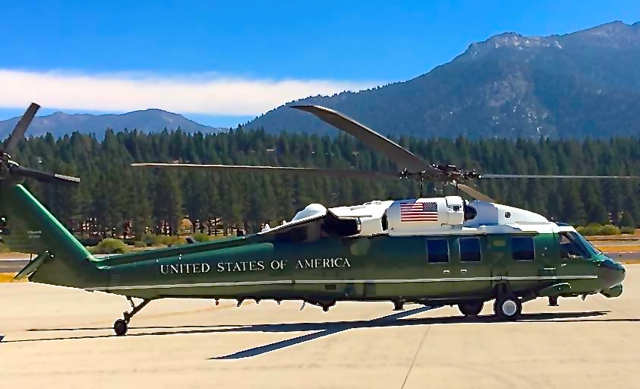
President Obama used Marine One to land at Lake Tahoe Airport in August. Photo/South Lake Tahoe
Measuring the impacts of noise
The technical measurement of acoustical sound levels is important in determining a noise event’s impacts. But equally important, and much harder to measure, is the subjective component of noise — how it is perceived by those who hear it.
The Federal Aviation Administration (FAA) in its Aviation Noise Effects circular concludes, “It is not possible to state simply that a given noise level from a given noise source will elicit a particular community reaction … an individual’s attitudes, beliefs and values may greatly influence the degree to which a person considers a given sound annoying.”
This is especially true at Lake Tahoe. The fact that the background, or ambient noise levels, at the lake are much lower than those in more industrial or urbanized areas makes noise events like aircraft arrivals and departures stand out. Because of the lake’s spectacular beauty and national status, there is a heightened focus on preventing degradation of its valued natural character.
How Lake Tahoe Airport monitors noise
Noise monitoring at the airport has been ongoing for decades, but recently, concerns were raised about the functionality of the aircraft noise monitoring equipment and how well noise complaints from the public and violations of the TRPA aircraft noise standards were being addressed.
For the noise monitoring of aircraft operations to be effective, the noise monitoring system must be able to not only accurately record the decibel levels of noise events at the monitored locations, but there must also be a way to differentiate between noise from aircraft and loud noises generated by other nearby sources such as roadway traffic or chain saws.
Over the years, the airport has used a variety of methods to tie TRPA noise level exceedances recorded at its monitoring sites to specific aircraft events. Until 2004, the airport had a manned FAA Air Traffic Control Tower, which recorded all aircraft to aircraft and aircraft to tower radio transmissions in the airport’s traffic pattern. All aircraft in the traffic pattern were required to be in contact with other aircraft in the pattern and the tower.
An administrative assistant at the city coordinated the timing of noise exceedance events at the monitoring stations with the FAA tower recordings. If a pilot were on the radio at the time of such an event, it was assumed the violation came from aircraft noise. If there were no aircraft transmissions around the time of an exceedance, it was considered a non-aircraft noise event. When the tower closed in 2004, the aircraft radio recording system owned by the FAA was decommissioned. Due to city budget cuts and reorganization, the administrative assistant position was later eliminated.
Mark Gibbs, the city’s new airport manager, told LTN that in 2005, the airport “tried another approach to differentiate noise monitoring exceedance events between aircraft and non-aircraft ….” However, it proved to be, “less accurate, more time consuming and quite costly to provide.” The airport purchased radar data from the Approach Control facility in Oakland. This radar data monitors all aircraft with transponders that are turned on in TVL terminal airspace. But not all aircraft have transponders and not all pilots who have transponders operate their planes with them turned on, so the only noise exceedances that could be positively identified were those from planes equipped with transponders that were turned on. The data was costly to purchase and also needed third-party software to translate the FAA data into a format for noise analysis. The city discontinued this approach in 2010.

Lake Tahoe Airport gets more use as a city hall than it does for planes. Photo/LTN file
TRPA’s analysis of compliance
Every five years, TRPA puts out a Threshold Evaluation Report which analyzes how well the standards and goals of its Regional Plan are being met. In its Draft Report for 2015, the agency originally noted that during the years between 2011 and 2015, analyzing the noise data from Lake Tahoe Airport was difficult and trends were hard to determine because the noise monitoring equipment was “malfunctioning” and unable to tell the difference between aircraft and other noise events.
Gibbs explained, “The French built 01DB Airport Noise Monitors were never designed to differentiate between aircraft sounds and other sources so that was never a “malfunction” of the equipment. The TVL noise monitors were operational the entire reporting period 2010-15. The noise monitoring equipment is designed to only log the time, date and dba level of each discrete exceedance of TRPA standards. There is no readily available electronic noise monitoring technology that can differentiate between aircraft and other sources.”
TRPA’s final 2015 Threshold Evaluation Report has removed any references to equipment malfunction, but does note that between 2011 and 2015, only total exceedances of the noise standards were reported by the city without discriminating between aircraft and non-aircraft noise events. This made it impossible to determine if the number of noise violations at the airport had trended upward or downward from previous reporting periods. TRPA did estimate, based on historical data, that an average of 17 percent of noise level exceedances are caused by aircraft. For the years during the latest monitoring period where the city reported a full year of data, total exceedances ranged from 1,038 to 1,698.
In 2015, the city found a cost-effective aircraft radio transmission recording system to replace the system in place when there was a control tower at the airport. VersaDial records aircraft radio traffic on the common traffic advisory frequency for TVL.
“If a noise complaint is logged,” Gibbs explained, “the city will review the recording to ascertain the aircraft in violation based on time/date of occurrence and compare that against the active noise monitoring system readings. If a noise exceedance is found, the airport can reference the owner of the aircraft by the call sign used on the radio transmissions. The airport now has the capability to replay aircraft radio transmissions to ascertain if a noise exceedance event logged by the noise monitoring equipment coincided with aircraft operations at the same time in terminal airspace.”
Gibbs added that, “The TRPA and the airport will continue a dialogue to ensure that the public has the best available data on airport noise impacts in the future … The airport and TRPA are both committed to limiting the negative impacts of noise in the community to the greatest extent practicable.”
Re-evaluating TRPA’s noise standards
Beyond the issue of how well the airport’s noise monitoring system can identify aircraft noise violations, is the question of the current validity of the standards themselves. Tom Lotshaw, TRPA’s public information officer, told Lake Tahoe News, “These airport noise standards are pushing 30 years old and were developed and adopted as part of the Settlement Agreement in 1992. From our perspective, these are legacy standards from back in the day when there were commercial service operations and a higher level of (airport) activity.”
TRPA’s 2011 Threshold Evaluation Report was peer reviewed, as was the 2015 report, by an outside panel of experts in different fields. The 2011 report’s review indicated that TRPA’s noise program is too complex with too many land categories and noise thresholds to be able to evaluate attainment. It could not effectively evaluate single noise events at the Lake Tahoe Airport for compliance and they were given a status of “unknown.” Lotshaw noted that under its Strategic Initiative, TRPA is now working with the Tahoe Science Advisory Council, a science advisory group, and several dozen other partners, to bring science to the table when trying to determine which TRPA policies continue to work. TRPA will be looking at their noise threshold standards and re-evaluating them to make sure they are scientifically sound.
This re-evaluation will not happen overnight. In the interim, the city will continue to monitor aircraft noise and submit reports to TRPA. In 2015, there were 19 noise complaints logged at the airport.
“Any noise complaint is investigated by the airport manager,” Gibbs confirmed, “and, if warranted, an attempt to contact the pilot is made.”
Residents can report noise concerns from aircraft by using the city’s website or by calling the airport manager’s office.
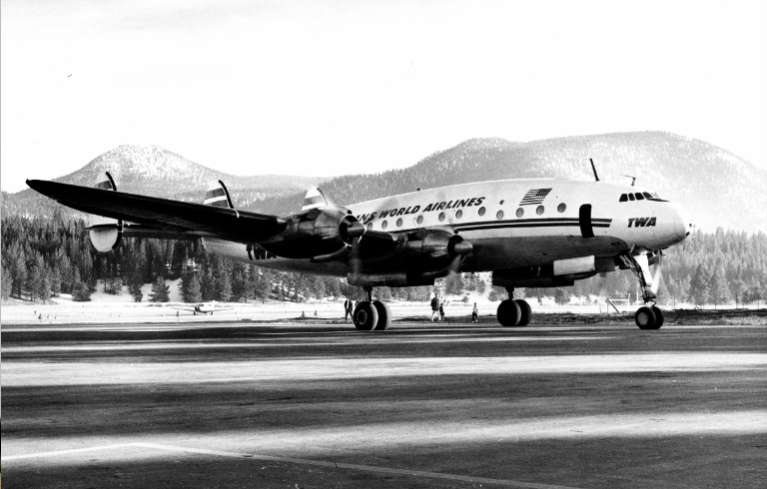
TWA was one of several airlines that used to fly into Lake Tahoe Airport. Photo/Del Laine
Aircraft noise as an issue in the future
With commercial service not envisioned in the Airport Master Plan update now being finalized, how much of an issue for the South Shore community will airport noise continue to be?
South Lake Tahoe City Manager Nancy Kerry said, “People don’t see it as a big issue. I don’t even think it was a big issue in the Master Plan (public) hearings. The issue was whether or not there would be commercial service.”
The city chose to do a mitigated negative declaration, a less exhaustive CEQA environmental document, instead of the more in-depth environmental impact report. Hilary Roverud, the city’s deputy director of Development Services, explained the rationale behind that choice.
“We feel there are no impacts that can’t be mitigated. We are not anticipating any expansion of the airport property or significant changes in its configuration. (ESA, the consultants) are evaluating the master plan based on the current baseline conditions and looking at any changes the master plan is proposing that will affect noise … nothing in the draft master plan will create noise issues. The city has already reduced the footprint of the airport, narrowed the runway, and performed SEZ (stream environment zone) restoration,” she said.
According to Gibbs, the city is also looking at NextGen, an FAA national initiative program that would replace ground-based navigation aids with GPS-enabled instrument procedures. This allows aircraft to follow a tighter flight path to the airport. In Tahoe’s case, it would make it easier for pilots to follow the recommended “meadow” approach which takes them over open space rather than residential neighborhoods. The city has put in a request for these procedures, hoping that Tahoe’s sensitive environment will make it good candidate, but it must compete with many other airports. It isn’t a grant program and doesn’t cost the city money because it only involves FAA-owned airspace. The selection process is expected to take a number of years.
The League to Save Lake Tahoe, which has remained vocal regarding the environmental impacts of the Lake Tahoe Airport, was asked about its view of aircraft noise as an ongoing issue. Darcie Goodman Collins, League executive director, told LTN in an email, “We are happy that the city has ended its efforts to renew the commercial status for the airport. As the city moves forward, they are required to take actions to comply with Tahoe’s threshold for noise. This will be challenging for an operational airport, but we remain confident that the city, working in cooperation with TRPA, will make progress on its efforts to reduce noise and be a good neighbor for the surrounding community.”
Once the mitigated negative declaration is completed it will be available for review by public agencies and individuals for 30 days. The city plans on having one public hearing during this review period to receive input from residents on potential environmental impacts identified in the Airport Master Plan, including aircraft noise, and the adequacy of the mitigation measures the Plan proposes to reduce them to less than significant. This will be the public’s chance to indicate how significant an issue airport noise is.
 Avocado Spinach Dip