Expect traffic issues in Tahoe for long weekend

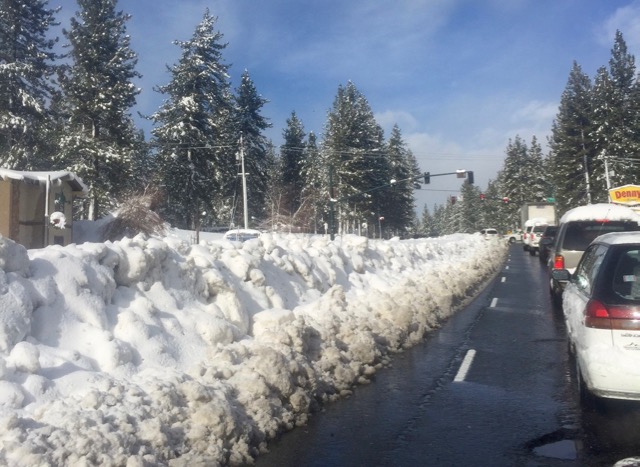
Caltrans is alerting motorists traveling this weekend in the Sierra foothills, mountain areas or over the Donner or Echo summits to be prepared for winter driving conditions, especially at the higher elevations and in the Lake Tahoe Basin. Motorists should also expect delays caused by increased traffic because of the holiday weekend.

Very cold overnight temperatures will freeze any melted snow, including on roadways. Motorists are encouraged to slow down and use extra caution on bridges, ramps, shaded areas and after sunset.

Additionally, while heavily traveled roadways may be free of snow, other roads will still be snow-covered and chain restrictions may be in force. Motorists are required to carry chains even if driving a four- or all-wheel drive vehicle with mud and snow rated tires.

Motorists may be held intermittently for avalanche control. Highway 89 over Emerald Bay is currently closed due to avalanche hazards. 


Nevada casinos earn 1st profit since 2008

By Associated Press

Stateline casinos helped contribute to 2016 being the first time since the 2008 fiscal year that Nevada casinos showed net income instead of a loss.

The Gaming Control Board released the figures Wednesday.

The South Shore reported a 5.1 percent increase year-over-year to $375 million. In 2015 the Stateline casinos had a net loss of $150.8 million. 

But it wasn’t due to gambling winnings, which in Stateline were down $2.1 million.

The report highlighted a continuing trend — revenues tilting away from tables and slot machines toward restaurants, retail, entertainment and rooms.

This “other” income is helping Tahoe tremendously. Also contributing the local increase is the addition of the Hard Rock Lake Tahoe.

The state says room rentals and fees helped resorts generate income of almost $1 billion from total revenues of $25.2 billion in the year ended June 30. 

That compared with a net loss of almost $662 million on revenues of $24.6 billion a year earlier.

Board analyst Michael Lawton says the bottom line is that casinos across the state recorded net income for the first time since fiscal 2008.

— Lake Tahoe News contributed to this report.


South Shore chamber hires CEO from Mammoth

Lake Tahoe South Shore Chamber of Commerce’s new CEO starts Feb. 6.

Craig Schmidt

Craig Schmidt

Craig Schmidt has been leading the Mammoth chamber since September 2014.

His background is being the chief executive officer of chambers in tourist areas. Prior to Mammoth he was in Morro Bay, Healdsburg and Hood River.

 Schmidt is a graduate of the Institute of Organizational Management at the University of Colorado and the Economic Development Institute at the University of Oklahoma. He also has a bachelor’s degree in geology and environmental science from the University of Toledo. 


Steve Teshara has been running the organization since B Gorman left in mid-2016.


Letter: Restaurant gang helps at Bread & Broth

To the community,

Base Camp Pizza, just one of many Tahoe Restaurant Group’s establishments, was the host for Bread & Broth’s Monday meal on Jan. 2 at St. Theresa Church Grace Hall.  Their Adopt A Day of Nourishment sponsorship is just one of the many ways that Ted Kennedy and members of his restaurant crews have been partnering with B&B.

In addition to sponsoring AADs, Tahoe Restaurant Group has been sending helpers to assist B&B volunteers with the Monday meal cleanup, purchasing dinner utensils and sponsoring and providing financial assistance and help whenever needed.

At Base Camp Pizza’s sponsorship meal, Ted Kennedy, Kelsey Zieba and Elli Gage came prepared to make sure that every dinner guest who came to their dinner was treated with warmth and a kind word. Their spirit of service was greatly appreciated by the B&B volunteers and always makes the evening a fun event.

Kennedy commented, “The salad was great!” But so was the lemon chicken, mashed potatoes and green beans with bacon all prepared by the talented B&B cooks.  “Seriously what makes this meal so great is all of you wonderful people giving back.  We’re so honored to be a part of it.” 

The B&B program is so glad and thankful to have Tahoe Restaurant Group as our partner and generous sponsor.


Carol Gerard, Bread & Broth


6 workshops for El Dorado County caregivers

El Dorado County Health and Human Services Agency is putting on a six-week program for caregivers.

The series topics include:

Feb. 24 – Taking Care of You
March 3 – Identifying and Reducing Personal Stress
March 10 – Communicating Feelings, Needs, and Concerns
March 17 – Communicating in Challenging Situations
March 24 – Learning From Our Emotions
March 31 – Mastering Caregiving Decisions

The program will be from 2-3:30pm at the El Dorado Hills Senior Center, 900 Lassen Lane.

The trainings in the educational series will provide caregivers of older adults with tools and strategies to assist them in handling the unique challenges they face.

Class size is limited and registration is required — 530.621.6192. The training series is offered at no cost; donations are accepted.


Bring in the birds for winter entertainment

By Melinda Myers

Brighten your winter days by inviting birds into your landscape. Their beauty and motion help enliven the garden and lighten your spirit. Not only do they provide entertainment, but also an opportunity for all ages to stay involved with nature year-round.

Increase the number of visitors to your yard by including all the essentials these winged visitors need; food, shelter and water.

Plants are the easiest way to bring birds into your landscape. These natural feeders provide seasonal food and shelter for the birds. Take a walk through your yard and look for trees, shrubs and perennials that provide food and evergreens that provide year-round shelter. Plan on adding a few of their favorites that provide food and shelter and seasonal beauty you can enjoy.

In the meantime, add a few feeders. This is a great way to increase the number and diversity of birds visiting your garden.

It's possible to attract birds to one's home. Photo/Gardener’s Supply Company

It’s possible to attract birds to one’s home. Photo/Gardener’s Supply Company

Place feeders in a quiet, sheltered location where you can easily watch these visitors come and go.  Avoid placing feeders too close to plants that provide easy places for squirrels to jump onto the feeders and cats to hide while hunting for a meal.

Select feeders to attract the type of birds you want to bring into the garden.

Tube feeders with metal ports keep the seeds fairly clean and dry and are somewhat squirrel resistant. Feeders with short perches attract small birds like chickadees, titmice, and finches. Those with the perches above the feeding port are suitable for birds like goldfinches, chickadees and pine siskins that can feed upside down.

Thistle feeders and socks have extra small openings designed to hold the small seeds of thistle. You’ll find small songbirds like finches feeding at these.

Suet feeders hold blocks of high energy food made of animal fat filled with seeds and berries. They attract woodpeckers, nuthatches, chickadees, titmice, jays and starlings. 

Platform feeders attract the greatest variety of birds, but give squirrels easy access to the seed. Plus, the open environment subjects the seeds to spoilage from damp weather and droppings from feeding birds. Enclosed hopper or house feeders are attractive to most birds, but once again the seed can be exposed to the weather and spoil.

Be sure to thoroughly clean the feeders monthly to avoid the spread of disease. Cover droppings and spoiled seed on the ground with a fresh layer of mulch.

Add additional feeding stations by dressing up your evergreens with bird-friendly ornaments. You can purchase seed coated ornaments or make your own. Roll an evergreen cone in peanut butter or suet and coat with birdseed. Coat a stale bagel with peanut butter and seed. Hang these on the tree with colorful yarn. Add a few orange slices and strings of cranberries for added food and color.

Keep the birds coming by adding a birdbath for a constant supply of water for drinking and bathing. Shallow birdbaths with sloping sides and a maximum depth of two inches in the center provide easy access for all birds. Keep the water flowing despite cold temperatures with the help of an immersion heater designed for birdbaths or purchase a birdbath with a built-in thermostatically controlled heater.

And once you create a bird-friendly environment you’ll be enjoying them year-round. Listen for their songs, watch them raise their young and thank them for helping keep garden pests under control.

Melinda Myers has more than 30 years of horticulture experience and has written over 20 gardening books, including “Small Space Gardening”. She hosts “How to Grow Anything: Food Gardening For Everyone” DVD set and the nationally syndicated ?Melinda’s Garden Moment” TV and radio segments. 


March Madness renews legalized sports betting war

By Richard N. Velotta, Las Vegas Review-Journal

March Madness is upon us, another time of the year when people who almost never set foot inside a race and sports book become sports experts and serious gamblers.

It was only a month ago that twice-a-year bettors showed their expertise on Super Bowl Sunday.
 
But come this afternoon — now known as Selection Sunday — college basketball fans will be glued to their televisions to learn how a committee constructed the brackets for the 68-team NCAA Tournament that will last through April 3.

Read the whole story


Placer County sheriff announces retirement

By Cathy Locke, Sacramento Bee

Placer County Sheriff Ed Bonner announced Wednesday that he will retire next month after 22 years in the post.

In a video posted on the Sheriff’s Office’s Facebook page, Bonner, 65, cited health reasons for his decision to leave office effective Feb. 24.

“My doctors and I have huddled up and they say, ‘You know what, son? You need to get rid of a little bit of stress in life to be healthier,’” Bonner said in the video.

Read the whole story


Snow removal ongoing; more weather next week

Crews will continue today to remove snow from roads in the basin. Photo/Provided

Crews will continue today to remove snow from roads in the basin. Photo/Provided

Update 5:34pm:

While a winter storm warning remains in effect for the Tahoe area until 10 tonight, the forecast for next week is for another atmospheric storm to hit the region. It is expected to arrive Tuesday night and last through Wednesday. 

Forecasters are saying it will not be as strong as the storms that just pummeled the region.

In the mean time, things should start to dry out — at least in terms of what is falling out of the sky.

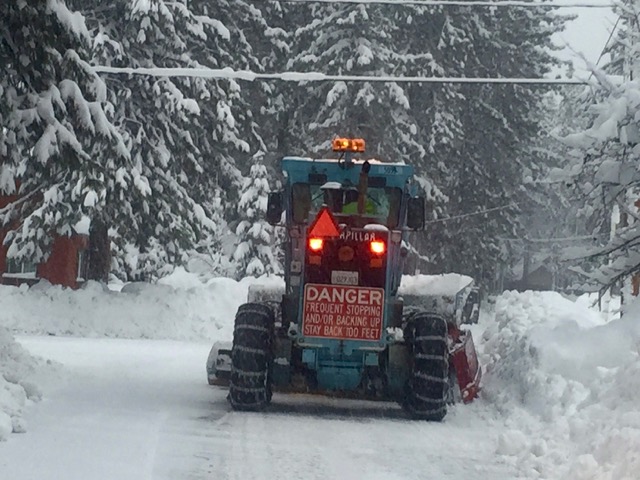
There is plenty of snow that still needs to be moved. Snowplows in the greater Lake Tahoe area continue to work to clear the white stuff.

All South Lake Tahoe streets have been plowed at least once. Snow removal crews will continue their 12-hour shifts with primary snow removal. It is estimated that the widening of streets and snow removal of bike paths will begin Saturday morning.

The city’s pool dome suffered damage during the storm which has resulted in the pool closure. The pool may open after the weekend.

A Go Fund Me account has been set for the Sokolov family of South Lake Tahoe. On Jan. 10 a tree fell on their home in the middle of the night, pinning Jamie Sokolov who was shielding her daughter, Alyssa, from the falling tree. The longtime locals both work in town. They were quoted $12,000 for the tree removal.

Thursday’s weather forced UNR to close down the campus.

Sporadic outages continue for Liberty Utilities customers. The West Shore continues to be out of power between Tahoe City and Fallen Leaf Road. Restoration work will continue by working in two directions. This is a very dynamic situation and this can change as large trees continue to fall. Customers in neighborhoods with heavy damage should prepare to be out for multiple days. The goal is to energize up to Tahoe Pines by midnight. 

The Rubicon Trail is open, but officials say, “Go prepared for weather and trail condition changes.”

Mount Rose Highway is open. 

Westbound Highway 88 at Picketts Junction is still closed, as is Highway 89 around Emerald Bay.

A plow clears snow Jan. 12 in the Bijou Pines area of South Lake Tahoe. Photo/Susan Wood

A plow clears snow Jan. 12 in the Bijou Pines area of South Lake Tahoe. Photo/Susan Wood

By Kathryn Reed

All the moisture from the fall and the start of this winter has dramatically improved the drought conditions in California and Nevada.

Even though 58 percent of California is still in a drought, only 2 percent is at the most critical stage. A year ago 98 percent of the state was in a drought. Most of El Dorado County is no longer considered in a drought, which includes the Lake Tahoe Basin. The same goes for Placer County.

Thirty-seven percent of Nevada remains in a drought. However, that does still include Douglas County. Even so, the conditions are tremendously better.

The storms have added 350 billion gallons of water to California’s biggest reservoirs. Lake Oroville, the state’s second-largest reservoir, is 35 feet higher than it was on Jan. 1. This makes it at 74 percent of capacity, which is 117 percent of average for this date.

Shasta Lake is 81 percent full. It is the largest reservoir in California.

State officials are not declaring the five-year drought over. It’s possible the spigot could be turned off. That’s happened in previous winters where there has been a deluge and then nothing.

Thirteenth Street in South Lake Tahoe is a snowy mess on Jan. 12. Photo/Susan Wood

Thirteenth Street in South Lake Tahoe is a snowy mess on Jan. 12. Photo/Susan Wood

However, for the immediate future more moisture is on the way to this region.

A winter storm warning remains in effect for the greater Lake Tahoe area through 10pm Thursday. Eight inches of snow are expected above 5,000 feet.

The sun is expected to come out Friday, though highs through the weekend will only be in the 30s.

Rivers and streams will continue to run high for the next couple of days. The drying trend should help them to recede to non-threatening levels.

Douglas County schools at the lake are open today, but only the main bus stops are being serviced. Lake Tahoe Community College begins its new quarter today.

Lake Tahoe Unified is closed in order to let city crews plow the streets. Tahoe Truckee Unified and Sierra Nevada College are also closed on Thursday. All schools in Incline Village are closed through Friday. El Dorado County workers in the basin have another day off.

Travel along local streets and state highways could be slow and dangerous. Chain requirements and closures could change at any time. For up to date information for highways, click on the state icons on the home page of Lake Tahoe News.

The avalanche danger remains considerable, according the Sierra Avalanche Center.

Ski resorts are digging out from the big dump. Check the resort’s website to make sure it is open before driving there.

A power outage is keeping Homewood Mountain Resort closed today. It has received 13 inches of snow in the last 24 hours.

Liberty Utilities and NV Energy crews have been working around the clock to try to restore power, with no estimated time when the remaining customers will have electricity.


Ski industry strives to curtail injuries

By Susan Wood

With Christmas snow conditions ripe, Heavenly Mountain Resort’s Chief Operating Officer Pete Sonntag tweeted he was about to drop into Killebrew Canyon and thanked his “ski patrol for keeping us safe.”

This January marks the 16th year of National Ski Safety Awareness, changed from a weeklong event to a month in 2013. And with the resorts bound to be packed for this coming three-day weekend, safety is a big concern with more people on the slopes.

Despite reports of accidents, incidents, a landmark Colorado court hearing and a slight rise in fatalities last ski season compared to the previous year, most stakeholders from the National Ski Areas Association and California Ski Industry Association to a Lake Tahoe ski area general manager and ski patroller believe the awareness campaigns are working.

There were 39 fatalities among U.S. ski areas last year, up by four from the 2014-15 season, according to the NSAA. This is out of 52.8 million ski days reported. Granted, the ski visits were at a slight decline from the previous year, but one needs to place the assessment into perspective.

That’s 0.74 fatalities per 1 million skier or snowboarder visits – near the decadelong average fatality rate of 0.67 deaths per 1 million riders visiting the hills.

Another perspective – the National Safety Council pointed out that in 2014 35,400 Americans died in motor vehicle accidents, 32,000 in unintentional falls and 42,000 from unintentional poisoning.

The NSAA also reported 45 catastrophic injuries in the 2015-16 season, a dip in the ski industry’s 10-year average. Catastrophic constitutes those involving forms of paralysis, broken necks, broken backs and life-altering head injuries.

“If you look at ski injuries broadly, it’s been declining for decades,” NSAA President Michael Berry told Lake Tahoe News. “Think of all the things we see that didn’t exist 25 years ago (that help the cause).”

Berry, who ran Kirkwood Mountain Resort for 13 years, listed the level of awareness, equipment and better grooming as contributing factors to a stunted growth of these types of serious incidents.

“Layer all those things, and we continue to see a decline in ski injuries,” he said.

For one thing, Berry cited an extraordinary number of signs on the mountains in the last decade. The ones indicating slow zones have popped up all over the slopes.

Berry suggested to those skiers or boarders who believe some riders are going too fast or get too close to perhaps consider this perspective.

“That skier flying by used to be me,” the 69-year-old ski executive said. “It generates some conflict. But when you say ‘I can’t believe he passed me that fast,’ consider that you were that person 20 years ago.”

Ski patrol as Sierra early this month train on chairlift evacuation techniques. Photo/Kathryn Reed

Ski patrol as Sierra early this month train on chairlift evacuation techniques. Photo/Kathryn Reed

It takes a level of courtesy, awareness and knowing your limits

Most of the time the mingling of people works out. But sometimes it doesn’t, resulting in impact on not only those who experience the injury, but to those who witness the incident.

Take Lake Tahoe skier Brenda Knox who witnessed a horrifying collision at Northstar last season. On Super Bowl Sunday she was coming down West Ridge from the summit of the backside when out of nowhere a skier acted like a linebacker by clobbering a snowboarder who was cruising into the slow zone.

The woman was between 15 to 20 feet in front of Knox doing her 10-foot turns when the man on skis who was straight lining down the hill sent her flying into the air. 

“He came from my left going really fast. As she turned, he ran into her, and she flew into the air. I saw her leg break. She was screaming. She kept screaming,” Knox said.

When the ski patrol arrived, Knox told them what happened and that she saw the woman’s leg snap.

“I told them they needed to treat her for shock,” she said. “It really shook me.”

She was forced to calm down in the Zephyr Lodge after witnessing such an incident.

“What he did was so wrong. It was a slow zone. Signs were up everywhere,” Knox told Lake Tahoe News.

Ski area stakeholders believe they can only do so much in making the slopes safer. They can’t make people be more courteous, despite what Squaw Valley-Alpine Meadows CEO Andy Wirth told Lake Tahoe News he would like to see in 2017.

“We do everything we can to make it safer. Still, there’s accountability with our guests. I’d like a reboot of people being more courteous,” Wirth said.

Granted, gravity goes with the sport of skiing.

“Gravity and the thrill of skiing is part of the general passion, but you have to have balance between what gravity does for us and safety,” Wirth said. “I’m of the very firm belief that our sport is safe, if not safer than most sports.”

Wirth pointed to training — which is “extensive and exhausting,” technical advancements and the focus on maintenance of equipment that have contributed to better safety.

And by all means, the awareness helps. At its core, all ski areas operate on the seven-point mantra of having riders live by the “responsibility code,” – which is posted in many places.

Ski patrollers at Sierra work to slow down skiers/snowboarders who go too fast. Photo/Provided

Ski patrollers at Sierra work to slow down skiers/snowboarders who go too fast. Photo/Provided

Knowing the code helps:

  • Always stay in control, and be able to stop or avoid other people or objects.
  • People ahead of you have the right of way. It is your responsibility to avoid them.
  • You must not stop where you obstruct a trail or are not visible from above.
  • Whenever starting downhill or merging into a trail, look uphill and yield to others.
  • Always use devices to help prevent runaway equipment.
  • Observe all posted signs and warnings. Keep off closed trails and out of closed areas.
  • Prior to using any lift, you must have the knowledge and ability to load, ride and unload safely.

Heavenly and Kirkwood spokesman Coop Cooper joined Northstar in declining input for this story, citing “our company’s corporate media policy,” but he didn’t indicate what the policy of parent company Vail Resorts is.

At Sierra-at-Tahoe on the South Shore, ski patroller Shannon Maguire notes the ski area goes a little further than the safety message.

Sierra takes its recruits for ski patrol and has them work as trail crew manning the slow zones.

“That program has grown since I’ve been here. More people are working the slow zones to have more eyes and ears on the hill,” Maguire said.

For patrollers, it’s just part of their training.

In the decade Maguire has been with Sierra, there are also more markers indicating mergers, high traffic areas and blind spots.

The ski resort has even expanded enhanced safety education to its racers – knowing they ski at ability levels that are quite different from beginners on the hill.

Tools of the trade when someone is injured on the slopes. Photo/LTN

Tools of the trade when someone is injured on the slopes. Photo/LTN

Education before punishment

Although there are no hard numbers on passes revoked locally or nationally for the season, Maguire indicated that’s done as a last resort.

She noted the resort has the option of stripping away a pass for a few weeks.

“Sometimes the situation is more severe demanding stronger repercussions. But our goal is to educate them rather than go that route,” she said of pass revocation.

And rarely do the consequences rise to the level of that of what Casey Ferguson endured. The Keystone (Colo.) Resort snowboarder was ordered to pay more than $260,000 in damages from a collision that separated the shoulder of Chicago resident Tom Dubert. He was charged with reckless skiing, a rarity in the courts because many cases are settled between attorneys and insurance companies. In this case, Ferguson’s parent’s homeowners’ insurance policy covered the damages.

This all comes with the territory for California Ski Industry Association President Michael Reitzell, who’s also a personal injury attorney.

The legal cases are few and far between, despite the accidents being dramatic. The outcomes may also be determined by the state they’re made in.

“Colorado is different when it comes to litigation. It’s thought of as a skier-friendly state, a place to go to ski,” he said. This means skiing, and therefore being safe skiing, is part of the image of Colorado.

“No doubt we’re gonna see increased efforts through the years and see less tolerance for less courtesy,” Reitzell told Lake Tahoe News. “Snowboarder, skier — whatever the equipment, if you choose to not be courteous, you’re an increased hazard on the hill and an increased risk to people around you.”

Reitzell also admitted a ski area can only do so much to reduce the risk – especially since the number of skier visits grew from 4.6 million in 2014-15 to 7.2 million the following year. The average of the six-year period is 6.5 million.

The association is beefing up its safety measures for the state including coming out with a generic ski safety map that highlights what to do at certain hazard zones at any given ski resort. For example, it would warn skiers and boarders to watch out for the hazards of tree wells.

“Our goal is 100 percent injury free,” Reitzell said.