Snippets about Lake Tahoe

·       Robert Leftwich will be sworn in as Truckee’s police chief on Jan. 24 at 4:30pm at the airport.

·       The preferred alternative for the Kings Beach recreation area will be presented at a Jan. 18 6-8pm meeting at North Tahoe Event Center.

·      Kings Beach Snowfest Parade will be March 11, 11:30am-12:30pm in downtown Kings Beach.

·       Melissa Caron, president of A.M. Smith Electric Inc., has been named president of the board of directors for Nevada Builders Alliance.

·      Smart & Final’s grand opening in South Lake Tahoe is Jan. 18 starting at 7am.


‘July & Winter’ simplifies gardening in Tahoe

By Kathryn Reed

Stop making excuses for not growing produce in Lake Tahoe. There is finally a book that seems to answer every question imaginable.

“July & Winter: Growing Food in the Sierra” is Gary Romano’s tell-all book about gardening at higher elevations. The book came out last year; published by Meyers-based Bona Fide Books.

JulyWinterGarden_CVR_FNow is the time to start reading this book if you intend to be digging in the soil later this year. For one, it’s not a quick read because it is really a reference book. It’s nothing like Romano’s book “Why I Farm” that came out in 2013.  That was more of a memoir. “July & Winter” is a how-to book.

It’s not just for those in Tahoe, though. The wealth of information is pertinent to anyone living at higher elevation – this includes the foothills.

“In any attempt to farm or garden in the Sierra, the consideration of extending your season is a must. Because of our short season, from 30 to 80 days at elevations above 4,000 feet, trying to grow any crops other than cool-season crops from June through September is difficult without some kind of season extension structure such as cold frames, hoop houses, or green houses,” Romano writes.

While Romano is a farmer, he is speaking to the masses in this latest book. It’s for the average person who wants to grow their own produce. Romano doesn’t glamorize the process. In fact, in some ways I felt exhausted at times reading the book. He made me realize why my feeble attempts at growing vegetables at 6,200 feet have not been all that successful. At the same time he has taught me how to change the outcome.

So many pages are dog-eared and passages underlined. I don’t usually like to deface a book, but at the same time I think reference books should be written in. One day my own notes about how things worked will fill the margins.

To me, this is one of those books that is better in print than electronic form because you might want it in the backyard as you construct the hoop house, or in the garage as you assemble parts. An index makes it easy to tap into a specific topic.

Romano doesn’t hold back in his opinion about how to do things and what to use (never use Round Up), but he is also humble as he shares what has gone wrong for him.

It’s not just what to plant and how to do it. Topics include dealing with wildlife, fruit trees, soil, water management and more.

—–

Notes:

·      “July & Winter” is available online for $19.95. 


DCSD won’t pay for KMS environmental documents

While Douglas County School District trustees and administration are eager to sell Kingsbury Middle School, officials don’t want to make further financial commitments to make that happen.

At this week’s board meeting the electeds voted not to allocate any money for environmental documents related to the site. The board’s belief is that the environmental impact statement for the Stateline parcel is the buyer’s responsibility.

“We are eager to sell it, but if different zoning were to change the value of the property, we cannot support paying for the work only to have the buyer reap the benefit,” Superintendent Teri White told Lake Tahoe News.

Patrick Taylor in July entered into an agreement with the district to purchase the 22-plus acre sitewith 36,000-square-feet of space for $3.25 million, which included paying half the utilities — $25,000 – for a year.

He has been given extensions on the due diligence deadline by the district because of issues related to zoning per Tahoe Regional Planning Agency. The current deadline is in April.

— Lake Tahoe News staff report


Accidents, bad road conditions in Douglas County

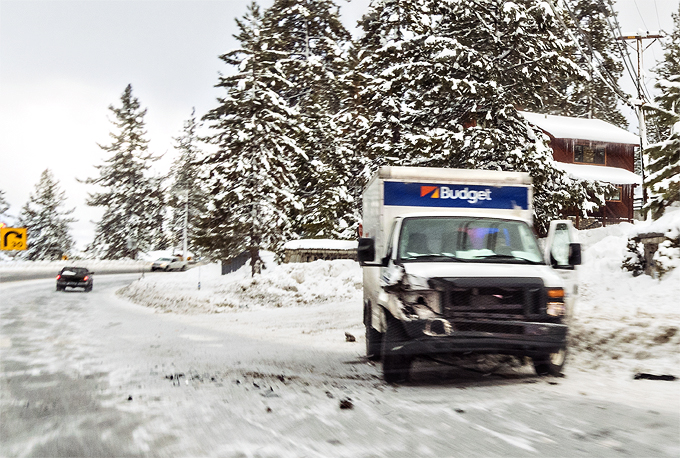
Multiple vehicles crashed Jan. 13 on slick roads on Highway 50. Photo/LTN

Multiple vehicles crashed Jan. 13 on slick roads on Highway 50. Photo/LTN

Highway 50 is closed between Round Hill and Glenbrook because of three accidents.

Two of them are property damage, the third involves an injury that is not life threatening.

“Because of the temperatures it’s freezing all of the water over to ice,” Nevada Highway Patrol Trooper Dan Gordon told Lake Tahoe News.

He did not have an estimate of when the road would be open. The accident occurred about 9:30am Jan. 13.

With two months of extreme freeze-thaw cycles with above average moisture in Douglas County, many of the roads such as Jacks Valley and Waterloo Lane have experienced an increase in potholes.  The recent flooding has caused shoulder erosion on areas of Genoa Lane, Mottsville Lane, and Centerville Lane. 

Flood cleanup and repair, and snow removal have been the main focus for our road crews this week.  Pothole repair will start as soon as possible on all county roads depending on several factors including severity, weather and work load priority.

— Lake Tahoe News staff report


Truckee’s Bennett 10th in alpine combined

By USSA

WENGEN, Switzerland – Friday’s Audi FIS Ski Word Cup alpine combined produced a surprise podium, and another top 10 World Cup result for Bryce Bennett (Squaw Valley).

With upward of 6 inches of new snow overnight, officials swapped the downhill and slalom events, running the slalom first and the downhill – which was moved to a lower start position – to later in the afternoon.

“Usually downhill (first) I’m more comfortable with. And then you can do the downhill and see where you stand and then go into the slalom,” said Bennett, who finished 10th in the morning slalom. “But with the slalom first, you definitely have to perform to get a better position for the downhill. It’s a little bit more pressure to perform in slalom.”

And Friday proved to be more about luck than position as Switzerland’s Niels Hintermann came out of the 51st start position to win his career-first World Cup event in only his 12th start on the World Cup circuit. And the surprises didn’t stop with Hintermann. France’s Maxence Muzaton scored a career-first World Cup podium in second, as did Austria’s Frederic Berthold, who finished third. In fact, all three had never posted a top 10 World Cup result in their young careers. Of the three, Muzaton had the previous highest placing World Cup result – 11th in the downhill at Kitzbuehel in 2015.

How did all this craziness unfold? It started with the new snow overnight and a rock-solid slalom track, followed by more snow.

“It snowed about 20cm this morning, so I went to go do some warm up runs – I haven’t skied slalom in a while – so there was a lot of soft snow so you couldn’t really get a good feel,” said Bennett, who matched his bib in the slalom, finishing 18th. “Then I got into slalom there in the first three gates and I was like ‘oh, OK, this is World Cup slalom, wake up.’”

Meanwhile, Hintermann was 23rd in the slalom and started eighth in the downhill. After moving atop the leaderboard, snow started falling again, which significantly slowed the track for the remaining starters, including Bennett.

“It was definitely challenging conditions,” Bennet said of his downhill run as heavy snow fell. “It started snowing pretty hard after about 10 guys and it definitely made the race interesting.”


Bill Mosher — 1953-2017

Bill Mosher

Bill Mosher

Bill Mosher, a descendent of several prominent South Lake Tahoe pioneer families, has died. He was 64.

William Merwin Mosher IV passed away Jan. 6, 2017, after a lifelong battle with rheumatoid arthritis.

He was born Jan. 2, 1953 in Sacramento to Melba and William G. Mosher Sr.

Mr. Mosher was a fourth generation cattleman in South Lake Tahoe and Sloughhouse. He ran cattle from the Barton Ranch to their summer range on family property in South Lake Tahoe.

He was owner/operator of the WM Cattle Co. With his easy going personality he had the same cattle crew for many years.

While serving as president of the Amador El Dorado Sacramento County Cattlemen’s Association he organized the Cattlemen’s Jackpot Show, which he continued for more than 30 years.

He also served on the Sloughhouse RCD Board and the last several years as chairman. He hosted many events including the Sheriff’s Ride and Elk Grove’s Project Ride at the Barton Ranch. He spent many years helping with Elk Grove’s Western Festival Days.

Mr. Mosher was a 45-year member of Elk Grove Parlor No. 41 Native Sons of the Golden West.

He had a love for agriculture, was an avid reader and loved his family. During his childhood Mr. Mosher went on many trips and visited many countries with his grandparents.

Mr. Mosher was a graduate of Elk Grove High School and Cal Poly, San Luis Obispo.

He was preceded in death by father William G. Mosher Sr., grandparents Lester and Fay Ledbetter, grandparents William and Rosalyn Mosher, great-aunt Alva Barton, uncle William Ledbetter and aunt Madelyn Valensin.

He is survived by wife Kay of 39 years; daughter Melanie Mosher Baiz (Sean) and grandchildren Madelyn and William; his mother Melba Mosher; sisters Faye Krull (Robert) and Ouida Garms (Herb); and many nieces, nephews and cousins.

A funeral Mass will be said at St. Vincent de Paul, 14673 Cantova Way, Rancho Murieta on Jan. 14 at 10am.

Donations may be made to Project Ride, 8840 Southside Ave., Elk Grove, CA 95624.


Calif. leads charge to combat climate change

By Susan Wood

STATELINE – Everybody talks about the weather. And few can accurately analyze it – especially when we speak of the climate, which is technically the statistics of weather.

But that’s just what many tried to do Thursday morning at Harveys as Operation Sierra Storm wrapped up amid an unprecedented series of storms that knocked out power, closed roads and buried residents with water and snow.
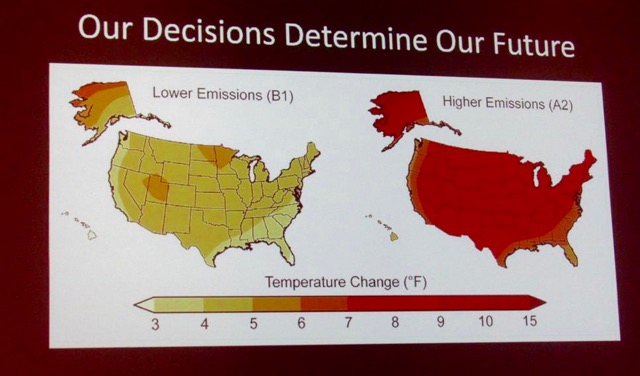
Making the case for the reality of climate change. Photo/Denise Haerr

Making the case for the reality of climate change. Photo/Denise Haerr

The annual climate conference brought out more than 30 stakeholders and weather enthusiasts to hear preeminent climate expert Richard Somerville of the Scripps Institution of Oceanography and California state Senate President Pro-tem Kevin de Leon.

For the first time, the Weather Channel sent three crews to cover the events – which seemed to take place both inside and out.

“Why is an El Nino happening in a non-El Nino year?” meteorologist and Weather Channel anchor Jim Cantore posed the question to Lake Tahoe News after the conference. The question could have been on the minds of everyone in the room after Mother Nature dumped a deluge of floodwaters and multiple feet of snow on the Sierra Nevada region.

Climatologists have long warned that climate change would be most noticeable with extreme weather events.

And despite a new Congress and administration filled with climate change deniers taking residence in Washington, D.C., this month, those on the frontline in forging the science to monitor man’s fossil-fuel impacts on the natural world see the lights at the end of the tunnel.

Sen. De Leon assured the attentive crowd that his state government would do everything in its power to hold back the weight of a changing federal government that has positioned human-caused climate change as a hoax at the very top spot in elected office.

“California is not waiting for Congress to pull its head out of the desert sand,” de Leon said, while reminding those in attendance that the state alone represents the sixth largest economy in the world.

This economy is discovering the financial benefits of converting dirty energy into clean, renewable technology. He even made the case that clean energy is becoming more cost efficient, as well as one that protects the livelihoods of current and future generations.
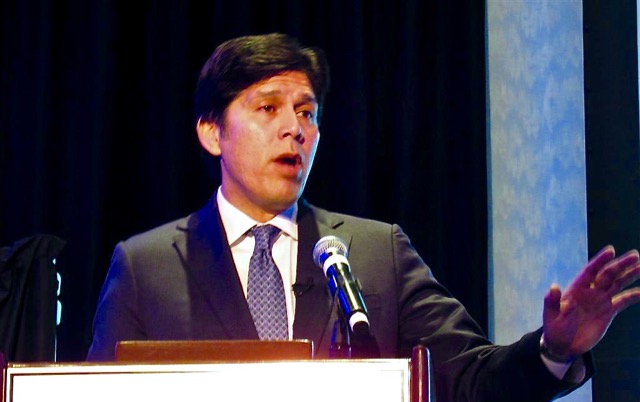
California Senate President Kevin de Leon won't let the feds change state policy. Photo/Denise Haerr

California Senate President Kevin de Leon won’t let the feds change state policy. Photo/Denise Haerr

“Clean energy is already out competing dirty energy on prices – even without subsidies,” he said. “With (President-elect Donald) Trump, there’s nothing he can do to make the case for coal.”

At one point, de Leon theorized that the reason why coal miners fight to hold onto the method of resource extraction is because it’s part of their culture – a way of life that past generations have come to rely on to put food on the table.

Further, he made it clear that he understands the pain of losing one’s way of life, an overwhelming abyss that may lead to divorce, loss of home, children and job and even suicide in some cases. 

So de Leon advocated using a simpler way of talking about global climate, minus the massive statistics, to have a reasonable discussion with those who doubt the science.

He also urged believers to involve the human factor in the discussion.

“Climate change is not about polar bears. It’s about people,” he said. “A majority of Americans don’t understand the risk (of not acting).”

In California, the senator’s goal of building a new, low-carbon economy hit a major milestone with Senate Bill 350, which essentially dictates that half the electricity in the state will be generated through renewable energy by 2030.

“That’s a big step,” he said.

California has always been on the forefront of emissions control compared to other states. But with a perceived threat from a new federal government, de Leon pledged the state would not only refuse to halt efforts, but would “double down” on its initiatives to change the tide of looming global danger.

“We’re not going to let one election change our values. Our biggest threat to our state is our (federal) head of state,” he said.

So how do we double down?

When asked by Lake Tahoe News if California should build its own wall becoming isolationist or reach out in a consortium of other states, de Leon replied that efforts are already under way for the latter.

“We’re reaching out to other like-minded states to reach agreements in MOUs,” the keynote speaker said, listing Oregon, Washington, Nevada, Illinois and the cluster of New England states as kin to the cause.

The first Latino leader of the state Senate also revealed that state representatives have met with federal authorities in Mexico to pool their resources and support each other’s causes.

“In Mexico, climate change is not controversial. It’s not left wing or right wing,” he said.

Mexico’s empathy to California’s plight was a crucial point in the underlying theory mentioned through the morning that climate change denying is rooted in politics, not science.
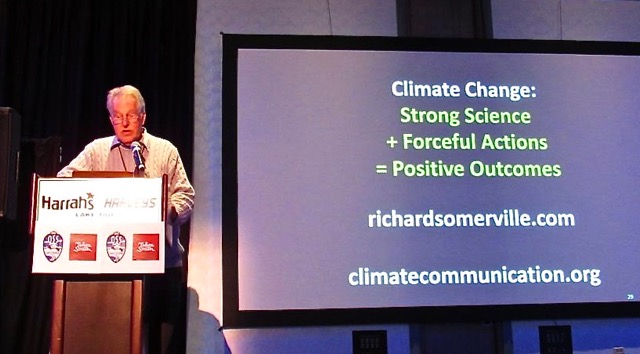
Scientist Richard Somerville speaks Jan. 12 in Stateline about climate change. Photo/Denise Haerr

Scientist Richard Somerville speaks Jan. 12 in Stateline about climate change. Photo/Denise Haerr

Climate change – right or wrong?

Scientists like Somerville are in good company in California.

In a stern rallying cry, Gov. Jerry Brown pleaded with thousands of scientists last month at one of the largest international gatherings of its kind to mobilize for the climate fight.

“The time has never been more urgent or your work never more important,” he said, promising the “truth-tellers” that the state and its main cause will persevere. “We will pursue a path of collaboration and bold political advancement – whatever they do in Washington – and eventually the truth will prevail.”

To climate experts like Somerville, the evidence is overwhelming as he placed image upon image of revealing data on a screen that supports the notion that the climate is changing and humans are the main cause.

“CO2 levels are rising conclusively. Each new decade is getting warmer,” he told the hushed audience. “This isn’t a string of evidence. This is a thick rope of evidence.”

At one point, he turned to the evidence going on outside as an extreme weather event supporting his claim.

Somerville broke his explanation down to sport.

“Carbon dioxide is the steroids of our climate system,” he said.

The analogy is: Do we ask ‘do the steroids of the (baseball) slugger cause the home run?’ Or, ‘does it increase the odds?’

“There’s no silver bullet that solves this problem. It’s silver buckshot,” Somerville said, mentioning more use of solar power and reducing our dependency on resource extraction energy methods as things to do.

“We have to change the lack of political will to act,” he said.

Somerville turned to France – the world’s largest producer of electricity — as an example of a nation that has turned around its method of operation in energy use. In just a quarter century, it’s now dominated by nuclear power.

“Those who claim we can’t change from fossil fuels are just wrong. It’s been proven. France did it,” he said.

The prospect of the silver buckshot has a slight silver lining – but much work in store.

Somerville noted he’s encouraged by the majority of Americans accepting the science of climate change.

“However, when the entire Republican leadership doesn’t accept the science, then we have a long way to go,” he said.

The scientist proposed that even if Trump doesn’t believe the science, he may cave to averting becoming “a laughing stock” in front of other world leaders who overwhelming have supported the global climate action plans as recently as the Paris Agreement signed last November, days before the election.

Somerville believes the truth-tellers should make an economic argument since the climate change deniers use that as a way to spur inaction.

During the question-and-answer session, attendees even asked for tips to convince climate change deniers to see the science differently.

“What’s worked for you?” longtime environmentalist Karen Fink asked Somerville.

He suggested more empathy and open minds to have a meaningful discussion.

“People tend to trust people who share their values. You could say: ‘Let’s (at least) agree on this,’” he said.

Somerville uses a cute analogy of the “Uncle Pete” in the room, the naysayer that ruins the family dinner with his refusal to refute climate myths. Uncle Pete is the inspiration for developing a website www.skepticalscience.com to combat closed-mindedness.

“We found the enemy. And the enemy is us,” he said.


Opinion: The coming public pension apocalypse

By Ed Ring, California Policy Center

When the next market downturn hits, every public employee pension fund in the United States will face severe challenges. Because public employee pension funds are not subject to the same rules that private pension funds have to adhere to – namely, the restrictions on risky investments as specified in the federal Employee Retirement Income Security Act of 1974 – they will be hit much harder in a downturn than private pension funds. Some states will face more significant challenges than others. California is destined to be one of the hardest hit.

This discussion of California’s coming public pension apocalypse has three sections. Part one will make the case, yet again, that public employee pension funds cannot possibly hope to earn the rates of return over the next 20 years that they earned over the past 20 years. Part two will show the precise impact that lower rates of return will have on the unfunded liability, the normal contribution, and the unfunded contribution – using projections that show all of California’s state and local public employee pension funds in a consolidated report. Those who are already convinced that pension funds are headed for trouble are encouraged to skip immediately to part two, to see exactly how many hundreds of billions we’re talking about.

Read the whole story


Snippets about Lake Tahoe

·      In 2016, TAMBA had 93 volunteer days on 17 trails, with 327 volunteers, and logged 5,212 hours of trail work.

·      Jeff Loux will be the head of Truckee’s Community Development Department starting Feb. 6.

·      Late-Nite Productions is presenting free concerts every Saturday night throughout the winter at Whiskey Disks in South Lake Tahoe. Doors open at 9pm. Must be 21 or older.

·      The final environmental document for the proposed roundabout at highways 50 and 89 in Meyers has been released. It is available online. 

·       TOCCATA’s Incline Village performance was postponed again. It is now set for Jan. 15 at 3:30pm at St. Patrick’s.


Falling tree kills Tahoe City driver near Squaw

The first fatality of the wicked storms that have thrashed the Lake Tahoe area occurred Thursday night.

A 43-year-old Tahoe City woman was killed when a tree fell onto the Subaru she was driving. She was headed south on Highway 89 near Squaw Valley at about 6:30pm Jan. 12. No one else was in the vehicle.

The tree struck two vehicles; the first was a Cadillac Escalade — no one was injured, the second was the Subaru.

Not long after the first tree fell another one tumbled onto a Tesla. The driver was standing outside the vehicle and was not hurt.

All the vehicles were headed south, and were just north of Squaw, in traffic that was crawling.

The highway between Squaw and Truckee reopened about 8:50pm. “We need to make sure the hill is stable,” CHP Officer Peter Mann told Lake Tahoe News.

This was the third tree to fall in this area in 36 hours. The one on Wednesday was about 100-feet tall and closed the roadway for about an hour.

— Lake Tahoe News staff report