Ski resorts trying to educate guests about laws

A group of North Lake Tahoe area resorts in collaboration with the Placer County Sheriff’s Office have created a campaign to educate skiers and snowboarders about the importance of making smart choices and avoiding behavior that is against the law.

The goal of Be Mountain Wise is to inform those who are unaware of the potential consequences of ignoring resort boundary lines and closed areas, or sharing lift tickets or a season pass.

“Most people simply aren’t aware that sharing lift ticket or season pass products is considered theft of
services, and that skiing or snowboarding in closed areas or beyond boundary lines is also illegal,” 
Dave Hunt, Placer County detective sergeant, said in a statement. “Both actions are misdemeanor
offenses. While there are legal consequences that can be enforced, our goal is to work with the resorts
to educate the public about these issues in a way that will encourage people to make smart choices.”

Both lift ticket/season pass fraud and guests skiing in closed areas are long-time issues throughout the
ski industry.

Participating resorts are Homewood Mountain Resort, Squaw Valley, Alpine Meadows and Sugar Bowl.


K’s Kitchen: Toasted quinoa soup

By Kathryn Reed

One of the nice things about living where there is a long winter is the opportunity to have soup over and over again. While I have my go-to recipes, there are times when I want something new.

Being a vegetarian I often don’t have protein in my soup except for beans. This was a first for me to have quinoa and soup together. It was great.

The quinoa would be a welcome addition to whatever your normal vegetable soup is. It could also be a substitute for whatever protein you usually use.

quinoa-soupToasted Quinoa Soup

1 C uncooked quinoa

2 T olive oil

½ C red onion, diced

1 large carrot, diced

1 red pepper, diced

8 cloves garlic, minced

1½ T fresh rosemary, minced

1 tsp ground cumin

8 C vegetable broth

1 medium potato, cubed

1 parsnip, chopped

1 medium zucchini, diced

8 Brussels sprouts, cut in half

½ C flat leaf parsley, chopped

Kosher salt

Preheat oven to 325 degrees.

Spread quinoa in a thin layer on a rimmed baking sheet; bake at 325 degrees until browned, about 30 minutes. Stir every 10 minutes.

Heat a large stockpot over medium. Add oil. Add onion, carrot, bell pepper, and garlic; cover and cook until vegetables are tender, stirring occasionally.

Uncover and stir in rosemary and cumin; cook 1 minute.

Stir in stock, potatoes, parsnip, and toasted quinoa. Bring mixture to a boil, then cover and reduce heat to medium. Cook 12 minutes.

Stir in zucchini and Brussels sprouts; cook until vegetables and quinoa are tender.

Stir in parsley and salt. Adjust seasonings as needed.


Hal Cole Sr. — 1922-2017

Hal Cole Sr.

Hal Cole Sr.

Even though Hal Cole Sr. brought in the New Year dancing with family and friends, he died of a short illness two weeks later. He was 94.

Harold Cole Sr. died Jan. 14, 2017, in Reno.

Mr. Cole was born in St. Louis, Mo., on July 24, 1922.

He overcame a rough start in life to become decorated for his service in the Navy during World War II and then ran his own electronics firm.

Mr. Cole was orphaned at age 5 when his mother died. He was shuffled between orphanages and an aunt.

He enlisted in the Navy at 17, where he served aboard the USS Nashville in the Pacific during World War II. He was a radioman, which was where he learned the trade that would shape his future. He was in the Battle of Guadalcanal, escorted Jimmy Doolittle in his raid on Japan, was with Gen. Douglas MacArthur for his return to the Philippines in 1944, and was hit by a kamikaze in December of that year that killed 133 of his fellow sailors. He received two battle stars.

Mr. Cole also played drums in a band aboard the Nashville. Between battles they would perform aboard various ships in the Pacific. He continued playing the drums throughout his life, favoring Dixieland and jazz music.

Mr. Cole’s love of music ultimately resulted in meeting his future wife. Carmen Rushing was playing the piano at a USO. They were married in Reno in 1948.

With their two sons, the family of four enjoyed many jam sessions at home.

After his stint in the Navy, Mr. Cole attended UC Berkeley, graduating in 1954.

Many summers were spent in Sciots Camp just west of Strawberry Lodge at the cabin Mr. Cole’s father-in-law had built in the early 1920s. Trips to Tahoe for groceries and beachcombing instilled a desire to relocate there. 

During the 1950s Mr. Cole worked for Shell Development as an electronics technician in the research department. It was there he used his skills and knowledge of radios, which later expanded into television. On one trip to Lake Tahoe he found a TV shop on Ski Run Boulevard for sale. It included the rock house at the corner of Aspen Boulevard, a building next door, a television shop with all the inventory, a Volvo station wagon and a malamute husky. All for $38,000. 

With the help of an aunt, Mr. Cole mustered up enough money for the down payment and opened up Cole Electronics in 1960. He operated the business through 1972. He then bought and operated Alpine Security, a local burglar alarm company, until he retired in 1998. 

While living in South Lake Tahoe, Mr. Cole was an active member of the Senior Center. He even served as president.

He was the drummer in the local Dixieland band The Tahoe Toads, which would often perform at the Senior Center.

Mr. Cole was the ski reporter for the Tahoe Daily Tribune. He also had a weekly column for much of the early 1960s.

He would transport the local high school ski racers to many events.

He also was an avid photographer and had his own darkroom.

After his wife died in 2000, Mr. Cole met Ruth Eachus at the Senior Center. She became his partner and loving companion. They lived in Reno until his death.  

He was preceded in death by his wife, Carmen Cole, and daughter Rhonda Cole.

Mr. Cole is survived by sons Hal Cole Jr. and Robert Cole, both of South Lake Tahoe; grandchildren Clayton Cole, Casey Cole, Melody Cole and Robert A. Cole; and companion Ruth Eachus.

The family will get together at an undetermined date to celebrate his life.


CDC reports Nevada’s first ‘nightmare bacteria’

By Marcella Corona, Reno Gazette-Journal

Public health officials reported a Reno woman who died last year from an incurable superbug – a problem that is spreading in the U.S.

The drug-resistant bacteria made its way overseas and was the first superbug case to be reported in Nevada, the Center for Disease Control said in a report last week.

The bug was resistant to 26 different antibiotics, according to the Morbidity and Mortality Weekly Report.

Read the whole story


Betting public beats books again in NFL playoffs

By Todd Dewey, Las Vegas Review-Journal

So much for the anticipated Super Bowl showdown between America’s Team and the team America loves to hate.

A potential Cowboys-Patriots matchup — which would’ve likely produced a record wagering handle in Nevada — was erased when the Packers outlasted Dallas in a 34-31 thriller Sunday that was the first upset of this year’s NFL playoffs.

The Packers, who paid plus-180 on the money line, were the first road team to cover this postseason after home favorites won and covered the first six games.

The Steelers, 2-point ’dogs, followed with a minor upset in a 18-16 win over the Chiefs on Sunday night, as Chris Boswell kicked a playoff-record six field goals.

The upsets didn’t prevent the betting public from enjoying another winning NFL weekend after it cashed in Saturday on the Falcons and over and the Patriots and over.

Read the whole story


Details of Maloff center at Barton subject of talk

Chris Proctor of Barton Health on Jan. 25 will talk about how the Robert Maloff Center of Excellence is changing the face of healthcare locally by moving from a reactive healthcare model based on treating illness/injury, to a proactive model using prevention and education.

The Robert Maloff Center of Excellence will house orthopedics, rehabilitation, sports performance and wellness programs designed to address all stages in the care continuum, enhancing health and wellness within our community.

It is expected to open in the fall.

The free talk starts at 6pm in the board room at Lake Tahoe Community College.


Tahoe Tails — Adoptable Pets in South Lake Tahoe

Conrado

Conrado

Conrado is a cute 5-year-old Pomeranian mixed with Chihuahua or maybe Papillon — who knows! He was brought to Tahoe by a rescue group along with several other nice dogs to find their forever homes.

Conrado is sweet and gentle, loves to wag his tail, and likes other dogs. He has beautiful long white and tan hair, and has a great personality.

Conrado is neutered, microchipped, tested for heartworm, and vaccinated. He is at the El Dorado County Animal Services shelter in Meyers, along with many other dogs and cats who are waiting for their new homes. Go to the Tahoe animal shelter’s Facebook page to see photos and descriptions of all pets at the shelter.

Call 530.573.7925 for directions, hours, and other information on adopting a pet.

For spay-neuter assistance for South Tahoe residents, go online.

— Karen Kuentz


Unlikely basketball star recalls her glory days

By Linda Fine Conaboy

Maybe some of you know South Lake Tahoe resident Maureen Stuhlman who is employed as the city’s vacation home investigator. Maybe not.

Perhaps a few readers know about Immaculata University in Malvern, Pa., just outside of Philly.

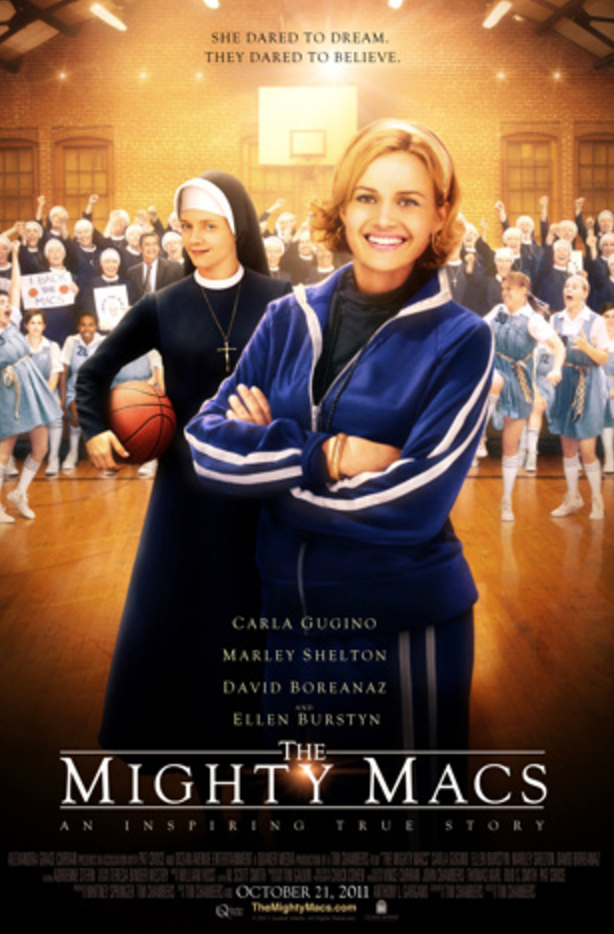
There is even a chance that some have seen the movie “The Mighty Mac,” released in 2011.

Stuhlman is the linchpin holding this unlikely triumvirate together.

As it turns out, both Stuhlman and Immaculata have stories to tell. Stuhlman’s, starting in the early 1970s when Immaculata was not more than 60-years-old, and she, a mere fun-loving lass in her teens living in Havertown, Pa., taking advantage of a special pre-college scholarship program offered by nearby Immaculata, a private Roman Catholic university founded in 1920 by the Sisters of the Immaculate Heart of Mary as an all-girls school. (In 2005 it became co-educational.)

The athletic teams at Immaculata University are known as the Mighty Macs.

When Stuhlman and her friends entered the college as freshmen, on a lark, they decided to join the basketball team. As she told Lake Tahoe News, it looked like a fun thing to do, although their knowledge of the game was limited. “Anyone who wanted to play just showed up,” she said. “And it was a pleasant way to spend an afternoon.”
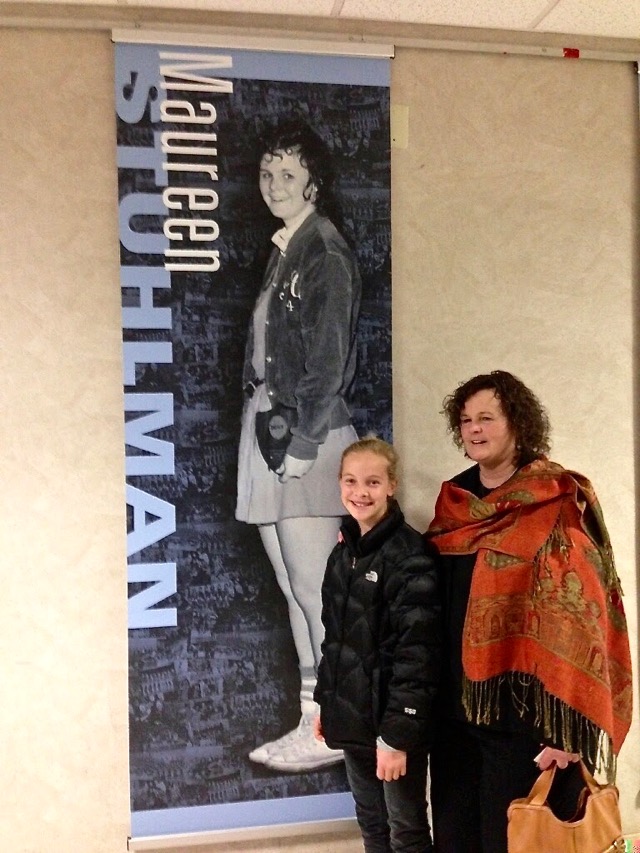
Maureen Stuhlman has passed the basketball bug onto her niece. Photo/Provided

Maureen Stuhlman has passed the basketball bug onto her niece. Photo/Provided

Nevertheless, lark or not, lack of skill on the part of her team didn’t deter Cathy Rush, the new girls’ basketball coach. She had a job to do. She was hired in the late 1960s at a salary of $450 a month with the mandate to mold a basketball team … and while she was at it, to build a gym since the old fieldhouse had burned down.

Stuhlman mused that in the early 1970s there were no sports scholarships for girls and there most definitely was no Title IX protection for women in sports. Title IX requires that all college students receive the same opportunity to play college sports under any education program or activity receiving federal financial assistance.

This was soon to become a significant factor to the fledgling team, who unbelievably began to win games. Not only did they win games, they also won tournaments, only to discover they would have to raise their own funds to attend the tournaments that were the spoils of their winning streak.

Stuhlman, who played forward, said her parents were troopers, ferrying she and as many teammates as they could fit into to the family station wagon to the games.

 “We didn’t know there were such things as tournaments. To us, basketball was totally a social thing,” Stuhlman said.

But win tournaments they did; these Mighty Macs, garbed in their wool tunics draped over the pleated skirts that served as their uniforms. These same Mighty Macs soon found themselves going door-to-door or accosting their friends and loved ones in an attempt to sell toothbrushes to fund their airfare to get to the national tournament at the University of Illinois in Normal.

“We did happen to win all of our games in one season,” she said. “We went to the regionals where they brought out their second string and we trounced them. When we returned to the regionals, they played their first string, and they trounced us.”

Feeling dejected by their defeat, upon their return to school the girls prepared to beat a hasty and silent retreat to their rooms. But their classmates as well as their teachers had other ideas. “The entire school gathered in the rotunda to greet us—we were all in tears.”

Although they came in second, they were invited to play in the National Championships. Surprisingly, they hammered the team that had just slaughtered them, although, according to Stuhlman, only one of the team members was a naturally good athlete.
screen-shot-2017-01-04-at-1-52-30-pmThe flight to Illinois was probably the first flight that many of the girls had taken. “It was such a lark for us. We had two hotel rooms, four to a room. We played four games in three days,” she said.

Stuhlman recalls the wins as much more than just wins. “We grew a lot and we learned we could do what we set our minds to do. We had confidence in each other; it was a team effort. At the time, it was new for women to train; [basketball] was considered a pastime. But these were formative years, they taught us what it meant to be a part of a team—we had formative experiences that still serve me today.”

As Stuhlman reminisced about the Mighty Macs, she recounted the achievements of her team: Of the starting five players, one, Theresa Shank Grentz, went on to become the first women’s basketball coach at Rutgers as well as a coach for the women’s Olympic basketball team.

Cathy Rush, the Macs coach from 1972 to 1977, led the school to three consecutive  AIAW national titles from 1972-74 and was inducted into the Basketball Hall of Fame in 2008. She had also been inducted to the Women’s Basketball Hall of Fame in 2000 and the Philadelphia Sports Hall of Fame in 2005.

Another Maureen (there were three on the team), coached women’s basketball at Pennsylvania State University and was an Olympic coach. Her married name is Rene Courtland; she is now retired.

“And then our entire team was inducted into the Basketball Hall of Fame in 2014—this was such an honor,” Stuhlman said. At the ceremony, Stuhlman recalled, the team had the opportunity to rub elbows with the likes of basketball greats Larry Johnson and Meadowlark Lemon.

To their amazement, 40 years later, “The Mighty Macs”, a movie about the season leading to the winning of the first women’s national basketball championship in 1972, was released. And just to prove that camaraderie is not fleeting, the entire team attended the movie’s premier en masse, which was at the Kimmel Center in Philadelphia.

According to the movie trailer, the film is about Cathy Rush, a woman ahead of her time who takes a job as the coach of the women’s basketball team at Immaculata College, as it was known in the 1970s. She and her team face huge challenges competing against perennial powerhouses—and the rest, as we know is history.

“The general theme of the movie is true,” Stuhlman said. “The coach who was married to an NBA referee, that was Cathy. But a lot of the details didn’t really happen.”

She laughed, describing a good bit of the movie as artistic license. But to those of us who were not part of the Mighty Macs, the movie does not seem to be merely artistic license. It’s the tale of a cohesive team of females, led by a tough but respectful coach, who were united to strive for a single goal—winning, while maintaining their youthful eagerness and their sense of loyalty to each other.

Now, Maureen Stuhlman is a happy resident of South Lake Tahoe, where she moved several years ago after visiting a friend and falling love with the place. Prior to her Tahoe gig, she lived in Venice Beach for 30 years working in the travel business. She said she also for a time worked in Dubai.

Not surprisingly, her niece is now a basketball player in Philadelphia. Stuhlman says although she’s not in the shape she was in her playing days, she loves snowshoeing out the back door of her Lake Tahoe home.



Opinion: Quantifying the American dream

By David Leonhardt, New York Times

The phrase “American dream” was invented during the Great Depression. It comes from a popular 1931 book by the historian James Truslow Adams, who defined it as “that dream of a land in which life should be better and richer and fuller for everyone.”

In the decades that followed, the dream became a reality. Thanks to rapid, widely shared economic growth, nearly all children grew up to achieve the most basic definition of a better life — earning more money and enjoying higher living standards than their parents had.

These days, people are arguably more worried about the American dream than at any point since the Depression. But there has been no real measure of it, despite all of the data available. No one has known how many Americans are more affluent than their parents were — and how the number has changed.

Read the whole story


Calif. needs bilingual teachers after Nov. vote

By Amy Taxin, AP

While Californians passed a ballot measure to bring back bilingual education in the upcoming school year, educators say a challenge to getting the programs started will be finding more bilingual teachers.

Nearly two decades after banning most bilingual education, Californians voted in November to let schools restore it for both English learners and English speakers whose parents want them to learn Spanish, Mandarin and other languages to compete globally for jobs.

Educators say growing interest in bilingual programs will boost already high demand for teachers trained and credentialed to teach the classes. Schools that already have such programs in California – and in other states, including Utah and Oregon – have brought teachers on visas from overseas to meet the need.

“There is already a shortage for bilingual teachers with just the demand we have right now,” said Joshua Speaks, a spokesman for the California Commission on Teacher Credentialing.

The overwhelming vote in favor of Proposition 58 is a huge turnaround from the backlash to bilingual education following a surge in immigration to California in the 1990s. Since then, some schools have started bilingual programs but parents of English learners had to sign annual waivers for their children to participate, and many districts were reluctant to take on the paperwork.

Since the measure passed – and with 73.5 percent of the vote – many schools are expected to expand bilingual offerings or start new programs. Among the most popular models are so-called dual language immersion programs mixing English learners and English speakers in the classroom and splitting instructional time between English and another language.

The state’s Department of Education estimates California currently has at least 350 dual language immersion programs, though the vast majority of the state’s 1.4 million English learners are currently taught using English immersion. Robert Oakes, a department spokesman, could not say how many districts will start bilingual programs, but expects many will.

“There is a hope and an expectation there will be a big expansion,” he said.

California is already facing a teacher shortage following the economic downturn. Areas where teachers are needed most include special education, science and bilingual education, Speaks said.

To obtain authorization to teach bilingual classes, teachers must take additional courses and pass additional exams. In the 2014-15 year, the state issued about 400 bilingual authorizations, Speaks said.

Cristina Alfaro, a professor of dual language and English learner education at San Diego State University, said her program annually graduates about 60 bilingual teachers.

“We don’t even credential enough to meet the demand for San Diego, and we have a lot of people from out of state and throughout the state who call us,” she said. “My phone rings off the hook.”

The lack of bilingual classrooms in California over the last two decades, especially at the high school level, has contributed to the dearth of bilingual teachers, said Nicole Knight, executive director of English Language Learner and Multilingual Achievement at Oakland Unified.

“We can’t grow our own if we’re not developing our skills,” she said. “Just because they graduate and they speak Spanish at home doesn’t mean they have academic levels of Spanish that are going to enable them to teach in that setting.”

To meet the demand, school districts have looked overseas. Los Angeles Unified, which has more than 500 teachers in dual language immersion programs, brought nine teachers and two support staff on visas for Mandarin programs, said Barbara Jones, a district spokeswoman. In Oakland Unified, the district has brought visiting teachers from Mexico and Spain.

With the passage of Proposition 58, efforts are underway to reach out to bilingual teachers from the 1990s who are now in English-only classrooms and get them updated training so they can switch back. Recruiters are also seeking candidates to enter bilingual teaching programs, especially among high school graduates who received a state seal of biliteracy.

California began awarding high school graduates who demonstrate proficiency in another language the state seal in 2012. Since then, many other states have adopted a similar program.

Alfaro said her university’s program will grow to train more teachers if more students enroll, which she expects could happen as the job market expands.

Bilingual education advocates say they expect school districts in California will spend the next year planning as it takes at least a year to establish a dual language immersion program.

“Twenty years ago, bilingual programs sprouted up overnight, and they didn’t have the foundation they needed to really deliver on a high quality program,” said Shelly Spiegel-Coleman, executive director of Californians Together, which supported the ballot measure. “We want to encourage districts to take their time.”