California Legislature fellowships available

Applications for the 2017-18 California Senate Fellows Program and Assembly Fellowship Program are available.

The programs provide college graduates an opportunity to become full-time Senate or Assembly staff members at the State Capitol for 11 months beginning in the fall.

Fellows are assigned to the personal or committee staff of a senator or assembly member, and also participate in academic seminars with legislators, senior staff, journalists, lobbyists and state government officials. The fellowship programs are administered by the Center for California Studies at CSU Sacramento in partnership with the state Senate and  Assembly. 

Fellows are paid a monthly stipend, plus health, vision and dental benefits. They enroll as graduate students at Sacramento State and receive graduate units. The enrollment fees are paid by the programs.

Anyone who will be at least 20 years of age and a graduate of a four-year college or university by the beginning of the program may apply. Individuals with advanced degrees and those in mid-career are also encouraged to apply. Detailed information about the fellowships and applications are online.

The application deadline is Feb, 13.


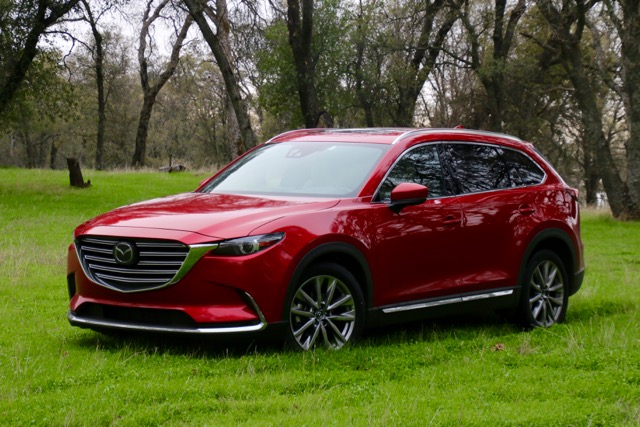
Road Beat: Mazda CX-9, full-size luxury CUV

The Mazda CX-9 is everything you expect in a Mazda and then some. Photos/Larry Weitman

The Mazda CX-9 is everything you expect in a Mazda and then some. Photos/Larry Weitman

By Larry Weitzman

For 2016, Mazda reintroduced a new CX-9 crossover utility vehicle, a brand-new vehicle, although it uses the nomenclature from the prior CX-9 which was a superb CUV in its own right. Mazda’s new tag line “driving matters,” is an obvious part of the CX-9’s DNA as it is a pleasure to drive while being at the same time engaging to drive.

Mazda’s Kodo design philosophy is apparent in the CX-9 in perhaps its most elegant form. Staring with its themed, aggressive front end, the lines flow in a fluid manner in perfect proportion only to disappear into its curvaceous body. There are four lines in the design, a hood line that flows into the A-pillar, another secondary hood/shoulder line that disappears into the body in the rear door and a third rear shoulder line starting in the formation of the taillight that also turns fluidic in the rear door and a subtle fourth line that starts in the rear D-pillar that also disappears in the upper window line. Clever stuff. Adding to its beauty are the perfect proportions of the body. In relation to other current Mazda designs, the hood is carried a bit higher, being less snout like.

CX-9 is a full size CUV with a length of 199 inches on a wheelbase of 115 inches. Its broad, strong shoulders of almost 78 inches offset its tall, 68 inches of height.                   

Under the exquisite hood is a blown version of Mazda’s 2.5L, DOHC, 16 valve, Skyactiv (direct injected) inline four-cylinder engine Instead of 185 hp the relatively low boost turbo charger adds 65 hp bringing the total output to a max of 250 hp at a super low 5,000 rpm and a stump pulling 310 pounds of twist (that’s the torque made by some 5.0L V-8s) arriving at just 2,000 rpm (on premium fuel) meaning this powerplant is cranking out a whopping 120 hp when peak torque arrives making this an extremely responsive engine that doesn’t require it to wind out before it starts making lots of thrust. It is so strong that you forget it’s a turbo with that characteristic turbo lag. Not here. Compression ratio is a very high 10.5:1.
Specifications Price $31,520 to about $45,000 for the Signature model Engine 2.5L turbocharged DOHC, 16 valve direct injected inline four 250 hp @ 5,000 rpm 310 lb.-ft. of torque @ 2,000 rpm Redline 6,300 rpm Transmission Six-speed torque converter automatic Configuration Transverse mounted front engine/FWD/AWD Dimensions Wheelbase 115.3 inches Length 199.4 inches Width 77.5 inches Height 67.6 inches Track (f/r) 65.3/65.2 inches Ground clearance 8.8 inches Weight (FWD/AWD) 4,054/4,307 pounds GVWR (FWD/AWD) 5,661/5,816 pounds Tow capacity 3,500 pounds Steering lock to lock 3.1 turns Turning circle 38.4 feet Fuel capacity 19.5 gallons Wheels 20X8.5 inches Tires 255/50X20 Co-efficient of drag 0.35 Performance 0-60 mph 6.54 seconds 50-70 mph 3.58 seconds 50-70 uphill (6-7%) 5.00 seconds Top Speed Does anyone really care? Fuel economy EPA rated (FWD//AWD) 22/28/25//21/27/23 mpg city/highway/combined. Expect 23 mpg in rural country and suburban driving and 28-29 mpg on a level highway at legal speeds.

Specifications
Price $31,520 to about $45,000 for the Signature model
Engine
2.5L turbocharged DOHC, 16 valve direct injected inline four 250 hp @ 5,000 rpm
310 lb.-ft. of torque @ 2,000 rpm
Redline 6,300 rpm
Transmission
Six-speed torque converter automatic
Configuration
Transverse mounted front engine/FWD/AWD
Dimensions
Wheelbase 115.3 inches
Length 199.4 inches
Width 77.5 inches
Height 67.6 inches
Track (f/r) 65.3/65.2 inches
Ground clearance 8.8 inches
Weight (FWD/AWD) 4,054/4,307 pounds
GVWR (FWD/AWD) 5,661/5,816 pounds
Tow capacity 3,500 pounds
Steering lock to lock 3.1 turns
Turning circle 38.4 feet
Fuel capacity 19.5 gallons
Wheels 20X8.5 inches
Tires 255/50X20
Co-efficient of drag 0.35
Performance
0-60 mph 6.54 seconds
50-70 mph 3.58 seconds
50-70 uphill (6-7%) 5.00 seconds
Top Speed Does anyone really care?
Fuel economy EPA rated (FWD//AWD) 22/28/25//21/27/23 mpg city/highway/combined. Expect 23 mpg in rural country and suburban driving and 28-29 mpg on a level highway at legal speeds.

One interesting note that if you choose to use regular fuel, the engine hp rating goes down to 227 hp at the same rpm probably due to the engine’s computer retarding the spark to prevent pre-ignition. I didn’t test the vehicle with regular gas, but I doubt the following performance numbers would be effected by much or that the overall feel of the vehicle would change or even be noticeable.

Speaking of performance, this 4,054-pound vehicle gets it done quickly. Zero to 60 mph occurs in 6.54 seconds, making it the quickest Mazda except for the MX-5 Miata and understanding that all Mazdas are pretty quick cars. There is no such thing as a lethargic Mazda. Passing times also reflect the CX-9’s outstanding performance with a 50-70 mph passing simulation of just 3.58 seconds and the same run up a 6-7 percent grade lasts just 5 seconds. This is a honkin’ on CUV with immediate and a linear throttle response that without the traction control and in spite of the big meats, can light’em up easily at lower speeds. What’s nice about a turbo charged engine and living in the foothills and Sierras, there is no performance loss as you climb in altitude. At 7,382-foot Echo Summit, the CX-9 is still making its max rated hp of 250 hp where a normally aspirated engine of the same sea-level power rating would be down to about 195 hp because of less oxygen and induction pressure.

Mazda also holds the title as the auto industry’s highest   average EPA CAFÉ (Corporate Average Fuel Economy) numbers for all their models, but the CX-9 has to bring up the rear as it’s rated by the EAP at 22/28/25 mpg city/highway/combined. My testing revealed almost identical numbers with a two-way highway run at 70 mph returning 28.5 mpg. A round trip to South Lake Tahoe from Placerville averaged 24.6 mpg and overall in country rural two-lane road driving showed 23.5 mpg. While not the greatest numbers on their face, when compared to other full size SUV/CUVs, the CX-9 looks darn good.

Now to a Mazda forte, handling. As with all Mazdas, handling matters and the CX-9 certainly is not only an easy handler, but an adept one as well. It has all the creds, sophisticated four well independent suspension, coils in all the corners, stab bars at both ends, a wide 65-inch track and reasonably quick steering at 3.1 turns lock to lock. Also, adding to the CX-9 cornering power are massive 255/50 series rubber mounted on 20X8.5-inch great looking alloy wheels. Needless to say, turn in is crisp and its attitude is flat when pushing hard in the twisties. It simply goes where you point it without feeling like a cumbersome, head tossing, big top-heavy SUV, but more like a sporting sedan. Making 2 tons change direction with aplomb is no easy feat, but Mazda has found a way.

Ride quality is excellent. One passenger immediately remarked about its quiet and wonderful ride quality. It has the ability to absorb road imperfections with its very supple suspension and absolutely no harshness. While the engine spins a relatively low 2,200 rpm at 70 mph, it extremely quiet with no wind or road noise.    

Four-wheel disc brakes (front ventilated) are over a foot in diameter and have all the safety acronyms making for powerful controlled stops and Smart City Braking which includes a large flashing red “brake” sign in the heads-up display. Standard in this Grand Touring unit are lane keep assist, blind spot monitoring, roll stability control, adaptive headlights which turn night into day and so much more. Safety has certainly not taken a backseat with Mazda.

Inside is another area where Mazda is an industry leader with soft, leather sublime (full power) front chairs, second row seating with huge legroom and a third-row fold down system for two. Actually, the second-row folds flat as well. Most all of the interior surfacing is quality soft touch.

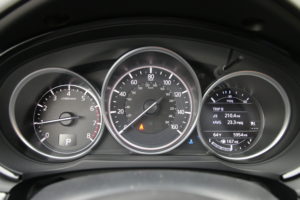
Instrumentation is all business with a three-hole dash containing tach and speedo left and center with the right dial containing the trip computer, with a secondary instant read out with a needle pointer instead of a graph which also depicts the average fuel economy with a blue indicator besides a digital average readout in the multipage trip computer. Nice.

If there is a negative, it is the center stack with the large screen stuck on top of the dash and its mouse like sound system/Nav controller. Mazda is such a great company making some of the best cars in the world all holding top of class positions, yet their radio systems need work. Maybe you get used to them after a while, but I have seen better. On the other hand, HVAC controls are easy to use.

In another surprise, the CX-9 is well priced with this top of the line Grand Touring model in FWD stickering for a very reasonable $40.170 plus $900 for the boat from Hiroshima, Japan. The only option was the (glow in the dark) Soul Red paint ($300) bringing the bottom line to $41,370. Personally, I like just about any color that is shiny. A base model CX-9 with the turbo engine and six speed auto cog swapper starts at just $31,520.  All wheel drive will add $1,800 to the price and will add about 250 pounds and cost you an mpg according to the EPA.

Larry Weitzman has been into cars since he was 5 years old. At 8 he could recite from memory the hp of every car made in the U.S. He has put in thousands of laps on racetracks all over the Western United States.


Flooding, snowstorms take toll on I-80

By Associated Press

The flooding and snowstorms that battered Northern Nevada last week have taken a toll on Interstate 80 in the Reno area.

The Nevada Department of Transportation says I-80 travelers should expect delays this week on the west side of town as crews work to repair potholes from the Keystone exit on the edge of downtown all the way to the California state line.

Westbound travel was reduced to one lane during emergency road work on Sunday.

NDOT says single-lane closures will continue at times in both directions. Speeds will be reduced to 55 mph and no passing will be allowed.


LVFPD chief restores traditions to department

By Kathryn Reed

Tradition is in large part what the fire service was built upon. It is those rituals that help bind the men and women who put the uniform on each day.

Lake Valley Fire Protection District, though, has been lacking those ceremonial rites. That’s all about to change.

Tim Alameda, who became chief last year, immediately knew he wanted to create an honor guard and reward his staff with commendations. These are some of the traditions he is introducing to the department even though they are the norm so many other places.

“This will probably be one of the most important things I will do in my career here,” Alameda said of creating the honor guard. “It’s a beautiful, gorgeous tradition. I’m just tickled to think I could bring that home.”

It is considered an honor to be chosen to be in this guard. The U.S., California and Lake Valley Fire flags are part of the ensemble. Another person gives the orders. They present the colors at official events, including funerals.

This summer the crew will be sent to a special training in Carson City to learn what to do in a full honor guard ceremony, which will include a mock funeral.

Another job of the honor guard is to make sure everyone’s uniform is correct.

The chief didn’t have his full dress uniform yet when it was time to attend Zach McAllister’s services at Sierra-at-Tahoe last month. He was going to wear a white shirt and tie. Honor guard members wouldn’t let him leave the station until they pieced together the uniform.

“They insisted their fire chief be in the right uniform to pay tribute to this young man,” Alameda told Lake Tahoe News.

The other team Alameda has assembled is the commendation group.

“What that means is if someone does something out of the ordinary, really special, then any firefighter in the organization can nominate them for a commendation,” Alameda explained.

The chief, though, is not involved in who gets what. That is entirely up to the select group, which is made up various ranks within the department as well as a board member.

The first award ceremony will be in the first quarter of this year. Mostly it will be from events in 2016, though it’s possible if something significant happened in 2015 that it may be included.

Most of the awards are a ribbon that then goes on the individual’s dress uniform.

The awards include:

Valor – This is going beyond the call of duty; where the risk is beyond the normal scope of the person’s job. “We don’t just hand that out,” Alameda said.

Lifesaver medal – Where someone’s life was saved because the employee either did something dangerous, technical or extraordinary. This goes beyond the routine lifesaving firefighters/paramedics do every day. “It’s when you get the patient to the hospital and the doctor says if you didn’t do what you did, the patient would have died.”

Merit – This can be awarded to employees and the public. It is the highest level award a civilian can receive. It’s about hard work. It can be hard to get the pin. Sometimes a letter of recognition is given instead of the ribbon.

Fire chiefs commendation – A plaque is given to the individual by the chief officers for doing something special, something that changed the dynamics of a situation.

Field save – This deals with CPR specifically. “You get the person to the hospital and that person then walks out of the hospital,” Alameda said.

Campaign ribbon – This is for significant events like last fall’s Emerald Fire. The first responders will receive a green and white ribbon to wear. This summer for the 10-year anniversary of the Angora Fire the department will be awarding ribbons for that fire to those who were involved in the initial attack.

“These rich traditions are so important,” Alameda said.


Opinion: Why America should be bullish about Wall Street

By Andrés Martinez 

You should be celebrating the fact that the stock market is soaring.

Yes, I’m talking to you, even if you are not a trust fund baby—make that especially if you are not a trust fund baby.

I fear that with all the politicized talk of Wall Street and the images that shorthand conjures up in our minds of rapacious bankers and hedge fund managers, we’ve lost track of what the stock market is really all about.  A bright young colleague of mine recently said she’d put a little money in the market, had seen it appreciate, but was now feeling a bit guilty about her “blood money” and wants to cash out. 

I fear her disdain is common among millennial progressives, who aren’t likely to break out in celebration if and when the Dow Jones Industrial Average breaks through the 20,000-point milestone it has approached in recent weeks. A Gallup survey last spring reported that only 52 percent of respondents had any money (or a spouse’s money) invested in the stock market, the lowest percentage in several decades.

That’s a shame. The stock market is not only a barometer of our nation’s business ingenuity, it’s also a testament to our shared commitment to a meritocratic form of participatory democracy.  

I was reminded of this reading “Shoe Dog,” Phil Knight’s engaging and refreshingly candid memoir. The Nike founder recounts how financially stressful the company’s early days were, not only at the very beginning, but well after it had become apparent that consumers craved Nike’s revolutionary running shoes, and the company was doubling its sales every year. The trouble was, the faster the scrappy Oregon-based competitor to the Adidas behemoth grew, the more nervous its bankers became, having to finance Knight’s vision “on the float,” paying the costs for each new product cycle, before their revenue came in to cover the bills. The only answer, which Knight resisted until 1980, was to raise capital by going public; only then was Nike’s long-term success assured. 

The stock market enabled the swoosh to eclipse Adidas as an iconic global brand, giving consumers more choice and, yes, making Knight and those who chose to back him billions of dollars in the ensuing decades. And now the stock market is the only reason scrappy Under Armour has itself been able to scale up to take on what it considers—as Knight once considered Adidas—the dominant but unimaginative incumbent in the industry based in Oregon. The market’s wonderfully subversive that way.

It’s become a political trope to talk about the distinction between Wall Street and Main Street, but what a stock market allows is for the most worthy ideas from Main Street to grow and succeed. Think what you will of the bankers on Wall Street, but the market is really about whether we will all be able to benefit from the inspiration of a Phil Knight or a Steve Jobs, and those who will improve upon what they have done.

Knight’s initial hesitation to going public—the significance of the phrase itself is worth appreciating—arose from the same reason the rest of us should appreciate the stock market and seek to preserve its central role in our economy.  He understood that once a company trades its shares on the market, it is accountable to the public. In exchange for being able to raise money from perfect strangers like you via your pension fund or 401(k), companies listed on the stock market are forced by landmark New Deal era legislation to embrace a radical degree of transparency, reporting quarterly results and any reverses they suffer along the way. Their managers, meanwhile, become directly subservient to outside shareholders. Knight had no choice but to embrace such transparency—his parents were not in a position to lend him millions of dollars to bankroll his company’s growth.

Which brings us (sorry) to Donald Trump. Our president-elect’s personal story, business practices and worldview don’t reflect the ethos of the stock market. Indeed, the opaque and dynastically-run Trump Organization is the antithesis of a democratic, publicly-traded company.

It’s a fun mental exercise to imagine Trump having to navigate the challenges of running a publicly-traded company all those years, if he hadn’t been able to take the aristocratic route of being financed by his father[Office1] , around the same time that Knight was having to access the public market. Imagine Trump having to report each quarter to pesky journalists, analysts and institutional investors how the company was faring, and why. Imagine him having to file public disclosures about all his vindictive litigation, and having to address pointed questions about why the CEO of a modestly-sized company was flying around in a 757, and appointing relatives to run various divisions, not to mention tarnishing the company’s brand by disparaging Latinos, Muslims, women, and plenty of other Americans.

Who knows, maybe Trump’s company, thus cured of its cult of personality, would have become a more formidable enterprise, one more closely resembling its creator’s hyperbole. Trump himself would have been long deposed, or long-since reformed into a person better qualified to represent and work on behalf of competing stakeholders and interests in a strategic manner—better qualified, that is, to be President of the United States.

Of course the stock market is far from perfect. Capitalism entails risk, and for every windfall pension funds or individual investors reaped investing early in the likes of Microsoft and Nike, plenty of money has been lost backing bad ideas. You’re smiling now if you bought into Facebook when it started trading publicly and frowning if you invested in Twitter. But who’s to know where each will be in five years? And worse than the speculative uncertainty inherent in stock investing is the recurring sense, triggered by accounting and insider trading scandals, that the market may be rigged by people in the know. 

Yet for all the scandals that have afflicted Wall Street, our system is far more efficient at funding worthy ideas to spark innovation and create jobs than any secretive and closed Trumpian world ever could be, where equity can only be raised from family, immediate associates or a bank loan officer. Our system, with its relentless insistence on transparency and disclosure, is also far better at minimizing fraud. The rule of law and a certain level of social cohesion are key prerequisites for a system in which people are willing to fund ventures beyond their immediate circle; it’s no accident the first functional modern stock market was established in the cosmopolitan, relatively tolerant and egalitarian Dutch Republic, as opposed to a more static, dynastic society. And it should be a source of pride to Americans that our stock market remains the envy of the world.  It’s easy for less open societies (see China) to open their own stock markets, but these don’t require the same level of transparency of listing companies, or protect the rights of minority shareholders to the degree ours does, which is why the best companies from those countries still yearn to be listed in our stock market.

The stock market shouldn’t be a partisan issue. It’s a shame that progressives don’t balance their justified outrage at some of Wall Street bankers’ excesses with an acknowledgment of the democratic essence of an accessible stock market that allows entrepreneurs and innovators to fund their companies and take on complacent incumbents.  Without dynamic equity markets, our economy would be dominated entirely by private companies like the Trump Organization and business tycoons who inherited their dominant position[Office2] . It’s a shame that President Obama hasn’t felt more comfortable explaining the market’s meritocratic ethos and applauding his own results in tripling the stock market’s value since its recession lows in the early days of his administration. It’s a shame that politicians from both parties spent this entire populist-tinged election cycle bad-mouthing the market, making millions of younger Americans like my colleague feel like they should stay away, or feel guilty if they don’t.

Andrés Martinez is the executive editor of Zócalo Public Square and a professor of journalism at the Cronkite School at Arizona State University. 


Letter: Irritated with VHRs in South Tahoe

To the community,

I’ve received the city’s notice of a Vacation Home Rental Application for 3861 Saddle Road, Unit 12.  I oppose this.

Vacation rentals are like the city’s SnowGlobe festival: both are fine ideas under the right circumstances, but terrible ideas when placed in residential neighborhoods. This puts conflicting interests in proximity, a group with short-term interests in having a good time without concern for noise, the environment, or neighbors against the goals of residents, with long-term hopes for a livable neighborhood and maybe just a night’s sleep.

Permitting these activities shows an appalling willingness to put the financial interests of non-residents and businesses ahead of the well-being of those who live in South Lake Tahoe. This is justified as promotion of “economic development”, favored buzzwords of City Council and the city manager. This is either a misunderstanding of the United States Constitution, or a perversion of it. The Constitution describes the purpose of government simply, right in the preamble. It’s union, justice, domestic tranquility, defense, promotion of general welfare and liberty. There is nothing there about allowing rentals to trash neighborhoods, or enough noise to break windows. It’s about people. There is no mention of money.

Recently City Council has started surveys and discussed possible restrictions on vacation rentals. I’d like to describe a few of my own experiences with city code enforcement in the 14 years I’ve lived in an area of South Lake Tahoe with VHR properties:

I’ve probably complained five or six times about noise. The city response has been zero.

I complained once about 25 people crammed into one house. The city response came five days later.  There was no problem, the house was empty.       

On two occasions I’ve asked city police driving by to please ticket cars parked on the streets forcing snowplows to go around them, meaning the street was never cleared. Both times the reply was no, that the city didn’t want to ticket tourists and possible degrade their local vacation experience.

Worst of all, on one occasion a local VHR had a plumbing malfunction resulting in days of raw sewage flushed directly on to the ground. The city responded to a complaint by calling the VHR owner, who blamed a contractor. This was relayed to me as resolution. Apparently it’s OK as long as there is somebody to blame. A little sewage on the ground or maybe in the lake – so what. I got to clean it up.  Multiple violations at this same rental have been ignored.

The sole city agency with any interest in quality of life issues seems to be Clean Tahoe, doing a fine job.

In summary, vacation rentals in residential neighborhoods are a bad idea. The city has demonstrated inability at regulation. The letterhead on the stationery I received containing the Notice Rental Application has the motto “making a positive difference now”, so here is an opportunity. If the city cannot reverse a deteriorating quality of life for residents, I urge an end to vacation rentals in residential neighborhoods.

Joshua Benin, South Lake Tahoe


Squaw hosting FIS race this week

Squaw Valley will host the Elite FIS Astle Memorial on Jan. 17-20, 2017.

The FIS tech series is traditionally at Snowbird in honor of Bryce Astle, one of two U.S. Ski Team members who passed away in an avalanche in 2015. A field of nearly 100 men and 100 women will compete in two days of giant slalom and two days of slalom on the same course as the women’s Audi FIS World Cup event that will be at Squaw Valley this March.

The series, which is being utilized as a test event for the World Cup, will feature men with FIS points as low as 18.03 and women with FIS points as low as 30.23, all 17 years of age and older. This elite field includes athletes from 18 countries as well as all three USSA regions across the United States. Forty of the athletes come from the Far West region, which includes athletes from the Tahoe basin, nine of whom are on the Squaw Valley Alpine Meadows Ski Team. 

In addition to the race, Squaw will host a free Know B4 You Go avalanche awareness presentation hosted by the Nickolay Dodov Foundation on Jan. 17 at 5pm. This free event will be at the Squaw Valley Conference Center (1901 Chamonix Place, Olympic Valley).


Liberty makes progress before next storms arrive

Just as Liberty Utilities has restored power to almost all of its customers, another series of storms is lined up, ready to bear down on Lake Tahoe and the surrounding region.

All customers except the 136 who live in the River Road area have had their power restored. Helicopter operations were limited Monday due to weather. Once they were under way, additional damage was discovered. If the weather cooperates and the helicopter is able to fly, Liberty hopes to restore power to these last customers by Tuesday night.

The first storm is expected to arrive Wednesday afternoon. Substantial wind will come, followed by rain and then snow.

According to the National Weather Service in Reno, about a foot of snow is possible in the higher elevations, with snow levels reaching the valley floors by Thursday morning. 

A colder system should arrive Friday and Saturday, with the potential for a more potent system Sunday
and Monday. 

— Lake Tahoe News staff report


Sandoval report card: Progress made, work to be done

By Sandra Chereb, Las Vegas Review-Journal

CARSON CITY — When Gov. Brian Sandoval delivers his final State of the State address Tuesday, Nevada lawmakers will receive a written report card from the administration highlighting achievements realized over the past six years.

Titled “Shared achievements for the Nevada Family,” the report is a synopsis of gains made since Sandoval took office in 2011, when the state was in the throes of recession, the housing market was in the gutter, unemployment soared and state finances were in shambles.

“We were not on the brink, we were over the brink in 2011,” Sandoval reflected during an interview Friday at his Capitol office.

In his first address to lawmakers that year, Sandoval pointed out the obvious: “Nevadans are confronted on all sides with bad news.”

Read the whole story


Input on Spooner Lake’s future being sought

Nevada State Parks is planning improvements for the Spooner unit of Lake Tahoe Nevada State Park.

The agency is seeking input on ways to improve the experience at Spooner, with particular emphasis on expanding educational and interpretive opportunities.

Input may be given via an online survey until Jan. 31. and invites input from the public. 

Spooner Lake offers fishing, hiking, picnicking and a quick escape into nature. The Spooner Backcountry encompasses more than 12,000 acres of forested open space with 50 miles of hiking, equestrian and mountain biking trails.