Train schedules return engagement to Tahoe

The Bay Area band Train is becoming a regular headliner at the Harveys Outdoor Concert Series.

The group will be back on July 9 at 7:30pm.

Opening will be O.A.R. and Natasha Bedingfield.

Train last played in Stateline in 2015.


10 locals to compete in Tahoe dance contest

Rehearsals for the 5th annual Dancing with the Tahoe Stars started this week.

The event is March 4 at 6:30pm at MontBleu.

Similar to the popular TV show, rookies will learn a choreographed dance routine complete with costumes. They will be paired with real dancers.

Local contestants and their partners are:

·      Betsy Belotti and Rainer Herm

·      Marimille Dacia and Gerzon Chaves

·      Alison Ganong and Bob Truesdale

·      Brooke Hernandez and Alex Kaskie

·      Cindy Martinez and Rex Kline

·      Jeff Cowen and Rhonda Keen

·      John Freidrich and Jodi Patton

·      Matt Levitt and Robyn Lindner

·      Chuck Malone and Angela Smith

·      Austin Sass and Catherine Arens.

Judges will be Marcia Sarosik, Don Bosson and Paul Middlebrook. The audience will have the opportunity to vote by text for their favorite couple. The people’s choice award is a separate prize based on the couple that raises the most money for Tahoe Arts Project by collecting donations. Online voting for People’s Choice can be done anytime through TAP’s website.

Tickets range from $10 to $50 and will go on sale Feb. 4. 


South Lake Tahoe missing man found

Updated 9:51am:

Daniel Trevis was found this morning at 9:26 on Park Avenue, wrapped in a blanket. This is less than a mile from his residence. Trevis was awake, and alert, but was very cold.

He will be evaluated by medical professionals.

—–

A 75-year-old South Lake Tahoe man with dementia is missing.

Daniel Trevis was reported missing at 4am Jan. 19 by his son, Henry Smart. The two live together near the state line.

Daniel Trevis

Daniel Trevis

When Smart returned to their shared residence, he discovered Trevis missing and called the police. Trevis reportedly has a tendency to wander from their residence. His son was away from their residence during the late afternoon and most of the night. 

Trevis is white, approximately 5-feet-3-inches, 135 pounds, green or hazel eyes, and has white shoulder length hair and a white beard. He wears dentures and glasses. Trevis may be wearing an orange jacket, black pants, and a black and white baseball cap.

Anyone with information is asked to call the South Lake Tahoe Police Department at 530.542.6100.

— Lake Tahoe News staff report


Nev. could get first new state parks in decades

By Benjamin Spillman, Reno Gazette-Journal

Nearly 30 miles of river that’s been largely locked away from the public could become a jewel of Nevada’s state parks system.

It’s one of two new parks included in the budget proposal by Republican Gov. Brian Sandoval, who announced the plans Tuesday in his State of the State address.

Read the whole story


Schools open despite slick, snowy roads

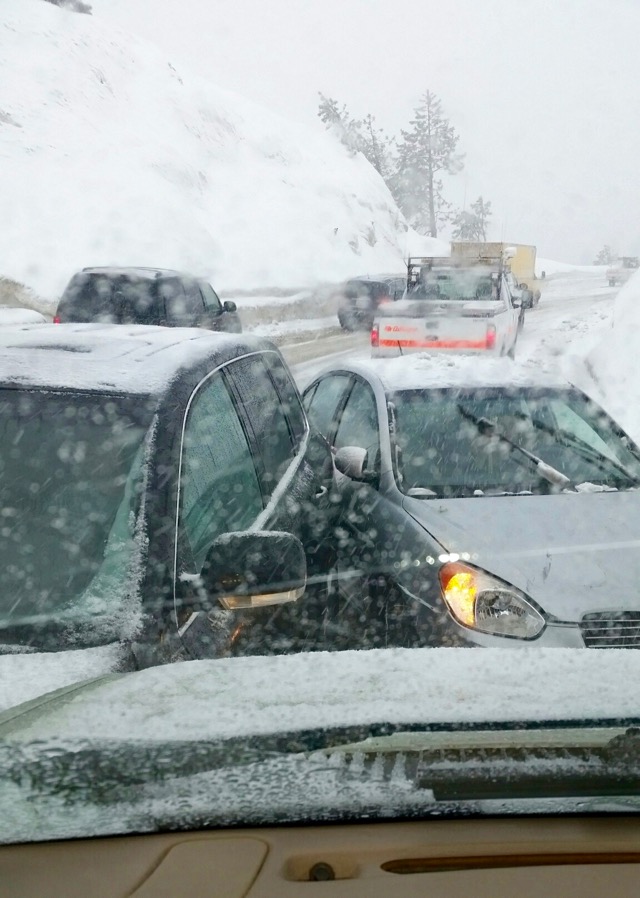
Two cars on Jan.  18 slide in a van on Echo Summit.  Photo/Julie Threewit

Two cars on Jan. 18 slide into a van on Echo Summit. Photo/Julie Threewit

Even though more than 6 inches of snow fell overnight, schools in the Lake Tahoe basin are open today. Buses will service the main stops for Zephyr Cove and Whittell schools.

Ski resorts are digging out. Expect delays before all chairs spin. Wind may impact resorts as well.

The avalanche danger today is considerable, according to the Sierra Avalanche Center.

Roads are slick and cars are spinning like it’s a bumper car ride. For up-to-date road information, click on the state icons on the home page of Lake Tahoe News.

A winter weather advisory is in effect until 10am Jan. 19, with another issued from 4am Friday to 10am Saturday for the greater Lake Tahoe area.

Snow accumulations with the next storm may bring 6-12 inches at the lake and 12-18 inches above 7,000 feet. Two to 3-foot waves are expected.

— Lake Tahoe News staff report


Tahoe concert promoter wants to use SLT field

By Kathryn Reed

Music festivals in the Stateline casino corridor are the norm throughout the summer. Now one of the promoters wants to bring them across the state line to South Lake Tahoe.

Paul Reder, founder and principal of PR Entertainment, gave a presentation Jan. 17 to the South Lake Tahoe City Council about his desire to put on concerts at the same field the three-day December SnowGlobe music festival uses.

Reder, who also owns The Loft in the city, has been in the entertainment industry for more than 30 years. He has staged shows in Stateline, North Shore, Truckee and Reno.

The main reasons to move the reggae, bluegrass and electronic music festivals are to be in a bigger space and at a venue with grass.

A festival on asphalt is not ideal – which is what happens at Hard Rock and MontBleu casinos because the events are in the parking lot. Attendees are standing or sitting on that hard surface. Even though 10,000-square-feet of turf was laid at Hard Rock last year, it wasn’t ideal, according to Reder.

While SnowGlobe was at a new location last month, the area was all dirt. The city opted to hold off on putting in the sod until this spring, after SnowGlobe. Chad Donnelly, promotor of SnowGlobe, has a contract for 2017 contingent upon inspection of the field after the snow melts.

City Attorney Tom Watson told Lake Tahoe News that even though there was no field per se in December, ruts in the dirt and potential debris found after the snow melts would be a concern, while at the same time if the ground looks as good as it did before the event, then Donnelly will have met his obligation.

That field is a community ball field, with the main purpose being for sports as soon as the grass is put in. Keeping it playable will be a requirement no matter what takes place on it outside of athletics.

Even though the concerts are a day or two, set up and break down would take the field out of commission for a few other days.

While the topic about Reder’s summer concerts was not an action item Tuesday, council members voiced comments about Reder’s desires. What the impact to the field will be, making sure the sports community would not be adversely affected, and noise were some the concerns brought up.

The council agreed to put the topic on a future agenda. However, timing is important because Reder needs to get contracts signed with the music acts, as well as market the events. He is looking at a one-day reggae festival and having the two-day electronic music fest to start with.

There is only one council meeting in February. Reder would need a decision by March. He would also need approval from Lake Tahoe Community College’s board.

After the meeting, Reder told Lake Tahoe News, “I’m looking at this as more of a future possibility. But we plan on keeping the festivals at Stateline until the right opportunity comes around on those grass fields or other grass areas on the South Shore.”

Reder said the noise level has not been an issue at his concerts, and added that he would be willing to work with the city to make sure his concerts don’t disturb neighbors. The Base Camp Festival is electronic music, just like SnowGlobe. City Manager Nancy Kerry said she intends to recommend the maximum decibel level for SnowGlobe be lowered when there is no snow on the ground to absorb the sound.

If the council does not green light Reder to bring his concerts to the city for this year, he is not taking the events out of the area.

“We are also talking to the Hard Rock about the possibility of building a larger grass field in their parking lot very similar to MontBleu and keeping it there all summer. If Hard Rock can build that kind of infrastructure, then we will keep the festivals there indefinitely,” Reder told Lake Tahoe News.


Opinion: Inaugurations more than hail to the new chief

By Richard M. Skinner

For all their happy pageantry – marching brass bands on parade, solemn invocations, evening gowns at the balls—our inaugurations expose some of the biggest tensions that define the American presidency.

At the founding of our republic, monarchs led nearly every other nation. Even as democratic systems spread, most countries adopted parliamentary systems where legislatures chose prime ministers to head their governments, often alongside a ceremonial head of state to hover above the partisan fray. But the U.S. presidency falls somewhere between: A head of government that assumes office on behalf of a political party, yet is expected to be a unifying head of state for all Americans.

As our first elected president, George Washington was conscious that he was setting precedent for this new position as head of a republic. He had resigned his command of the Continental Army a few years earlier, despite calls for him to keep his wartime powers and rule the nation as a dictator or king. Yet he and his supporters also saw how his vast prestige could help support a fragile new government. So instead of simply taking his oath of office, the only constitutionally-mandated element of an inauguration, they turned Washington’s ascension to the presidency into a show—one that publicly reconciled the compound, if not contradictory, roles bestowed on America’s top post.

The result blended the trappings of European monarchs with heavy nods to the presidency’s democratic foundations. In many ways, the inauguration looked like a coronation, with throngs of adoring lookers-on, invocations of the divine, and a gun salute.  But the new president wore a plain brown suit to the affair, held at Federal Hall in the then-capital, New York. He used his inaugural address to show humility at the task “to which the voice of my country called me,” and drew attention to his solemn pledge to “preserve, protect and defend the Constitution of the United States.”

Washington set another powerful precedent eight years later: After two elected terms, he retired. His refusal to cling to control provided reassurance to those who feared the power of a single executive. It also set the stage for peaceful, regular transitions.

After Washington, most of America’s presidents decided to keep up the pageantry of the inaugural inauguration too. In 1797, Oliver Ellsworth became the first chief justice to administer the oath of office when he swore in John Adams. Thomas Jefferson’s first inaugural was also the first to take place in the new Capitol of Washington, and his second featured the first parade. James Madison had the first inaugural ball in 1809.  And in 1981, Ronald Reagan shifted the ceremony from the Capitol’s East Portico to its West Front, allowing more of the public to witness the event from the National Mall.

Inaugurations seek to show stability during contentious transitions. But divisiveness can still undermine democracy’s big day. Between Abraham Lincoln’s election and inauguration in 1861, seven southern states declared their secession from the Union and began forming the Confederate States of America. Rumors spread of plots to prevent Lincoln from reaching the Capitol to ascend the presidency, so the president-elect disguised himself and took a night train through pro-slavery Baltimore to reach Washington on time. Artillery companies guarded Capitol Hill and sharpshooters lined his Pennsylvania Avenue route on Inauguration Day.

Despite the drama, Lincoln used his first address to strike a conciliatory tone, telling Southerners, “We are not enemies, but friends.” It was all for naught. Within six weeks, the Civil War had begun. But America did have a properly sworn-in president at the helm.

Even in the absence of a secessionist movement, partisanship can undercut aspirations for inaugurations to celebrate national unity. In 1829, Andrew Jackson’s new presidency marked a stark, populist departure from those of incumbent John Quincy Adams. Following a bitter election fight, his inauguration became more victory party than reconciliation. The outgoing president Adams didn’t show. But, fitting the new everyman order, a rowdy crowd of over 10,000 supporters did.

Just as many inaugurations are remembered for presidents-elect who tried to smooth bumpy handoffs. In 1801, Jefferson, the first president to come from a different party from that of his predecessor, declared, “We are all Republicans, we are all Federalists.”  

In 1933, the outgoing Herbert Hoover and incoming Franklin D. Roosevelt, who openly loathed each other during a rocky transition, shared a lift to the new president’s inauguration. Hoover mostly scowled as FDR tipped top hat to the crowds. But Hoover honored the tradition that, with rare exception (assassination, resignation, natural death, and a few 19th century cases of animosity), the outgoing president has always made some sort of symbolic show on Inauguration Day. It’s perhaps the ceremony’s most powerful symbol of the peaceful passage of power.

Richard M. Skinner teaches political science at Johns Hopkins and George Washington Universities.


Calif. schools chief urges districts to become ‘safe havens’

By Loretta Kalb, Sacramento Bee

California’s education chief has called on districts throughout the state to declare schools as safe havens against deportation and offered the Sacramento City Unified School District as a model.

State Superintendent of Public Instruction Tom Torlakson urged educators serving about 6.2 million students in California to take action, citing rising reports of bullying, harassment, and intimidation of K-12 students. The recommendation was distributed this week to county and school district superintendents, charter school administrators, and principals.

Torlakson said that after the November presidential election, families face “anxiety and in many cases outright fear. We want to use this as an opportunity to reassure parents that, regardless of immigration status, schools are welcoming places.”

Read the whole story


National park visits hit record

By Brady McCombs, AP

SALT LAKE CITY — Visits to U.S. national parks set a record in 2016 for the third consecutive year as landmarks such Zion, Yellowstone and Rocky Mountain experienced historic levels of popularity that brought collateral headaches stemming from overcrowded roads and trails and increasing visitor misbehavior.

 At many parks, visitors waited an hour or more in cars to get through entrance gates and then spent the day trying to outmaneuver fellow visitors for parking spots and room on popular trails. They left behind enormous amounts of trash and sometimes, human waste.

Encountering a crowded, Disneyland-like situation when people were expecting peaceful serenity can lead to aggression and bad decisions, park officials said.

“The level of frustration, we’ve certainly seen an increase in that,” said Kyle Patterson, Rocky Mountain National park spokeswoman. “Sometimes they take it out on each other and sometimes they take it out on park.

It created a good news-bad news story for park managers. They praise the increased interest but are struggling to preserve iconic mountains, slot canyons and wildlife habitat for future generations. The National Park Service budget has remained basically the flat, leaving parks to grapple with the problems without higher staffing levels.

“We love having people come to the park,” said John Marciano, Zion National Park spokesman. “But our No. 1 goal, our mandate, is to preserve the park into perpetuity and to ensure our visitors have a best of kind and safe experience.”

Overall visitation to national parks is on track to surpass 325 million in 2016, breaking last year’s all-time high of 307 million, federal figures show. The record-breaking three-year stretch came after parks visitation ebbed and flowed between 255-287 million for nearly three decades.

The National Park Service launched a major marketing campaign to celebrate its 100th birthday in 2016, including free passes for every fourth-grader and their families. That renewed attention coupled with reasonable gas prices and an improved economy likely fueled the increase, said National Parks Service spokesman Jeffrey Olson.

The agency’s “Find Your park ” campaign will continue this year and officials expect to surpass 300 million visitors again even if there’s no record, Olson said.

Absent December totals, the Grand Canyon in northern Arizona hit 5.9 million visits. Yellowstone, which stretches into Wyoming, Montana and Idaho, had 4.3 million visits.

The final year tally for Rocky Mountain in Colorado was 4.5 million. Zion in southern Utah had 4.3 million visitors — nearly double the 2010 total.

Cramming all those people into the narrow confines of Zion where most visitors want to see the same iconic slot canyons and trails has led many days to hour-long waits to get in the park, lots that fill up by 9 a.m. and crowded shuttles, Marciano said.

“Then, you hike like ducks in a row up the trail because there are so many going up the same trail,” Marciano said. “That’s not what we want.”

One employee spent her entire summer hiking every day to the popular Angels Landing trail to clean and put more toilet paper in two portable toilets designed for 40 visits daily that had 200, he said.

Both Zion and Yellowstone are reassessing how to create better crowd plans and Zion is considering a reservation system for park entries and a daily visitor limit.

Even though it is prohibited, more people are taking dogs on trails in the Rocky Mountain park. Visitors are also parking cars on native vegetation or fragile alpine tundra and leaving human waste right near backcountry trails, Patterson said.

This summer, the park on certain days for the first time limited the number of cars allowed on two popular roads, she said.

After Yellowstone hit 4 million visitors for the time in 2015, park spokeswoman Morgan Warthin said the park last year the “Yellowstone Pledge” urging visitors to follow guidelines that include not stopping on the side of the road to look at bears and staying on boardwalks. A man who stepped off a boardwalk died last year after falling into a boiling, acidic spring.

Yellowstone has also implored visitors to take “safe selfies” by staying far away from wild animals.

“That want that perfect picture so they’re driven to get closer and closer to the point they’re risking their own safety,” Warthin said.


Kingsbury Grade fixed and open

Kingsbury Grade is open.

In December, a sinkhole formed where a drainage pipe crosses underneath the road at mile marker 4.3, approximately 10 miles up from Foothill Road. The road was temporarily repaired and reopened before recent flooding caused more extensive erosion to the road.

Q&D Construction worked 14-hour days between storms. They excavated approximately 150 feet across and 50 feet below the road surface to completely remove and replace the eroded drainage pipe, and then rebuilt and repaved the roadway.

As weather warms up and dries out in future months, additional drainage improvements may be needed along the same section of road.