Settelmeyer plans to seek GOP Nev. leadership post

By Ray Hagar, Nevada Newsmakers

State Sen. James Settelmeyer, R-Minden, says he plans to seek the leadership role of the Republican Senate caucus for the 2019 session of the Nevada Legislature.

“I am going for leadership, and we’ll have that vote after the election to determine who will be the best to lead us during the session,” Settelmeyer said Thursday on Nevada Newsmakers.

Read the whole story


El Dorado, Placer home prices surge

By Tony Bizjak, Sacramento Bee

El Dorado County had the highest median home sales price in the region last month, at $486,000. Placer’s median home price in April was $482,000. Both were up substantially over the past year.

The median price has now risen every month in the last six years, hitting $357,000 in April, according to CoreLogic, a real estate data company. That’s 12 percent higher than the $317,000 median sales price a year ago.

Read the whole story


Multi-agency investigation leads to arrests in Tahoe

By KTVN-TV

Placer County Sheriff’s Office reports that two Concord men were arrested on charges of burglary and vehicle theft, after a multi-agency investigation.

Placer County Sheriff’s deputies stopped a truck speeding through Carnelian Bay in North Lake Tahoe on May 15 and found stolen construction tools and equipment. They say some of the equipment was covered in shards of auto safety glass, and the vehicle had just been stolen from Incline Village.

At the same time, a number of window-smash burglaries were being reported in Washoe County.

Read the whole story


12 must plant pollinator-friendly flowers

By Melinda Myers

Fill your garden with colorful annuals you and the pollinators can enjoy all season long. Look for outstanding varieties chosen by All-America Selections (AAS), a nonprofit plant trialing organization, to brighten your garden, attract pollinators and outperform other varieties on the market.

Attract hummingbirds and second looks from passersby with the vibrant bright orange flowers of Canna South Pacific. This compact variety can be started from seed and was selected as a 2018 AAS winner for its vigorous, full and uniform growth habit.

Echinacea PowWow Wild Berry is a perennial that provides continual bloom without deadheading or grooming. Photo/All-America Selections

Whether it’s spikes of lavender, pink, white or red your garden and container need, you’ll find them in the Salvia Jewel series. Watch the butterflies and hummingbirds stop by for a sip of nectar and the finches feast upon the seeds later in the season.

Add more vertical interest and pollinator appeal in the garden and large planters with Asian Garden Celosia. The bright pink blooms hold their color all season long atop sturdy stems 31- to 40-inches tall. 

Include a few Cupheas, also known as Mexican Heather in containers, borders and mass plantings. FloriGlory Diana has more and larger flowers than its counterparts. The season long bloom of intense magenta flowers made this a winner.

Incorporate beauty even in challenging locations with EnduraScape Pink Bicolor Verbena. As the name implies it is tough as nails, tolerating drought, heat and temperatures in the low teens. Use this spreader in large containers and baskets where you can appreciate the soft pink blooms with their darker center.

Wow visitors and lure pollinators to your garden and containers with Vinca Mega Bloom Orchid Halo. The bright purple blooms with a white eye stand up to heat and humidity without succumbing to disease.

Grow winning varieties of a traditional favorite, zinnia. These low maintenance sun-loving annuals can be started from seed directly in the garden. Add vibrant color to the garden with Queeny Lime, Zowie! Yellow Flame and Magellan Coral. Include smaller scale beauty with Profusion and Zahara varieties.

Gardeners and pollinators love purple coneflowers (Echinacea). Two colorful winning varieties, Cheyenne Spirit and PowWow Wild Berry will fill your garden with color for seasons to come.

Cheyenne Spirit coneflower produces a mix of purple, pink, red and orange flowers along side lighter yellows, creams and white. This compact plant stands tall in wind and rain and is drought tolerant once established.

PowWow Wild Berry coneflower lives up to its name. The vivid deep rose-purple flowers retain their beautiful color all season long. You’ll enjoy continual bloom without deadheading or grooming.

Add more perennial beauty with Twizzle Purple Penstemon. The spikes of vibrant purple blooms are favorites of hummingbirds and other pollinators. Include them in containers for added height or high-impact color anywhere in the landscape.

Extend your budget and increase perennial plantings next year by starting these three winners indoors by late January. Your efforts will be rewarded with flowers that same season.

Don’t let shade stop you from inviting pollinators into the garden. Bounce Pink Flame Impatiens has all the flower power of common impatiens but is resistant to downy mildew. Plus, they are a bit more forgiving if you allow them to wilt. Just add water and they bounce back.

Plant Sunpatiens Spreading Shell Pink in full sun or shade. Enjoy the season long, soft pink flowers even in high heat, rain and humidity. This variety has all the low maintenance beauty of impatiens but is resistant to downy mildew.

Once you’ve added these beauties to your landscape, sit back and enjoy. You and the pollinators will reap the many benefits of these winning additions to your gardens and containers.

Melinda Myers has written more than 20 gardening books, including “Small Space Gardening.” She hosts the Great Courses “How to Grow Anything: Food Gardening for Everyone” DVD set and the nationally syndicated “Melinda’s Garden Moment” TV and radio segments.


Outdoor recreation powers Lake Tahoe economy

By Susan Wood

“In or out?” This was the question posed by many mothers to their children in respect to the opening and closing of their home’s front door.

It appears these kids grew up opting for the outdoors – opening the door to growth in the lucrative outdoor recreation market now measuring at least $373 billion by the federal Bureau of Economic Analysis.  

With Lake Tahoe being an outdoor paradise, the lifestyle is the norm for the two states it straddles.

From fishing charters and coolers to e-bikes and smaller backpacking gear, the stuff we do and carry has created a big business to shops catering to enthusiasts on all four sides of the lake and Reno.

“The desire for people to get outdoors is strong. We get mothers who have had their kids, and it’s opened a window for a whole new market,” said Jared Lopez, the gear guru at REI in Reno. “There’s definitely something going on.”

Lopez made the case for basing the outdoor gear giant’s surge in growth to people wanting to escape being a slave to their electronic devices. It seems the manufacturers have answered the call.
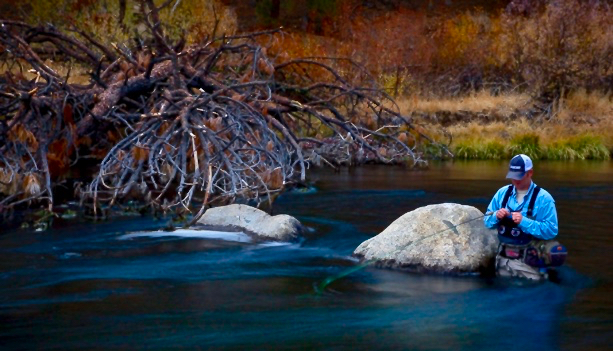
Fly fishing guide Matt Heron never gets tired of his sport. Photo/Keith Brauneis

For those needing power, solar generators by Goal Zero are compact and energy efficient in a 150-watt package starting at $199 retail. This represents an ideal alternative to the noisy, stinky, clunky gas-powered versions.

REI can barely keep up with the demand for Yeti coolers that are bear resistant – a must for car campers and fishing enthusiasts. The big-boy Tundra model at 160-liter capacity often sells out and could put you out $350 retail.

The Roadie is smaller with a handle but can still support a person standing on top of it.

“A lot of fishermen have to stand on coolers to get a cast,” Lopez explained.

Fly fishing tour guide Matt Heron has found his sport “tagged the rich old man’s sport” is no longer just that as it’s changed into new generations and genders.

The Truckee River guide has seen his North Shore business grow. In 12 years, the season starting in May has increased from an average of one person a day to 12.

“There’s a better quality product for entry level anglers, and more people can afford it,” Heron said. Some of these people can pop over $500 for the right rod, now wrapped in a flexible graphite.
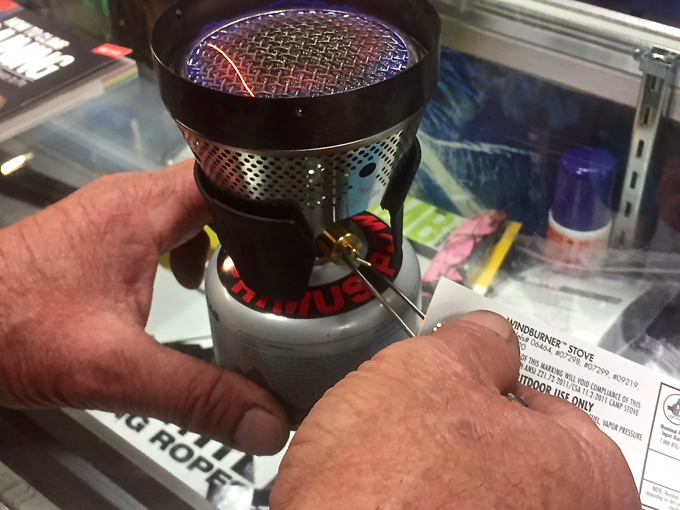
MSR stoves come with radiant heat, so no problem with wind. Photo/Susan Wood

Heron recently took out two first-timers who had the time of their lives. The two women represent Resort Mountains Cities, a 29-year-old destination management company that appeases clients seeking outdoor adventures.

As if Heron ordered it, both women landed fish right away.

“It’s pretty magical out there,” RMC saleswoman Stacie Krenicki told Lake Tahoe News. “We’re always in a rush. When you’re fishing, you have to calm down and relax and be yourself.”

Her colleague in RMC operations, Jaime Haddad, was shocked by how much she enjoyed the sport.

“I would have been out there all day. I truly have the bug,” said Haddad, who clad in chest-high waders caught a 20-incher.

In California, outdoor recreation generates $92 billion in consumer spending, according to a 2017 report by the Outdoor Industry Association. Over the border, OIA states Nevada spurs $12.6 billion in purchases. Much of this figure comprises receipts for outdoor gear.

After all, Nevada Travel’s mantra is “Don’t fence me in.”

The same thing could be said for quantifying the industry totaling $887 billion in size. The OIA used a methodology that included touring companies, travel expenses and outdoor gear made here and overseas.  

SUP Tahoe owner Brandon Miller has a fleet of VESL boards to show off. Photo/Susan Wood

The BEA’s figure is less than half that because it chose not to factor in travel expenses on recreation trips less than 50 miles from home and gear manufactured outside the country.

Even with the discrepancy, U.S. officials have discovered an often-overlooked means of consumer spending that comprises 2 percent of the U.S. Gross Domestic Product – something Tahoe recreation-oriented businesses have long known about.

According to the OIA study, over half of residents in Nevada’s 2nd Congressional and California’s 4th Congressional District where Tahoe lies on the map participate in one of the activities that consist of fishing, backpacking, climbing, hunting and cycling.

South Lake’s Tahoe Sports Ltd. has launched a fleet of e-bikes in the hopes of expanding on its human-powered variety. Owner Mark Gandt is giddy with excitement over the new German-inspired technology. One lithium battery charge can power the 20-speed, pedal-assist Haibike for 30 miles.

“This is the future,” he said, comparing it to the fat ski evolution. “It’s the biggest change in the sporting goods industry in years.”

Pedaling can easily prompt the bike to travel 30mph. Like cycling technology overall, the price range isn’t for the faint of heart, running between $2,500 and $6,000.

Carabiners are lighter in weight, but more durable. Photo/Susan Wood

At age 83, retired South Lake Tahoe surgeon Larry Foster didn’t hesitate popping that much at the South Lake Tahoe shop.

“I’ve been mountain biking for 40 years. Once I turned 60, I can no longer make it up the high country trails. The e-bike allowed me to go back to my old trails,” he told LTN.

Traditional mountain bikes have still ruled the pedaling market. These days, the rage there lies in full suspension bikes to overcome the shock of hard objects encountered. Tahoe’s steep hills also require a quick release on the seat post – up for the ascent, down for the descent.

“People come from all around the world and want to ride our terrain,” said Russ Stewart of Village Ski Loft. The Incline Village shop offers several demos and rentals.

Tahoe adventure seekers who pound the trail may also take solace in technological breakthroughs with hydrophobic sleeping bags, in which every feather is treated. Plus, the pads they sleep on are twice as thick but weigh the same as those from four years ago – 1 pound, 5 ounces, Tahoe Sports Ltd. gear hound Jay Sell noted.

Backpacks have gotten lighter with larger capacities too and adjustable holes for better fitting.

Stoves have become more efficient by using radiant heat. The MSR Windburner even comes equipped with a pot at $159 suggested retail.

Climbers will also find carabiners are now lighter yet stronger for building rope anchors and confidence belaying off them. With just a small addition of a metal piece planted at the carabiner opening, a swift bang on a rock won’t open the device.

From rock to water, outdoor gear has changed dramatically over the last five years.

With that revolution, paddleboards have surged in popularity. One obstacle remains the price for the new sport.

The early adopters who took up the sport back then are now graduating from a beginner board to more of a touring board that allows them to go farther without breaking the bank.

“Many people going on the second board want something with enough volume that’s stable, but 95 percent of these people are price conscious,” SUP Tahoe owner Brandon Miller told Lake Tahoe News. That’s why the South Lake Tahoe business provides 11-, 12- and 13-foot VESL boards this summer to find that happy medium between speed and stability – ones sold for under $1,000.

“It’s a balancing act,” he said.

Balancing is something Dax Willards is hoping will catch on quickly as he sells and rents the Onewheel at his West Shore shop. Billed as an alternative to a skateboard, a user propels forward with simple weight shifts. The one center wheel is durable enough to handle the rocks and ruts of Tahoe terrain. It retails for $1,499.

Lake Tahoe South Shore Chamber Chief Executive Officer Steve Teshara hopes the feds will invest in the infrastructure since studying the industry’s merit.

“It’s great the federal government recognizes outdoor recreation now, but it’s critical (it) puts the emphasis on operations and management and invests in it,” Teshara said.



Opinion: Pruitt making air dirtier, Americans less healthy

By Robert Percival, The Conversation

Environmental Protection Agency Administrator Scott Pruitt’s ethical lapses and extravagant spending habits have distracted the public from what he is doing to roll back important environmental protections.

Pruitt helped persuade President Trump to withdraw from the Paris climate accord, making the United States the only country in the world to reject the pact. At Trump’s urging, Pruitt has moved to repeal the Obama administration’s Clean Power Plan and EPA rules clarifying federal jurisdiction to protect wetlands.

He also plans to scrap national fuel economy standards the auto industry once embraced. And he sought to suspend regulation of methane leaks from new oil and gas wells, but was overruled by a federal court.

And Pruitt’s agenda extends far beyond simply rolling back Obama administration initiatives. In a memo to EPA staff on May 9, 2018, Pruitt ordered significant changes in the process for setting air quality standards under the Clean Air Act, in the name of “cooperative federalism and the rule of law.”

These standards are the heart of what has been the most successful environmental law in history. According to the EPA’s own estimates, the Clean Air Act saves thousands of lives every year and generates net benefits to society that are vastly larger than the costs of complying with it.

But the law is now under attack from the very agency charged with implementing it. Pruitt seeks to undermine the scientific basis for the EPA’s national air quality standards by changing who advises the EPA, restricting the data they can use, and requiring them to shift their focus away from protecting public health.

Science-based regulation

The Clean Air Act has reduced air pollution so effectively that even Pruitt acknowledges its success. U.S. air quality standards are the reason why our air is not like China’s, where air pollution kills an estimated 1.6 million people each year.

The Clean Air Act has succeeded because it requires air quality standards to be based solely on what science shows is necessary to protect public health. The law directs the EPA administrator to consult with “an independent scientific review committee” known as the Clean Air Scientific Advisory Committee (CASAC). This committee summarizes what science shows about the impact of various levels of air pollution on public health and welfare.

Based on this scientific information, the EPA is required to set national air quality standards for six key air pollutants that will protect public health with an “adequate margin of safety.” These standards are required to be updated every five years to reflect the latest scientific information.

The EPA is scheduled to complete reviews of standards for ozone and particulate matter by the end of 2020. According to the American Lung Association, more than 4 in 10 Americans still live in areas with unhealthy levels of ozone or particle pollution.

Pruitt’s memo expands CASAC’s charge to include advice on any adverse “economic” or “energy effects” of emission control measures – even though the law does not allow such factors to be considered during the standard-setting process. In Whitman v. American Trucking Associations Inc. in 2001, the U.S. Supreme Court unanimously declared that the text of the Clean Air Act “unambiguously bars cost considerations from the [standard]-setting process.”

In that case, industry litigants sought to persuade the court that air quality standards should be based on cost-benefit analyses. But the court, in an opinion by the late Justice Antonin Scalia, unanimously rejected that argument, stating: “[C]ost of implementation … is both so indirectly related to public health and so full of potential for canceling the conclusions drawn from direct health effects that it would surely have been expressly mentioned in [the law] if Congress meant it to be considered.”

The court declared that if it could be proved “that the EPA is secretly considering the costs of attainment without telling anyone,” this would be grounds for striking down the standards “because the Administrator had not followed the law.”

Weakening existing standards

Pruitt’s memo pays lip service to the notion that compliance costs are not relevant to standard-setting, while requesting “robust feedback” on adverse effects of implementing air quality standards. He also wants CASAC to emphasize scientific uncertainty and research on naturally occurring air pollution, harkening back to President Reagan’s famous claim that “trees cause more pollution than automobiles.”

Even if Pruitt follows the law, his memo’s emphasis on compliance costs, uncertainty and “background” levels of air pollution suggests that he is laying the groundwork for undermining existing air quality standards.

Toward this end, Pruitt wants to make significant changes to the EPA’s sources of scientific advice. His memo emphasizes that new members of CASAC review panels must be selected in accordance with his Oct. 31, 2017, directive, disqualifying experts who receive research funding from EPA – but not experts employed or funded by industry groups.

Pruitt’s action responds to an April 12, 2018, memorandum from President Trump directing EPA to speed up permitting of air pollution sources, and to grant states more flexibility in meeting air quality standards. But if the administration truly was serious about speeding up implementation of the act, it would not be proposing to slash the EPA’s FY 2019 budget from $8 billion to $6.1 billion and shrink the agency’s work force from 15,400 to 12,250.

When Congress last amended the Clean Air Act in 1990, it did so by overwhelming bipartisan majorities of 89-11 in the Senate and a voice vote without objection in the House. These amendments strengthened air pollution control measures while creating an innovative market-based emissions trading program that experts widely view as a success.

President Trump has abandoned his campaign promise to abolish the EPA, but his EPA administrator is on a slash and burn expedition to roll back crucial environmental protections. This effort reflects profound distrust of the science that underpins U.S. environmental policies and profound disregard for millions of Americans who still live in areas with unhealthy air.

Robert Percival is a professor of environmental law at University of Maryland.


Nearly half of U.S. families can’t afford basics

By Tami Luhby, CNN Money

The economy may be chugging along, but many Americans are still struggling to afford a basic middle class life.

Nearly 51 million households don’t earn enough to afford a monthly budget that includes housing, food, child care, health care, transportation and a cell phone, according to a study released this month by the United Way ALICE Project.

That’s 43 percent of households in the United States.

Read the whole story


Is CalFire’s crackdown going too far?

By Adam Ashton, Sacramento Bee

Firefighters can’t say they weren’t warned.

A new professional standards program at CalFire is giving the department a mechanism to hand down discipline in a consistent manner across the state for the first time in its history.

It’s racking up pay reductions, suspensions and dismissals at a rate that rivals scandal-plagued 2014 – the year when an instructor at its fire academy murdered his mistress and brought intense scrutiny on the department.

Read the whole story


Oldest Pearl Harbor survivor reflects ahead of Memorial Day

By David Wright, CNN

Ray Chavez is the oldest survivor of the attack on Pearl Harbor that launched America’s entry into World War II in 1941.

At 106, the indefatigable veteran has been traveling around the country for years, attending memorial services and commemorations. This week, he met with President Trump in the Oval Office while in Washington for a series of Memorial Day events.

Ahead of the Memorial Day weekend, Chavez reflected on his service, and recounted his experience on the day that President Franklin Roosevelt declared would “live in infamy.”

Read the whole story


Snippets about Lake Tahoe

·      South Lake Tahoe’s city manager opening is now listed – on Craigslist.

·      The El Dorado County Behavioral Health Commission is seeking five members to fill vacancies. The 16-member commission is advisory to the El Dorado County Board of Supervisors and the county behavioral health director. Applications are available online.

·      Truckee is offering rebates for the removal of non-compliant woodstoves and other solid fuel burning devices. For more information, go online.

·      Last year, the cost of clearing litter and debris from California’s highway system exceeded $69 million.

·      Lake Valley firefighter Larry Stewart, who lost is life in the line of duty in 1964, will be dedicated on the Happy Homestead Cemetery Wall of Honor on Memorial Day.