Letter: Warm room appreciative of Barton

To the community,

On behalf of the Tahoe Coalition for the Homeless, I would like to thank Barton Health employees and physicians for their incredible generosity.

In December, Barton Health departments participated in a fundraising drive for the South Lake Tahoe Warm Room. Employees and physicians donated $600 in gift cards and funds to support operations of the warm room and to allow Tahoe Coalition for the Homeless to purchase food and much-needed supplies to operate this winter. Barton Health’s contributions will help homeless individuals stay warm, prevent cold-related illnesses, and address some of the hurdles of overcoming homelessness. 

The Tahoe Coalition for the Homeless is working together to end homelessness on the South Shore with community partners, including Barton Health. Our mission is to meet the needs of our neighbors experiencing homelessness by providing warm beds and promoting community awareness. We aim to give short-term assistance to our friends and neighbors who find themselves without housing this winter, and to provide resource referrals to help break the cycle of homelessness.  

The community is invited to see the Warm Room at our open house honoring City Council member Wendy David on Feb. 22 from 4 to 6pm at 2179 Lake Tahoe Blvd. Together we can all make a difference in helping members of our community who need our support.

Marissa Muscat, executive director Tahoe Coalition for the Homeless


Demo event proves all gear is not the same

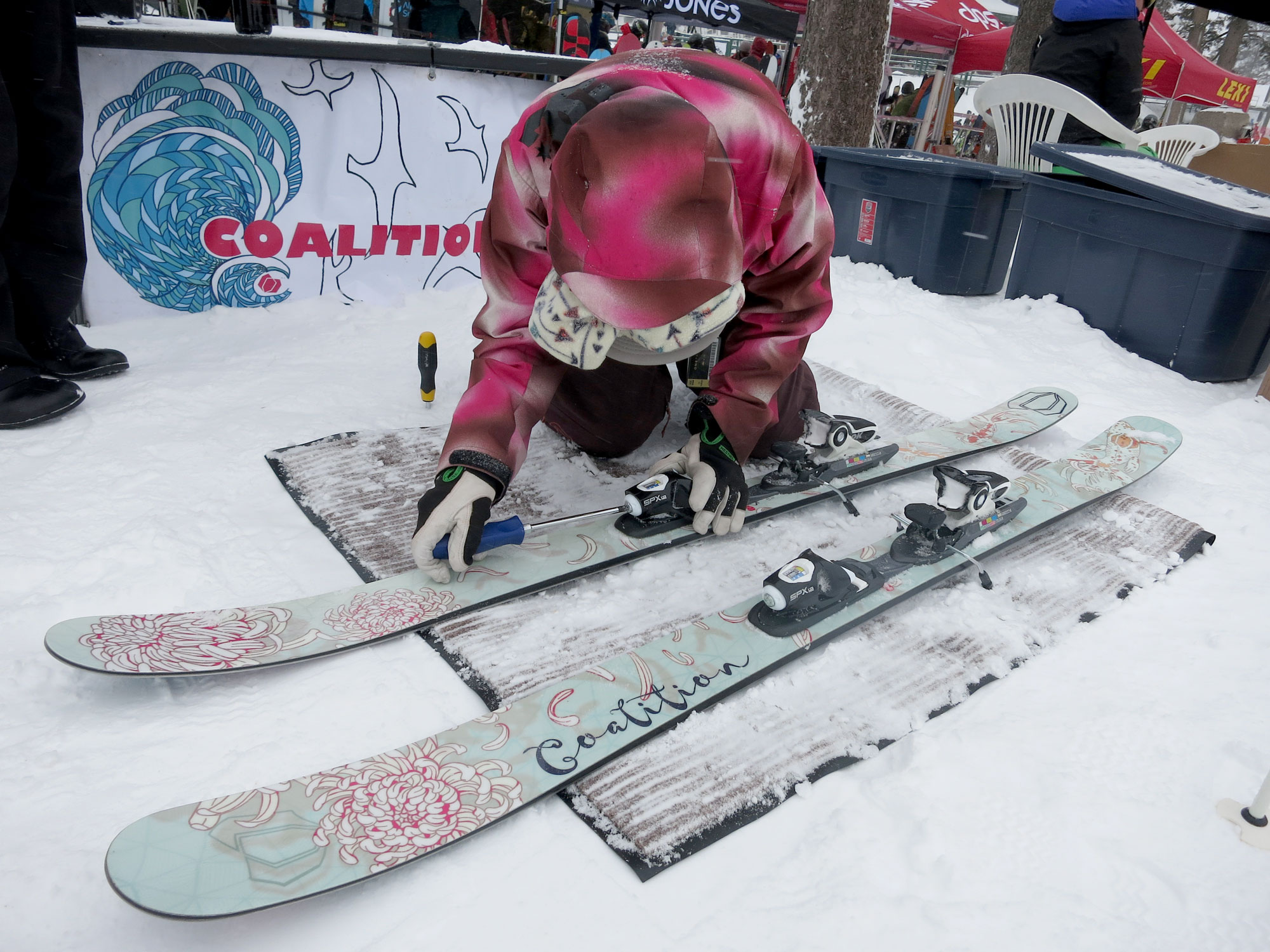
Jenn Sheridan of the women's ski and snowboard line Coalition Snow sets up a pair of SOS all-mountain skis. Photo/Jessie Marchesseau

Jenn Sheridan of the women’s line Coalition Snow sets up a pair of SOS all-mountain skis. Photo/Jessie Marchesseau

By Jessie Marchesseau

ALPINE MEADOWS – New ski and snowboard gear can set you back hundreds or even thousands of dollars. Most of the time we’re expected to spend this money based solely on the recommendations of salespeople, friends and gear reviews.

Occasionally you can catch a ski or snowboard company doing a demo day at a local ski resort, allowing you to try out their lineup. While a side-by-side comparison of different brands would often prove more useful, it’s not generally an option.

However, on Jan. 21, Tahoe City’s Alpenglow Sports hosted North America’s largest backcountry gear demo event. More than 20 vendors came out to share their wares with the skiers and riders at Alpine Meadows.

For 11 years running, the Lake Tahoe Backcountry Demo Event has provided skiers and riders the opportunity to ride this year’s top-of-the-line telemark, alpine skiing, touring and snowboard gear.

Testing out the gear is totally free, and hundreds of snow sports enthusiasts took advantage, as did I. Mixed in with the major ski companies like Blizzard, Salomon, and Volkl was a selection smaller, less mainstream ski companies. Those were the ones which piqued my interest.
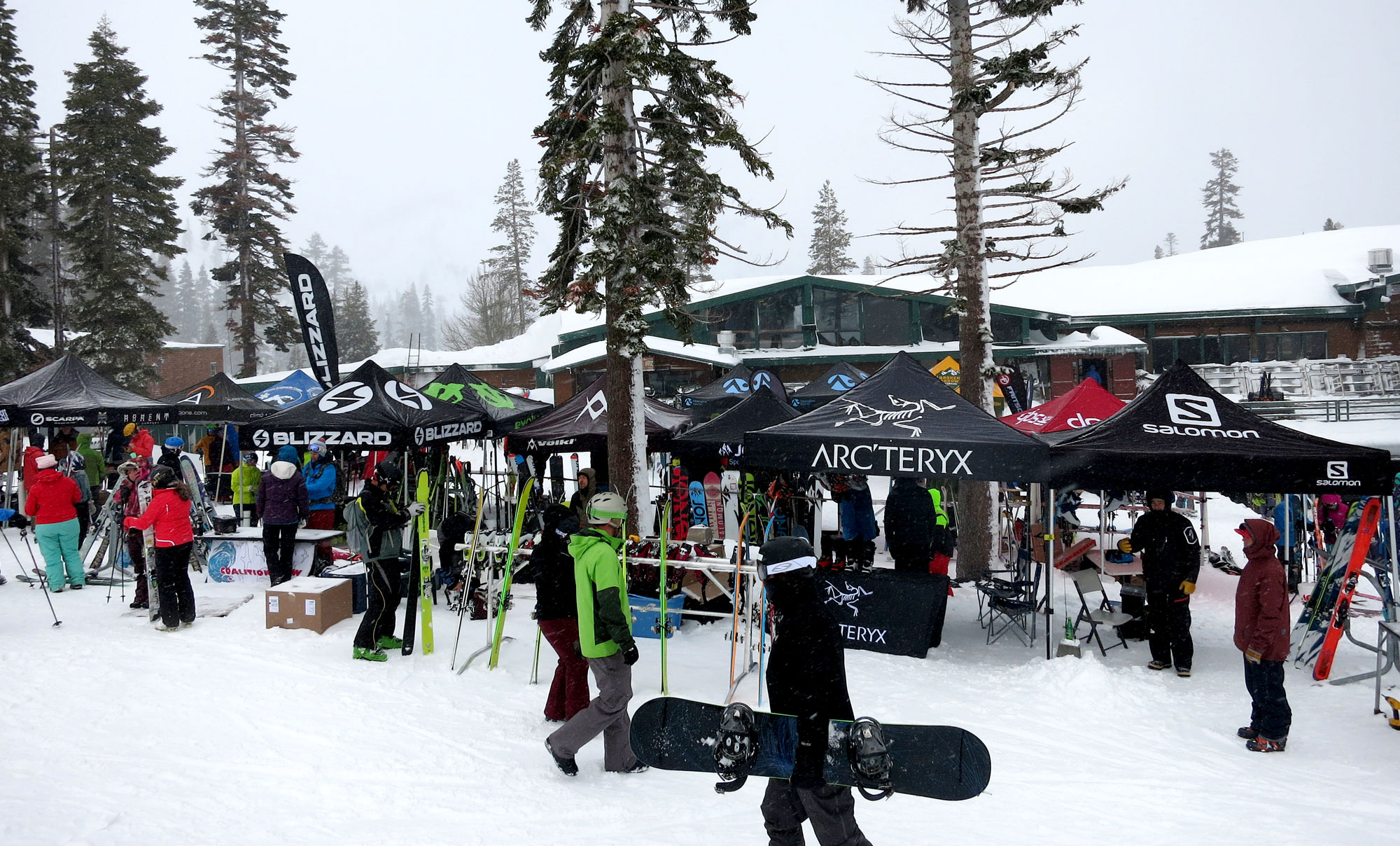
More than twenty vendors set up shop at Alpenglow Sports' 11th Annual Lake Tahoe Backcountry Demo Event at Alpine Meadows on Jan. 21. Photo/Jessie Marchesseau

More than 20 vendors set up shop at Alpenglow Sports’ 11th Lake Tahoe Backcountry Demo Event at Alpine Meadows on Jan. 21. Photo/Jessie Marchesseau

The gear test

My first stop was Coalition Snow. I’ve heard of the women-run ski and snowboard company, but had never seen any of the gear in person. Based in Truckee, Coalition Snow was started by a group of women fed up with riding skis and boards designed for men. Their lineup of snow sticks is engineered specifically with women in mind. Coalition’s creative director Lauren Bello assured me there is no reason men can’t ride their gear, they even had a few men demo it that day, it’s just designed with a focus on the way females ride.

I’m not usually one to judge a ski by its cover, but I have to admit, the stuff was pretty. I think I may have drooled a little over the peacock feather topsheet of the Abyss powder ski. Ultimately though, Bello suggested I test out the SOS. It’s a solid all-mountain design and what their website calls a “one-quiver” ski. I normally ski on a 166 length, but she put me on a pair of 173s, assuring me they ski shorter. She was right.

A full 7 centimeters longer than what I’m used to, the skis didn’t feel too long at all. In fact, after a couple runs, I was thinking maybe I could go even longer. They smashed through the crud with a little help from the rockered tip and tail, and even though I didn’t test them out on a groomer, I have no doubt the traditional camber underfoot would arc a nice turn there, too.

Next, I made my way over to the Moment tent. I’ve been dying to try a pair of handmade skis from the Reno-based ski company for years, but always seem to miss the local demo days. Colton Shaff, and intern with Moment, put me on the Hot Mess in a 172. The women’s version of the popular PB&J, it’s an all-mountain ski with camber in the center and rockered tip and tail.

At first glance, I thought the Hot Mess may be a little too narrow for the afternoon’s chopped up crud. On the contrary, they charged right through. I didn’t find myself being tossed or bounced around, but instead felt like I was in four-wheel drive, crushing everything in my path. Not bad for a ski that was only 91mm at the waist.

For my final test ride of the day, I asked Alpenglow manager Jeff Dostie to hook me up with a ski. He grabbed one from a collection of brightly-colored skis all the way at the other end of the aisle. I wasn’t familiar with the company, but they seemed to have the largest presence at the event. The ski brand was DPS.

Based out of Park City, DPS has been around for a decade, constructing skis out of materials such as carbon, bamboo and even balsa wood. Dostie handed me a pair of Foundation Nina 99s in a 168 and I was off to the chairlift. Much like the other skis I had been riding all day, DPS considers this a middle-of-the-road, all-mountain women’s ski. I admit, having never heard of the company before, my expectations for the skis were not high. They proved me wrong.

The choppy crud I had been skiing all afternoon suddenly felt like butter. Smooth sailing all the way to the bottom. I thought perhaps the wind had just filled in the ruts, so I tried again on a slightly more bumped out slope: the same thing. Cut, camber, construction or some combination of all three, the skis managed to practically cancel out any unevenness underfoot. I was smitten.

While all the skis I rode were fun and legitimate contenders for my next ski purchase, the DPS took the cake for me. More of a boutique ski company, and, according to Dan Benshoff, director of marketing and PR, the pioneers of the carbon fat powder ski, DPS has the prices to reflect the exclusivity, ranging from $799 to more than $1,200.

“When they can get out there and ski and have fun, that’s what it’s all about,” Benshoff said of giving people the chance to demo their skis. “It’s not easy to sell a $1,200 ski, but once they ski and experience and see what it’s all about, they get it.”

And while that price tag may be a lot to swallow, I totally get it.

Colton Shaff works on a pair of Moment Hot Mess skis at the Moment demo tent. Photo/Jessie Marchesseau

Colton Shaff works on a pair of Moment Hot Mess skis at the Moment demo tent. Photo/Jessie Marchesseau

The event

I was far from the only one testing out gear last weekend. The annual event averages more than 500 participants a year, both resort and backcountry riders.

I rode the chairlift with Monica, a local who was excited to be trying out a new pair of Scarpa boots she’d had her eye on. She was riding them with the same DPS skis she had at home, but with a different binding. She explained how she has been skiing with A/T bindings but was considering switching to telemark. Trying the new boots and bindings on skis she already owned was a great way to see if she would like the new setup with her existing skis.

A few chair rides later I met Chris from Folsom. He had on a pair of Salomon skis, his fourth pair of the day. It was his first time at a demo event, and he readily declared the Moments and Black Diamonds his favorites so far. Accustomed to riding relatively narrow skis, he was enjoying the opportunity to try out some fatter more powder-oriented ones.

Both the conditions of the day and the available terrain provided an ideal opportunity to test a variety of ski types. Known for its backcountry and sidecountry access, Alpine Meadows is a “natural fit” for this demo event, said Brendan Madigan, owner of Alpenglow Sports.

Madigan explained that backcountry snow sports is the only growing segment of the snow sports industry right now. This is part of the reason he believes the event is so important, and so successful. The way Madigan sees it, everyone benefits.

Alpine Meadows benefits from hosting the largest consumer backcountry event in North America. Ski companies get the chance to have hundreds of people try their gear. And, most important, skiers and snowboards have the opportunity to try myriad gear before they purchase.

This was Moment’s sixth year as a vendor at the Lake Tahoe Backcountry Demo Event. Dane Dacus, event coordinator and ski builder for Moment, said the consumer is the biggest winner of the day. “Otherwise they’re buying something on a hope and a dream and a prayer,” he said.

Alpenglow even added non-gear companies to the list of partners at the event this year such as Sierra Avalanche Center, Clif Bar and Alpenglow Expeditions. Their booths stood alongside companies including DPS, Black Crows, Dynafit, Tecnica, Blizzard, G3, Scarpa, NTN, Salomon, Scott, Marker, Volkl, Twenty-Two Designs, La Sportiva, Voile, Moment, Julbo, Fly Low, Jones Snowboards and more.

With so many options in one place, the event is a goldmine for anyone considering new backcountry, alpine, telemark or snowboard gear.

Madigan said Alpenglow hosts the annual demo day, not so much for the shop, as for the community. “We’ve been doing it because we want to share the passion behind the sport,” he told Lake Tahoe News. “We feel we want to support the community who supports us.”


Opinion: Sanctuary is an integral part of human nature

By Linda Rabben

Since Donald Trump’s election, I’ve had to change the focus of the talks I give at churches, community events, universities, schools, and bookshops about sanctuary and asylum.

I used to take audiences on a 125,000-year tour of these two venerable institutions. I’d tell them about bonobos, chimps and baboons giving sanctuary to members of enemy primate communities; about the ancient custom of seeking sanctuary by touching the garment or body of a powerful priest or ruler; about 1,000 years of church sanctuary in England and other countries; about the Underground Railroad, Holocaust rescuers, and the Sanctuary Movement of the 1980s.

But recently, at a high school in suburban Maryland, the students’ first question was, “What can we do to help refugees and asylum seekers right now?” They also wanted to know how I, as an activist, keep going in the face of politicians’ racist and xenophobic attacks on people fleeing persecution, torture and murder.

“First of all,” I said, “I’m a very stubborn person, prone to indignation about injustice.” I explained that I try to undertake modest efforts to help migrants in my local community, so I can see short-term, positive results. And I said that those who defend and protect refugees and asylum seekers are part of something much bigger than themselves, something that’s been going on for thousands of years.

Giving refuge to the stranger is in our DNA. We’re a highly social species, as likely to welcome outsiders as to drive them away. Hospitality, protection, welcome, and refuge are ingrained in our customs and behavior. In many societies studied by anthropologists and historians, hospitality may be extended to members of hostile communities. Offering refuge to strangers diversifies the gene pool, encourages innovation, and enriches cultural practices. It institutionalizes empathy, mercy, sociability, and openness.

Shelter for those accused of wrongdoing or fleeing from persecution or slavery has existed in every major religious tradition and in numerous societies since time immemorial. Its recorded history goes back at least 5,000 years. Sanctuaries have included altars, churches, temples, cities, and sacred groves. Asylum comes from the Greek word asylos, “inviolable,” which referred to sacred spaces in ancient Greece to which slaves could flee from cruel masters.

Even the ancient Romans, who were not renowned for their compassion, built temples where slaves and miscreants could flee. When Christianity became the official religion of the Roman Empire, the Catholic Church borrowed sanctuary from other traditions. Church sanctuary lasted for more than a thousand years in Europe, until governments abolished it in the 17th century, because it interfered with their control of the legal system. The Treaty of Westphalia, which ended the Thirty Years’ War in 1648 and laid the foundations of modern international law, proclaimed provision of asylum as a sovereign right of nation states. Thus asylum, a secular institution under state control, replaced religious sanctuary in the law.

Over the past 500 years, government asylum and religious sanctuary have sometimes run along parallel lines, sometimes conflicted and sometimes diverged. During the 20th century, governments started passing laws to restrict access to asylum, especially before, during, and after wars, when massive numbers of desperate, persecuted people sought refuge.

In response to the flight of refugees from Germany and other European countries in the 1930s, the principle of nonrefoulement came into international law. It stipulates that no asylum seeker may be returned to a country where he or she will be persecuted, tortured, or killed. The Universal Declaration of Human Rights, adopted by the United Nations in 1948, proclaims, “Everyone has the right to seek and to enjoy in other countries asylum from persecution.” But despite signing many international agreements and passing national laws that mandate these principles, governments have often violated them for political and economic reasons.

So sanctuary usually operates outside or against the law. The Underground Railroad was an illegal, secret movement, some of whose leaders were prosecuted, fined, or imprisoned. Holocaust rescuers risked death, and some were killed, for hiding thousands of Jews. The U.S. government prosecuted leaders of the 1980s Sanctuary Movement for harboring or smuggling migrants.

Yet sanctuary thrives as a powerful expression of resistance to unjust laws. It is often a deliberate act of civil disobedience. Giving sanctuary may mean accepting the risk of prosecution to obey what its practitioners consider a higher law. Sanctuary has life-saving meaning to those who seek it and is a moral imperative for those who provide it. That is where its power lies.

At the peak of the 1980s Sanctuary Movement, some 400 churches and dozens of cities gave shelter to thousands of Central Americans denied asylum in the United States. The churches’ and cities’ efforts, along with widespread opposition to U.S. backing of murderous regimes in Central America, helped change U.S. foreign and immigration policies. After 1988, the U.S. government lessened support for repressive governments in that region and allowed more Central Americans to stay in the United States. 

The New Sanctuary Movement started about 10 years ago, to aid Mexican and other migrants living in the shadows. Over the past two years, dozens of churches around the country have given sanctuary to undocumented people, for months at a time. The migrants waited in the safety of churches and synagogues while their lawyers negotiated with the government for suspension of deportation orders. Then the migrants returned to their U.S. families to await the outcome of their cases. These are a few among many examples of successful sanctuary, in highly publicized instances where local communities know and support migrants and their families.

For decades U.S. enforcement agents have refrained from raiding schools, hospitals, and houses of worship. The government seems to have recognized that invading traditional safe havens would arouse public outcry. However, U.S. Immigration and Customs Enforcement, or ICE, could cancel this “sensitive-locations policy” at any moment, leaving sanctuary-giving institutions vulnerable to government intrusion.

Even during the Obama administration, agents raided private homes without warrants, sometimes under false pretenses. They arrested undocumented high school students on their way to school, parishioners in church parking lots, and patients outside hospitals. More than 2 million undocumented people were deported from the U.S. between 2009 and 2016. ICE increased the number of detained migrants in 2016 from 34,000 to more than 40,000 per day, in hundreds of facilities. Like the Reagan administration during the 1980s, the Obama administration refused to recognize most Central American asylum claims. The government detained thousands of migrant mothers and children, even after federal courts ordered their release.

The Trump administration already has shown that it will show no more mercy toward undocumented people or would-be asylum seekers slated for detention and deportation. In response, increasing numbers of people are likely to offer sanctuary in houses of worship, educational institutions and their own homes. As millions of desperate people flee persecution, war, and environmental disaster, and governments refuse to shelter them, asylum is under threat all over the world. But history teaches that sanctuary is an integral part of human nature. It will last as long as people of good will are ready to risk welcoming the stranger.

Linda Rabben is an associate research professor of anthropology at University of Maryland and the author of “Sanctuary and Asylum: A Social and Political History” (University of Washington Press, 2016) and other books on human rights. 


Study: Hospital patients do better with women docs

By Efali Luthra, Kaiser Health News

When patients go to the hospital, they hope for a doctor who is knowledgeable and experienced, but new research suggests they might start wishing for something else: a woman physician.

That’s because female doctors may on average be better than their male counterparts at treating patients in the hospital and keeping them healthy long-term, according to findings published last month in JAMA Internal Medicine.

The study, conducted by a team of researchers at Harvard, examined a random sample of Medicare patients hospitalized between January 2011 and December 2014 treated by general internists. Overall, the researchers scrutinized more than 1.5 million hospitalizations, controlling for differences in hospitals and patient cases.

Read the whole story


Antique TV show looking for Tahoe valuables

“American Pickers” is returning to the South Shore this spring.

This is a documentary series that explores the world of antique picking on. The hit show follows Mike Wolfe, Frank Fritz, and their team hunts for  America’s most valuable antiques. 

The pair hopes to give historically significant objects a new lease on life, while learning a thing or two about America’s past along the way.

“American Pickers” is looking for leads. Anyone with a large, private collection or accumulation of antiques that the pickers can spend the better part of the day looking through is asked to send their name, phone number, location and description of the collection with photos to americanpickers@cineflix.com.


Measure T deemed invalid, unconstitutional

By Kathryn Reed

South Lake Tahoe’s Measure T is not valid.

That was the decision today by El Dorado County Superior Court Judge Jim Wagoner.

He ruled that the measure was unconstitutional, unenforceable and fundamentally flawed. These are the same arguments the city said from the get-go.

Measure T was put before the voters in November asking them to decide if they should have a say via the ballot process on the loop road.  (The proposed loop road would realign Highway 50 in the state line area.) The question, though, was not that straightforward. It would have prevented the City Council from being able to do its job; one of the reasons it was ruled unconstitutional.

Jason Collin before he got elected to the council last fall filed a lawsuit challenging the measure. His goal was to have the court decide before the election. Wagoner said he’d decide after the election. That decision came Jan. 27.

Collin was not able to attend the Friday hearing in Placerville because he is out of town at a conference. By phone he told Lake Tahoe News he is happy with the outcome.

“I hope we solve issues like this farther upstream in the future,” Collin said. “It’s not a good use of time and resources for anyone.”

The city was the defendant because it is the entity that put the measure on the ballot at the request of the Measure T proponents. 

“It is as done as it possibly can be because the only people who could possibly appeal is the city and we are not going to,” City Attorney Tom Watson told Lake Tahoe News.

The proponents have no recourse. Bruce Grego, who was one of the Measure T backers, had not read the decision and therefore could not comment.


Ganong ends U.S. World Cup drought

By Nick Zaccardi, NBC Sports

Travis Ganong ended the U.S.’ longest drought between men’s World Cup wins since 2000, while teammate Steven Nyman‘s season is over after he was airlifted off the downhill course after crashing in Garmisch-Partenkirchen, Germany, on Friday.

Ganong prevailed by 0.38 of a second over Norway’s Kjetil Jansrud to notch the first U.S. men’s World Cup win in any discipline since Oct. 25, 2015.


Ganong and Nyman are the only U.S. men to make a World Cup downhill podium the last three seasons. In 2016, the U.S. went a calendar year without a men’s World Cup win in any discipline for the first time since 1999.

Read the whole story


Letter: Successful Festival of Trees & Lights

To the community,

What a lively and jubilant occasion at Barton Health’s eighth annual Festival of Trees & Lights. It is always a treat to see the delight in children’s eyes as they admire handcrafted trees and seek “treatment” for their injured teddy bears at the Teddy Bear Hospital.

This year, we achieved several festival records. More than 4,300 people attended the event and, thanks to private donations, 100 families-in-need received free admission and photos with Santa. The event topped the fundraising charts and community members raised $90,000 to support the expansion of Barton Health’s Cancer Wellness Program. These funds will give all cancer patients and their families from the South Tahoe region access to complimentary services that enhance their physical, social, and emotional well-being.

This four-day extravaganza would not be possible without the support and generosity of our community. More than 300 volunteers helped set up, design trees, run activities, dress up as holiday characters, and ensure the four-day event went smoothly. Extra kudos to Marsha Ticas, Michelle Gomez, Joanne Donmoyer, Gary Colton, and Calee Allen who put in a combined 200-plus hours of their time.

I would also like to express gratitude to our festival sponsors, donors, and local entertainers. It truly takes a village to put on this extravaganza. On behalf of the Barton Foundation staff, board of trustees, and festival committee, thank you to our “village” for making this festival a record-breaking success.

Kindle Craig, executive director Barton Foundation


Western governors’ group putting on art contest

The Western Governors’ Association is sponsoring a regional art competition that challenges high school students to create works inspired by their state.

Entrants must create an original two-dimensional artwork inspired by their state or informed by living in the West. Students may draw ideas from a variety of sources, including state history, landmarks, natural resources, national parks and monuments, people, communities, and culture.

It is open to high school students in the 19 Western states and three U.S.-flag islands served by the nonpartisan policy association. 

Winning artists will receive cash prizes and their works will be displayed at an upcoming WGA Governors’ meeting, as well as on the WGA website.

For more information, go online.


Founder of Miaplaza to give talk at SNC

Johannes Ziegler, founder and CEO Miaplaza Inc., will give a talk at Sierra Nevada College in Incline Village on Feb. 15.

In 2004, Ziegler started Miaplaza Inc., focused on “social networking for everyone.” Initially, the company partnered with traditional media conglomerates to help them transition to more interactive customer relationships. When Facebook took over the general social networking space, Ziegler led Miaplaza Inc. through a radical transformation into a company focused on interactive online educational platforms for children.

The free talk is from 11:45am-12:45pm in room TCES 139/141.