Nonprofit gives free ski trip to disabled vets

By Brad Branan, Sacramento Bee

Accidentally shot by a fellow U.S. Army soldier, Larry Celano suffered a spinal cord injury that left him unable to walk. After earning a Purple Heart for his service in the 1989 Panama invasion, Celano worked as an accountant for five years before continued medical problems led to an early retirement.

Despite the setbacks, Celano said he tries not to let his disability get in the way, including going on ski trips in the Sierra the last two years.

“Last year the goal was not to get hurt,” the Chandler, Ariz., resident said as he got ready for a run at Alpine Meadows ski resort. “This year the goal is to go a little bit faster.”

 Celano was one of 17 veterans who received an all-expenses-paid trip last week from Achieve Tahoe, a nonprofit organization based at Alpine Meadows and a national pioneer in helping the disabled ski and participate in other “high-challenge” sports.

Read the whole story


Power outage in Meyers-Christmas Valley

About 3,ooo people in the Meyers-Christmas Valley area without power this afternoon.

Liberty Utilities believes a fuse blew because customers on the streets of Oglala and Mandan reported hearing a bang or boom at about 3:20pm Jan. 29.

Crews are on their way to determine the exact cause of the outage. Liberty also told Lake Tahoe News there may be downed wires.

Until the exact cause is determined there is no estimated time when power will be restored.

— Lake Tahoe News staff report


K’s Kitchen: Sweet potato crust quiche

By Kathryn Reed

Crusts are one of those things that often keeps people from making pies or quiches. This recipe will make you rethink that dreaded crust.

Not only is this easy, but it’s healthier than most crusts.

The best thing for cutting the sweet potatoes would be a mandolin. I’m still struggling to figure out how to use mine, so the slices were not all uniform. It didn’t matter. But you will want them to be a similar thickness and not even a quarter inch thick.

The flavor of this quiche is outstanding. It’s a medley in the mouth with the sweetness of the potatoes, the tanginess of the cheese and the smooth, richness of the egg-spinach concoction.

Don’t reserve this just for breakfast. It’s good for lunch and dinner, too. And reheated, just as good as fresh out of the oven.

quicheSweet Potato Crust Quiche

Cooking spray

2 medium sweet potatoes, peeled and cut into thin slices

1 tsp canola oil

½ C onion, diced

5 ounces baby spinach

½ C milk

¼ tsp kosher salt

¼ tsp pepper

¼ tsp red pepper flakes

4 large eggs

2 large egg whites

1/3 C feta cheese, crumbled

Preheat oven to 350 degrees.

Coat a 9-inch pie plate with cooking spray. Layer sweet potatoes in plate – on the bottom and sides. Coat potatoes with cooking spray. Bake 20 minutes or until potatoes are slightly tender. Remove from oven.

Increase oven temperature to 375F.

Over medium heat sauté onion in oil until opaque. Add spinach. Cook until wilted.

Combine milk and next 5 ingredients (through egg whites) in a medium bowl.

Arrange spinach mixture in crust, then pour egg mixture over spinach. Sprinkle with feta. Bake for 35 minutes or until egg mixture is set. Let stand 5 minutes before serving.


Biggest NorCal traffic jam? Try Tahoe

By Tony Bizjak, Sacramento Bee

Where’s the biggest traffic jam in Northern California this weekend? Try Tahoe. 

With sunny skies, clear roads and plenty of snow, tens of thousands of skiers, snowboarders, families and other recreationists are hitting mountain highways this weekend, creating hourlong traffic jams in some areas around Lake Tahoe.

“It’s ‘blue bird weather’ up there this weekend,” Caltrans spokeswoman Deanna Shoopman said. Any sunny weekend after a few weeks of heavy snowfall, “everybody has the same idea,” she said.

The result this weekend, much like the recent Martin Luther King Jr. holiday weekend, is traffic backups at numerous crossroads and main corridors, notably in Truckee, where Highway 89 heads to Squaw Valley and Alpine Meadows, and on the often congested roads in the South Lake Tahoe and Stateline area.

Read the whole story


Chickenfoot’s Tahoe concert featured on new album

Chickenfoot’s latest two-CD set has 13 songs from the group’s two shows at Harrah’s Lake Tahoe in March 2016.

The CD — “Best + Live” — will be released this March.

Chickenfoot is comprised of Sammy Hagar, founding Van Halen bassist Michael Anthony, Red Hot Chili Peppers drummer Chad Smith and guitarist Joe Satriani.

The first disc is songs from the group’s past, while the second is the live performance at Tahoe. Many of those songs are not new, though.

— Lake Tahoe News staff report


Reno’s Jitloff returns to racing with 20th place

By USSA

GARMISCH-PARTENKIRCHEN, Germany — Tommy Ford (Bend, Ore.) picked up his third Audi FIS Ski World Cup top-15 giant slalom result of the season, finishing 14th on Sunday.

Austria’s Marcel Hirscher skied to his 20th career World Cup giant slalom victory by a massive 1.50 seconds ahead of Matts Olsson of Sweden in second and 1.95 seconds in front of Stefan Luitz of Germany in third. With his victory, Hirscher pulled farther ahead of Norway’s Henrik Kristoffersen, who finished seventh Sunday, in the overall World Cup standings.

Tim Jitloff (Reno), who is returning to form following a back injury last month, posted his first top 20 of the season, finishing 20th on the demanding and dark Kandahar course.

“Considering I couldn’t walk two weeks ago, I’m pretty damn happy about today,” Jitloff said. “It was a solid effort, and the skiing was not bad at all – the second run I just had an unlucky mistake there that cost me probably a top 15.”

Ford started 26th and finished 10th in the first run. In the second run, he made a slight mistake, but kept charging to the finish.


Sunday’s race was the final World Cup giant slalom before next month’s FIS Alpine World Ski Championships in St. Moritz, Switzerland. 


Injured skier rescued from Donner Pass area

A backcountry skier had to be rescued from the Flora Lake area on Friday.

The skier, whose name has not been disclosed, was one of four who left from the Donner Pass rest area on Interstate 80  on Jan. 27. An injury to the man’s leg prevented him from continuing.

A California Highway Patrol helicopter retrieved him from the back country at about 1pm. An ambulance took him to Tahoe Forest Hospital in Truckee.

— Lake Tahoe News staff report


Hight snares gold in X Games halfpipe

By USSA

ASPEN, Colo. – California women took two of the three podium spots in halfpipe at the X Games on Saturday night. Elena Hight (South Lake Tahoe) won her first X Games gold medal and Chloe Kim (Torrance) earned bronze.  

In a contest where only six of 18 runs were landed, Hight rose above the field by being the only athlete to land both of her passes. She put down a highly technical run that included a back-to-back 900 combo and an alley-oop backside rodeo. The 27-year-old already owns three silver and two bronze medals, but it was her first gold in 13 appearances.

Kim, who was the three-time defending gold medalist, also put down a technical run full of switch tricks but it wasn’t enough to top the field in 2017. Kim and Hight were joined on the podium by Xuetong Cai of China, who earned silver.   

Seven-time X Games halfpipe champion Kelly Clark (West Dover, Vt.) finished just off the podium in fourth. Arielle Gold (Steamboat Springs, Colo.) was sixth; Maddie Mastro (Wrightwood) was seventh; Hannah Teter (Meyers) was eighth.


Icy Emerald Bay a treat to Hwy. 89 foot traffic

emerald bay-lead

Emerald Bay is frozen at the west end. Photo/Kathryn Reed

By Kathryn Reed

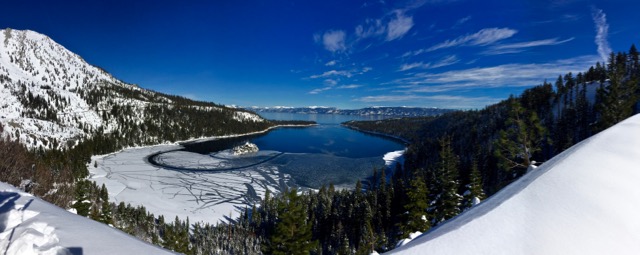
EMERALD BAY STATE PARK – Splintered ice on the bay’s edge gives way to a deep sapphire hue. Inviting, mesmerizing, magical. Emerald Bay.

With Highway 89 closed, now is the time to explore this area on foot. For decades it was the norm for the South and West shores to be cut off all winter. Now, with modern technology, the highway is rarely closed more than a few days in the winter.

But this has not been an ordinary winter.

“The amount of snow and the timing of the storms are what have made this season challenging so far to keep it open. We have snow piled up as high as 30 feet on the highway in some locations,” Steve Nelson, spokesman for Caltrans, told Lake Tahoe News. “There are about a dozen slide areas in that 4-mile section of the highway, and it’s not just snow that falls down – it’s large boulders, tree limbs, entire trees in some cases.”

A large amount of snow still covers Highway 89, making off-limits to vehicles. Photo/Kathryn Reed

A large amount of snow still on Jan. 28 covers Highway 89, making it off-limits to vehicles. Photo/Kathryn Reed

Compounding the problem is that three blowers are in the shop for repairs and crews have not even reached the main slide.

The good news is that the scar from last fall’s Emerald Fire is remaining in place. Kit Bailey, Lake Tahoe Basin Management Unit’s chief fire officer, told Lake Tahoe News, “The Emerald Fire area is holding up great.” He has been making periodic visits to that section of Highway 89. “It’s a testament to the excellent post-fire mitigation that took place on a slope with a high-use transportation route.”

When the original highway was built in 1930-31 it was to link Highway 70 on the north to Highway 50 on the south.

“With the construction methods available at that time, the road closely followed the lay of the land, following ridge lines and older wagon trails along the edge of the lake. This resulted in a number of very dramatic vistas from the route, particularly in the area around Emerald Bay,” according to the Federal Highway Administration.

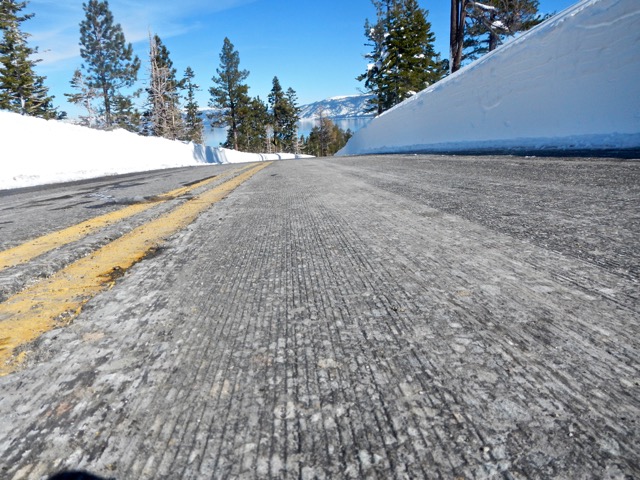
According to Caltrans, profile grinding on the highway makes the road level. Photo/Kathryn Reed

According to Caltrans, profile grinding on the highway makes the road level. Photo/Kathryn Reed

Sixty years later this stretch of highway was overhauled a bit. Slope stabilization was a main part of the $9.2 million, 18-month project that started in April 1992. The entire road was closed for six weeks, with alternating traffic the rest of the time.

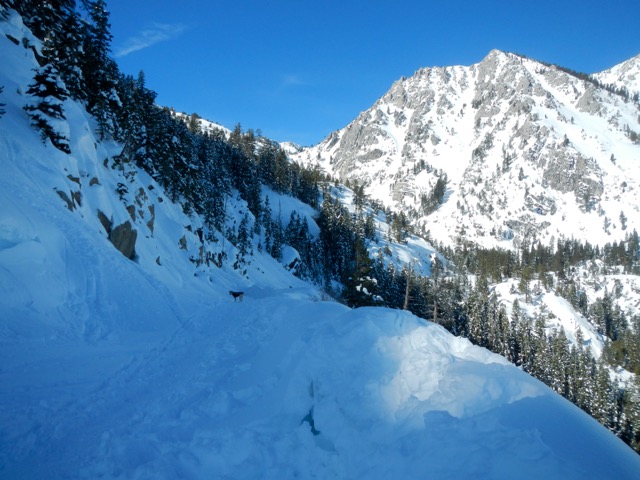
On Saturday people in all types of footwear were walking along the road. On the south side it is pavement – though slick in some locations –  from the gate to just past Inspiration Point. After that a fairly worn path is accessible without the need for snowshoes. Those coming from the D.L. Bliss area to the north had snowshoes on.

Others took off into the trees to make fresh tracks on their skis and snowboards.

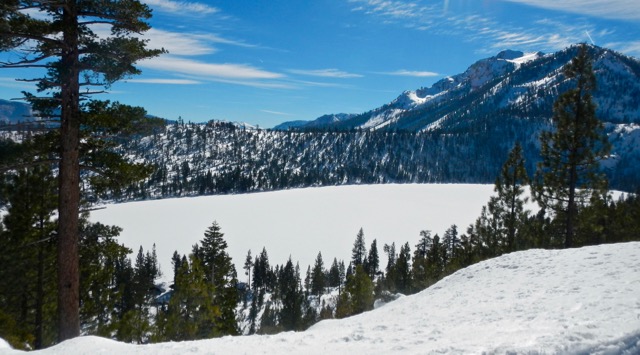
Cascade Lake looks like an ice rink in need of a Zamboni machine. Photo/Kathryn Reed

Cascade Lake looks like an ice rink in need of a Zamboni machine. Photo/Kathryn Reed

We stopped as the trail narrowed and the path went up a bit. One slip and that would have easily been a fatal fall. After all, this is prime avalanche area.

We had seen what we came for – Emerald Bay in all her glory. And the views were not going to get any better.

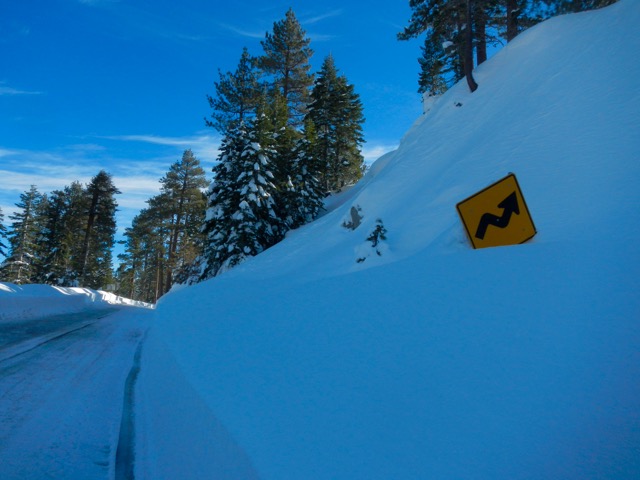
Most of the road signs near Emerald Bay are at least partially buried. Photo/Kathryn Reed

Most of the road signs near Emerald Bay are at least partially buried. Photo/Kathryn Reed

Most of the area between the western shore and Fannette Island is a layer of ice. It’s obvious a boat has plowed through it. Chunks of ice float near the mouth of the bay. A sailboat barely enters before deciding to turn around.

The last time the entire bay froze was January 1993 when the mercury hit minus 28 degrees in South Lake Tahoe. Prior to that the bay was solid ice in February 1989; the temperature in South Lake Tahoe was minus 29.

With not a whisper of wind, the bay is like glass. The few clouds seem to dance across the water, looking more like steam rising than a reflection.


Opinion: Why Groundhog Day elevates science over superstition

By Dan Blumstein

I am a scientist who loves Groundhog Day, that least scientific of holidays. Every February, as Punxsutawney Phil shakes the dust off his coat, emerges from his burrow, glances at his shadow (or not) and allegedly prognosticates winter’s end, I gather a group of professors, graduate students and other assorted science geeks at my UCLA lab to nibble, drink, schmooze and revel in ground-hoggery in all its magnificent splendor.

I study the behavior, ecology and evolution of groundhogs and the 14 other species of marmots—large, charismatic ground squirrels that live throughout the Northern Hemisphere. I realize that these rodents can’t tell us when seasons will change. I know that the whole idea of celebrating a mid-winter festival in Los Angeles’s usually balmy clime also makes little or no sense. I know that hanging out with a taxidermied animal I stuffed myself might seem a bit quirky for a tenured professor.

But Groundhog Day—and its inherent absurdity—also serves as a reminder to me and my colleagues of why we do what we do. The United States has prospered in no small part because of our commitment to supporting science and technological innovation. With each new advance—from the automobile to the polio vaccine to computers to space travel—we have reinvented ourselves and the world around us. Scientific discovery is at the core of America’s success. Conversely, an Internet meme a few years ago wondered, “Why is that only in America do we accept weather prognostication from a rodent but deny climate change from a scientist?” But for my colleagues and me, groundhogs are symbols of science, not superstition.  

At my annual lab celebration, posters of groundhogs and plush stuffed groundhogs—not to mention a glittering Swarovski crystal specimen, given to me by UCLA’s Department of Ecology and Evolutionary Biology as thanks for years of service as department chair—add to the ambiance. Groundhog-themed comics festoon the lab walls. “Two Buck Chuck”, our stuffed adolescent groundhog, presides over the festivities perched in one corner. One fall long ago, when I was doing my postdoctoral research, I found him dead on the side of the road and threw him into the freezer. My wife Janice and I had to wait to stuff him until Christmas break, when the smell associated with thawing and skinning him would be less offensive to our lab mates.

We’ve been holding our Groundhog Day fête since 2001. America has been at it far longer than that. Groundhog Day was originally a reimagining of Candlemas Day, a Catholic mid-winter festival which itself had roots in a pagan celebration. Europeans observing Candlemas tracked hibernating hedgehogs to predict when winter would end. When the Pennsylvania Dutch came to our shores, they too looked for a hibernating mammal that might help them monitor the weather.

Woodchucks, also known as groundhogs, were native and seemed to fit the bill: males popped up out of their burrows each February, probably checking things out and deciding when they should start waking up females to mate. The new Americans took notice, and Groundhog Day was born. 

Since 2001, I have run a long-term study, initiated 55 years ago by my mentor Ken Armitage, now an emeritus professor at the University of Kansas. Armitage is the world authority on marmots, and is credited with emphasizing the importance of their annual cycle, which varies by location, in explaining why marmot sociality varies. It was Armitage, actually, who first came up with the idea of celebrating Groundhog Day. He used to host the members of his lab at his house, serve “ground hog” (a.k.a. sausage), and recite marmot poetry. 

The study follows individually-marked yellow-bellied marmots at the Rocky Mountain Biological Laboratory in Gothic, Colo. The value of the work is rooted in its longevity—it’s one of the longest-running studies of its kind and an important tool for studying evolution in action. The animals are now emerging about a month earlier in the spring than they did 30 or 40 years ago.

Understanding how individuals respond to environmental change is essential if we want to predict how animals will react to global warming and other human-driven habitat shifts.

Science is what I do. I’m thrilled and inspired by being able to spend my days uncovering the secrets that hide in plain sight around us, and to use my marmot studies to train students to think critically and objectively. Our grand American experiment has prospered when it has the best possible information—and I know that the scientific method is a very efficient process for revealing nature’s truths. This is the spirit in which I commemorate Groundhog Day—celebrating America’s devotion to science, not just superstition.

Dan Blumstein is a professor at the UCLA Department of Ecology and Evolutionary Biology and the UCLA Institute of the Environment and Sustainability. His seventh book, “Ecotourism’s Promise and Peril: A Biological Evaluation,” will be published by Springer in 2018. This was written for Zócalo Public Square.