Brian Boyer — 1968-2018

Brian William Boyer

Brian William Boyer of South Lake Tahoe passed away unexpectedly at home on May 9, 2018. He was 49.

Brian was born on July 4, 1968, in Van Nuys to Brian and Pamela Boyer. The family moved to South Lake Tahoe in the summer of 1971. Brian attended Meyers Elementary School, South Tahoe Middle School and South Tahoe High School, graduating in 1987.

Brian loved Lake Tahoe for all its beauty, all the activities it offered and all the great friends he made through the years. Brian loved snowboarding, golfing, mountain biking, tennis and being out on the lake with friends. 

His dad was in construction and taught him carpentry. He excelled at it and took great pride in his work. He enjoyed helping his mom plant flowers and taking care of the yard. He loved doing things with his favorite nephew Thomas. They liked to watch his Cowboys play football together. He would always make sure to tell everyone what a good mother his sister was.

Brian will be remembered for his warm smile and great laugh. He will be greatly missed by all.

He was preceded in death by his sister, Christine Carol.

Brian is survived by his father, Brian, mother Pamela, his sister Kimberley, nephew Thomas and many aunts, uncles, and cousins.

A celebration of life for Brian will be on June 2 from 2-6 pm at Revive Coffee & Wine in South Lake Tahoe.


Opinion: Shroud of secrecy envelops S. Lake Tahoe

By Kathryn Reed

Public Records Act requests sent to the city of South Lake Tahoe seem to disappear into a dark hole that never see the light of day.

It is the city clerk, Suzie Alessi, who is responsible for responding to them. She is an elected official who is only answerable to the residents. Her seat will be on the November ballot. In the past she has said this would be her last term. Let’s hope she keeps her word since she doesn’t do her job well.

According to the city’s website, “The city clerk oversees, promotes and encourages open and participatory government.”

It’s what the position is supposed to do. It’s the opposite of what is going on today.

Alessi doesn’t actually have to show up for a regular 9am-5pm, Monday-Friday workweek. And she doesn’t. She comes and goes as she likes. No one knows when she might show up. She takes extended leaves. If she shows up in some inappropriate state, there is no one to tell her to go home, no one to discipline her.

If she doesn’t do her job, there are no consequences. The media or another entity could sue to get the public records. The city would then be liable for those attorney fees if it were to lose.

Lake Tahoe News has asked for a variety of records. In early April LTN sought text messages. The last correspondence from Alessi was on May 3 when she wrote, “Estimated date of completion is middle to end of next week.”

Still no records.

Then LTN started investigating the theft of Councilmember Austin Sass’s iPhone 7 and iPad Air 2. He told police they were stolen from his vehicle on the morning of April 6. The car was parked in front of St. Theresa Church, where his wife works. The vehicle was not locked.

Sass called the police chief, who then let dispatch know. Sass left the church even though the officer arrived seven minutes after being notified. The councilman was tracked down at the gym where he works out.

The city’s IT department tried to track the devices, but they were turned off. Why carry them, if you can’t be reached? Why not just have them on silent if you don’t want to be disturbed?

There is no proof they were actually taken from the vehicle. With the devices deliberately turned off, it meant they could never be traced. Iphones when turned on can be found even from another phone.

The devices went missing just as Sass was asked to turn them in because of multiple PRAs. The timing is suspicious.

According to the city’s Information Security Policy, “All messages created, sent, or retrieved over the internet are property of the city of South Lake Tahoe.”

Police Chief Uhler was asked why on the police report it says the case is closed. Uhler told Lake Tahoe News, “A lack of investigative leads routinely leads to closing cases. Attempts to ‘ping’ or use device locating didn’t pan-out in terms of finding the devices. Lastly, just because it is closed at this moment in time, doesn’t mean we cannot open the case in the event we receive investigatory information or catch some thief with the device in his/her possession.”

The city has a phone and IT policy of which at least staff is to follow.

Tom Stuart, human resources director, was brought into the conversation by Uhler.

On May 3, LTN asked Stuart these questions:

·      The cell phone policy says employee cell phone bills will be monitored by department heads. Does anyone monitor the calls of City Council members?

·      Do any other elected officials have city issued cell phones?

·      How many employees have city issued phones; and may I please get those numbers by department? Same for tablets and laptops?

·      What is the cost to the city on an annual basis for electronic devices in terms of hardware, and then service plans?

·      Will Austin Sass have to pay for his devices to be replaced or will the city? If the city, what is the cost?

·      Do council members ever get copies of both of the (IT policy) documents? Do they have to sign anything that says they read it and agreed with it?

·      It says email messages will be deleted after 45 days. Are they backed up on a server for a longer period of time? How long?

·      What is the threat of confidential information that would have been on Sass’s devices from being accessed? Is the city concerned about what was on the devices?

·      Is there a way to have the manufacturer prevent the devices from being accessible? Are these Apple or some other brand?

·      And what kind of data was on the phone that could be accessed by whoever has the devices? Email? City documents? Anything confidential?

·      Are the devices insured?

On May 8, Stuart said, “I have forwarded your questions to Susan Alessi for response.”

The questions had also been sent to acting City Manager Jeff Meston.

Naturally, Alessi has not responded. Legally, she has 10 days to respond. There are exceptions, but the person requesting the records is supposed to be notified why the 10-day limit will be exceeded. That didn’t happen in this case.

Most of these questions are pretty straight forward and have no business falling under the category of a Public Records Act request.

The delay by Alessi is suspicious as well. How is anyone to know if she deletes documents that would be less than flattering to her?

This city is so incredibly screwed up. It’s time to clean house. It’s time to elect responsible people to all the positions. It’s also time to think about no longer having an elected city clerk, after all, most cities don’t.


Opinion: Wildfire knows no season

By Lisa Herron

What began as a very dry winter in the Lake Tahoe Basin ended with Sierra snowpack approximately 85 percent of normal, thanks to heavy precipitation received during the month of March. However, both the National Interagency Fire Center (NIFC) and the Reno National Weather Service (NWS) expect a warming trend to develop that will lead to drier than normal conditions by late spring. 

As a result, the below average snowpack is expected to melt faster, grasses and other vegetation are expected to dry out earlier and wildland fire activity is likely to increase to above average by mid-summer.

“Although we received a great deal of precipitation during the month of March, we are on track for an above average potential for significant wildfire activity this summer,” said U.S. Forest Service fire management officer Steve Burns. “It’s important to keep in mind that in the U.S., year-round fire seasons have become the new normal, which means for people living in fire-prone areas like the Tahoe basin, wildfire preparedness is essential.”

Across the U.S., nearly nine out of 10 wildfires are human-caused with illegal and unattended campfires being the biggest source of human-caused wildfires. In 2007, an illegal, abandoned campfire was the cause of the Angora Fire, which burned more than 250 homes, 231 acres of private property and 3,072 acres of National Forest land near South Lake Tahoe. The public can help the Forest Service and other fire agencies prevent these human-caused ignitions by learning where and when campfires are allowed and making sure campfires are completely extinguished using the Soak, Stir and Feel method before leaving. On National Forest land in the Tahoe Basin, campfires are only allowed in designated campgrounds and never on the beach, in Desolation Wilderness or in the general forest. For more information about campfire safety, go online and/or go here.   

The Tahoe Fire and Fuels Team (TFFT), which consists of the Forest Service and other state and local partners, has thinned and removed excess vegetation on more than 70,000 acres of National Forest and other lands around communities in the Tahoe basin to reduce the threat of severe wildfire.  Forest thinning projects, also known as fuels reduction projects, are a top priority for the Forest Service and the TFFT and will continue to be implemented each year in the Tahoe basin. In order to complement Forest Service and TFFT fuels reduction projects, there are important steps residents and communities must take to improve defensible space and community wildfire preparedness at Lake Tahoe. 

Springtime in the Sierra is the perfect time to complete defensible space clean up around homes, review evacuation plans, sign-up for reverse 911 with cities and/or counties, contact local fire districts to schedule free defensible space evaluations, learn about free chipping services and talk to neighbors about the importance of wildfire preparedness. 

The time to prepare for the next wildland fire is now. Permanent residents, second-home owners and vacation home owners/renters should familiarize themselves with and follow advice found here and here on how to prepare their homes and neighborhoods for the next wildfire. Remember it’s not a matter of “if” the next wildfire will occur, it’s a matter of “when.”

Another step toward wildfire preparedness is to sign-up for the Tahoe Network of Fire Adapted Communities (TNFAC) newsletter. TNFAC provides community members with education, communication and advice; facilitates collaboration between communities and stakeholders; helps communities organize events and neighborhood-level vegetation removal projects and tracks community accomplishments. 

Lisa Herron works for the Lake Tahoe Basin Management Unit.


What to do about ticks and mosquitoes

By Joyce Sakamoto and Shelley Whitehead, The Conversation

Cases of vector-borne disease have more than doubled in the U.S. since 2004, the Centers for Disease Control and Prevention recently reported, with mosquitoes and ticks bearing most of the blame.

Mosquitoes, long spreaders of malaria and yellow fever, have more recently spread dengue, Zika and Chikungunya viruses, and caused epidemic outbreaks, mainly in U.S. territories. The insects are also largely responsible for making West Nile virus endemic in the continental U.S.

Ticks, which are not insects but parasitic arthropods, actually cause more disease in the U.S. than mosquitoes do, accounting for 76.51 percent of total U.S. vector-borne disease cases. These include Lyme disease and Rocky Mountain spotted fever and newer diseases as well.

Why the uptick in vector-borne disease, and more importantly, how can we protect ourselves from potentially serious diseases? As researchers of these types of diseases, we have some answers.

Blood: The high cost of living

Both mosquitoes and ticks transmit disease-causing pathogens through bites.

Only the female mosquito takes a blood meal to make eggs, but almost all life stages of ticks need blood to survive.

Although mosquitoes were first demonstrated to have the ability to transmit diseases in 1889, mosquitoes have been transmitting diseases for far longer. Written records as early as 2700 B.C. suggest malaria plagued humans in China.

The first suspected dengue outbreak occurred in the early 1600s, but it took three centuries for the first three mosquito-borne diseases – malaria, dengue and yellow fever – to invade the Americas. Yet, in the past two decades alone, we’ve experienced a wave of three more mosquito-borne diseases – West Nile, Chikungunya and Zika viruses. This marked increase in disease spread is due to several factors, including advances in air and water travel and warming temperatures.

The high cost of international travel and trade

The international tire trade has made Aedes albopictus, the Asian tiger mosquito, a global traveler. This mosquito gains passage on cargo ships and gets unlimited access to man-made containers, which it needs for breeding, in the thousands of tires on board these ships. Rainwater collecting in the tires are ideal breeding sites. Even though it is not a major vector of dengue, Chikungunya and Zika viruses, this invasive species is still especially dangerous. It is able to outcompete most other mosquito species that live in similar habitats.

We humans serve as hosts for many vector-borne diseases, and our own movement can aid transmission. We can hop on a plane and be in a different country within hours. Diseases once quarantined to other regions of the globe can now be easily transported within an infected human. Some people don’t even realize they are sick. Researchers have estimated that up to 80 percent of individuals infected with Zika virus are symptomless. Yet, if the right vector feeds on a symptomless but infected person, transmission can still occur.

Increased climate fluctuations, largely due to human activity, can also affect how vector-borne diseases spread. Warmer climates may allow mosquitoes to survive in areas previously too cold to support them.

Predicting the outcome of warming on overall vector populations can be difficult. If, for example, summer in the deep Southeast becomes too hot and dry for mosquito development, peaks in transmission and mosquito numbers could shift to the fall. Higher temperatures may shorten the time it takes for pathogens to develop within mosquitoes, so mosquitoes may become infectious faster and transmit pathogens sooner.

Tick-borne diseases

Five percent of 900 tick species are known to transmit disease-causing microorganisms. Because 38 percent of all tick species have been known to bite humans, researchers will likely find more tick-borne diseases. Since 2004, there have been nine new vector-borne diseases described in the U.S., and seven of these are tick-transmitted, including the two potentially fatal Bourbon and Heartland viruses.

Most, or 82 percent of tick-borne disease cases, are Lyme disease, which is caused by the bacteria Borrelia burgdorferi, and transmitted by the blacklegged, or deer, tick. Cases of Lyme, Rocky Mountain spotted fever, babesiosis, anaplasmosis and ehrlichiosis have increased two-and-a-half to six-and-a-half fold.

Tick-borne diseases may be rising due to global travel, animal transport, habitat fragmentation and changing climate. Climate change is correlated with range expansion of several important tick species. Ticks previously limited by cold winters are now becoming established farther north. In response to the arrival of Lyme disease to Canadian soil, the Public Health Agency of Canada responded with a Federal Framework on Lyme Disease focused on disease surveillance, education and awareness, and best practices for control, prevention and treatment of Lyme disease.

What can you do?

To lower your risk of transmission from mosquitoes:

  • Check backyards for anything that could hold water and empty such vessels. This includes children’s toys, bird baths, empty soda cans and flower pots.
  • Use mosquito repellents that are EPA approved. Avoid natural repellents that haven’t been verified for their effectiveness.

To prevent tick bites:

One sure way to prevent tick bites is to avoid suitable habitats for ticks, but this isn’t always possible. Large-scale habitat control or acaricide (tick-killing) treatment of wildlife, though possible, can be difficult or not cost-effective for homeowners. The best preventative measures are:

  • Use CDC-recommended repellents such as DEET or picaridin.
  • Shower and do a thorough tick check.

Tick checks are absolutely crucial. People usually follow this routine after going outdoors, but sometimes forget. And, they often avoid places that ticks love, such as between your legs. Hard-to-reach areas are prime real estate for blood-feeding parasites that don’t want to be dislodged, so make sure to check: the hairline (especially on children), torso, belly button and groin. If necessary, get assistance or a mirror and a bright light.

If you find an embedded tick, correctly dislodge it with fine-tipped tweezers, grasping the part closest to the skin and pulling straight up. Do not burn, squeeze, twist or smother the tick, since this may cause it to regurgitate. Gross-out alert: Any pathogens they have in their saliva can then be dumped into the bite site.

After removal, keep the tick for identification; different species transmit different pathogens. Finally, see a doctor after finding an embedded tick or if you think you have been bitten. In addition to getting medical attention, your data will be added to the national list of reported tick-borne diseases.

The CDC has several pages dedicated to vector-borne disease control and prevention. Local state health departments, general practitioners and veterinarians will also have recommendations for prevention, treatment and vector control. Talk to your veterinarian about repellents or agents that will kill mites called acaricides for pets, since some can be toxic to cats.

Joyce Sakamoto is an assistant research professor of entomology at Pennsylvania State University. Shelley Whitehead is a doctoral candidate of entomology at Pennsylvania State University.


Calif. lawmakers take on plastic pollution

By Rosanna Xia, Los Angeles Times

It took years of activist campaigns to turn the plastic bag into a villain, and hard-fought legislation to reduce its presence in oceans and waterways. Now, environmentalists and lawmakers are deploying similar tactics against a new generation of plastic pollutants.

There are drinking straws, which as a viral video shows can get stuck in a sea turtle’s nose. The hundreds of thousands of bottle caps that wind up on beaches. And the microfibers that wash off polyester clothes, making their way into the ocean, the stomachs of marine life and ultimately our seafood.

Each is the subject of statewide legislation under debate in Sacramento, as California again considers new environmental law that’s at once pioneering and controversial.

Read the whole story


PCT hiker reported missing

By Jessica Johnson, Sacramento Bee

A 67-year-old experienced backpacker who has been on the Pacific Crest Trail since March has gone missing.

Stephen McGuire of Washington state was last seen on May 18 by another hiker who was concerned that McGuire looked tired and was low on food.

When McGuire didn’t pick up his planned food resupply in Mammoth, concern grew and he was reported missing May 23.

Read the whole story


Military prosthetic technologies benefit more than vets

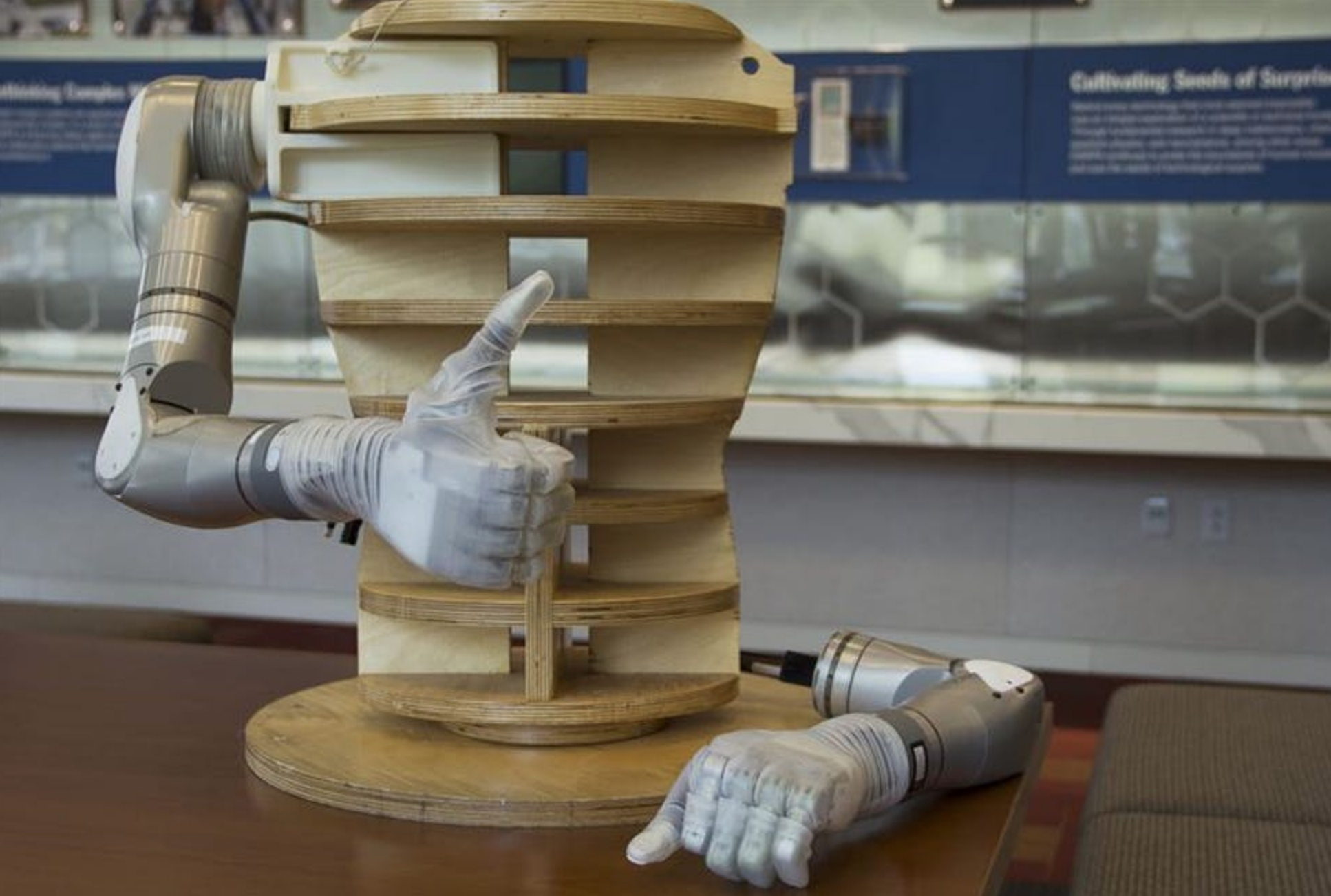
The Luke Arm is revolutionary. Photo/U.S. Department of Defense

By Mark Geil, The Conversation

In 1905, an Ohio farmer survived a railroad accident that cost him both of his legs. Two years later, he founded the Ohio Willow Wood company, using the namesake timber to hand-carve prosthetic limbs. The company grew, surviving the Great Depression and a fire that destroyed the plant, and still thrives today in rural Ohio. Few who work there now might remember the curious footnote in the company’s history that occurred during World War II, when the rebuilt factory was diversified to build parts for PT boats and B-17 bombers.

Today, it is ironic to consider a company that specializes in prosthetic limbs building parts for the war machine that unfortunately increases demand on companies making prosthetic limbs. Indeed, the tragedy of war has pushed prosthetics researchers to work ever harder to help service members and veterans who have lost limbs.

Not only are soldiers losing limbs from IEDs; older veterans are losing limbs from diabetes and vascular disease. Mobility is key to long-term health, and prosthetic limbs are key to mobility.

That has made the U.S. Department of Veterans Affairs a key player in prosthetics development and technological innovation. But what is created for service members and veterans has benefits far beyond them, helping nearly 2 million Americans – civilian children, elderly people and young adults with amputations – maximize their mobility.

A key funding source

As a biomedical engineer specializing in prosthetics, I’ve reviewed grant proposals seeking funding from the VA to research prosthetic limbs for several years.

The federal government has long played a vital role in advancing prosthetic technologies. Before the 1980s, prosthetic feet were adequate for standing and walking, but very limited for more intense activities involving running and jumping. Veterans Administration Rehabilitation Research and Development funds were used to develop the Seattle Foot. That device and its carbon-fiber contemporaries paved the way for “blade”-style prostheses seen in the Paralympics.

Decades later, defense-related government spending continues to drive innovation in prosthetics. The Defense Advanced Research Projects Agency has gained attention with the “Luke Arm,” named after a certain fictitious Mr. Skywalker, and headlines that read like they’re actually from Star Wars: “DARPA Helps Paralyzed Man Feel Again Using a Brain-Controlled Robotic Arm.”

For prosthetics researchers, funding from traditional sources such as the National Institutes of Health and the National Science Foundation has become remarkably difficult to obtain, at least in part because of competition. Consequently, many researchers have turned their attention to soldiers and veterans. In 2014-15, the Congressionally Directed Medical Research Program funded 18 proposals in Orthotics and Prosthetics Outcomes. But that funding is getting more competitive too: 98 proposals were rejected.

Connecting with the body

All this work is, generally speaking, focused on transforming a prosthesis from an external tool used by a person to an integrated replacement that becomes a part of a person. Much of the research involves taking small steps toward reproducing the grand complexity and robust design of human anatomy. We have not yet achieved the flashy and functional capability of a real-life Luke Skywalker with cranial nerves attached directly to motors in a robotic hand. But researchers have made important progress through intermediate steps.

A process called targeted muscle reinnervation can connect nerves carrying messages from the brain, like “close hand,” to a muscle over which a set of electrodes are placed. Those electrodes in turn send the signal to the motorized hand to close. Sensory feedback is being developed in a similar manner. While these efforts are not yet ready for everyday community use, they represent crucial progress.

Consider also a CDMRP-funded project at the Rehabilitation Institute of Chicago and Vanderbilt University. The lower-limb prostheses used are not just passive spring-like materials: They’re active, motorized joints. Motors require careful control, and the project headed by neuroengineering specialist Levi Hargrove has attempted to learn from the amputee’s muscles when she wants to transition from walking to, say, walking up stairs or down a ramp. Just like your phone’s voice recognition better understands your voice over time, Hargrove’s control algorithm allows the motorized prosthesis to make fewer errors in ambulation.

Clearly, projects like Hargrove’s stand to benefit much broader populations than just soldiers and veterans. My own research focuses on children with limb loss, and I see so-called “civilian spinoffs” every day. In our Center for Pediatric Locomotion Sciences at Georgia State University, we’re modeling the material and structural properties of pediatric prosthetic feet. Many of those components can be traced back to that original VA-funded Seattle Foot. Across town at the Shepherd Center, a renowned hospital specializing in brain and spinal cord injury, robotic exoskeletons help paralyzed individuals move their limbs and remap neural pathways, a project with connections to VA prosthetic research.

Though they won’t get the public recognition of the Jeep or GPS, these civilian spinoffs from military-funded research in prosthetics will have long-term benefits for people of all ages, and they’ll feel the results every day.

Mark Geil is a professor of kinesiology and health at Georgia State University.


Friends of Hope Valley workday, concert

Friends of Hope Valley’s annual workday is June 9 starting at 9am.

Meet at Pickett’s Junction to join in a work party. Projects include watershed habitat improvement, highway clean up and fence work. Bring work gloves, shovels, sun

block, hats and a snack. Projects will be completed by 11:30, allowing time to join the celebrations at Woodfords.

At Mad Dog Cafe a trio of local authors will be signing their local history books. Then at the newly-opened cafe there will be free hors d’oeuvres. Friends of Hope Valley membership meeting will be at the Café following the celebration.

The Friends of Hope Valley is a nonprofit organization whose members share a deep affection for the unspoiled beauty of the Sierra’s Eastern slope in Alpine County.

On June 10 Back Forty Bluegrass band will return for a Friends of Hope Valley benefit concert. This event will take place at Sorensen’s Resort in Hope Valley. Accompanying the Back Forty will be “local folkies” Larry Nair and Beth Oliverto, the Ten Dollar Pony.

Sorensen’s Resort will match the funds raised by the $10 tickets for the concert. The concert is from 1-4pm.

For more information, email info@hopevalley.com.


Parking lot changes in Truckee

Beginning May 29, the two-hour public parking lot commonly referred to as the Beacon lot located on Donner Pass Road in downtown Truckee, behind the Beacon gas station, will be closed for construction-related activities.

Two temporary parking lots are being constructed to replace the parking spaces at the Beacon. One is located directly adjacent to the Beacon lot in a northeast direction. The second lot is located approximately 200 yards east of the Beacon lot.

These two temporary lots will still be considered two-hour maximum parking lots. The lots will also be available for employee parking all day with the appropriate employee parking pass and as overnight parking areas.

The changes are necessary during the construction of the railyard project. As the project progresses, there will be more changes to the parking in this area.


Snippets about Lake Tahoe

·      Bijou Golf Course in South Lake Tahoe opens May 28.

·      On June 7, Douglas County commissioners will honor Assessor Doug Sonnemann who will end his 30-year career with the county following the election.

·      Here are the El Dorado-Tahoe and Sierra roadwork schedules from Caltrans for the week.

·      Margaret Cho is bringing her irreverent brand of stand-up to MontBleu in Stateline on June 30 at 8pm.

·      The meeting last week between South Lake Tahoe and El Dorado County officials, and Charter regarding KCRA going away in June on the South Shore didn’t change anything.