
What goes into a 10,000 foot day in the backcountry?

By Sage Sauerbrey, Moonshine Ink

Most people think of 10,000 feet as the altitude they can pretend to turn their electronics back on at during a long flight, but for professional athletes Josh Daiek and Abe Greenspan, it’s a full day in the Tahoe backcountry and the second installment of their “Tahoe Ten” series.

In coordination with the launch of their new ski film, “Tahoe Ten – Kirkwood to Hope Valley,” we decided to interview with Daiek and Greenspan about what it takes to link some of Tahoe’s rowdiest lines into a five peak, 20-mile, 10,000 foot, single day push.

How did the idea for “Tahoe Ten” first come about? Daiek, “Abe and I were hiking Mt. Tallac last season chatting up ideas for different link ups and how we could connect multiple ski tours into a single day. It didn’t actually start as ‘let’s go hike 10,000 vertical feet,’ it was more or less let’s see how far we can go.”

Read the whole story


Nevada tourism gurus revamping ad campaign

By Richard N. Velotta, Las Vegas Review-Journal

What’s the best way to lure prospective adventure-seekers to Nevada?

Is it an image of a park ranger and the mantra “when other states restrict, we allow”?

Or is it a campaign featuring a man with a beard, images of all-terrain vehicles and a message of “we go about things our own way”?

Those were the choices that were presented Wednesday to the marketing committee of the Nevada Commission on Tourism, which got its first glimpse of spring and summer ad concepts.

Read the whole story


Danger in Sierra: 50 closed until Sat., slides, floods

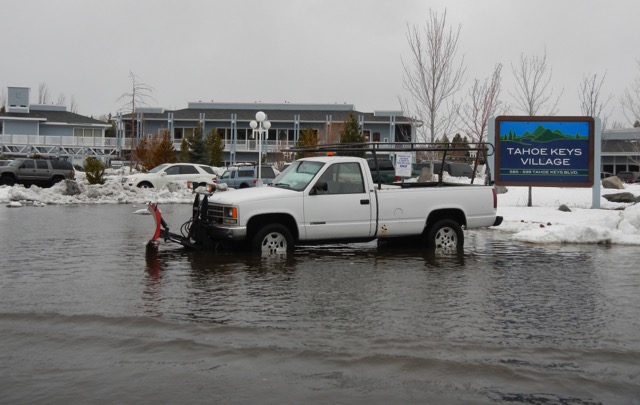
Flooding remains an issue throughout many parts of the Lake Tahoe Basin. Photo/Kathryn Reed

Updated 10:07pm:

Power is off for thousands of people in the Lake Tahoe Basin and Carson Valley areas.

“Road closures from flooding are hampering our crews’ efforts to get to the remaining outages in the Carson/Genoa/Gardnerville area,” NV Energy says on its website.

In the Kingsbury Grade area of Stateline there are four outages affecting 2,356 customers. The weather has caused poles and wires to come down. Crews are hoping power is restored by midnight.

There are 141 Liberty Utilities customers without power in the El Dorado County portion of the basin, while 93 Placer County customers are in the dark.

Travelers trying to reach Lake Tahoe are creating problems for law enforcement because they are blindly following what their GPS says.

“This has led to numerous parties getting stuck on roads that are closed during the winter, and in the end, tie up valuable resources rescuing them from deep snow or impassable roads,” El Dorado County sheriff’s deputies said in a statement. “In the winter, the only safe alternate route when Highway 50 is closed is to use Highway 88 to the south, or Interstate 80 to the North.  If you are using any other road that you are not absolutely familiar with and you see snow on the roadway, or the road turns to dirt; stop, turn around, and go back to main roadway.”

Updated 8pm:

A mudslide has closed Highway 50 between Meyers and Placerville. It is not expected to open until Saturday.

The Carson Spur is now open.

The long route to Tahoe on Friday night is via Highway 20 to Interstate 80. Travelers tell Lake Tahoe News this route is extremely congested.

There was a second avalanche Friday afternoon in the Crystal Bay subdivision near east Tuscarora Road.

First responders and public safety personnel are monitoring and assessing the situation.

Residents in the Crystal Bay area should exercise caution if accessing the slopes above their homes. 

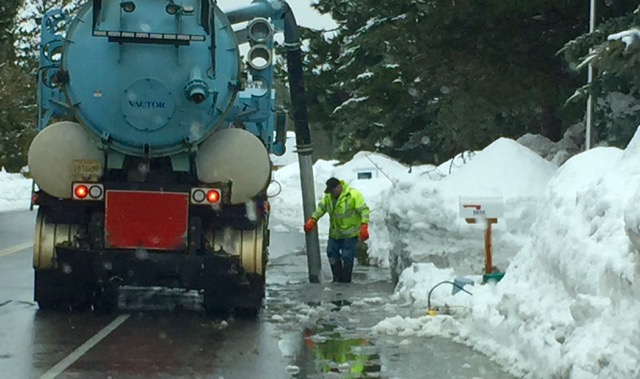
South Lake Tahoe crews on Feb. 10 unclog drains in the city. Photo/Kathryn Reed

Updated 4:23pm:

Because of avalanche activity this morning in the Crystal Bay subdivision near east Tuscarora Road, residents are being asked to avoid outdoor activity and to shelter in place until further notice. 

Incline Village residents woke up to more than 2 feet of snow Friday morning.

Sierra Avalanche Center said the danger level is considerable.

Interstate 80 is closed at Colfax because of a significant mudslide. Traffic is being diverted to Highway 20, though trucks are not allowed there.

“The soil is so saturated it can’t take anymore water. Something has to give,” Caltrans spokesman Steve Nelson told Lake Tahoe News.

Trees as tall as 100 feet came down in the slide.

Some have questioned whether all of Caltrans’ thinning of trees last year made the slopes unstable. Nelson said that wasn’t the case with this slide.

Traffic has been moving intermittently between Meyers and Placerville because of slides.

On Feb. 10 the Douglas County Board of Commissioners declared a state of emergency due to a flood and wind event that took place over the last couple of days. 

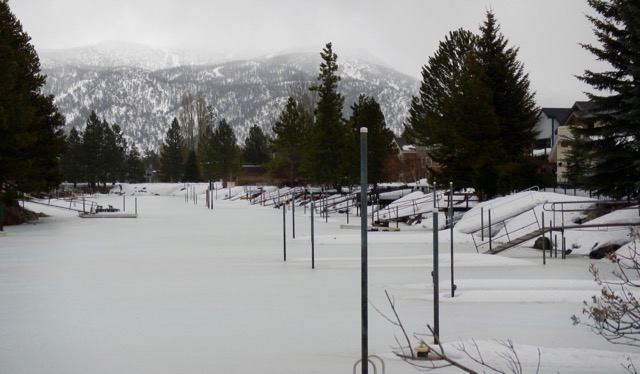
It’s hard to find the docks and the water with the snow and slush in the Tahoe Keys. Photo/Kathryn Reed

By Kathryn Reed

A flood warning for the greater Lake Tahoe area remains in effect until 9am Friday, with the winter storm warning going through Saturday at 1am.

The Upper Truckee River crested to 12.41 feet at about 4:40am Feb. 10.

“We are firmly in second for all time crest. Only the 1997 flood was higher,” Jim Marino, South Lake Tahoe assistant public works director, told Lake Tahoe News. In 1997 the river reached about 13.41 feet. “It will take days for the water to recede.”

Sander plows and loaders are on the streets to deal with flooding issues. No new flooding in South Lake Tahoe has been reported overnight, with the same areas reported on Thursday being an issue.

Pot holes will be addressed as soon as possible, Marino said.

While snow is generally better than rain in the Sierra, the temps are still on the high side so much of the snow is melting as it hits the ground. This is making roads slushy and means drains are clogging. This in turn leads to more flooding. 

In El Dorado County: 

  • Arapahoe Street is closed between San Diego Street and Country Club Drive due to a sink hole caused by a failed culvert.
  • Elks Club Drive is closed between Highway 50 and Waverly Drive. A culvert has failed.
  • Most of Waverly Drive is closed due to the condition of the road.

Snow levels are expected to drop this afternoon and evening. According to the National Weather Service in Reno, there could be 2 to 5 inches of snow by Friday night at lake level.

Truckee Tahoe Unified and Carson City schools are closed for Feb. 10. All Washoe County are on a two-hour delay Friday. Sierra Nevada College in Incline Village is starting classes at 1oam.

A flood warning continues for the Carson River near Carson City, from Friday morning to Saturday afternoon. The highest risk of flooding is in urban areas and along creeks and streams leading out of the Carson Range. The river is expected to hit the major flood stage late tonight or early Saturday.

Water is moving onto Highway 395 with the Cradlebaugh bridge expected to close. An alternate route to northbound Highway 395 is Fairview to Foothill to Jacks Valley Road.

Voluntary evacuations of the Aspen Mobile Home Park and Kingslane Mobile Home Park occurred late Thursday evening and Friday morning. The Community and Senior Center has been set up as a shelter and is taking evacuees and their pets.

Flooding and downed power lines have Mottsville, Centerville, Muller and Genoa Lanes in Gardnerville closed.

There is no estimated time when Highway 89 around Emerald Bay or Highway 50 near Logan Creek will open to allow traffic between the South Shore and Carson City via Spooner Summit.

Other highways leading into and out of the Tahoe basin are open, some with restrictions. Current highway information may be found by clicking on the state icons on the home page of Lake Tahoe News.

This is a warning from the Weather Service: “Each year, more deaths occur due to flooding than from any other hazard. The Centers for Disease Control and Prevention report that over half of all flood-related drownings occur when a vehicle is driven into hazardous flood water. The next highest percentage of flood-related deaths is due to walking into or near flood waters.”


NYT editor talks about importance of real news

New York Times Executive Editor Dean Baque and Caesar Andrews with UNR’s journalism department on Feb. 8 in Reno. Photo/David Calvert

By Linda Fine Conaboy

RENO – To some, the latest chapters in U.S. political history read like a catchy novel; to others, current changes are merely pulp fiction.

These are attention-grabbing times no matter how one views the unfolding daily drama floating over the political landscape.

In a conversation on Feb. 8 sponsored by the University of Nevada Don Reynolds School of Journalism at UNR and later that evening at the Nevada Museum of Art, New York Times executive editor, Dean Baquet (pronounced like valet), the current and the first black editor of the New York Times and previously, the Los Angeles Times, discussed the need to keep his paper nimble, open-minded and forward thinking.

His UNR audience consisted mainly of students, who were all exceedingly interested in the election of the new U.S. president and who peppered Baquet with hard-hitting questions about current issues such as fake news, accountability, integrity and presidential tweets.

Regarding his integrity as executive editor of a major newspaper, Baquet said he always tries to make sure associates don’t know where he stands on issues. “It drives some people crazy. Almost all of my friends are journalists, and I don’t know their political views either. I at least vote, but some other editors don’t,” he said, explaining their need for total transparency.

He said he avoids relationships with public officials and he didn’t meet President Barack Obama until near the end of his presidency.

He cautioned that in the newspaper business it’s imperative to hold people accountable, but to also remain objective. “Don’t take for granted what politicians say, be skeptical.”

He said President Trump has told many falsehoods, the first coming to his mind is the Obama birther issue. “It’s an effective cover to say things that are blatantly false.”

Baquet added that the new president’s tweets are particularly revealing. “He is the president of the United States. When he tweets, it’s an unfiltered view of the most powerful person in the U.S. It’s the closest view inside the mind of the president that we’ll ever get.”

Warming to his subject, he declared, “We must cover Trump. The things he does have huge consequences; what he does affects the lives of hundreds of thousands of people. Trump eats away at the trust in the media.”

Fake news is really nothing new, Baquet said, declaring there has always been fake news and pointing to the blatant and salacious headlines the National Enquirer spouts regularly as a case in point. However, he said, some fake news is designed to lessen the trust the public has in journalism.

“Journalism is not flawless, but what the First Amendment is meant to protect is under attack,” Baquet said. “Now though, fake news is on steroids. It’s insidious and puts more pressure on us to be honest and honorable.”

Facebook and other sites, he said, need to work harder to police it.

Because the fake news issue is on the minds of many, Baquet said his reporters are becoming exceedingly motivated.

“There’s an extraordinary clarity about what needs to be done. I remind [reporters] what our jobs are and the fact that we’re the opposition party necessitates that we ask hard questions. It’s not the job of journalism to be liked,” Baquet said.

He added that when people call the NY Times on a mistake, he and his staff will always own up to those mistakes and attempt to make them right.

Unfortunately, according to Baquet, all media now is in financial turmoil, but the NY Times less than others. “Now, more than half of our revenue comes not from advertising, but from our readers, and readers make measurable demands.”

Baquet said after the presidential election, he received many angry emails blaming the Times because Trump won the election. However, shortly thereafter, his emails took a positive turn resulting in a sizable and unexpected increase in circulation.

“There used to be a powerful world of great newspapers. But now the whole system has broken down,” he said. Nevertheless, according to Baquet, liberal media elitism is curable starting with getting out into the world and listening to people’s views.

“Objectivity is real and it is important. People have a right to unbiased news,” Baquet said.

He said his outlook on journalism has changed over the years.

“I am very confident about the future of journalism. There’s been a tremendous increase in readership. I’m probably more a believer in asking hard questions of powerful people now,” Baquet said. “We’re in for years of rapid change, but there have been periods like this before. We need to train journalists as much as possible. Journalism schools have a larger role than they have ever had and now it’s important to cross-train them.”

He explained that to his way of thinking future journalists must be comfortable not only in the world of words, but also be within the realm of the visual aspects of journalism.

What makes a good reporter? A good reporter listens, is open minded, is a voracious reader, especially of good novels, and is open to learning new ways to tell a story. “Everything in journalism has happened before, except now, we know more about it and we know it instantly.”

As he prepared to wind down his conversation, Baquet returned to the newly elected president.

“The myth of the uneducated person who voted for Trump is just that—a myth. He won the Republican vote; he won the vote of those who make a lot of money; he won votes from people who think the system is screwed up,” Baquet said. “A Trump voter is probably more sophisticated than we think. The political elite don’t understand the upheaval, but Trump seized on it. There are people who voted for Trump who also voted for Obama.

“It is my job to understand all sides of the story and to do this every day. I feel like I’m in a novel; you get a glimpse of the world you’re never going to get anywhere else.”

Opinion: Opportunities for Al Tahoe reopening

By Rebecca Bryson

At the last Lake Tahoe Unified School District board meeting, board members pondered the question of whether to reopen Al Tahoe Elementary School and if so to what purpose. The proposal on the table was to reopen it as a STEAM (science, technology, engineering, art and mathematics) center and theme school. 

As I read the proposal, I got excited. It sounded very forward thinking and state-of-the-art. I appreciated the inclusion of a daycare option for school employees and focusing STEAM — starting with all the preschoolers already there. However, I couldn’t help but think, isn’t there a way all of our elementary kids could have access to the science and technology resources described in the plan? Technology, robotics and engineering jobs are the wave of the future. These skills will be necessary for future jobs.  All of our students should have the opportunity to engage in innovative science and tech activities that engage their minds, promote analytical thinking, and prepare them for the future.

In addition, hands on robotics and coding programs are the kinds of activities that get many kids excited about learning. They provide a different type of learning opportunity where kids can be collaborative, inventive and work with their hands. It is intrinsically exciting. We need that. Teachers have told me that even their lower performing students can get excited about that.

I recently led a Girl Scout meeting where the girls were earning their home scientist badge. The Environmental Magnet school kids were quick to point out that they had all done all 15 experiments already in class — whereas the Bijou kids had only ever seen one. I know the teachers at Bijou try to fit science in where they can, but they don’t seem to have many resources or much support. This incident emphasized for me how deep the divide has grown. And I wonder, will another magnet school – especially one with a STEAM focus – further stratify the divide between our kids and pull science and technology resources and attention from our other schools at a time when we need them most? 

The district is working to integrate the New Generation Science Standards into our curricula. This is very positive, but the students’ curricula are seemingly jam packed already. The teachers will likely need extra training, resources and support. Now is the time to commit to taking our science programs to the next level for all our students.

To their credit, when these issues were raised at last week’s school board meeting, the school board members and staff addressed it. They discussed how STEAM resources from the Al Tahoe project could be brought to the other schools. And, if AL Tahoe is reopened, it would free up space at the other schools to create technology centers or hands on makerspaces at each school. Another suggestion was to make Al Tahoe more of a training center to support to teachers and staff across schools. Finally, they also discussed how to make it a strong neighborhood school as well as a theme school.  

We have a good group of new board members. I trust that Superintendent Jim Tarwater, the board, and staff will come up with a thoughtful plan for Al Tahoe. I hope they will continue to reach out to the public and families likely to be impacted to get input. Perhaps a survey, special session, or other type of community outreach strategy would be useful to garner public input. If you have positive solutions or options, get involved. Contact your school board representative, attend a PTA or Cafecitos meeting, or volunteer for your school site council group. 

No matter what they do at Al Tahoe, however, the larger question of equity and access to opportunity for all of our kids still remains. It is a concern of many parents I know. This issue is obviously very delicate and bears further research and discussion. But we — as a community (not just as a school district) — need to grapple with it in order to ensure that we enable all our children to thrive. But that is perhaps a topic for another article. As they say, full STEAM ahead (but in a way that all can participate).

Rebecca Bryson is a member of Tahoe’s Small World parent group. The mission is to create a global community of parents and families committed to ensuring a peaceful, livable, just planet for all children on Earth.


Starring Friday night: a full moon, a lunar eclipse, a comet

By Marcia Dunn, AP

Hope for clear skies. A full moon and comet share double billing in a special night sky show this weekend.

A lunar eclipse starts everything off Friday night. The moon will pass into Earth’s outer shadow, or penumbra. The moon won’t be blacked out like in a full eclipse. Only part of the moon will be shaded, but it should be easily visible from much of the world.

Comet 45P, meanwhile, will zoom past Earth early Saturday morning. It will be an extremely close encounter as these things go, passing within 7.4 million miles (12.4 million kilometers) of Earth. Its relative speed: 14.2 miles per second, or a breakneck 51,120 mph.

The comet, glowing green, will be visible in the constellation Hercules. Binoculars and telescopes will help in the search.

 Stargazers have been tracking Comet 45P for the past couple of months. The ice ball — an estimated mile across — comes around every five years. It’s officially known as Comet 45P/Honda-Mrkos-Pajdusakova, named after the Japanese, Czech and Slovak astronomers who discovered it in 1948. The letter P stands for periodic, meaning it’s a recurring visitor to the inner solar system.

The eclipse will last more than four hours, beginning at 2:32pm local time. The action will unfold early Saturday in Europe, Africa and western Asia.


Unity at the Lake looking for new home

Unity at the Lake’s days are numbered at the South Lake Tahoe owned building on Rufus Allen Boulevard.

The lease goes through Jan. 31, 2018. The city wants the building back to be able to use it on a temporary basis for recreation while the new permanent facility is built.

When the church signed the first contract in fall 2011 it was for five years. The City Council at the time didn’t learn about the deal until July 2012. Since that time the city has created rules for long term leases that get the elected involved early on.

“The whole experience was not good. It was not put out to bid. It was not a good process,” City Manager Nancy Kerry said.

The department head who signed the lease is no longer with the city.

At this week’s council meeting the five agreed to waive the monthly rent increase and to have the lease expire Jan. 31. Some flexibility will be granted if need be, according to staff.

No one from Unity was at the Feb. 7 meeting.

— Lake Tahoe News staff report


Tourist traffic in neighborhoods subject of meeting

El Dorado County Supervisor Sue Novasel is hosting a meeting Feb. 13 to discuss tourist traffic congestion.

There is a growing concern from neighborhood residents regarding online map applications that redirect travelers off the main roads and highways, and onto local roads and into neighborhoods.

Representatives from the El Dorado County Sheriff’s Office and California Highway Patrol will also be in attendance.

The meeting will be at the CCC headquarters in Meyers in the upstairs conference room starting at 6pm.


Bill would open primaries in Nevada

By Sandra Chereb, Las Vegas Review-Journal

CARSON CITY — State Sen. James Settelmeyer introduced a bill Tuesday seeking to open Nevada primaries to all candidates and voters, not just those registered as Republican or Democrat.

Senate Bill 103 is a do-over of sorts of a bill the Minden Republican brought in 2015 to create open primaries. But the final version of that bill had a way different outcome: Instead of allowing more voters to cast a vote, it denied tens of thousands an opportunity to vote for some races in the general election if the outcome was decided in the primary.

The bill would create a modified blanket primary system for partisan offices, where all candidates — not just those affiliated with a major political party — are on the ballot. The two candidates who receive the most votes would advance to the general election, regardless of party.

Read the whole story


Jack Johnson, Rebelution coming to Tahoe

Two shows have been added to the Harveys Outdoor Concert Series — Jack Johnson and Rebelution.

For the first time since 2014, Johnson is hitting the road. He will be in Tahoe on July 28. Tickets go on sale Feb. 17.

Fans who purchase a ticket will receive a download of Johnson’s new song, “Fragments,” which is also available for purchase or streaming on all music services on Feb. 17. The new material accompanies the film “The Smog Of The Sea,” a documentary that provides a new perspective on the once pristine oceans of the world, while making an artful call to action for rethinking single-use plastic. 

On the 2017 tour, additional greening actions include sourcing sustainable biodiesel for tour vehicles, producing up-cycled and eco-friendly merchandise, and expanding waste reduction, composting and recycling. The tour will also source local, organic food as part of a “farm to stage” program, offer bike valets and alternative transportation incentives, as well as offset all remaining CO2 emissions.

Tickets to the Stateline show are $70 plus fees.

Rebelution, a California Reggae band, will be in town June 30. Tickets for this general admission show are all $37.50, plus fees. Tickets go on sale Feb. 16