With pension reform looming, Calif. went on a hiring spree

By Adam Ashton and Phillip Reese, Sacramento Bee

On the eve of major pension changes that would crimp retirement benefits for new hires, a handful of California government agencies went on a holiday hiring spree.

The Board of Equalization hired 25 new faces that week. Seventeen reported for their first day of work on New Year’s Eve.

By beginning work in the waning days of 2012, the employees enrolled in the California Public Employees’ Retirement System just in time to gain a generous pension formula adopted during the dot-com boom of 1999 that allowed most public workers to retire at age 55.

By contrast, most employees hired after Jan. 1, 2013, would have to work until age 67 to gain their full benefits.

Read the whole story


Gaming numbers cruncher has lots to digest

By Richard N. Velotta, Las Vegas Review-Journal

This time of year, David Schwartz, the director of UNLV’s Center for Gaming Research, crunches more numbers than an accountant on a tax-filing deadline.

If it has anything to do with revenue generated on a casino floor, Schwartz has a chart filled with historical data to explain its significance.

It was a busy time for Schwartz last week because the state Gaming Control Board released its December numbers capping another calendar year.

Read the whole story


California’s roads are in dire shape

By Patrick McGreevy, Los Angeles Times
 
In more than four decades as a top transportation planner in California, Will Kempton says the state’s roads have never been in as bad condition as they are right now.

Kempton, 69, who is retiring as executive director of the advocacy group Transportation California, said he is “frustrated and disappointed” that California has failed for decades to agree on a plan to pay for a $136-billion backlog of repairs on state highways and local roads. Gov. Jerry Brown and legislative leaders said they will take another crack at reaching a deal during the next two months, which Kempton said is welcome news.

“This is the worst I have seen,” he said of street conditions in California.

Read the whole story


Truckee plans seven more roundabouts

By Jim Hemig, Moonshine Ink

We all have stories of out-of-towners who can’t seem to get it right. You know the ones, the drivers who stop right in the middle of the roundabout to let you enter, which is nice, but wrong. Or those who don’t even bother to look on their way in, blasting through the circle, oblivious to any other cars. At least it’s easy to spot the tourists in our town!

I personally love roundabouts, also known as traffic circles. Sometimes I’ll skip my exit and just go around and around. Is that legal?

I like them so much I have a hard time fully stopping at stop signs. Now, I know that’s illegal.

Fully on the roundabout bandwagon, Truckee now has seven, last I counted. Does seven seem excessive for a small town? What if I told you Truckee plans to add seven more in the next several years?

Read the whole story


Road Beat: Improved design on Sportage

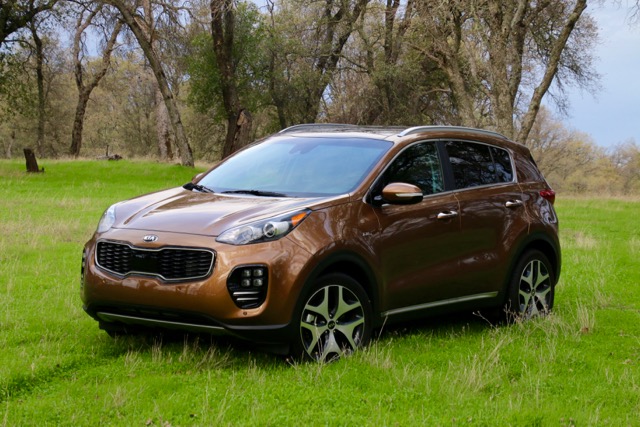
The latest Kia Sportage has substantive improvements. Photos/Larry Weitzman

By Larry Weitzman

Kia Sportage was launched in the United States in about 1994, a year after Kia arrived in the United States with the Sephia. Now in in its fourth generation, which came out about a year ago, the Sportage has grown by an inch and a half in wheelbase and length over generation three. While the new design, again by Kia President Peter Schreyer, it has a strikingly similar design with most changes in detailing. But the profile and window line are similar.

However, Schreyer’s design improvements make a big difference. It has lost some of its bulk, especially in the front end. The new Kia signature grille is smoother and more refined. It has been given a set of menacing four block driving lights a la the K900, Kia’s super luxury car. New taillights give the new Sportage a cohesive, slick modern look. Everything ties together beautifully. I am not a fan of the truncated window line and its “Hofmeister kink” terminating the rear window line. It gives the Sportage a bit of a stubby ending. Wilhelm Hofmeister was the legendary BMW designer who first used the “reverse” window line design in the 1961 BMW 1500.

Now with a length of just 176.4 inches on a wheelbase of 105 inches, Sportage offers an unusually large cabin because of its wide 73 beam. And no, this is no boat, unless you are thinking small deep “V” off shore racer, like a Reggie Fountain or Formula. It stands a reasonable 65 inches tall. Total interior volume is pushing 130 cubic feet and there is a solid m60 cubes behind the front chairs and half again as much behind the second row. This “small” CUV can definitely hail the mail in more wats than one.

Under the bonnet is one of two engines, the ubiquitous 2.4L DOHC, 16 valve inline wazoo four found in so many Kias and Hyundais today as well as some other manufacturers as this engine was designed by a consortium and it has been refined over the years to be a world class, direct injected engine which in the Sportage cranks out 181 hp at 6,000 rpm and 175 pounds of twist at 4,000 rpm. But forget about that engine and focus on the rocket motor, or should I say a square 2.0L DOHC 16 valve turbo blown inline four that pits out a conservative 240 hp at 6,000 rpm and 260 pound of twist between 1,450 to 3,500 rpm. That is a serious torque curve which translates into massive down low power.

Specifications
Price $34,895
Engine Turbo-direct injected DOHC, 16 valve, 2.0L inline four 240 hp @ 6,000 rpm
260 lb-ft of torque @ 1,450-3,500 rpm
Transmission
Six-speed torque converter automatic with lock-up
Configuration
Transverse front engine/FWD/AWD
Dimensions
Wheelbase 105.1 inches
Length 176.4 inches
Width 73.0 inches
Height 64.8 inches
Track (f/r) 63.3/63.8 inches
Ground clearance 6.4 inches
Fuel capacity 16.4 gallons
Weight 3,765-3,997
Steering lock to lock 2.71 turns
Turning circle 34.9 feet
Wheels 19X7.5 inch alloys
Tires 245/45X19
Cargo capacity (rear seats/up/down) 30.7/60.1 cubic feet
Tow capacity 2,000 pounds (with trailer brakes)
Co-efficient of drag 0.33
Performance
0-60 mph 6.73 seconds
50-70 mph 3.53 seconds
50-70 uphill 5.15 seconds
Top speed Plenty fast (well into triple digits)
Fuel economy EPA rated 20/23/21 mpg city/highway/combined. Expect 24-25 mpg in rural country, suburban driving. 29s mpg on the highway at legal speeds.

How serious? How about 0-60 mph in a very quick 6.73 seconds or a level 50-70 mph pass in 3.53 seconds and going up a steep (6-7 percent) grade only slows that time 1.6 seconds or 5.15 seconds for the run. Not only does this Sportage fly, but throttle response is almost too strong as when it comes on boost it creates some significant “G” forces. Sportage rocks, especially considering is almost 4,000 pounds at the curb. Tow capacity is limited to 2,000 pounds meaning perhaps a small bass or aluminum boat with as much as a 100 hp outboard or a couple of jet skis.

Power is sent to all four wheels via a six-speed auto torque converter tranny and a single speed transfer case. Very smooth and there is little if any gear hunting. In fact, in Eco mode shifting becomes aggressive meaning even with throttle pressure in sixth gear at speeds below 40 mph, the tranny will not downshift. That improves fuel economy.

EPA rates the Sportage Turbo at a not so good 20/23/21 mpg city/highway/combined. But as with most Kia Hyundai products, those numbers are extremely conservative. At 70 mph in cruise control on a level highway during a two-way run the Sportage averaged 29.5 mpg and on a round trip run from Placerville to Carson City the Sportage averaged 28 mpg. Overall it returned about 24-25 mpg, far better than the dismal mileage projected by the EPA. With this power train in a Santa Fe Sport returned even a couple of mpg better, so the numbers I am reporting should be accurate.

Sportage has all the credentials of a sweet handling CUV. Significant suspension and steering improvements have been made. The structure is safer, stiffer and stronger. Steering is a quick electric power rack at 2.7 turns lock to lock, turning circle is under 35 feet, track is almost 64 inches, it has 19X7.5 inch alloys shod with lower profile, wide 245/45 series rubber and all four wheels are independently sprung on a state of the art system. The results are a quick and crisp turn in with only mild understeer, a flat attitude and excellent cornering power. In other words, the Sportage flat out handles like a sporting sedan. In traffic, handling couldn’t be easier, but while I found the steering perfectly weighted some might find it just slightly heavy.

Ride quality is quiet. This powertrain is perhaps the least intrusive of all four bangers. It rides beautifully when the going gets tough, with sublime compliance and well-tuned shocks. On smooth roads, because of the quiet, it seems extra smooth. NVH has become a term of the past. The engine spins about 2,150-2,200 rpm at 70 which may be the reason the Santa Fe Sport returns slightly better fuel economy as it is geared to spin 2,000 rpm at 70 mph. But if minimum overall length is important then go with the Sportage as it is inches shorter without sacrificing width.

Brakes are over a foot in diameter and are very strong with all the acronyms. It has a forward collision warning system and advanced emergency braking. Headlights are terrific and you gotta’ love those parking/driving lights. Although high beam automatic dimming has been around for about 60 years (I remember Cadillacs from the 1950s have a spacey looking device on the left side of the upper dash that was an auto dimmer), but the one on the Kia is better than a human it works so well. Also, loved the adaptive front lighting (developed by Tucker in 1947) that bends the light in the direct of your turn (Kia calls it Dynamic Bending Light). Of course, standard are blind spot detection, lane change assist, lane departure warning, and rear cross traffic alert. Safety definitely does not take a back seat here.

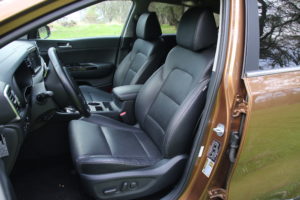
When you open the door, it is amazing just how luxurious the new Sportage is. High quality, soft touch materials are everywhere and the seats in my top of the line tester are well designed in soft leather. A great place to spend several hours. About the only negative is that the head restraints at their lowest position intrudes into the area where my upper back resides. You might have to adjust them up by about an inch. Rear seating is spacious for three and the rear cargo area is huge for a vehicle this size.

Instrumentation is complete (speedo, tach flanking the trip/info computer) in a well-designed IP. The center stack (radio/HVAC) is complete and easy and intuitive to use, no problems there. 

Finally, what is it going to cost you? My loaded tester had a Monroney of $34,000, which is refreshing not to see something like $33,999. (It’s called a Monroney in honor of Oklahoma Sen. Mike Monroney who introduced the window sticker legislation back in about 1957. The FAA headquarters is also named after him.) The boat from South Korea is $895 bringing the total to $34,895. This vehicle had no options or add-ons. Everything but the kitchen sink and hot and cold running water is standard, including the famous 10 year/100,000-mile powertrain warranty. Even the entire vehicle is warranted for five years/60,000 miles. Nothing like standard piece of mind as well.

Larry Weitzman has been into cars since he was 5 years old. At 8 he could recite from memory the hp of every car made in the U.S. He has put in thousands of laps on racetracks all over the Western United States.


Snippets about Lake Tahoe

·      South Tahoe High and South Tahoe Middle schools have been revalidated AVID National Demonstration Schools, a status each site has achieved since 2000 and 2001, respectively. 

·       El Dorado County Fair received five first place, three second place and three third place awards at the Western Fairs Association’s Convention & Trade Show.

·      Douglas County Public Library in Minden will be closed Feb. 20 in observance of Presidents Day. 

·       Northstar’s master plan will be before the Placer County supervisors on Feb. 21. The meeting is in Auburn. 

·      The 8th annual Kid-O-Rama returns to Squaw Valley on Feb. 18-25. All the details are available online. 


Caltrans: Hwy. 50 to be closed indefinitely

Mudslides continue to make Highway 50 inaccessible through the American River Canyon. Photo/Caltrans

Updated 6:54pm

Highway 50 in the Kyburz area will remain closed indefinitely due to multiple mudslides. 

This means the main route between the South Shore and Placerville is off limits at least as a thoroughfare. It is possible to access some points along the route from each direction. For example, Sierra-at-Tahoe is open.

Crews are working on three significant slides in a 12-mile area along the American River Canyon, along with other minor slides.

The first major slide occurred Feb. 10 near Sand Flat. The second slide, which is between Whitehall and Kyburz, came down Saturday afternoon. The third slide is two miles east of Kyburz and has been slipping for the last few days. It came down Saturday afternoon. 

Highway 50 was closed for four weeks in January 1997 for what was called the Mill Creek landslide. That year 350,000 cubic yards of debris were removed at a cost of $4.5 million, according to Caltrans. 

There is still no time for when Highway 50 in Nevada will open either.

By Kathryn Reed

Highway 50 linking Tahoe and Placerville will not be opening on Sunday, nor will motorists be able to use Highway 50 in Nevada to get from the South Shore to Carson City any time soon.

Neither Caltrans nor NDOT have an estimate when the highways will open. Both transportation departments said it is too dangerous to have people driving through the area. And in California, it’s just impossible to do so because of all the debris crossing all lanes.

“It is constantly moving with water moving through the mountains,” Deanna Shoopman with Caltrans told Lake Tahoe News. It is literally a fluid situation.

Highway crews had hoped to open the roadway this evening, but that is not happening because is it not safe. What is being called a tall slide, as opposed to wide, fell near Whitehall. This is in addition to the major slide that fell Friday and shutdown this main artery between the South Shore and points west.

Shoopman said the hill an engineer was standing on Saturday to observe the situation is gone today.

“It’s crazy how many waterfalls there are; there are waterfall I’ve never seen,” one Meyers resident who drove through 50 to Sonoma County on Friday said. She will be able to get back using Highway 88 via Kirkwood, though there could be delays with avalanche control in the Carson Spur area.

Interstate 80 westbound from state line to Truckee is down to one lane because of a mudslide. It is estimated to open Feb. 13 at 10am.

Highway 395 is open in both directions.

Boulders in the road and an unstable hillside have shut down the Nevada part of Highway 50 at Logan Creek since Feb. 8.

“It all depends on Mother Nature, if it dries out,” Meg Ragonese with the Nevada Department of Transportation told Lake Tahoe News in regards to opening that stretch of road. For now the hillside is too soaked to be able to stabilize it.

In all of the slides in the region there has one been one vehicle reported to be damaged. That was near Pollock Pines and Ice House Road where the initial large slide was on 50. The Jeep had been pinned against a tree, which prevented it from rolling into the American River. The occupants were able to get out safely and without injury.

The weather forecast is for it to be dry in the greater Lake Tahoe-Truckee area until Wednesday night, when rain is expected to start falling – again.


Trying to understand political divide in U.S.

By Linda Fine Conaboy

Is American politics becoming clannish? Cliquish? Segregated? Disunited? Or perhaps we’re headed backward and the definitive word would be tribal.

The question then is, did the 2016 election confirm the fact that we’re segregating ourselves into tribes? Resoundingly, yes, said Christopher Hare in hard hitting community presentation at Sierra Nevada College last week. He has bachelor’s, master’s and doctorate degrees in political science.

Christopher Hare

“Partisans increasingly dislike and distrust each other,” Hare said. “They filter out opposing viewpoints and process objective facts through a distinctly partisan lens.”

When Lake Tahoe News asked him his definition of tribal, Hare, an assistant professor of political science at UC Davis, called it “tribal mentality, or an us versus them way of thinking. That is, a strong, almost unquestioning attachment to members of your own ‘tribe’ or party and a strong aversion to and a distrust of the opposing tribe, or opposite party.”

A quick Internet search into tribal mentality described it as bands of those who share morals, beliefs and the survival of a group. Generally, tribes are closed to outside interference and they move as a group. Today, the Middle East is an example of tribal mentality.

And closer to home, think about American history and the tightly-knit bands of American Indians, tribes, if you will, fiercely defending their ideals and their way of life against all comers.

“Even though some evidence suggests that Americans haven’t necessarily become more ideologically extreme, it is abundantly clear that different kinds of conflicts based on policy attitudes, religious beliefs, core values, race and ethnicity, gender, region (urban vs. rural, etc.) are being absorbed into the partisan divide between Democrats and Republicans,” Hare said.

Hare said this is consequential because it means there is even less common ground between the parties, brought clearly into focus during the last election. He added the politicization of already deep religious and value divides serves to further splinter American society.

“Political differences are now organized in terms of fundamental value conflicts, with political compromise interpreted as moral surrender,” he said.

Thinking about the definition of moral—a person’s standard of behavior or beliefs concerning what is right or prudent—so says Miriam Webster. And surrender, which means giving up, resignation or submission, it’s easy to see that within the current political climate, no politician or voter for that matter, is about to give up his or her beliefs, to morally surrender those beliefs, which are considered to be right or prudent.

The result? There is little consensus about what the big issues are. “Few Republicans say environmental protection is a pressing national concern, and few Democrats say the same about the national debt,” Hare said.  “The implications for policy making are that parties have ever less incentive to work together, especially on issues that require trade-offs and compromise, but are only viewed as important to one party.”

It’s also important to note how polarization is intertwined with other big forces in American society, Hare said. Forces such as relatively stagnant economic growth, income inequality, the concentration of family breakdown among lower-income Americans and an aging population.

When asked what kind of political system now needs to be in place to goose stagnant economic growth, Hare had this to say: “This is the $64,000 question. One perspective is that stagnant GDP growth (gross domestic product) is inevitable in advanced, industrialized nations.

“But the U.S. has some real advantages that may allow us to buck the trend. For instance, we have the best university system in the world, bar none, and a tremendous spirit of entrepreneurialism. Another perspective is that a lot of these problems, such as family breakdown, are simply cultural and don’t have political solutions.”

Although Hare did not make any prognostications as to the future state of political affairs in the U.S., he did offer one more potential reason for the great divide, that being the influence of talk radio and social media.

He mentioned the “echo chamber.” For those not familiar with the term, the echo chamber is analogous to an acoustic echo chamber, where sounds reverberate in a hollow space. In other words, one talking head will make a claim, which many like-minded people then repeat, overhear and repeat again, until most people assume that some extreme variation of the story is true.

“Fragmented media and the echo chamber certainly aren’t helping polarization,” Hare said. “One other aspect of this is that our social networks are becoming more like-minded, so we’re more likely to surround ourselves with people of similar partisan, ideological persuasions.

“This is a natural byproduct of geographic sorting—Democrats are clustered in urban areas; Republicans in rural areas. The current political system has proved itself to be incapable of addressing these economic and societal stresses,” he said.


Opinion: Ferrari gets almost too much right about Calif.

By Joe Mathews

When I got the keys to California, I floored the accelerator until I was driving 100 mph.

I felt exhilaration—and fear. This speed was totally unfamiliar to someone who has spent his life driving beaten-up Toyotas. In California we like to think we can go as fast as our imaginations can take us, but this shiny red convertible named California moved too fast for me.

Joe Mathews

Ferrari let me drive the Ferrari California T for four rainy January days. I requested the loaner because I thought it might provide some escapist fun at a difficult time for our country, and because I’m old enough to deserve a mid-life crisis. But for journalistic purposes, I wanted to know whether a car could really embody California. I suspected the folks in Maranello, Italy, where Ferrari makes its cars, might just be using our state’s name to sell a pretty automobile.

My suspicions were wrong. The Ferrari California is as wonderful as our state’s most kaleidoscopic dreams. The only problem is that Ferrari’s California is so damn perfect it keeps reminding you of our state’s imperfections.

The Ferrari California aligns with the state on the level of metaphor. California is famously the “Great Exception” among American states, as the 20th century author Carey McWilliams named it, and California is an exception among Ferraris. It is not the most expensive, glamorous or fastest Ferrari. Instead, Ferrari markets the California as practical and versatile.

The California is not a sports car, but a convertible grand touring car—with eight cylinders instead of the 12 of some other Ferraris—that is built for comfort, which makes sense if you’re a Californian often stuck in traffic. It’s got two doors, but also enough space in back to fit two children’s car seats.

“It is a little bit an exception,” Edwin Fenech, the president and CEO of Ferrari North America, told me by phone. “It’s able to be very versatile. You can go to the grocery store with your car.”

Fenech said that versatility shouldn’t detract from the car’s mystique, or California’s. He added pointedly that, as self-driving—or autonomous—vehicles emerge, Ferrari wanted to affirm its support for Californians determined to steer their own cars.

“We are the ones who are going to defend the right to drive,” Fenech told me. “Don’t brainwash the new generation with autonomous driving—it’s so beautiful, driving.”

Today’s Ferrari California draws not just on our love for driving, but on our infatuation with everything mid-20th century. Ferrari produced three different California models between 1957 and 1967. The car became such a valuable collector’s item (some have sold for $20 million or more) that Ferrari revived the brand in 2008.

The newest iteration, the Ferrari California T, was introduced for the 2015 model year. It’s designed with a dual-clutch automatic transmission and a technologically advanced suspension, which makes it easy to navigate through dense neighborhoods in America’s most urban state. And the T stands for Turbo, as in the twin-turbo, 3.9-liter engine, which can still get the car to 196 mph, but uses less fuel and produces fewer emissions.

The Ferrari representative encouraged me to test its California-ness. So I drove it 90 minutes through bumper-to-bumper traffic to Santa Monica. I navigated potholes in downtown L.A. I went through the In-N-Out drive-through, complete with the requisite in-car consumption of a double-double. I chauffeured my kids to school, and secured in their car seats in the back. And I carted luggage and golf clubs in the trunk.

I felt far safer while driving the Ferrari in a rainstorm than I do with my usual ride, a 5-year-old Prius. With the top down, I loved the way that the car connected me with other drivers and pedestrians, who offered a thumbs-up and asked what the car was. And I’ve never had an automotive experience happier than driving up Angeles Crest Highway, with the radio playing R.E.M.’s “Electrolite” (“Hollywood is under me. I’m Martin Sheen. I’m Steve McQueen. I’m Jimmy Dean”).

Of course, the car, like many wonderful California things, fails the core test of accessibility: the base MSRP of the Ferrari California T is $198,973. The one I drove costs $240,000. By Ferrari standards, that’s a bargain (the hybrid La Ferrari sells for well over $1 million), which is by design: half of Ferrari California buyers are new to the brand. But the car I was driving would cost this nonprofit journalist more than three years’ take-home pay.

Which is another thing that makes the California very Californian. The good life is highly visible throughout our state. But only a few can afford more than a brief ride.

Joe Mathews writes the Connecting California column for Zócalo Public Square.


When does a cyberattack mean war?

By Byard Duncan, Reveal

Sen. John McCain, who spent more than five years in Vietnamese captivity, is no stranger to traditional war. But when the Arizona Republican recently brought together officials from three intelligence agencies, his focus was on a more modern frontier: cyberspace.

Given reports of Russian interference in last year’s presidential election, McCain wanted to know how the U.S. might appropriately respond. So 20 minutes into the hearing, he posed a blunt question to Director of National Security James Clapper: Would a successful digital campaign to alter the outcome of a U.S. election equal an attack on the U.S.?

Clapper demurred.

“Whether or not that constitutes an act of war I think is a very heavy policy call that I don’t believe the intelligence community should make,” he said. “But it certainly would carry, in my view, great gravity.”

Clapper’s response highlighted an alarming point about U.S. cyber policy, one that could prove troublesome as U.S.-Russia tensions mount and an unpredictable new administration gets its bearings: America does not have a clearly defined threshold at which digital offensives escalate into all-out war.

A history of disagreement

In 1996, the U.S. and Russia began meeting in secret to establish a set of common protocols for their respective operations in cyberspace. Since then, they’ve managed to agree, via the United Nations, that international law applies in the digital realm – and that countries must take responsibility for the actions of hackers operating within their borders. As recently as 2015, the two parties also agreed that no state should use digital tools to target each other’s critical infrastructure during peacetime.

But the common ground essentially ends there. While Russia historically has pushed for treaties that limit the use of digital weapons, the U.S. for years has claimed that cooperation among international police is a better technique for regulating cyberspace.

Throughout this standoff, both sides have taken shots at the other’s approach: U.S. critics say any treaty Russia creates would limit free speech by targeting citizens who find a way around the country’s censorship infrastructure; Russia maintains that America, in refusing to come to the table, is willfully stoking a digital arms race.

The latter assessment isn’t so far off, according to some experts.

“Of all countries, the U.S. has the fewest incentives to reach any binding agreements about the limitations of use of cyber weapons,” said Bruce McConnell, a former deputy undersecretary for cybersecurity at the Department of Homeland Security in the Obama administration. “When you have asymmetry in the world, as we still do, there’s less incentive in the most powerful superpower to put something on the table that says we won’t use this capability.”

Yet even as the U.S. has developed and refined its cyber arsenal, its deep reliance on information technology has made it among the world’s most alluring targets for hackers, McConnell said. At the same time, its own record of cyber espionage and interference across the globe – even against allies such as Germany and Brazil – repeatedly has damaged its international credibility.

All the while, Russia has made no secret of its intention to use cyber tools as a means of gaining geopolitical leverage. In 2007, the country allegedly launched a devastating attack on Estonia’s government and banks as retaliation for the country’s removal of a Soviet-era statue. And in its 2010 military doctrine, Russia acknowledged its interest in waging “information warfare,” which can “achieve political objectives without the utilization of military force.” That approach aligns with a recent intelligence community assessment that Russian President Vladimir Putin “ordered an influence campaign in 2016 aimed at the US presidential election.”

“There is a kind of sparring back and forth that the United States didn’t really see but the Russians believed they were engaged in,” said Adam Segal, a senior fellow at the Council on Foreign Relations and the author of “The Hacked World Order.”

“The U.S. clearly is not an innocent actor in cyberspace,” he added. “But I do think Russian behavior crossed a new line.”

Cold War II?

During the Cold War, the U.S. and the Soviet Union engaged in a constant dialogue about what might constitute a “red line” and what forms of retaliation might be appropriate. Huge nuclear stockpiles in both countries provided a deterrence structure based on the concept of mutually assured destruction. But as Segal points out in his book, no such dynamic exists in cyberspace, where capabilities can be disguised and attribution is difficult.

“Washington, Moscow, and Beijing have an interest in identifying legitimate targets and thresholds,” Segal writes, adding that the three powers likely would agree that a cyberattack with “ ‘kinetic effects’ equivalent to those of a conventional armed attack” could warrant an act of boots-on-the-ground self-defense.

Indeed, the Obama administration, in a 2011 document titled “International Strategy of Cyberspace,” affirmed that “when warranted, the United States will respond to hostile acts in cyberspace as we would to any other threat to our country.”

So how severe must an attack be for the U.S. to retaliate? It doesn’t always take much, according to Herbert Lin, a senior research scholar for cyber policy and security at Stanford University. Lin points to Operation El Dorado Canyon, a 1986 U.S. airstrike campaign, as an example: After Libyan forces bombed a Berlin discotheque frequented by Americans, killing two and wounding 79 others, the U.S. targeted Libyan airfields and barracks, killing at least 40 people in retaliation.

“In justifying this,” Lin said, “we invoked our right to self-defense, saying that this was an action that was intended to discourage future attacks and therefore was legal under the U.N. Charter.” The U.N. disagreed.

The event raises questions about the U.S.’ willingness to use force following a cyberattack: What happens if a country such as Russia or Iran launches a digital assault against an American factory, accidentally killing 10 workers? Or 20?

“There is no clearly defined threshold, even outside of cyber,” Lin said. “If there’s no clearly defined threshold outside of cyber, how do you expect there to be one in cyber?”

These boundaries will matter more as countries such as Russia and the U.S. continue to test their tools on adversaries. The U.S.’ cyberattacks on Iran’s nuclear facilities, for example, were the first (and, so far, the only) to yield physical destruction; they also were criticized as an illegal act of force in a NATO-commissioned report. Meanwhile, Russia’s alleged infiltration of U.S. electoral boards might have qualified as an assault on critical infrastructure (therefore violating U.N. protocols), were it not for one fact: The Department of Homeland Security failed to designate electoral systems as critical infrastructure until Jan. 6 – two months after Donald Trump won the presidency.

Many experts agree that escalating tensions, coupled with ever-developing cyber weapons, call for a new military paradigm. Yet there’s not a fully developed picture of how that paradigm should look. This predicament was neatly summed up in a 2015 study in the Texas International Law Journal:

“Traditional kinetic (laws of armed conflict) principles simply do not fit this new wave of warfare. The limitations of applying traditional (laws of armed conflict) to cyber acts have left nation States misguided and confused.”

The rules in place

To be clear, there is a solid – albeit imperfect – legal framework that governs how the U.S. and other countries should respond to cyberattacks. The U.N. Charter draws a distinction between actions that constitute a use of force and others that amount only to meddling in another country’s sovereign matters. Although it makes no direct mention of “cyber,” the charter also dictates what sort of responses might be appropriate in each case.

That doesn’t mean it’s free of vagaries, though. A 2002 analysis published by the U.S. Naval War College on whether the U.N. Charter’s Article 2(4), which bans the use of force, applies in cyberspace offered an equivocal answer.

“It likely will be a long time, if ever, before the practice of States, decisions of the International Court of Justice, or other recognized sources of international law yield a clarification of how Article 2(4) applies to (computer network attacks),” it states.

According to Catherine Lotrionte, Georgetown University’s CyberProject director in the School of Foreign Service, most legal experts would agree on one thing: Russia’s alleged efforts to swing the presidential election don’t rise to the level of an armed attack – or even a use of force. They were, however, still forbidden under a provision of international law that bans “coercive interference.”

So how might the incoming Trump administration – whose affinities for Russia are well documented – respond to similar attacks if they persist?

“There won’t be one standard threshold or trigger for all occasions,” Lotrionte said. “It will all depend on the nuances of the facts of a specific case.”

It’s a theme: Few firm boundaries exist in cyberspace – mostly because any nation’s military decisions will be flavored by a host of political considerations, such as an adversary’s military capabilities. Yet the clearest protocols available might have come from a speech at a legal conference for government agencies in September 2012. There, a legal adviser to the U.S. State Department  named Harold Koh explained how the use of cyber weapons factors into the U.S.’ larger national defense goals.

He began by posing – and answering – a series of questions: Do international laws apply in cyberspace? (Yes.) Do cyber activities ever constitute a use of force? (Yes.) May a state ever respond to a computer network attack by exercising a right of national self-defense? (Yes.)

But he also acknowledged that many pressing cyberdefense issues, such as how to properly attribute attacks to a nation or group, do not yet have clear legal answers. And they might not come anytime soon.

“Answering … tough questions within the framework of existing law, consistent with our values and accounting for the legitimate needs of national security, will require a constant dialogue between lawyers, operators and policymakers,” he said.

Given Trump’s clashes with the intelligence community, most recently over his associates’ potential ties to Russia, it’s unclear how robust this dialogue will be. Even experts such as Segal, the “Hacked World Order” author, aren’t sure what to expect.

“We don’t really understand necessarily how it’s going to play itself out, what the outcomes are going to be,” he said.