Letter: SITS dishes up food at B&B

To the community,

In line with their mission, Soroptimist International of Tahoe Sierra participates in local programs based on the specific needs of the South Shore community. On Feb. 6, the SITS joined with Bread & Broth to provide a full course, nutritious meal to food insecure community members who attended B&B’s Monday meal at St. Theresa Grace Hall.

“This was a very gratifying time,” said Teddi Breaux, a Soroptimist sponsor crew volunteer. “The guests were eager to enjoy the volunteers and vice versa. I’m very impressed with the organized event and the quality of food. People here are amazing to work with and friendly to a fault. Love the experience and want to sponsor an Adopt A Day again.” 

B&B would be very happy to see the Soroptimist of Tahoe Sierra back again because they were a great group of conscientious volunteers.

In addition to Breaux, Soroptimist members helping at the dinner included Blair Bolles, Nancy Muller, Joy Rogers and B&B Team No. 2 volunteer cooks Wendy David and Linda Malzone and setup/serving crew member Shelly Martinez who currently serves as the organization’s president.    

Soroptimist International of Tahoe Sierra strives to better the lives of women and children in our community.  Bread & Broth is fortunate to partner with this generous and wonderful women’s organization.

Carol Gerard, Bread & Broth


Guided snowshoe at Spooner State Park

Park rangers will lead a two-mile snowshoe hike at Spooner Lake State Park on Feb. 25 from 10am-noon.

The hike is fairly easy and open to all skill levels, though snowshoes will not be provided. Dogs on a leash are welcome.

Meet in the parking lot to the right after the driveway splits. 

The event is free, but park entrance fees apply. Entry is $7 per vehicle, Nevada residents receive a $2 discount.                                               

For more info, email spooner.ranger@gmail.com.


Tahoe Tails — Adoptable Pets in South Lake Tahoe

Marshall is a 6 year old Chihuahua mix who is very friendly and wags his tail constantly. He is house trained and likes other dogs. Marshall is very smart. Even though he’s a little guy, he can climb fences so he must be kept on a leash while outside.

Marshall is neutered, microchipped, tested for heart worm, and vaccinated. He is at the El Dorado County Animal Services shelter in Meyers, along with many other dogs and cats who are waiting for their new homes. Go to the Tahoe animal shelter’s Facebook page to see photos and descriptions of all pets at the shelter.

Call 530.573.7925 for directions, hours, and other information on adopting a pet.

For spay-neuter assistance for South Tahoe residents, go online.

— Karen Kuentz


Snippets about Lake Tahoe

·       Lake Tahoe Community College and Lake Tahoe Unified School District boards of education will meet together on March 28 at 5pm at the college.

·       El Dorado County is accepting nominations for senior of the year. Must be at least 60. Nomination forms are available online. 

·      There will be a blood drive on March 3 starting at 11am at the South Lake Tahoe Recreation Center, 1180 Rufus Allen Blvd.

·      Truckee Tavern and Grill’s Blueprint of the Cocktails classes will be on Saturdays from 6-7:30pm in July and August. Classes are $75 per person (gratuity included) and limited to 10 participants ages 21 and older. Reserve a spot by calling 530.587.3766.

·      El Dorado County Supervisor Shiva Frentzen is having a for a town hall meeting regarding road conditions in the southern part of the county on Feb. 15 from 6-8pm at Mountain Creek Middle School, 6862 Mt. Aukum Road, Somerset.


Man found near American River identified

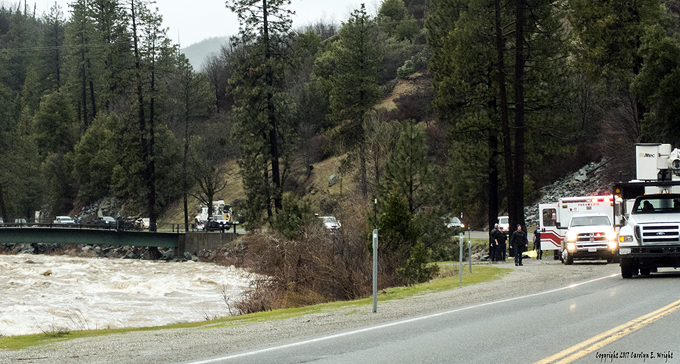
Rescue personnel recover a body from the American River on Feb. 10. Photo Copyright 2017 Carolyn E. Wright

The man who drowned in the American River on Friday has been identified as Digger Gooch, 37, of Silver Fork.

He was on his way to work in Pollock Pines when it’s believed he lost control of his vehicle on the icy, slushy Highway 50.

A passerby saw his body tangled in brush near the river the afternoon of Feb. 10. This was by the Randall Tract Bridge near Whitehall. Investigators found evidence of the vehicle leaving the road about three-quarters of a mile from where the body was located.

“CHP flew a helicopter up the canyon yesterday and was still unable to locate the vehicle,” El Dorado County sheriff’s Lt. Matt Underhill told Lake Tahoe News.

— Lake Tahoe News staff report


Nev. hunters shoot down land transfer idea

By Benjamin Spillman, Reno Gazette-Journal

A proposal that would unload millions of acres of federal public land in Nevada fell flat Friday in Carson City.

Dozens of hunters and anglers told the Nevada Wildlife Commission they oppose the proposal contained in Congressional bill by Rep. Mark Amodei, R-Nev.

The commission, a state body which oversees the Nevada Department of Wildlife, voted unanimously to summarize the hunters’ concerns in a letter to Amodei.

Read the whole story


Grassroots effort to deal with affordable housing

Publisher’s note: This is one in a series of stories about affordable housing in the Lake Tahoe-Truckee region. All articles may be accessed via the home page under Special Projects, 2017 Affordable Housing.

By Terra Breeden

Most of the single-family homes in South Lake Tahoe sit empty. They are second homes, used by the owners only a handful of times a year, or as vacation rentals.

Affordable housing options have become limited in South Lake Tahoe and around the lake. There simply are not enough long-term rental homes or affordable subdivisions to house the local population. Many residents are forced to pay an inflated monthly rent in order to secure a decent living situation, stay in hotel rooms for extended periods of time, or move to less expensive areas like Minden and Gardnerville.

Because of the housing crisis, South Lake Tahoe is losing many of its longstanding current residents and potential newcomers. This creates a community where actual residents are scarce and vacationers are plentiful.

“Seventy-five percent of our residents are in a low income bracket,” El Dorado County Supervisor Sue Novasel said a meeting Feb. 10. “There are 1,800 employees who come here for the winter and we can’t get them to stay in Tahoe. In my mind, there is no difference between workforce housing and affordable housing. So now we are asking, ‘what are people’s needs’ and looking at the economic side of it.”

Progress for Tahoe hosted a community meeting at Mountain Lab on Friday to discuss the South Lake Tahoe housing crisis. Progress for Tahoe, a grassroots movement founded last year, has declared the lack of affordable housing to be one of the most pressing issues facing South Lake Tahoe residents. The meeting was attended by about 20 community members from El Dorado County officials to concerned residents.

“As a local, I wanted to be at this meeting and let the community know about their options,” founder of the Tahomes Facebook page and South Lake Tahoe resident Kelsey Adams said. “A lot of people are into affordable housing, but I have to turn down about 30 people who are looking for homes each day.”

At the meeting, attendees broke into small groups and brainstormed solutions to the housing crisis. They discussed a variety of proposed ideas, from improving the balance of vacation home rentals and long-term rentals in South Lake Tahoe to reviving the Silent Second Mortgage program. Any idea that might create more affordable housing in the community was considered.

Crested Butte, Colo., a ski resort town similar to South Lake Tahoe, was introduced as a model of what a small community can do to build affordable housing for its residents. Crested Butte has built multiple affordable housing units (without relying on grants or government money) by issuing a $2,000 to $50,000 fee for building new homes in the area and installing a public transportation tax. The money gathered from these incentives is put into a community pot that is used explicitly to build affordable housing for its long-term residents.

“We want to honor the fact that we live in a beautiful place and it’s sensitive to development, but if we look at communities like these, we see that it can be done,” a woman in the audience said.

Other ideas discussed at the meeting included reviving the Silent Second Mortgage program, a program that helps people who make less than $60,000 a year purchase homes. Troy Matthews, a member of the Progress for Tahoe steering committee, wants to make an appointment with the city manager to see if the city of South Lake Tahoe can reinstate the program.

Zoning South Lake Tahoe neighborhoods so that ratios of vacation home rentals, second homes, and long-term rentals are equalized was another solution proposed at the Progress for Tahoe community meeting. By zoning neighborhoods, the belief is the city could create a required ratio of long-term rentals for residents and help solve the housing crisis.

Everyone at the meeting agreed that there is a substantial shortage of long-term home rentals for families and short-term rentals for Heavenly Ski Resort employees in South Lake Tahoe. But building one affordable housing unit is not going to solve the housing crisis. And there are several obstacles to building new homes in Lake Tahoe. The cost to even put a shovel in the soil and break ground is humongous due to zoning and government fees.

However, Novasel has put together a task force to look at what can be done to reduce building fees and to collect data on current housing conditions in South Lake Tahoe.

“We want to look at zoning, fees, and the fact that we have limited space to build,” Novasel said. “These are the three major barriers to building more affordable housing.”


Opinion: How passports became symbol of U.S. identity

By Craig Robertson

It was originally a European tradition, not ours. But in 1780, needing a more formal way to send former Continental Rep. Francis Dana from France to Holland, Benjamin Franklin used his own printing press to create a new document. The single-sheet letter, written entirely in French, politely requested that Dana and his servant be allowed to pass freely as they traveled for the next month. Franklin signed and sealed the page himself and handed it off to Dana, creating one of the first known U.S. “passe-ports.”

Today, the nation’s passports still display vestiges of their diplomatic origins with a written entreaty to let “the citizen national named herein to pass without delay or hindrance.” But in almost every other aspect, the modern 32-page, eagle-emblazoned booklets bear little resemblance to Franklin’s makeshift bit of ambassadorial decorum. The differences hint at the profound shifts—in appearance, in use, in meaning, in trust, in who got to carry them—that produced a document that came to play a much larger role in American life than originally intended. It’s the story of how a few pieces of paper came to produce new answers to the question “who are you?”

The idea of the passport pre-dates the founding of the republic—one can find early mention of “safe conducts” in the biblical passages of the Book of Nehemiah and in histories of Medieval Europe. Like the Franklin-issued passe-port, these early documents evolved from deals that granted negotiators safe passage through foreign territory. They relied largely on an assumption that the person presenting the papers was the person or group named in them (if any was named at all). But mostly, they were a formality. The privilege and reputation of the limited number of people who frequently traveled usually trumped the need for any formal letter of introduction.

For the hundred years  following the American Revolution, the U.S. passport largely followed this historic form too. In the first half of the 19th century, the State Department only issued a few hundred passports per year. Governors and mayors did too, absent any law prohibiting it. The letter-like documents usually only identified the bearer’s name, and could be drawn up to cover a diplomat, a private citizen, a non-citizen, a man’s entire family, or even an entire ship. Passports then were rarely required for cross-border travel. Instead, they were more often used to gain access to private museums, collect mail from a post office, get invitations to social events, or to serve as a souvenir worth framing.

In these early years, the U.S. lacked compelling reasons to identify each person coming in and out of its borders. Immigration levels had been low, and the newcomers who arrived helped fill labor shortages and sparsely populated frontiers. And, unlike citizens of most other countries, Americans had long been skittish about any sort of national identification system. By the latter half of the 1800s, however, demographic and political winds began to shift. First came the laws prohibiting entry of prostitutes and convicts in 1875. Then came the Chinese Exclusion Act of 1882. During World War I, the U.S. government began scanning for spies, radicals, and Communists; and soon after, the Immigration Acts of the 1920s established hard nationality-based quotas. The more xenophobic the U.S. became, the more interest it had in separating traveling citizens from unwanted aliens at its ports.

In response to these new screening demands, the federal government turned to the passport. Through a series of ad hoc laws and policies over the course of a few decades, policymakers radically transformed the passport from a diplomatic introduction for traveling elites into the highly-controlled identification for citizens we’d recognize today. In 1856, Congress granted the State Department sole issuing power over the papers, and limited their use to U.S. citizens. The agency also slowly standardized the passport’s appearance. Engraving plates, signatures, and seals all lent the document a look of authority—giving it a form more like a certificate than a letter (the booklet form came later, in 1926).

Officials also added markedly modern requirements. Applicants had to produce supporting documents to prove their identity. Forms demanded consistently spelled full names and dates of birth. The passports themselves began consistently listing objective physical features of the bearer, such as height and eye color—shortly replaced by a stark, square headshot photo. Designated government clerks now checked all of the information, all with the idea of creating a verifiable identity that couldn’t be easily assumed or forged. Congress made yet another big change: During World War I, legislators (alongside European nations) passed emergency measures that demanded passports from everyone entering the country.  And after the war ended, the requirements never went away.

Between the 1850s and 1930s, these transformations did not go unnoticed. Newspapers filled pages with stories on the “passport nuisance”—the term used to cover the perceived absurdity that the government would force people of the “better” class to be documented like common criminals. Ladies blushed at having to tell their age to a clerk. Gentlemen objected to having their romantic notions of individual character reduced to a generic list of physical traits. Headlines like “W.K. Vanderbilt Tries to Identify Himself” detailed bureaucratic bothers, and the fact that President Woodrow Wilson needed a passport made front-page news. Stories chronicled tales like that of a Danish man who allegedly waited weeks at the border to regrow the moustache in his ID photo. A 1920s advice columnist even recommended a young woman show a fiancé her passport picture as a test to see if he loved her. If he survived the shock of seeing the mugshot-like image, she could safely assume that he truly adored her.

In a society that previously relied on local reputation, the idea that the government could replace respectability with an impersonal bureaucratic document seemed, to many, preposterous. Rather than a privilege, some saw the passport as a symbol of eroding trust between citizens and their government.

But the government’s new demands for proof of identity hit on another major shift going on in the United States at the time: it was becoming more difficult to immediately recognize who should be considered an American. Citizenship was extended to free slaves. The previous generation’s surge in immigrant labor made it difficult to distinguish old faces from new. Women were beginning to demand recognition independent of a husband. A rising industrial middle class blurred old markers of status. At the same time, prosperity and easier modes of transportation were giving people more reason and means to move around.  Travelers of all races and social status now mattered. Having a passport that said you were American took on new meaning for those who had to, and were allowed to, carry one.  

The passport had become an instrument of control to help further xenophobic exclusion, but to many of its holders, the document could feel empowering, proof of their belonging. Because the U.S. doesn’t issue any other form of national identification card (state driver’s licenses and Social Security numbers fill the gaps, and can be obtained by foreign residents), carrying a passport became a way for citizens in the wide-reaching federation to assume a national identity. Though few possessed one—less than a tenth of the population for most of the 20th century—the passport, with its elaborate seals and ornamentations, became the supreme authenticator of national identity.

The passport, more or less, settled into its current form by the late 1930s. Small adaptations in decades since generally followed larger historical trends. Authorities used them in reaction to the country’s fears, attempting to impede Communists, terrorists, and scares in between. Tweaks were made in response to new technologies (the new 2017 passports will feature a stiff polycarbonate ID page containing an RFID chip), and to the expanding politics of inclusion (applications now accommodate gender changes and same-sex parents). 

Perhaps the biggest change to the passport is that it’s no longer novel. More Americans than ever have one—132 million, nearly quadruple the number 20 years ago.  The “nuisance” of producing our small certificates of citizenship at the border has largely faded into thoughtless routine. Identities are blurring as more and more people move around. And, as they do, the little blue pocketbook with its lithographed scenes of Americana, awaiting all those coming-and-going stamps, has become one of the more improbable symbols of American identity.

Craig Robertson is a professor of media studies at Northeastern University and author of “The Passport in America: The History of a Document.”


Librarians take up arms against fake news

By Jerry Large, Seattle Times

Janelle Hagen is a school librarian whose job goes far beyond checking out books. She and many other librarians are equipping students to fight through lies, distortion and trickery to find their way to truth.

Helping students become smarter evaluators of the information that floods into their lives has become increasingly necessary in an era in which fake news is a constant.

Two University of Washington professors recently announced a new class that will focus on the ways data are misused to mislead the public. Younger students may need guidance even more.

Besides running the library, Hagen said, she teaches a class called “digital life.” She meets with fifth-graders twice a week and with eighth-graders once a week. The classes are a mix of technology and information-literacy skills, but since the presidential election, she’s increased the focus on the latter.

Read the whole story


Squaw men not in top 10 in downhill

By USSA

ST. MORITZ, Switzerland – Jared Goldberg (Holladay, Utah) led the Americans at the makeup day for the Audi FIS Alpine World Ski Championships downhill, taking 20th.

Beat Feuz of Switzerland, who won the downhill and super G test events at St. Moritz during the 2015-16 season, secured the gold medal in front of the hometown crowd. Canadian Erik Guay continued his dominant week in St. Moritz to take silver and Max Franz of Austria took bronze.

The day started out with similar weather to Saturday’s postponed downhill—a thick layer of fog hovering in the middle of the course. But as the day went on, the cloud lifted, leaving brilliant sunshine sparkling on the World Championships track.

Due to the early weather, the downhill start was lowered, but that didn’t restrict the men from catching huge air off the jumps.

Behind Goldberg, Travis Ganong (Squaw Valley) was 25th, Bryce Bennett (Squaw Valley) 26th and Tommy Biesemeyer (Keene, N.Y.) 29th.