A big apology from Lake Tahoe News

I want to apologize to all Lake Tahoe News readers for the difficulty you are having logging onto the news site. 

The server crashed because there are so many of you all of a sudden interested primarily in our weather related stories. While on the one hand this is a good thing, I know it is also incredibly frustrating.

We are working to rectify the problem, but it won’t be instantaneous.

We are still producing the news every day. So, if you seemed to miss something, it will always be online. Keep logging on and refreshing your browser, we’ll be back with uninterrupted service as soon as possible.

— Kathryn Reed, LTN publisher


Alliance aims to make Nev. esports hub

By Richard N. Velotta, Las Vegas Review-Journal

A group of businesses, advocates and academics have formed an association focused on advancing the development of Nevada as a global hub for esports.

The Nevada Esports Alliance is a new non-profit organization that plans to boost the state as the center of the convergence of video gaming and the casino industry.

Nevada regulators approved rules for skill-based gaming last year and that has led to growth in esports competitions and wagering on game outcomes. In addition, the first esports lab opened last year at UNLV’s International Gaming Institute.

Read the whole story


CalPERS asset allocation less than projected

By Robin Respaut, Reuters

California Public Employees’ Retirement System expects a 5.8 percent annual investment return under its new portfolio asset allocation, significantly lower than the fund’s assumed rate of return of 7 percent by 2020.

The reduced expectation, disclosed late Monday in documents from the largest U.S. public pension fund, is based on a lower-risk, lower-return asset allocation adopted by CalPERS in September and announced in December.

CalPERS’ caution mirrors outlooks from public pension funds across the United States as they try to grapple with investment forecasts of slow market growth over the next decade.

Read the whole story


Squaw’s Bennett takes 11th in slalom

By USSA

ST. MORITZ, Switzerland – Standing 6-feet-7-inches tall, Bryce Bennett (Squaw Valley) is built more like a power forward than a power slalom skier. But competing in his first World Championships, Bennett hammered through a challenging slalom course to an 11th-place finish in Monday’s alpine combined to lead the U.S. at the 2017 FIS Alpine World Ski Championships.

Switzerland’s Luca Aerni surprised the best skiers in the world, winning his first major event in front of the roaring home country crowd. Prior to Monday’s win, Aerni’s best results were a couple Swiss national titles (slalom 2015, alpine combined 2012) and a handful of top 10 World Cup finishes. Austria’s Marcel Hirscher, currently the best ski racer in the world, took the silver, followed by Aerni’s Swiss teammate Mauro Caviezel taking the bronze.

Bennett, who towers over the slalom gates, finished 18th in the morning downhill, and then put down a solid slalom run to lead four Americans into the top 25, including Brennan Rubie (Salt Lake City) in 15th, Ryan Cochran-Siegle (Starksboro, Vt.) in 19th and Jared Goldberg (Holladay, Utah) on 21st.

“In slalom, I don’t know what it’s like to be short, so I just go out and do what I do best … make it work,” said Bennett, who also commented on the slalom course conditions. “The course workers are doing a pretty good job. They injected last night, which was a questionable call. It didn’t really sink in, so it broke through pretty quick. But for the most part it’s alright, doable.”

The injected portions of the slalom course caught a number of racers off-guard as the top finishers from the morning downhill ran into trouble on the first break-over on the slalom track. Aerni, who finished 30th in the downhill and ran first in the slalom, posted the time to beat on a clean track and then watch in disbelief as 29 more racers failed to knock him off the top step of the podium.


Residents want to put a stop to tourist traffic

By Kathryn Reed

MEYERS – El Dorado County is in the process of crafting a “traction ordinance” that could help keep tourist traffic out of neighborhoods – at least in the winter. It would not solve the summer traffic problem.

The ordinance would allow the county to require chains, snow tires and/or four-wheel drive on county streets. This in turn would mean law enforcement could cite anyone who is violating that law — even locals.

However, with how slow the wheels of government work, the ordinance is not expected to be in place to make an impact this winter.

Residents – especially those in the Meyers area – are tired of sharing their neighborhoods with tourists looking for a short cut. Not only do these wayward drivers want to avoid the backup on Highway 50, many want to bypass the chain inspection at the base of Echo Summit.

What these people don’t realize is often the side streets have more snow and really are where two-wheel drive vehicles without chains are going to be the most problematic.

The advent of navigation apps has people going places they have no business being. Some roads are narrow, others are steep, all are residential streets that were never designed to be a thoroughfare. Topography isn’t part of the information that is given out, though it may not matter even if it were a feature.

Local authorities have spoken with Apple. Old Meyers Grade is no longer listed as a viable route. Google officials, though, have been unreachable. Novasel said San Francisco was able to get Google to change some things. The City, unlike El Dorado County, has leverage with Google because the tech company does business there.

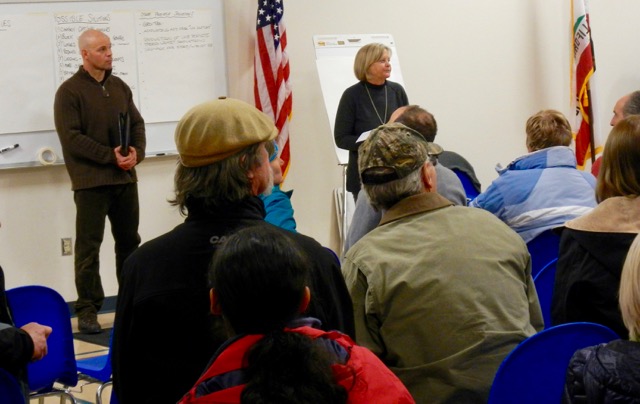
Of the 100-plus people who attended the meeting Feb. 13 convened by El Dorado County Supervisor Sue Novasel, more than 30 voiced their frustration about what has become a chronic issue on Sundays or the last day of a holiday period. Questions were asked. Ideas were shared.

One person suggested a class-action lawsuit against the app makers. It was then pointed out even if the more than dozen apps out there affecting the local situation were shutdown, there is nothing to stop someone from creating something else.

One of the more popular ideas was to fight technology with technology. One man suggested using the FasTrak device used on Bay Area bridges so tourists are paying for the use – then ideally upkeep – of local roads. Cameras would record the license plate and the person would be sent a bill if they didn’t have a transponder.

Novasel said toll roads have been talked about. Doing so would be reviving a practice what was popular more than 100 years ago.

In addition to Novasel on Monday night there were reps from the California Highway Patrol, El Dorado County Sheriff’s Office and county transportation department. The latter had nothing to contribute to the discussion.

Law enforcement pointed out how the roads are public so it’s not possible to legally close them to some of the people and keep them open for others. Audience members, though, questioned if public safety were an overriding concern, then perhaps that would be reason enough to regulate who comes and goes.

One of the more immediate and basic things that could be done is better signage. Even the chain requirement sign on Highway 89 toward Hope Valley was covered with snow for about two weeks. New signs were suggested for residential areas to tell people it’s not a suggested route, or warning them of the grade/conditions ahead.

Part of the backup problem is farther west beyond Echo Summit. People making snow play areas along Highway 50 are creating traffic problems that reverberate back to the basin. Dealing with those landowners is one strategy. Other ideas included talk of eliminating passing lanes because, according the CHP, they cause more problems with people jockeying for front position. Another idea is to stop eastbound traffic at Sierra-at-Tahoe for a bit and let multiple lanes of traffic go west to clear things out.

Getting hotels to not all have an 11am checkout, to offer discounts for another night, for restaurants to entice people to stay longer for meal – those are all ideas that have been brought up in the past, but either aren’t implemented or don’t work.

Long drives from Tahoe to the Bay Area aren’t new. It’s been happening for decades. And the people making the drive keep doing so weekend after weekend. These people presumably sit in traffic during the week going to work so this isn’t much different.

But it isn’t the norm for people living in Tahoe. Being caught in Highway 50 traffic in one thing, taking hours to drive a few miles home is another. What those gathered Monday night really want is to be able to get around their neighborhoods and not be delayed by tourists who have no business being on side streets.

Novasel said she’d take the suggestions, concerns and questions back to Placerville where all the real decisions get made.


Opinion: Importance of Central Valley

By Joe Mathews

Are you finally growing up, Sacramento?

I pose that question not to our state government, but to the real Sacramento, the capital region. It’s a query that also should be aimed at the Central Valley’s other big urban areas.

Joe Mathews

The maturity of Fresno, Bakersfield or Stockton is not just a local question. The valley persistently lags California as a whole in employment, access to health care, and educational attainment. If California is going to make big gains, valley cities will have to lead the way.

Unfortunately, this narrative, which should be conventional wisdom, still feels novel. That’s because the valley still thinks of itself as agricultural. That’s understandable, given the region’s rural history and the outsized influence agriculture retains over land use and politics. But that influence obscures the 21st­ century reality—most people in the Central Valley live in cities, the true economic engines of the region.

Valley cities are “small” only compared with the global mega-regions on the coast. More people live in the cities of Fresno and Sacramento than in the cities of Atlanta or Miami. And valley cities have grown into places far larger and more complicated than the governments and infrastructure that once sustained them. One great underappreciated drama in California is the race of these cities to catch up to their urban needs, by adding cultural venues, revamping downtowns, and developing new infrastructure.

Cities are in different stages of this process. The struggle in Fresno has been particularly dramatic. There is new life and housing in its downtown. A new bicycle and hiking trail will connect Fresno to Clovis, and a bus rapid transit system is being launched. Planning is under way to establish mixed-use zoning districts on major thoroughfares.

But the most promising—and often most puzzling—urban case is Sacramento.

The capital region has long had advantages that give it a more diverse economy than other valley cities—from the presence of the state government to its proximity to the Bay Area. But for much of its history it coasted, happily lagging the fast-growing coast.

Today, it’s a bigger, more ambitious place: The nine counties of the larger region together have 2.8 million residents, on par with the city of Chicago. The past decade has brought more than $1 billion in public and private investment to Sacramento’s center. A sports arena opened last year, a hospital is planned for the railyards and midtown Sacramento’s neighborhoods are livelier than ever.  

But beyond these gains, the picture is as muddy as the valley rivers.

A Sacramento leadership class heavy in real estate and state government types has a weakness for seeking validation—and outside visitors—with showy projects of dubious value, the same strategy that contributed to Stockton’s bankruptcy. Among their current ideas are building an aquarium and expanding the struggling convention center.

Outside the city, getting the disparate parts of the capital region to work together remains difficult. While there are recent examples of regional progress on transportation, water, and workforce development, the capital region is not naturally cohesive. There’s not even a consensus on how many of the area’s counties are part of the region. The Sacramento Bee says there are four, government documents often refer to six counties, while a few philanthropists and academics list nine.

One of Sacramento’s disadvantages as a region is its political diversity; unlike the Democrat-dominated Bay Area, Sacramento is a swing region, from the left-wing NIMBYs of Davis to the Republican NIMBYS of the foothills. Another challenge to developing urban strategy is all the people who live in the so-called UnCity— unincorporated Sacramento County.

This lack of clear identity has made it harder for greater Sacramento to address its most stubborn regional problems, from housing affordability to transit. Sacramento County voters defeated a transportation sales tax hike in November that would have restored previous service cuts. And the lack of job growth in the region deserves greater attention. The Brookings Institution ranks Sacramento 95th among the nation’s largest 100 metro regions in economic output per capita, with a 9.5 percent decrease over the past 10 years.

Sacramento’s optimists argue that efforts to address such regional problems are deepening. They also point to Sacramento’s new mayor, Darrell Steinberg, a former legislative leader with deep contacts among the overlapping governments of the region. To the good, Steinberg has made decreasing homelessness a priority, and is addressing it regionally, in a way that should force Sacramento County to offer more mental health services. (To the bad, he is pushing the aquarium idea.)

Californians are understandably wary when big plans emerge from the Capitol. But we should be rooting hard for the capital region. Our state will be much better off if Sacramento can fully launch itself.

Joe Mathews writes the Connecting California column for Zócalo Public Square.


How to fend off hijacking of home devices

By Brian X. Chen, New York Times

Modern homes today are getting internet-connected light bulbs, thermostats, TVs and speakers. So with a simple voice command or the touch of a button on our smartphones, we can set the temperature, turn on a light or prepare the TV to record a program.

What could go wrong?

A lot more than most people are prepared for, it turns out. If one of these devices gets hijacked, hackers could potentially snoop around for sensitive data like financial or health information. Or they could use a network of compromised devices to perform a widespread attack that takes down major websites, which is what happened last October.

Read the whole story


LTCC to host rail jam

The inaugural Coyote Country Rail Jam is March 10 from 5-10pm in and around Lake Tahoe Community College’s Physical Education building.

There’s no entry cost. All ages are welcome to participate!.

The event will include the rail jam, free sledding hill, food, music,  games for the kids and more. 

For more info, email booth@ltcc.edu.


Nev. Dems touting state rights to fight feds

By Colton Lochhead, Las Vegas Review-Journal

Donald Trump set a feverish pace at the outset of his presidency by signing nine executive orders in his first 21 days in office.

Some, like those on immigration and health care, hit at the heart of Nevada’s political atmosphere, but the Trump administration said this month those orders could take months, or even years, to be fully implemented.

Democratic lawmakers in Nevada have expressed concern over the actions. They say roughly 400,000 Nevadans could be left without health insurance, undocumented immigrants will deported and marriage equality could be targeted if all of Trump’s policies go into effect.

With Democrats in control of the Legislature, several lawmakers are exploring the power of states’ rights to rebuff the president.

Read the whole story


Nev. considers ways to overhaul voting process

By Alison Noon, AP

CARSON CITY — Lawmakers are gearing up to change how and whether people cast ballots in Nevada as the state faces a shifting electorate and unfounded claims of voter fraud and intimidation.

Eligible Nevadans would automatically be registered to vote and be able to participate in primary elections despite their party affiliation under a couple of the proposals up for debate this session.

Democrats won control of the Legislature in November and have pledged to prioritize access and equality in the state’s elections. But proponents of change on both sides of the aisle say they’re cautiously optimistic about the proposals.

More than 125,000 Nevadans signed a petition to automatically register people age 18 or older to vote, and update registrants’ information, when they apply for any state identification card at the Department of Motor Vehicles — unless they opt out in writing.

Six states and the District of Columbia have similar policies, according to the Brennan Center for Justice at New York University School of Law. Twenty-two state legislatures are considering implementing or expanding automatic registration this year.

Nevada law required the petition to move to the state government, which could implement the policy if lawmakers approve it by mid-March and Republican Gov. Brian Sandoval signs it. Democratic legislative leaders and Sandoval have declined to say whether they support the petition.

If lawmakers or the governor do not approve it, the measure would go before voters on the 2018 ballot.

An assembly committee will hear the bill Tuesday.

A shrinking portion of the Nevada electorate is able to participate in the state’s primary elections, which allow only voters affiliated with a political party to take part in that party’s primary.

“People have got to have a say in who represents them,” said Doug Goodman, who lobbies the Legislature for various election reforms, including one this year to abolish the current primary system. “They are voluntarily giving up that right when you have a closed primary.”

Goodman is working with Republican Sen. James Settelmeyer of Minden to enact a new process that would put candidates from all parties on the same ballot and allow the top two vote-getters to advance to the general election.

Settelmeyer sponsored the measure after hearing from registered-nonpartisan constituents frustrated they didn’t have a say in the 2016 Republican or Democratic primaries.

Supporters of the top-two primary system say it would not only increase turnout and expand voters’ choices, but also force politicians into less-polarizing political positions as they attempt to win over voters.

Opponents argue the parties should reserve the right to select their own candidates.

Nearly 21 percent of Nevadans who voted in November did not identify with a political party. “Recapturing that pool of voters is what drives this whole thing,” Goodman said.

The Democratic majority has not deterred Republican efforts for stricter identification requirements in Nevada, where people already must prove their residency in the state to register to vote. Republican lawmakers introduced a bill this week that would give voters the option to decide ahead of an election to voluntarily show proof of identification at the ballot box and prohibit those people from voting at the polling place if they show up without a valid ID.

Senate Majority Leader Aaron Ford, a Las Vegas Democrat, said no voter ID-related bills will succeed under his watch.

But Republican Sen. Don Gustavson of Sparks said he and the measure’s four other sponsors hope Democrats will consider it an option for people to voluntarily protect their vote from ballot theft.

Republican Sen. Pete Goicoechea of Eureka said he would elect to show his driver’s license at a polling station if for no other reason than to pressure other voters to do the same.

Nevada Secretary of State Barbara Cegavske, a former Republican lawmaker who supports ID requirements, said her office found no evidence of illegal voting in November.

Her office is seeking to correct isolated incidents of voter-registration fraud identified after the November election. Two people were convicted of tampering with others’ registrations, and Cegavske said the state is still investigating the election.

She’s backing a ball this session that, among other things, would allow her to require training for anyone who registers voters.