EDC backs off supporting state gas tax hike

El Dorado County’s supervisors seem confused about what they want regarding roads and funding.

The elected decided to reconsider their Jan. 24 vote that supported Senate Bill 1 and Assembly Bill 1.

Supervisor Shiva Frenzen was the lone supervisor last month to say no to the bills. Not long after that vote Supervisor Michael Ranalli got cold feet regarding his vote. He represents a very Republican district that is anti-taxes, and groups were already making noise. Ranalli will need those people as he mounts a re-election bid in a year.

The state bills are just starting to make their way through Sacramento. They would raise the gas tax and other fees that drivers would then feel at the pump.

El Dorado County supes’ stance now is that because the bills are in their infancy and could change, it’s better to hold off on support.

It was CAO Don Ashton who brought the idea of supporting the measures forward because the board had done so last October. At that Supervisor Ron Mikulaco initially brought it to his colleagues’ attention. Still, Ashton supports these taxes even though El Dorado would get back less than half of what gas payers would pay. And this idea was instead of a local tax that would stay in the county and be dedicated for roads.

— Lake Tahoe News staff report


Residents urged to keep fire hydrants clear

North Lake Tahoe Fire Protection District has more than 1,000 fire hydrants in its jurisdiction. With the recent snowstorms and more on the way, it has been difficult to keep all of them clear.

If fire hydrants are located on private property, it is the homeowners or homeowners association responsibility to keep the fire hydrant clear.

Fire personnel are working daily to uncover and clear hydrants. Nevada Division of Forestry hand crews are helping.

Residents and businesses are encourages to clear any hydrant near them. When maintaining a hydrant please try to ensure that a 3-foot clear space is maintained around the hydrant and to the roads edge.


DCSO expanding Neighborhood Watch program

The Douglas County Sheriff’s Office is strengthening its crime fighting efforts by strengthening neighborhoods. 

Neighborhood Watch is a crime prevention program that enlists the active participation of citizens in cooperation with the sheriff’s office in an effort to reduce crime. It is an organized group of neighbors who observe more closely any unusual activity in their neighborhoods.

Citizen Patrol member Tom Martel is spearheading the program. Contact him at 775.413.0260 or neighborhoodwatch@douglasnv.us about hosting a neighborhood watch meeting.


Plenty of California disaster declarations

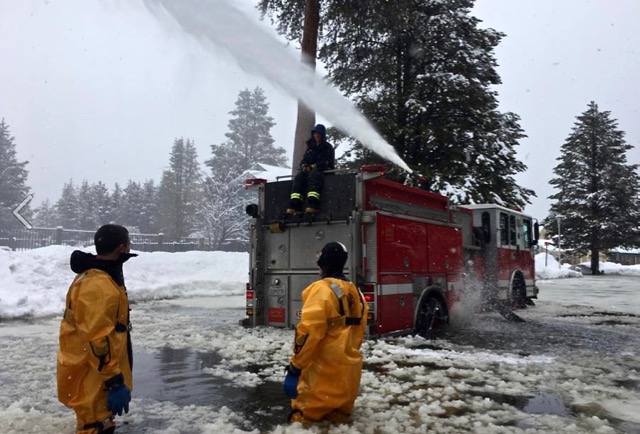
South Lake Tahoe fire crews this month get rid of ice and water on city streets. Photo/SLTFD

By Jim Miller, Sacramento Bee

This year’s heavy rains and the ongoing crisis at Oroville Dam recently prompted Gov. Jerry Brown to do what he and his predecessors have done many times before: ask for federal help.

Once approved, presidential declarations – the most common is a major disaster – open the door to assistance from a range of federal programs, such as money to fix roads or help with living expenses for people thrown out of work.

California knows the programs well.

Read the whole story


Money Matters: Helping parents with their finances

By Rick Gross

Keeping track of finances takes time, attention and energy at any age. In the case of older adults, health challenges such as memory loss can make it difficult to manage their financial obligations as well as they did in the past. If you’re the son or daughter of aging parents, here are a few items to keep in mind that can help protect your parents from financial missteps as they grow older.

Rick Gross

For many seniors, signs of memory loss or dementia may first become apparent when they start to lose track of financial responsibilities. These signs could include unusual spending patterns, failing to remember which bills were paid or incurring uncharacteristic late or overdraft fees. Unfortunately, seniors are far more vulnerable to financial scams as well. Savvy swindlers routinely target older adults who may not be as quick to discern fraud in the form of phony phone calls, letters, emails or texts.

If you notice that mom or dad is struggling to stay on top of their finances, approach the situation delicately. People experiencing memory loss may not want to admit they’re having difficulties, while other family members may be in denial about mom or dad needing help. Start the conversation by offering a helping hand. Older adults often want to maintain their independence, so keep that in mind as you start to get involved.

Creating a support plan

Ideally, it’s best to get mom and dad involved in creating a financial plan while they’re able to communicate their wishes. While this isn’t always possible, any preparations you can do before the situation is critical can help you feel better about their financial affairs.

Start by reviewing your parent’s financial situation, covering off on all their assets and liabilities. If he or she is working with a financial advisor, invite that professional to the meeting. Work together on a strategy to make sure mom or dad is able to cover current expenses and prepare for future ones. The following checklist can help you get started:

1.     Designate someone who is committed to the best interest of your parent to take the lead on financial matters. While many family members may want to be involved in decisions affecting the individual with memory issues, consider choosing one person as the financial contact. This person should make sure bills are paid on time, taxes are completed and keep track of mom or dad’s overall finances, looping in other family members as necessary. Meet with your attorney to discuss if the designated person should seek legal financial responsibility as well, by becoming a power of attorney.

2.     Ensure each asset is properly titled and has a beneficiary that reflects your parent’s wishes. Suggest a meeting with an estate attorney if you think your parent needs to set up or update their will, health care proxy or other estate planning documents.

3.     Establish automatic bill pay where you can. Suggest that your mom or dad set-up his or her account to receive emails when bills are due or paid so that there’s a paper trail to follow in case of confusion.

4.     Create a retirement income strategy – or document your parents’ income if they’re already retired – so that it’s clear what their sources of income are and how they will pay for caregiving expenses. Sources of income may include Social Security, pensions, retirement accounts, annuities or other investments, while their life, health, long-term care and disability insurance policies may provide important coverage to offset expenses. Caregiving costs can be significant, particularly if a higher level of care is needed. Take the time now to explore options and costs for in-home and facility care, and make sure you understand how your parent feels about the various options.

5.     If your parent is still fairly independent financially, remind him or her about the prevalence of money-related scams. Demonstrate how your parent can protect themselves against fraud.

If you are concerned about your parents’ memory issues, try to find some time to lay out a caregiving and financial plan of action while your parents are still able to be part of the conversation. Consulting with a financial advisor or an attorney familiar with elder law issues may help get the discussion started.

Rick Gross is a financial advisor and private wealth advisor with Ameriprise Financial Services Inc. in South Lake Tahoe.


Lithium battery causes fire at TC school

Fire investigator at North Tahoe High School in Tahoe City on Feb. 17. Photo/Provided

North Tahoe High School in Tahoe City was temporarily evacuated on Friday after a lithium battery in a student’s backpack exploded.

Flames could be seen coming from a backpack that was on the floor of multipurpose room. The floor sustained minor damage.

The evacuation on Feb. 17 was necessary because of the smoke.

It is not known what type of device was in the backpack.

— Lake Tahoe News staff report


SNC writing instructor to give talk, workshop

Brian Turner will share his unique talent as the next Writer in the Woods installment, with a reading and workshop in March.

In addition to being the creative writing director at Sierra Nevada College, Turner is the author of two collections of poetry: “Here, Bullet” (2005) and “Phantom Noise” (2010), which was short-listed for the T.S. Eliot Prize in England. His poetry and essays have been published in the New York Times, National Geographic, Poetry Daily, Georgia Review, Virginia Quarterly Review and other journals.

Turner earned an MFA from the University of Oregon before serving for seven years in the U.S. Army. He was an infantry team leader for a year in Iraq with the 3rd Stryker Brigade Combat Team, 2nd Infantry Division. Prior to that, he deployed to Bosnia-Herzegovina with the 10th Mountain Division (1999-2000). Turner was featured in the documentary film “Operation Homecoming: Writing the Wartime Experience”, which was nominated for an Academy Award.

He will give a free talk on March 3 from 7-9pm at SNC. A writing workshop will be on March 4 from 10am-noon. To register, go online.


Government intervention likely in Truckee to help find solutions for affordable housing crisis

Publisher’s note: This is one in a series of stories about affordable housing in the Lake Tahoe-Truckee region. All articles may be accessed via the home page under Special Projects, 2017 Affordable Housing.

By Linda Fine Conaboy

TRUCKEE – With more and more recreational and business opportunities presenting themselves, the Tahoe-Truckee area has become hard pressed to identify enough affordable residential units to accommodate the rapidly increasing need. The situation is reaching a tipping point.

Enter the Tahoe Truckee Community Foundation, who embarked on a long-term study of the situation, with results becoming available last summer. The report, titled “Truckee North Lake Tahoe Regional Housing Needs Assessment”, contained a comprehensive review of the area’s needs and demographics and was funded by Placer County, Truckee, Nevada County and the Workforce Housing Association of Truckee Tahoe.

Stacy Caldwell, CEO of the Tahoe Truckee Community Foundation, was one of the speakers at the Truckee Donner Chamber of Commerce breakfast this week.

The affordable housing challenge within the region an issue which has been barreling to a point of crisis for years, with the rapid rate of growth within the region seen as the culprit.

The area of study for the report roughly encompassed the West Shore of Lake Tahoe into El Dorado County, Truckee, Tahoe City, Tahoma and Kings Beach as well as the Donner Summit area.

Briefly, the research discovered that:

·      55 percent of the households have incomes classified as moderate or low

·      59 percent of workers commute to their jobs

·      47 percent commute out of the region to their jobs

·      4,000-plus new jobs are expected to be created in the region over the next 15 years

·      Almost half spend more than 30 percent of their income on housing; 26 percent spend 50 percent of income on housing

·      Rental rates are high, and there is little rental housing available

·      80 percent of the region’s 474 below-market housing units are in Truckee, all with full waiting lists.

Caldwell admitted that TTCF’s foray into the housing world is “hard stuff.”  The results of the latest study, she said, can no longer sit on the shelf as previous housing surveys have.

Producing the comprehensive analysis, Caldwell said, involved many partners, including several funding collaborators, a large technical advisory group and BAE Urban Economics, an urban economics and development advisory consulting practice, all of whom conducted surveys, participated in public forums and produced myriad stories for publication.

What they found included the fact that because affordable housing is at a minimum, it’s hard to retain good teachers as well as other professionals; that more than half of the houses built within the study area were built before 1979; and that 65 percent sit vacant half of the time.

The median income within the region is $75,000, making it difficult to purchase an affordable home. Rents are high, resulting in elevated occupancy rates within very small spaces, and more than 12,000 additional units are needed to meet demand.

Truckee is suffering from a housing shortage like the Lake Tahoe Basin. Photo/Michael Nevins/U.S. Army Corps of Engineers

“Most mountain communities are facing the same problems,” Caldwell said. “We’re all learning from each other.” She added there is no beginning, middle or end. “We don’t want to lead a parade and have no one behind us. This study just can’t sit on the shelf. There’s widespread momentum now.”

Caldwell said the study has commitments from several partners, but she is hoping that Placer County will jump on board with funding as have other entities. “We need a three- to five-year commitment and everyone must be accountable to the plan.”

We have seen collaborative engagements, she said. “My hope and vision is that it brings the key decision-makers to the table who can offer up leaders, land, policy and money and show a clear signal to our community that we are taking the housing situation seriously and are committed to accelerated change. That’s the mission of my organization.”

Tony Lashbrook, Truckee town manager, said the housing crisis is a top priority for Truckee. “The lack of housing is having a real impact on the quality of life for residents. Medical help and education are suffering,” he said, “because there’s no money; it all goes to housing.”

Additionally, Lashbrook said the situation has an effect on the area’s business climate too. He added that, “Placer County and the town of Truckee are the 800 pound gorillas in the room who need to be at the table to make this collaboration work.”

He told Lake Tahoe News, “The town of Truckee has committed to participate in the Housing Council, subject to the participation of Placer County.”

The Housing Council Lashbrook referenced was proposed by TTCF. In brief, it requests that Truckee commit $50,000 per year for three years to launch the endeavor. Placer County has also been requested to make an identical commitment, while Nevada County and other stakeholders have been asked to participate, although at reduced costs. This information was gleaned from a 2017 document entitled “The Housing Crisis in Truckee”.

Additional speakers at the breakfast were Ulrik Binzer of Host Compliance, who is working with Truckee on its transit occupancy tax compliance on short-term rentals, and Hirsh Jain of Airbnb.

A press release from the Truckee Chamber of Commerce says that the short–term rental and the house-sharing market has grown rapidly in recent years, making it hard to ensure that these rentals are paying their transient occupancy tax. They also can create nuisances in neighborhoods as well as remove much needed housing from the available market.

Binzer said his company, a San Francisco-based startup, offers a solution to this problem. “We help local government implement and enforce short-term rental ordinances,” he said. “We make sure landlords are playing by the rules.”

He explained there are close to 1,150 short-term rental properties in Truckee, with 65 percent of them listed on multiple websites. “It’s a very dynamic market,” Binzer said.

“Originally, 398 single family residence were not in compliance, and now [with the help of Host Compliance] 32 percent of them have been brought into compliance and are paying their fair share of taxes. The problem is not yet solved, it’s a continuing effort.”

In the last five years, according to Placer County staff members, vacation rentals have increased dramatically—more than 300 percent in five years—but tax revenues have not kept pace.

Jain, a senior manager for Global Public Policy for Airbnb, provided an overview of Airbnb and discussed the impact of short-term rentals on housing availability.

From its roots in 2008 to its current global impact, Airbnb now has more than 2 million listings worldwide.

“We want to make sure Airbnb pays taxes,” Jain said. “And we want to build open and transparent communication.”

An op-ed in the February issue of Planning magazine said that the dramatic rise of Airbnb and other short-term rental and home-sharing companies has caused cities like Truckee to seek regulations to ease some of the problems caused, especially the impact on affordable housing.

However, Jain said his company is working on ways to promote responsible home sharing. He reminded the audience that people like to stay in a local environment and not in a hotel setting. They spend locally, they stay longer and they’re vitally important to the local economy.

“We want to work with cities,” Jain said. “We are committed to facilitating the process of collecting taxes. We’re eager to work this out. We’re good actors.”

And Caldwell’s take on the area’s housing crisis and the impact of the short-term rental market?

She told Lake Tahoe News, “This is a complex issue requiring a sophisticated approach. We all have to be at the table and track the solutions. I’m optimistic because we have more than a handful of partners who have stepped up. We see a blended approach to the solution. There are a lot of dynamics that play into this situation.”

She said that Airbnb does change the dynamic of what’s available on the housing market, but they are also trying to lift the burden. “We need our tourists. They’re a part of the economy.”



Opinion: Mid-season check-in from Squaw

To the community,

This has literally been a historic season for our mountains and the region in terms of the nature and severity of the weather, with hurricane force winds, impressive and rapid snow accumulation, extreme flooding, intermittent and sometimes long lasting power outages, mudslides, avalanche conditions and more. From general operational challenges to very specific tragedies, this has been a winter we won’t soon forget. On behalf of our entire team at Squaw Valley Alpine Meadows, I’d like to thank you for bearing with us as we continue to work hard to respond to the unique set of challenges Mother Nature has presented this winter.

Andy Wirth

With that said, I wanted to acknowledge specifically how our company is working to improve its performance. Despite factors that are materially out of our control such as sustained high winds over the mountain tops and varying snowpack layers, we are working hard to refine the intense, safety-first choreography that goes into opening these remarkable, high alpine mountains. We readily acknowledge your zeal and passion to hit the slopes and enjoy the snow, and are just as frustrated when we’re unable to provide access. I can assure you that we too, are passionate about the skiing and riding experience. While we simply cannot compromise safety as it relates to our team and guests, our intention is to open terrain as soon as conditions permit.

We are committed to continuing to make improvements across our operation by way of capital investments. An important example is our recent investment in Gazex, a remotely controlled avalanche mitigation system that uses propane gas and oxygen to create a concussive blast, triggering controlled avalanches before they can become a hazard. In addition to ski patrol efforts, the Gazex Inertia Exploders may decrease delays in lift start times, and increase the efficiency of Ski Patrol in opening the ski areas. We have invested over $1.5 million in five deployments, and are working on plans to deploy many more across both mountains in an effort to ensure more efficient and expeditious terrain openings while not compromising on our all-critical safety focus.

We are also striving to communicate to you on a near-real-time-basis, primarily through our new app, website and Mountain Ops Twitter. For guests looking for a more in-depth understanding of our day-to-day operations, we also maintain a detailed Operations Blog. We have identified areas where we can and will improve, including a very real-time view and perspective of what winds, in particular, are doing across the top of the mountains.

Toward the goal of improving the decades old, region-wide issue of road congestion, we’ve been working with, if not challenging, our civic leaders in the region to develop real solutions – in the present tense – for regional mass transit and traffic congestion reduction on Highway 89. We have been actively working on in-valley “micro mass transit” for Olympic Valley and Alpine Meadows with Chariot, incentivizing high occupancy vehicle (HOV) use with our POW Parking program, and improved communications via real-time road signage (along Highway 89, Squaw Valley and Alpine Meadows Roads) in addition to our app.

The Squaw Valley Alpine Meadows leadership team and I remain very open to feedback and suggestions. Through many channels, we welcome feedback on your experience, whether it’s related to our grooming, service or operations. We will always be open to your input, but ask that it be respectful in its construct. Our team works extremely hard to provide a great experience, and while we recognize areas where we can and will improve, it is imperative that respectful dialogue be the guidepost—predominantly with respect for the dedicated and hardworking men and women that comprise our team.

Our passion for these mountains is real and very genuine. We recognize that in the context of remarkable and historic weather circumstances, we can and will do better…by way of our commitment to review and improve our operations so we can more effectively communicate with you. This is our commitment, and we remain very appreciative of your support and understanding, and look forward to sharing many more powder days with you this season. It’s not a question of if, but how far into June we will be open. And it’s not a question of if, but how many lifts we will be running over 4th of July!

Warm regards,

Andy Wirth, president and CEO Squaw Valley Ski Holdings


Why you should get around to drawing up a will

By Ann Carrns, New York Times

No one likes to think about dying — and that is probably one reason most Americans lack wills.

Fewer than half of American adults (42 percent) have a will, according to a survey published this week on Caring.com, a website that offers resources for older Americans and their caregivers.

The most common excuse given for not having a will (or an alternative legal tool called a living trust) was, “I just haven’t gotten around to it,” cited by nearly half of survey participants who lacked one.

Read the whole story