Hospitality jobs require tech know-how

By Julie Weed, New York Times

The front desk manager or housekeeper may epitomize the hotel employee, but the hospitality industry is increasingly dependent on tech workers, vacuuming data scientists, web designers and other experts into its ranks.

More than ever, guests look to their phones and computers to research, book, stay in and communicate with hotels. That translates to critical technology needs in information security, mobile development and systems integration.

Inside hotel operations, data analysis can help find new customers, make a dining room more profitable or provide information to executives making business decisions.

Kate Walsh, interim dean of the School of Hotel Administration at Cornell, says she is seeing more companies coming on campus to hire students who are specializing in areas like digital marketing and business analytics. “They want foodies who code,” she said.

Read the whole story


Probe: Nev. cut staff for prescribed burn turned wildfire

By Scott Sonner, AP

An independent investigation into a smoldering prescribed burn that sparked a Nevada wildfire and destroyed 23 homes found several questionable practices at the state forestry division, including understaffing despite repeated warnings about unstable, windy weather.

The state of Nevada late Wednesday ordered the review made public on the fire that started Oct. 14 by lingering embers that spread in the Washoe Valley between Carson City and Reno.

“With knowledge of the impending wind event, staffing continued to decrease on the two days prior to the escape,” according to the report overseen by the Phoenix National Incident Management Organization.

It concluded that repeated requests from Washoe County and others to halt the operation due to deteriorating air quality and weather conditions were either ignored or failed to make their way up the line of command at the Nevada Division of Forestry.

In addition to failing to adequately monitor mop-up efforts on the burn, the report cites a lack of documentation for certain training requirements for some fire department personnel. In some cases, a “burn boss trainee” who was reporting to the “burn boss” improperly checked off on conditions necessary to ensure safety despite the fact wind speeds and relatively humidity outside the approved parameters.

The burn boss and trainee specifically discussed the forecast for high winds the day before the fire escaped.

“Based on the limited amount of heat near the control lines, success of the current mop-up effort and the risk to firefighters working in timber during high winds, the decision was made to not staff the prescribed fire in the night of Oct. 13,” the report said.

Other findings include:

  • a daily risk analysis that identified hazards and mitigations was not done for the prescribed fire
  • the smoke management and air quality plan was insufficient to effectively minimize negative impacts
  • a review of the “complexity rating” assigned to the project “revealed that a few elements might have been underrated,” including “management organization” and “public and political interest.”

Gov. Brian Sandoval said he would discuss the findings with the Department of Conservation and Natural Resources overseeing the Division of Forestry.

“Bringing in an outside professional perspective was an important step in understanding how this tragedy occurred,” he said. “Once again, I would like to express my heartfelt sorrow to the victims of this tragic event and my sincere gratitude to the first responders and firefighters who battled this intense and shocking event without injury or loss of life.”

The actual prescribed burn that began on Oct. 4 was done “slowly and cautiously and was well staffed” with more than 100 personnel, the report said. But the next day, humidity levels fell below the approved parameters and smoke started to impact Incline Village at Lake Tahoe where it wasn’t anticipated.

Late that afternoon, the Washoe County Air Quality Management District “expressed concerns with air quality and asked the burn boss not to burn on the next day.” The report said the burn boss stated he did not recall that Oct. 5 conversation.

The operation continued Oct. 6 despite humidity levels, wind speed and direction outside the parameters. County officials told the burn boss that day “conditions were not favorable to continuing burning,” and then spoke directly to the state forester on Oct. 7 in an attempt to “compel NDF to cease burning,” the report said.


Star Guide: Perceptions of the Cosmos

By Tony Berendsen

As the star guide for Tahoe Star Tours, I spend countless hours under the stars. My passion for helping people understand what they see while looking up on a starry evening is my purpose, and this mission statement sums up my intention, “One day everyone will walk out under a starry sky they understand.”

I tell people when they hear the mission statement, “I know it’s a tall order, but you have to set your sights high. The understanding of the starry sky begins with one little bit of knowledge: the sun is a star.” We all know that it’s a star, but when we take a minute to think about it, while looking at other stars in the night at distances so great they are just points of light, we start to gain a sense of the immensity of the Cosmos.

It is at that moment, looking at the stars in the distance, we begin to ask questions about our place in the Cosmos. In the last Star Guide, I asked the question: “How do you define your Cosmos?” Here are some of the answers:

·       “So, do you think there is life up there?”

Male, United States

·       “You know who made the moon. Yes, you do”

Female, Italy

·       “I don’t need to ask questions about the Cosmos, the creator tells me what I need to know.”

Female, Korea

·       My venue is the dome of the night,

The master works I have trained myself to know are nothing less than the star patterns that populate our lives, all lives, everywhere the world over,

And not only these here in the sky above my head,

But in the books and stories and buildings and fields and wishes and ceremonies and sciences of ages. 

It is good work. 

It is human being at the center work, 

It is truth.”

Mary Stewart Adams, director Headlands, International Dark Sky Park

·       “Thinking about the cosmos, and my place in it, expands my vision beyond my life on earth. I feel a part of a vast continuum beyond my comprehension that is somehow reassuring.”

Sally Jacob, Reno

·       “My Cosmos is a bucket that I fill with love, peace and forgiveness. When it’s full I pour it all over the Galaxy”

Linda Kovalcheck, San Diego

·       “Why am I me?”

Kathleen Berendsen, Reno

·       “The Cosmos is such a large collection of stars I can’t imagine the size. They are beautiful to look at!”

Chad Carvin, Reno

We are all so different in our interpretation of the Cosmos. The questions we ask, and thoughts we share, will help us understand the starry sky above and our place in the Cosmos.

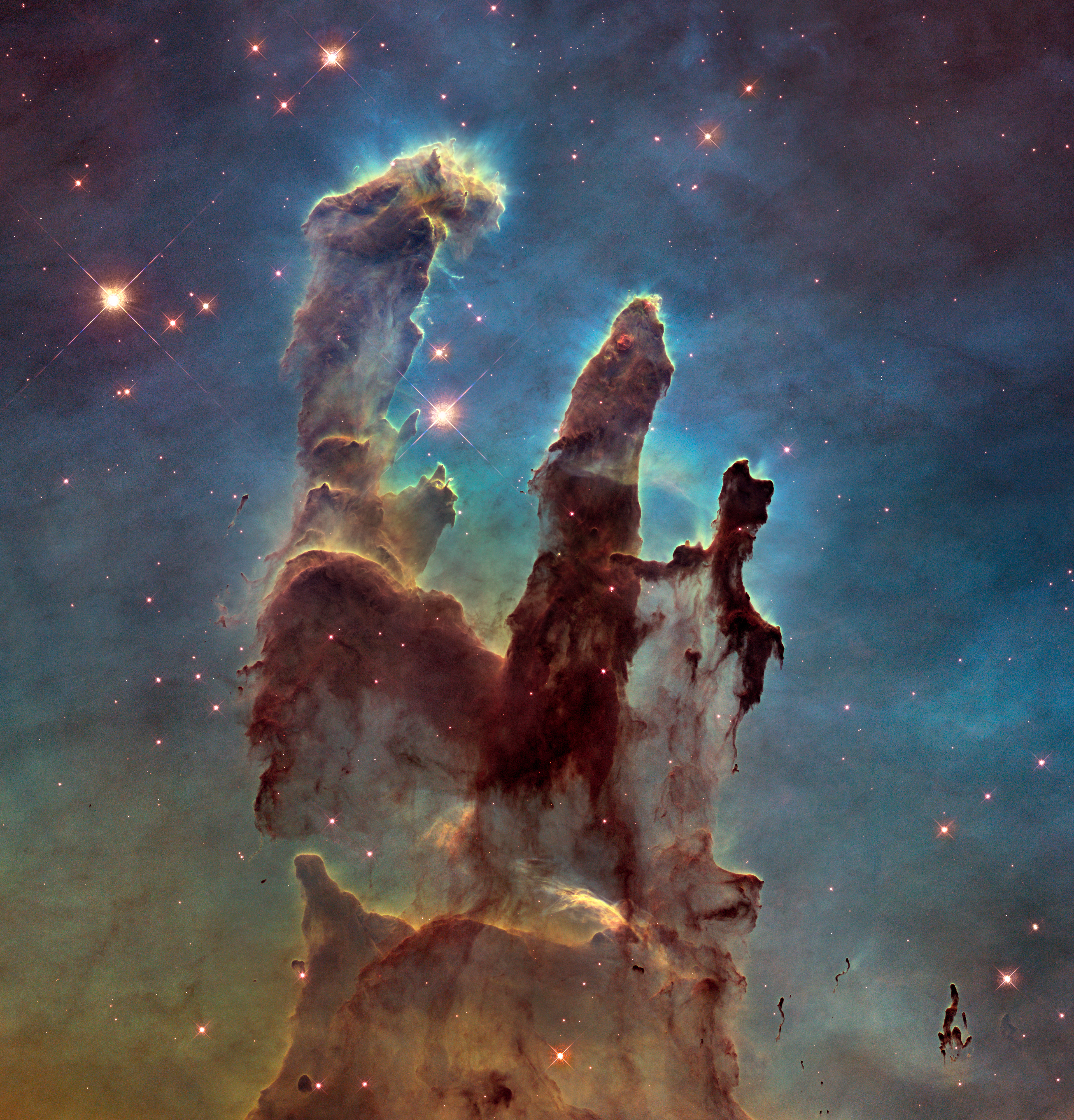
NASA Hubble Space Telescope — Pillars of Creation.

A poem I wrote several years ago after giving a talk at Great Basin National Park describes how I feel:

The Milky Way

Above as we walk hand in hand in the darkness

She has wrapped her silver band upon us

A motion so gentle we hardly notice

As a nest sways in an earthly breeze

Caressing the beginnings of an endless cycle

We see from inside and beyond

To the realm of other kindred souls

She wonders about us so

Our existence in such a small space

Thinking of ourselves as masters

Holding on to each other till

We accept the inevitability of it all

And her arms release us to roam this place.

Next Star Guide: What is a molecular gas cloud, and where can I see one?

Tony Berendsen runs Tahoe Star Tours. He may be reached at 775.232.0844 or tony@tahoestartours.com.


Opinion: Fix California water and data systems

By Michael Kiparsky and Roger Bales, Modesto Bee
 
Few people realize how outdated our systems for water information are. Because of data limitations, real-time, transparent decisions about drought management, flood response and groundwater protection have eluded the state for the past century. Without basic numbers on where, when and how much water is available and being used, we can’t improve how we manage our most precious water and natural resources.

A proposed law, the Open and Transparent Water Data Act – Assembly Bill 1755 – could coordinate and integrate existing data. Paired with the vision of the Sustainable Groundwater Management Act, AB1755 could foster entrepreneurship, innovation and scientific discovery. But the long-term opportunity is even greater: AB1755 could help move water and natural resource management in California from sticky notes and push pins to the smart data tools of the 21st century.

Read the whole story


Sun Valley ski resort — a mountain of history

By Kathryn Reed

SUN VALLEY, Idaho – In this era of corporate consolidation in the ski industry, Sun Valley ski resort stands out as being independent. But the area also stands out as being a company town.

The Holding family owns Sun Valley in Idaho and Snowbasin in Utah through their company Sinclair Oil. So, while their ski portfolio is not large, the family and affiliates know quite a bit about the corporate world.

The 220-room Sun Valley Lodge, Sun Valley Inn, restaurants, stores, three golf courses – and ski resort – are all under the same ownership. It’s diversification and control in a limited space. It seems to be working.

Like Lake Tahoe, Sun Valley is boasting about its incredible snowfall. Skier visits have hit record numbers on some days.

Sun Valley has 3,400 vertical feet of skiing. Photo/Pamala Ward

In early January they were getting pummeled by snow, no rain. One day the fog was so heavy Pam and I had no idea where we were. Oh, but, the smiles we had on our faces when we met the rest of the gang for lunch. The powder was simply glorious – thigh deep at times, light and bountiful.

The groomers seemed to go on forever. Bald Mountain tops out at 9,150 feet, with the base being 5,750 feet.

The mountain has two distinct sides – River Run and Warm Springs. The latter is where things started, the former is where most now begin their ski day.

The hot tub at Sun Valley Lodge is larger than some hotel pools. Photo/Pamala Ward

It was in 1936 that Sun Valley first opened. One claim to fame is that it had the country’s first ski lift.

Notable Olympians from the area are Kaitlyn Farrington who in 2014 won gold in halfpipe. Kaitlyn’s Bowl is named after her. Picabo’s Street is named after Picabo Street, who won multiple Olympic medals for ski racing. Gretchen’s Gold is for Gretchen Fraser who in 1948 became the first American to win an Olympic gold in skiing.

The mountain has plenty of terrain for those who will never even make the Olympic team, let alone medal.

Sun Valley has produced multiple Olympic athletes. Photo/Kathryn Reed

On our third day of skiing the sun finally came out – making me understand why it’s called Sun Valley. It really is a valley of sun.

Finally, I see the Sawtooth range – so craggily it’s understandable how it got its name. In a more populous area I’m sure those other mountains would be developed.

What helps this resort in the middle of Idaho survive despite being so remote is in part its location. People have to want to go there. There is no drive-up market to tap into like Tahoe does. It was built by railroad tycoon Averell Harriman as the country’s first destination ski resort and remains a destination today.

A full moon shines upon the historic Sun Valley Lodge. Photo/Pamala Ward

“I think one of the things about Sun Valley is that we are very iconic,” resort spokesman Mike Fitzgerald told Lake Tahoe News. “It is more of a year-round resort. We are a busy in summertime as we are in winter.”

People return year after year.

“Of our guests, about 76 percent are return visitors. We have incredible loyalty,” Fitzgerald said.

I’m one of those returnees, only it had been 35 years since I was last at Sun Valley. I don’t remember much about the mountain. What stands out from that trip with my parents, and my best friend and her parents was the sleigh ride to dinner. It’s still offered.

The free bus system through Sun Valley-Ketchum operates efficiently. We used it to get to and from the slopes each day. Stops are clearly marked and times given when the next bus will arrive. It was refreshing coming from a city that doesn’t even have a bus as a symbol at its stops.

Tom Ward pedals on the multi-use trails at the Nordic center. Photo/Pamala Ward

In 2007 three bus systems were consolidated into what is known today as Mountain Rides. “Mountain Rides operates as a public agency under a joint powers Agreement partnership that includes the cities of Bellevue, Hailey, Ketchum, Sun Valley and Blaine County. Mountain Rides’ funding comes from local option sales tax and general funds from its local funding partners, as well as from the Federal Transit Administration and revenue from fares,” the bus system’s website says.

In casually speaking with a variety of Sun Valley employees they raved about working for the company. Full-time workers get health and retirement benefits. Dorm style lodging is available for many employees.

One man used to live in Truckee. He’s happier in Idaho. It’s not as expensive to live. He boasts about the trail network being right in town and not needing to drive anywhere.

Still, others spoke of how it is expensive to live in this mountain area. Some drive more than hour to get go work.

Nonetheless, if the workers’ jovialness was an act, they’ve been trained well. Customer service is reminiscent of Deer Valley, only more authentic in the sense there wasn’t anything pretentious about Sun Valley.

The lodge was renovated a year ago, and the inn will be in the coming year.

I was there for a week in January with eight others. Three of us were in the same condo owned by Sun Valley. While it was adequate, it clearly was not on the most recent renovation schedule. We were under the impression going in that it was going to be a little higher end than it was.

We had access to the hot tub which is pool-size. It was an easy walk. But one of the best things about the lodge is the shuttle service. Perfect for getting a ride back to the condo after soaking. Drivers took us into town, to the Nordic center where Pam, Tom and I tried fat bike tires for the first time. (Fun, but no need to add another sport to my repertoire.) The center, though, would be worth exploring further because of the myriad snowshoe and cross country trails. In summer this is where golfers flock.

While the Sun Valley-Ketchum area has a bit of a rugged feel, it is also modern. The restaurants offer a variety of fare – from local trout to wild game to plenty of potatoes. Being a vegetarian was not a problem.


Feasting on potatoes while in Idaho

It’s hard to find a menu in Idaho without some form of potato. Photo/Kathryn reed

By Kathryn Reed

KETCHUM, Idaho – I can’t move to Idaho. It’s all because of the potatoes.

I have a problem with French fries. I think they are food group. I think they can be eaten at any time of day. I think they can be a meal unto themselves.

Not that potatoes can’t be found in every state, but they do seem to be on the menu a bit more in Idaho – and in other forms than French fries.

“Idaho’s growing season of warm days and cool nights, ample mountain-fed irrigation and rich volcanic soil, give Idaho potatoes their unique texture, taste and dependable performance,” according to the Idaho Potato Commission.

Fries and potato skins at Whiskey Jacques in Ketchum. Photo/Kathryn Reed

Potatoes are Idaho’s No. 1 crop, with 13 billion pounds harvested each year. The Idaho Farm Bureau says, “About 60 percent of Idaho’s potato crop is processed into French fries, tater tots and other fried products, or dehydrated into flakes and various other forms. Statewide, the crop is valued at between $550 million and $700 million per year.” 

Russet, red, fingerling and gold are what this state grows. Most are grown in the southern half of the state, which includes Sun Valley. When I was there last month I tried to eat as many potatoes as possible.

Potato salad at Cristina’s in Ketchum tastes almost as good as mom’s. Photo/Kathryn Reed

Even on the mountain at Sun Valley ski resort baked potatoes are served for lunch. A loaded potato – sour cream, bacon, chives, sharp cheddar – cost $11.50, while the chili cheese loaded potato was $12.50. A side of fries was $5, while sweet potato fries were $6. All of these were available at Seattle Ridge Day Lodge.

At River Run Lodge, at the base, deli sandwiches came with two sides – choices included twice baked potato, mashed potatoes and gravy, and sweet potato mash. From the grill there were cheese fries ($5.75), Idaho fries ($4.50), chili cheese fries ($8.50), and sweet potato fries ($5.50).

Mashed potatoes complement the steak at Sawtooth. Photo/Kathryn Reed

At Whiskey Jacques it was time for potato skins. It had been years, maybe decades, since I last had potato skins. Cheesy good, but felt like I could be rolled out of there.

At Cristina’s I ordered potato salad as a side with my sandwich. My sister and I are potato salad snobs, probably because mom makes the best, but we both admitted this restaurant in Ketchum got high marks. They used red potatoes and were light with the mayo.

At the Pioneer restaurant a baked potato with sour cream and chives was dinner – and only $4.95. It was so big that I could not finish it. Those wanting a potato with dinner could pay $2.95. Everyone passed on the Jim Spud – a filet inside of a potato with cheddar and sour cream. ($12.95)

Fries for lunch on the slopes of Sun Valley. Photo/Kathryn Reed

I so wanted to have the homemade potato leek soup at the Sawtooth, but the bacon in it had me dining on a non-potato item. But those who ordered it said it was tasty. I did have a bite of the garlic mashed potatoes – wow – could have had that and wine, and called it a meal.

I’m not sure I could have endured such a highly intensive carb diet for more than a week. While potatoes are not super unhealthy, it’s all the crap we put on them and then if they are fried that gives them such a deservedly bad reputation. Still, I’m not quitting my French fry habit, but I might start asking if they are Idaho potatoes.


Hemingway left indelible mark on Ketchum

Ernest Hemingway’s Royal typewriter in Ketchum, Idaho. Photo/Kathryn Reed

By Kathryn Reed

KETCHUM, Idaho – “There is nothing to writing. All you do is sit down at a typewriter and bleed.” – Ernest Hemingway

Oh, the stories that old Royal typewriter in the glass case could tell. The blood – perhaps literal and figurative – that fell onto those keys. The legendary prose that spilled forth onto once blank pieces of paper with every peck.

This typewriter at the museum in Ketchum is said to belong to Ernest Hemingway.

Hemingway earned the Nobel Prize in Literature in 1954, and was nominated for the same award in 1950 and 1947. He was awarded the Pulitzer for fiction writing for “The Old Man and the Sea” and was nominated for the Pulitzer for “For Whom the Bell Tolls.”

This is the perspective Ernest Hemingway had from his seat at  the Casino in Ketchum. Photo/Pamala Ward

His presence in this small outpost in Idaho (population 3,319 – Sun Valley is 1,476) can still be felt to this day.

Bars that he would frequent still exist, though most have evolved in the last 55 years. At the Casino, locals said, he would sit at the end of the bar near the door. A few old pictures with Hemingway in them hang on the walls. 

Hemingway is said to have been a regular at the Sawtooth Club, Whiskey Jacques, and the Pioneer, too. His last dinner out was at the Christiana.

While the Sun Valley Lodge touts how Hemingway finished “For Whom the Bell Tolls” while staying in a second floor room, no marker on the outside indicates this fact.

This is one of the bars Ernest Hemingway enjoyed. Photo/Pamala Ward

Hemingway first came to the resort – specifically the lodge – in 1939. Averell Harriman, who founded the ski area, had enough marketing savvy to know if he brought celebrities to the area, the common person would follow. It worked – and still does.

The renowned novelist fell in love with the area; especially the fishing and hunting. Establishments throughout town have photos of Hemingway hunting. It was a love of his since growing up in Illinois.

He lived in Ketchum multiple times. Hemingway set up residence in 1946 with one wife, and came back in 1958 with a different wife.

Ketchum is where he took his life in July 1961. He’s buried in the cemetery in town. In January, there was too much snow to go looking for his headstone. The stories are that people who visit leave smoked cigars and whiskey bottles as a token of appreciation.

The Sun Valley Museum of History has a section devoted to Ernest Hemingway. Photo/Pamala Ward

Hemingway left behind a treasure of works that to this day are must reads: “The Sun Also Rises,” “A Farewell to Arms,” “The Old Man and the Sea,” “For Whom the Bell Tolls,” and “To Have and Have Not.”

The library in Ketchum has an entire section devoted to him. Books by and about the author are on display. Photos of him are on the wall. For the past dozen years, the library has put on the Ernest Hemingway Festival in the fall.

An entire section of the museum in town is also devoted to Hemingway.


Missing Alpine snowboarder found safe

A Bay Area snowboarder who went missing Saturday at Alpine Meadows has been found safe.

The 32-year-old man from Oakland had hiked about three miles to an area known as Diamond Crossing.

His name has not been provided.

The snowboarder was on the back side of the mountain. Placer County sheriff’s search and rescue team lead him out of the backcountry on Feb. 18.

— Lake Tahoe News staff report


Technology slow to help predict avalanches

By Ethan Baron, Bay Area News Group

It’s a bountiful winter in the snowy Sierra Nevada, with the biggest snowpack in 22 years. That’s great news for skiers and snowboarders, but all that snow can transform in an instant from a beautiful blanket to a deadly shroud when an avalanche hits.

In December, Aptos doctor Tom Barker, 64, was swept more than 200 yards in an avalanche that left him buried under 9 feet of snow, after he and a friend skied into a closed area at the Mt. Rose ski resort without their avalanche-safety gear. Barker did not survive.

Slides kill one or two winter-wilderness travelers every couple of years in the Sierra around Lake Tahoe. For every death, avalanche experts say, about 10 people are caught in a cascade of snow and ice and barely escape with their lives.

The popularity, and the risk, are driving companies to develop new avalanche-safety products based on bleeding-edge technology better known in the fast-evolving realms of self-driving cars, the Internet of Things, and big-data computing. The technology holds promise for preventing fatalities, according to experts, but it’s in its infancy.

Read the whole story


Sandoval won’t use National Guard for immigrants

By Colton Lochhead, Las Vegas Review-Journal

Nevada Gov. Brian Sandoval said Friday he would not activate the Nevada National Guard to round up undocumented immigrants for deportation.

Sandoval, speaking to the Review-Journal during a break at a Nevada homeland security commission meeting, said he was aware of the report but had not read the memo. The Associated Press detailed a memo draft that was considered by the White House, which called for the mobilization of National Guard troops across 11 states, including Nevada.

The memo proposed to use as many as 100,000 troops to act as immigration enforcers in finding and deporting undocumented immigrants.

Read the whole story