Heavenly snowboarder survives night in wilderness

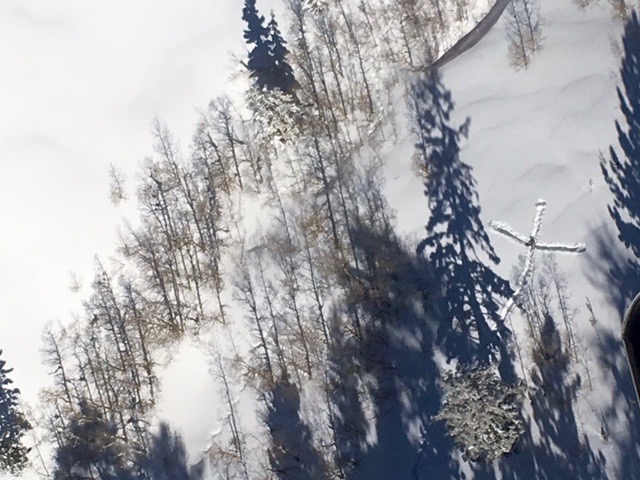
An X in the snow, to the right, alerted search teams to the missing snowboarder on Feb. 22. Photo/EDSO

By Kathryn Reed

A snowboarder spent the night out in a snowstorm Tuesday after skiing out of bounds at Heavenly Mountain Resort.

Aarin Yu, 32, of Los Angeles was at the top of Canyon Express chairlift when he got disoriented because of the whiteout conditions. El Dorado County sheriff’s deputies said he admitted to going under a rope, but thought he was still in bounds. There is rope in the area that separates the runs from the terrain park.

“He got into heavy, thick snow and trees and realized he was not on the resort’s lands,” sheriff’s Deputy Greg Almos told Lake Tahoe News.

At 2:30pm he called ski patrol to say he was lost. They scoured the area where Yu thought he was. At about 4:15pm Heavenly called El Dorado County Sheriff’s Office realizing Yu probably was not inside the resort’s boundaries.

The weather and time of day kept searchers from going out until daybreak on Feb. 22.

When Yu heard the helicopters he drew an X in the snow. That is what led CalStar to locate him. He had spent the night in a tree well less than a mile from the resort.

A California Highway Patrol helicopter with an EDSO search and rescue team member used a hoist to retrieve Yu from the snow. He was taken to Barton Memorial Hospital with exposure concerns, but nothing life threatening.

Kevin Cooper, spokesman for Heavenly, would not talk about the importance of why ropes are put up at the resort or anything else about this incident. Instead he deferred all comment to the sheriff’s department.


Federal advisory panel to meet in SLT

Lake Tahoe Basin Federal Advisory Committee (LTBFAC) is scheduled to meet Feb. 28 from 1-4pm at the Forest Supervisor’s office, 35 College Drive, South Lake Tahoe. 

LTBFAC will address issues related to federal activities at Lake Tahoe.

Items on the agenda include an update on the Southern Nevada Public Land Management Act (SNPLMA) secondary list and priority setting, a review of LTBFAC goals and objectives, a schedule of 2017 meetings, and membership and vacancy information.  

LTBFAC consists of 20 members representing a broad array of constituencies.


Flood worries throughout Northern California

By Associated Press

Communities downstream from a Northern California reservoir gushing water for the first time in 20 years braced for flash floods and evacuations after authorities warned them to prepare for rising rivers and creeks.

Northern California is forecast to get a brief break from persistent downpours today but the surge of water released from Don Pedro Dam into the Tuolumne River in the foothills east of Modesto is expected to reach overtopped levees later in the day.

Katie Whitley, who manages the Driftwood Mobile Home Park in Modesto, said residents nearest the river have been moving their trailers out since the start of the weekend.

“We’re just holding our own,” Whitley told the Los Angeles Times. “That’s what we have to do. You just have to hope for the best. But you can expect it when you live on the river.”

The water released from Don Pedro is expected to reach its peak along a stretch near Vernalis that’s already at danger stage, said Tim Daly, a spokesman for the San Joaquin County Office of Emergency Services. The water isn’t expected to spill over the levees but rather increase pressure on them, causing possible breaks in any weak places.

Farther south, the Anderson Dam in Santa Clara County reached capacity over the weekend and after heavy rain it began overflowing into the Coyote Creek.

Rescuers chest-deep in water steered boats full of people, some with babies and pets, from a San Jose neighborhood inundated Tuesday by water from the creek.

At least 225 residents were taken to dry land and rinsed with soap and water to prevent them from being sickened by floodwaters that had traveled through engine fuel, garbage, debris and over sewer lines, said San Jose Fire Capt. Mitch Matlow.

Rescuers went door-to-door searching for people who needed to leave the neighborhood. Only residents who could prove they had been cleaned of the floodwaters were allowed to board buses to shelters.

“The water started to seep in the driveway, and then it started to creep up into the front door. It kept getting worse and worse,” said Alex Hilario, who walked in knee-high water to get to his car and leave.

Earlier Tuesday, firefighters rescued five people stranded by flooding at a homeless camp along the same creek in San Jose.

Firefighters knocked on doors to tell residents to get out of their homes because the city does not have sirens or another emergency warning system, San Jose spokesman David Vossbrink said.

The rains were the latest produced by a series of storms generated by so-called atmospheric rivers that dump massive quantities of Pacific Ocean water on California after carrying it aloft from as far away as Hawaii.

One of the main routes to Lake Tahoe was in danger of collapsing after a roadway shoulder gave way following heavy storms, leaving a gaping hole on part of Highway 50, Caltrans engineer Jarrett Woodruff said.

Crews opened one lane Tuesday as Caltrans workers tried to fix the road failure after numerous mudslides blocked it for days in recent weeks.

The water level rose at Lake Oroville for the first time since authorities ordered an emergency evacuation of 188,000 people more than a week ago after a damaged spillway caused major flooding concerns.

The rains have saturated the once-drought stricken region and wreaked havoc for residents hit hard by the heavy rain. At least four people have died in the storms throughout the state in the last week.


Liberty assessing damage to electric lines

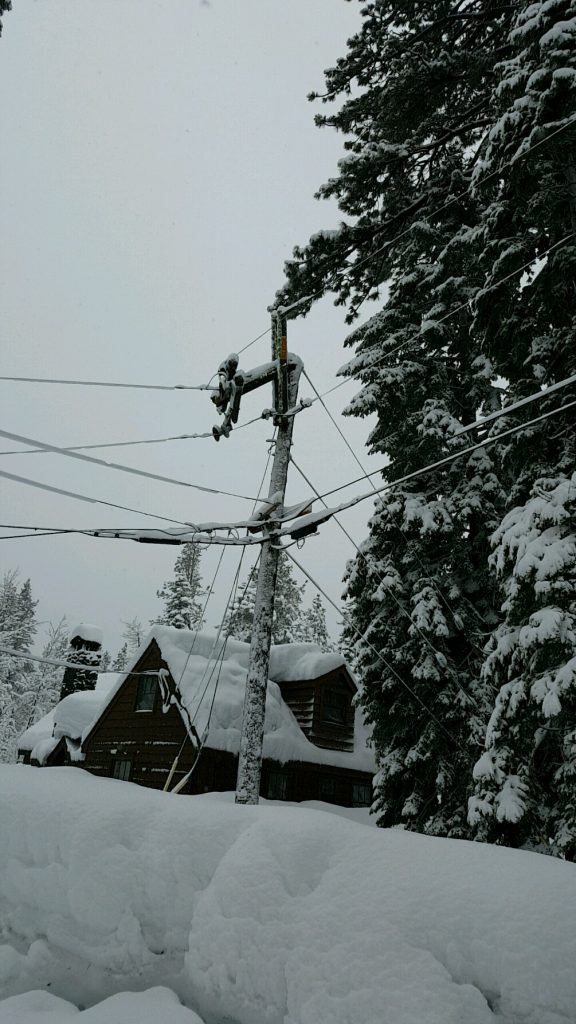
A broken pole in Ward Canyon took out service to part of Alpine Meadows on Feb. 21. Photo/Provided

Tuesday night’s storm caused extensive damage to Liberty Utilities infrastructure.

Via helicopter crews are assessing the damage on Feb. 22.

Glenshire in the Truckee area: Most customers without power; no estimated restoration time until helicopter assessment is complete.

Kings Beach downtown: A tree fell through a wire early Wednesday morning; crews on site making repairs with power expected to return by 3pm.

River Road/Silver Creek/Fir Crags Road/Highway 89: Avalanche danger still making access difficult; helicopter will patrol today to make damage assessment.

“Customers should continue to plan for extended outage. Smaller outages will be assessed and repaired as crews are available,” Liberty said in a press release.

Nearly 1,200 customers in both Placer and Nevada counties are without power. Liberty said it could be a multi-day outage.

— Lake Tahoe News staff report


Crumbled Hwy. 50 will take months to repair

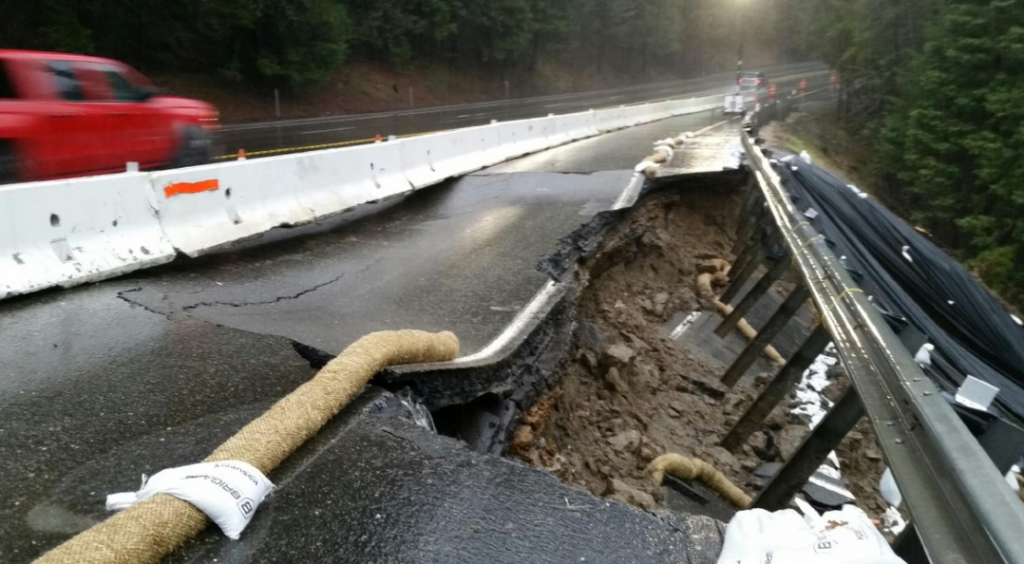
Part of Highway 50 near Bridal Veil Falls has fallen down the hillside. Photo/Caltrans

By Brad Branan, Sacramento Bee
 
A section of Highway 50 crumbled farther down the hillside early Tuesday near Bridal Veil Falls, offering the latest dramatic reminder of how vulnerable Sierra highways have become in this winter’s deluge of rain and snow.

Though the damaged road did not result in injuries, it prompted the closure of both westbound lanes and will reduce traffic to one lane in each direction for months to come. Crews will work on stabilizing the slope and fixing the highway, according to Caltrans.

“It’s going to be a long-term closure,” said Caltrans spokesman Steve Nelson. “The contractor is still figuring out how to fix the road; but whatever they come up with, it’s going to take at least a few months.”

Read the whole story


Does California need more dams?

By George Skelton, Los Angeles Times
 
You hear this every time there’s a drought or deluge in California: “Why haven’t they built more dams?” Truth is, they’ve built a bunch. And they’re about done with it.

Tally them up. There are more than 1,400 dams in the state. At least 1,000 are major and 55 can hold 100,000 acre-feet or more of water. One acre-foot is enough to supply two average households for a year.

There are 36 reservoirs that can contain at least 200,000 acre-feet. Eleven can hold 1 million or more.

Read the whole story


Feds evaluate using drones at ski resorts


Sierra-at-Tahoe isn’t ready to stop having patrollers be in charge of avalanche control. Photo/Provided

By Susan Wood

The idea of having drones deliver avalanche charges at ski resorts may one day fly with regulators, but major roadblocks now hinder movement in that practice.

The U.S. Department of the Interior is looking into the initial concept as a way of keeping ski patrollers who conduct this duty even more safe.

The high-flying practice is illegal right now. But that hasn’t stopped some who monitor the nation’s ski resorts and accidents from looking into it.

The turn-about in the snow patrol world appears to raise more questions than answers — from resort chiefs and ski industry pros to forest officials and aviation regulators.

Currently, the Federal Aviation Administration’s drone regulations ban them from being flown over crowds or dropping anything – much less explosives from the sky. A drone is deemed an aircraft under federal law as it is “capable of sustained flight in the atmosphere,” according to FAA statute.

The U.S. Department of Defense uses drones for reconnaissance and air strikes over foreign land. U.S. airspace is not allowed.

“Anyone who wants to drop something from an aircraft must take steps to ensure that doing so won’t endanger people or property on the ground,” FAA Pacific Northwest spokesman Ian Gregor explained to Lake Tahoe News.

The ski industry is keeping a close eye on the suggestion.

“The federal government would need to allow the delivery of explosives from a drone first. The FAA prohibits it at this time, so that is a major obstacle. Until that changes, I don’t see much movement in this area,” National Ski Areas Association spokeswoman Geraldine Link said.

Lake Tahoe ski resorts may now use an unmanned aircraft system (UAS), aka drone, for advertising and snow monitoring purposes under special use permits, according to the Lake Tahoe Basin Management Unit. Dropping charges for avalanche control is yet another matter.

No ski resorts have sought a permit yet, LTBMU spokeswoman Heather Noel indicated. If the request meets the screening criteria, the Forest Service may allow for the flight under the discretion of its authorized officer.

“It can be an amazing technology or a detriment,” Noel said.

And there lies the bane and the blessing of using drones.

The video footage coming out of these devices is amazing and often useful. Take the recording made during the last series of wet storms that produced major flooding in the Carson Valley.

Hence, a picture – or in this case a track, is worth a thousand words.

However, drones have also come under fire for flying into areas where crews are fighting wildland blazes. In some circumstances, they have already hindered firefighting air operations.

Still, if managed well, drones may bring a whole new dimension to avalanche control safety as well as pilot programs to film skiers.

“This is certainly an idea worth considering, but there are so many things to think about,” California Ski Industry Association Executive Director Michael Reitzell said, listing a whole set of questions:

·      How would the drone be programmed?

·      Who would operate the drone?

·      How will it deliver the explosives?

·      How would the explosive be lit?

·      In hard snow conditions, how will the drone make sure the explosive does not slide all the way down the hill?

Reitzell, who is an attorney, noted a major case would have to be made that this technology is safer than current methods. He pointed to the recent fatality of a Squaw Valley patroller, but defined the tragic incident as “extremely rare.” (Squaw officials declined to comment on the drone topic.)

Then, what happens when one malfunctions? After all, it is a computerized device.

“A resort would have to be pretty much 100 percent certain that it will always have control over the drones. They also would need to withstand the significant weather as well,” he told LTN. “

Moreover, should we take out the human factor in judging the safety of a slope?

“I would also imagine that many patrollers would say there is a bit of an art to avalanche hazard mitigation. It would probably be much more difficult for them to feel comfortable that a slope is stable if they were using drones,” Reitzell added.

At least one Lake Tahoe ski resort head expressed cautious optimism in terms of considering new technology as an alternative to snow safety patrol.

Sierra-at-Tahoe General Manager John Rice told LTN he believes drone technology “would be worth looking at” if crucial factors are considered.

“I feel that drone technology is still in development stages, as we have seen they can sometimes drop out of the sky or be affected by other signals,” he said. “The placement of hand charges in avalanche control work is very precise to achieve desired results. If the GPS accuracy could be dialed in to the degree of military use, and drones could be operated in high wind and storm events, then it might be an alternative. But I don’t believe the current drones can operate successfully in such conditions as they currently exist.”

Heavenly and Kirkwood mountain resorts’ spokesman Kevin Cooper declined to comment for this story.


Opinion: How Medicare came into being

By Julian E. Zelizer

Before Congress passed Medicare and Medicaid in 1965 millions of elderly Americans lacked health insurance. They could not afford to go to the hospital, nor could they cover the cost of a physician. Medical breakthroughs ranging from antibiotics to new surgical procedures kept increasing the cost of health care, but the elderly were left out in the cold, and were unable to buy the         insurance that was being given to workers in manufacturing jobs.

For them, just going to the hospital could result in bills that would take a decade to pay off. The old then squeaked by on getting special rates from doctors and hospitals who knew they had limited resources. Many relied upon their families to help them pay. There was no safety net whatsoever: One 1963 survey found that 9 out of 10 couples, and 8 out of 10 elderly individuals, paid for their own care without help from government or private sources.

Since 1946 through 1952, when Harry Truman was president, liberals had argued that the United States lagged behind other countries by failing to guarantee health care to all of its citizens. But in the ensuing decades, health care reform had been a losing issue for Democrats. Taking on the health care issue was a top liberal issue, but it wasn’t easy. The U.S. had a well-developed system of private health care, which meant that when liberals pushed for their policy, those with a vested interest in the existing system—including doctors—would have reason to say no. The process of crafting Medicare and Medicaid, building a federal program on top of a well-established private system, left scars on the legislation itself so that these unresolved arguments from half a century ago still haunt American healthcare today.

In 1949, the American Medical Association and congressional conservatives had defeated President Truman’s plan to provide national health insurance for all Americans by branding the proposal as “socialized medicine” and warning that patients would lose their relationship to their doctors. During the mid-1950s, liberals narrowed their focus by proposing a federal health care program for the elderly, paying for the cost of hospital insurance through Social Security taxes. President John F. Kennedy picked up on the idea and pushed for Medicare in 1962 and 1963.

But congressional conservatives and the AMA blocked the proposal. California Gov. Ronald Reagan produced a record that the wives of doctors in the AMA played during coffee klatches in which he warned: “One of the traditional methods of imposing statism or socialism on a people has been by way of medicine.” The AMA distributed posters that doctors hung in their offices, warning patients that should Congress pass Medicare, bureaucrats would make their next medical decisions. “The doctors in Florida agreed that the first three minutes of every consultation with every patient,” said Florida Sen. Claude Pepper, “would be devoted to attacking socialized medicine….”

But the politics changed in the spring of 1965. Lyndon Johnson won a landslide re-election against Arizona Sen. Barry Goldwater, a right-wing Republican who spent much of his campaign blasting Medicare proposals. With Goldwater’s defeat, many Republicans believed that they would have to move to the center and work with the administration to survive. The election produced huge Democratic majorities in the House and Senate, with many of the new members having entered into Congress determined to pass the languishing health care proposal.

Johnson, sensing that he might be victorious, told one of his top advisors, Wilbur Cohen, to find a bill that would please Wilbur Mills, the conservative chairman of the House Ways and Means Committee. “You get him something, though … if labor will buy, that he can call a Mills bill, that’s what it amounts to….” Johnson understood that his time was limited, and urged everyone to move as fast as possible. “For God sakes, don’t let dead cats stand on your porch,” he said about the Medicare bill—explaining that if a bill sat around too long, like a carcass, it would begin to “stink.”

Republicans, eager to distinguish themselves from Goldwater, proposed their own alternatives to Medicare. One proposal provided insurance to cover the cost of physicians, paid for through general tax revenue and a contribution from participants. Another program would provide health care to the poor, those who were “medically indigent” and couldn’t afford care on their own.

When the House Ways and Means Committee met to discuss the three plans in early March, administration officials were worried that their plan would not be able to garner enough support to pass the committee. But Chairman Mills, who decided that it was no longer possible to hold back the tide on the legislation, given that so many of the new members elected in 1964 had promised to deliver on Medicare, shocked everyone in a closed committee hearing. He turned to Wilbur Cohen and said: “Maybe it would be a good idea if we put all three of these bills together. You go back and work this out overnight and see what there is to this.”

In that moment Mills transformed himself from the top opponent to the main architect of the new program. The rest was history. The bill moved through the Ways and Means Committee, the House, and finally the Senate. Johnson was happy to give Mills all the credit in exchange for a bill, though the president was taken aback at just how expansive the revised program would be.

Johnson traveled to Independence, Mo., to sign the Social Security Amendments of 1965 into law on July 30, 1965, with Harry Truman standing by his side. The final legislation, officially called the Social Security Amendments of 1965, contained three parts. The first, Part A, provided hospital insurance to elderly Americans covered by Social Security paid for through the payroll tax. Part B was a voluntary program that covered doctor’s bills, paid for through a combination of general tax revenue and premium contributions from recipients. Finally, Part C, which we now call Medicaid, provided health care coverage for poor Americans who were “medically indigent.” The final part was much more like a welfare program, administered by the states and paid for through a combination of federal and state money.

Yet even at a moment when liberalism was strong, Medicare proponents still had to make a number of consequential compromises because of America’s resistance toward strong government. The most important was that Medicare and Medicaid provided this insurance within the existing health care system. As the sociologist Paul Starr has argued, the system layered the federal insurance on top of the existing system, thereby leaving many of the dysfunctional elements of American health care fully in place.

Medicare and Medicaid also stuck to the American political tradition of distinguishing between “deserving” and “undeserving” recipients of government help. This was a central feature of political discourse about government assistance since the start of the Republic, as the historian Michael Katz has written. In this case, the government provided benefits based on status rather than as a right.

With Medicare and Medicaid, you had to be old or you had to be poor to receive this help. You couldn’t just be an American.

The result was that even in a moment of victory, liberals legitimated a narrower vision of public policy than existed in other comparable systems in Europe. The fact that Medicare depended on a Social Security tax, which was sold as a way of showing this was an “earned benefit” likewise confirmed a limited vision of the obligations of government.

And then there was the problem of cost control. During the final weeks of negotiation over the bill, Ways and Means Chairman Wilbur Mills pushed back against efforts to include stronger regulatory mechanisms to control health care costs in the legislation. The final law allowed hospitals to determine what a “reasonable fee” would be, with a guarantee that the government would pay it. The result was skyrocketing costs over the next few decades. Although Congress did impose tighter cost controls during the 1980s, the overall strength of the federal government remained limited and health care providers came to rely on high charges.

All of these compromises, which made Medicare and Medicaid possible in 1965, would have long-lasting effects. By providing health insurance to the elderly the program made a huge difference. In 1963, one of every five Americans who lived below the poverty line never had been examined by a doctor, and poor people used medical facilities less than others. By 1970 that proportion had fallen to about 8 percent. Most elderly Americans had access to hospitals and doctors. Medicaid vastly expanded over the next few decades to include pregnant women, kids, and other categories of Americans who have limited access to care. By 2011, close to one-third of all Americans, not just the elderly, were covered by Medicare and Medicaid.

Hospital administrators, doctors and other people in the health care system now depended on these federal dollars. State governments counted on Medicaid dollars in their health care budgets. The programs became so ingrained in the national political consciousness that when conservatives rallied to oppose President Obama’s Affordable Care Act in 2009—which achieved some cost savings through cuts in Medicare—they held up signs saying “Get Your Government Hands off My Medicare.” The signs were ironic and funny, but also the best evidence of success, namely that even the right wing accepted these plans as part of the status quo.

Julian E. Zelizer is the Malcolm Stevenson Forbes, Class of 1941 Professor of History and Public Affairs at Princeton University and a Fellow at the New America Foundation. He is the author of “The Fierce Urgency of Now: Lyndon Johnson, Congress, and the Battle for the Great Society” (Penguin Press).


Mountain lion hunter tracks big cats in Nev.

By John M. Glionna, Las Vegas Review-Journal

The men arrived at Letha Roberson’s house early, with crackers and beef jerky for the job of skinning and harvesting the downed mountain lion. But the one with the knife and the know-how provided a profound twist to this gritty ritual of the hunt: A woman was showing them how it was done.

The day before, Roberson had guided 27-year-old Glen Stoner to a spot where he’d felled the big cat from its tree perch 300 yards away with a powerful shot from a high-powered rifle.

Later, Stoner, his father and his grandfather joined Roberson to celebrate at a nearby bar as the regular drinkers marveled at the snarling carcass of a predator so stealthy many people here have yet to see one, let alone kill it.

In Western states such as Nevada, Utah, Idaho and Arizona, where mountain lion hunting is legal, many hunters go years without bagging a big cat. So the occasion called for countless shots of whiskey and gin.

Read the whole story


Snippets about Lake Tahoe

·       Harrah’s Lake Tahoe and Harveys are having some fun with all this weather. They’ve created The Atmospheric River – a drink that combines fruit juices, vodka, cognac and other ingredients. The cocktail is available exclusively at the two California Bars, located on the main casino floors.

·       Liberty Utilities is having two meeting March 15 to talk about service reliability. The first is from 10:30-11:30am at the South Lake Tahoe Recreation Center, the second is from 2-3p at the North Tahoe Event Center in Kings Beach.

·      Lake Tahoe Marathon made the top 10 list for waterfront marathon bucket list from Runners World. 

·      Sprint plans to install a 150-foot monopole this summer off Pioneer Trail in South Lake Tahoe.

·      Eurasian milfoil has been discovered at Tahoe Vista Recreation Area. Tahoe Resource Conservation District is working with North Tahoe Public Utility District to eradicate the milfoil, which includes placing mats over the submerged plants and hand removal.