Sandoval: Affordable Care Act overhaul a concern

By Gary Martin, Las Vegas Review-Journal

WASHINGTON — Nevada Gov. Brian Sandoval said Saturday he would take his concerns about the overhaul of the Affordable Care Act to Capitol Hill where lawmakers are mulling over various proposals to replace Obamacare.

The nation’s governors, in town for their annual meeting, are expected to spend Monday talking with Republican leaders and members of Congress about repeal and replacement of the health care act.

Many states, including Nevada, broadened Medicaid programs to take advantage of federal funds to help insure more elderly and poor. Officials in those states are concerned about how the federal government will continue its funding commitment for the expanded programs.

Read the whole story


Demand for lithium a potential boon for Nevada

The Chemetall Foote Lithium Operation in Clayton Valley, a dry lake bed in Esmeralda County. Photo/Doc Searls

By Ben Botkin, Las Vegas Review-Journal

Deep within the bowels of Nevada, a mineral found in the underground brines represents a potential growth industry for the Silver State.

Lithium, used in car batteries, ceramics and even anti-depressant medications, is mined in one place in the U.S.: Nevada.

State mining regulators are working on Assembly Bill 52, which would create a framework for lithium mining and exploration in Nevada. State officials say it would add clarity to a system that requires explorers to rely on water well regulations and waivers to sample brines for lithium from drilled wells.

Read the whole story


Skiers trigger avalanche at Incline Peak

A 75-foot-long, 150-foot-wide avalanche on Incline Peak was triggered by two skiers on Saturday afternoon.

They were at about 9,000 feet in the Mount Rose area on Feb. 25 at 1:30pm on a 40-degree slope. They were on the north side of the east ride.

“A crack formed perhaps 150 feet laterally and propagated for perhaps 75 to 100 feet before stopping on lower angle terrain. The slope was crowded by many skiers and riders so it seems fortunate the slide was not larger as it could have traveled downslope to a few other parties of backcountry skiers and riders,” according to the Sierra Avalanche Center. 

— Lake Tahoe News staff report


Easy-care dahlias add pizazz to gardens

By Melinda Myers

Plan now for a memorable grand finale in this year’s garden. Dahlias are spring-planted bulbs with big, colorful flowers that bloom continuously from midsummer to the first fall frost.

Early in the season, the foliage of these easy-care plants provides a lush green backdrop for nearby annuals and perennials. Then, as many other plants are waning from the summer heat, dahlias burst into bloom, filling the garden with their impressive flowers for months to come.

There are many types of dahlias and many ways to use them. Shorter border dahlias like the Gallery or Melody series are perfect for planting along walkways, in the front of a flower border, or in pots next to the patio. The compact plants support full size flowers for a dazzling display.

Mixes of dahlias create decorative floral arrangements. Photo/Longfield-Gardens

Plant taller varieties in the middle of the flower border, and boost their ornamental appeal by including varieties like Fascination and HS Flame with burgundy foliage. The darker leaves combine nicely with the greens of their neighbors and are the perfect backdrop for the rose-pink and bright red blossoms.

Dahlias dazzle with their many unique flower shapes and sizes. The brilliant color and rolled petals of the cactus dahlia Karma Red Corona are sure to make you stop and take a second look. Or consider the powder puff blooms of Myrtles Folly, with petals that capture the colors of a sunrise. Dinnerplate dahlias, like deep purple Thomas Edison, grow 4 feet tall and have enormous, 8 inche flowers.

Suppliers like Longfield Gardens (longfield-gardens.com) offer dozens of dahlia varieties as well as attractive mixes based on color themes and flower styles. A combination like the Soft Orange mix, works great in the garden and combines nicely in an arrangement. 

Don’t be afraid to cut your dahlias. Picking encourages more blooms for you to enjoy. With as few as three to six plants you’ll have plenty of flowers to enjoy yourself and share with friends. Since dahlias thrive in the same great soil as vegetables, consider adding a few plants to your food garden as well. You’ll be able to cut fresh flowers for the dinner table when harvesting the vegetables for your next meal.

In northern areas where dahlias are not winter hardy, the tubers can be dug and stored indoors for the winter. Or make it easy and just treat your dahlias like other annuals. With so many wonderful varieties to choose from, it’s fun to try different ones each year.

Review your garden plans to identify places that could benefit from a burst of late season color. Order your dahlias early for the best selection, plant them in the spring and enjoy a spectacular show.

Melinda Myers has written over 20 gardening books, including Small Space Gardening. She hosts The Great Courses “How to Grow Anything: Food Gardening For Everyone” DVD set and the nationally syndicated “Melinda’s Garden Moment” TV and radio program. 


Opinion: Trump’s health policy is worrisome

By Anne Foster

One of the priorities mentioned during Donald Trump’s election campaign, public health, is thus far missing from the top issues category of his government’s new website.

Experts are stressing the importance of governmental support for the Centers for Disease Control and Prevention and its work with international institutions, to prevent the spread of illness in the United States. The CDC plays an important role in public health, detecting and responding to STDs and infectious diseases such as Ebola, fighting the proliferation of highly antibiotic-resistant bacteria, and working to lower chronic health issues such as obesity and heart disease. The agency is also in charge of battling serious issues caused by substance abuse, especially prescription drug abuse, in an attempt to reduce the high rate of drug overdoses in the U.S.

Tom Frieden, former director of the CDC, recently told the press that the CDC lacks the funding or power to deal with imminent threats, with due rapidity, and that the establishment of an emergency fund for emergencies, is key. Legal authority to act quickly is also important, if serious threats such as Zika and Ebola, which know no borders, are to be addressed as and when they arise, so they can be nipped in the bud.

Frieden also noted that a repeal of the Affordable Care Act would place the Prevention and Public Health Fund, which takes up over 10 percent of the agency’s budget at risk. The Prevention and Public Health Fund has supported immunization programs, which could be eliminated if funding was no longer available.

Frieden recently handed over the reins of the CDC to Anne Schuchat, who was principal deputy director during his reign. It is not clear how long she will continue to hold the post since she is currently acting head. What is clear is that whoever commands the CDC in the long term, will have to make education and training a priority, so the agency can glean the most pressing issues both on a national and worldwide scale.

According to Frieden, keen diplomacy skills are also key if trust is to be built between countries. Most countries, he noted, would be reticent to admit they were facing the problem of superbugs, as bad press could result in a big drop in tourist figures. Therefore, great diplomacy would be needed in dealing with these countries.

The new CDC director will also need to stress the importance of funding global health initiatives. It is a myth to think that problems such as Ebola can be solved by closing borders. Rather, other countries are unlikely to share knowledge about the health threats they are facing, unless a relationship of trust is established. The United States needs to be financially involved if it is to help these countries detect and quell serious health threats. Providing funds for research is also important. For instance, the link between Zika and microcephaly in babies has been discovered, yet there is much that is still to be learned about the long-term effects of this virus.

The administration will also need to develop plans for tackling HIV/AIDS. The CDC notes that around 1.2 million Americans are currently battling HIV. Thus far, President Trump’s platform on health care has not mentioned the issue. Vice President Mike Pence, meanwhile, was at the center of the largest HIV outbreak when he was governor of Indiana. The outbreak, which occurred in 2015, saw Pence initially refuse to lift the state’s prohibition of needle exchange programs, which have been shown to significantly reduce the risk of spreading HIV. Pence has voiced his opposition to needle exchanges forming part of an anti-drug policy. During the outbreak, he did allow some of these programs to operate in Indiana, but some many argue that the response should have been quicker and more extensive.

Trump’s choice for secretary of Health and Human Services, meanwhile, Tom Price, opposes the expansion of Medicaid, which aids may of those battling HIV and AIDS. As Global Heath Access Project activist, Matt Kavanaugh states, “One of the most important things that happened with Medicaid expansion is that people were able to move off of ADAP and not just get HIV drugs but full [health] insurance.”

The Trump government’s health policy is still to be formulated, though it is hoped that it will uphold rather than destroy the national health safety net, and take a global view of major health concerns.

Anne Foster is a freelance writer and mother. Prior to parenthood she worked in the healthcare industry and now tries to combine her two passions for a more flexible lifestyle. 


Editorial: Attack on press is assault on public

Publisher’s note: This editorial is from the Feb. 25, 2017, Sacramento Bee.

President Donald Trump ramped up his war on the media Friday, as his press secretary barred selected reporters from a question-and-answer session in the White House.

The press is right to be outraged. The public should be, too.

Reporters who cover the White House – a public building – are the eyes and ears of the public, and ask questions on issues that Americans care about. Sure, much important reporting on the new presidency is happening in communities across the country. But access to Trump’s official spokespeople is important. That access cannot be based on whether the Republican president believes the coverage is positive.

Read the whole story


SLT ambulance rear-ends vehicle on highway

This ambulance is out of commission for the foreseeable future. Photo/LTN

By Kathryn Reed

A South Lake Tahoe-based ambulance was involved in an accident early Saturday morning on Highway 50 just east of Sierra-at-Tahoe.

No one was injured and no patients were in the ambulance.

“There were other vehicles traveling that were able to avoid it … and able to merge into the one lane and avoid the collision,” CHP Sgt. Kurt Peterson told Lake Tahoe News.

According the California Highway Patrol, a black Acura sedan was stopped in the right lane with its hazard lights on when the ambulance crashed into it.

“It is still under investigation how fast the ambulance was going,” Peterson said. “It was going fast enough to disable the vehicle. There was significant damage to the rear.”

The ambulance was still drivable, but the front end smashed in, with the grill missing. In what looks like pink lipstick “drive line out” is written on the driver’s side window of the ambulance.

The accident occurred just after 1am Feb. 25. The ambulance was returning from an inter-agency transfer.

“The mechanic and insurance company will determine extent of damage and replacement time line,” Ryan Wagoner, who runs the CalTahoe ambulance service, told Lake Tahoe News. “The contract requires we have three medic units in service, with two additional reserves, but we actually have four reserve medic units.”


SLT goal: Embrace Tahoe as national treasure

By Kathryn Reed

Unhook preconceived ideas. Steer rather than row. Visioning is to be unfettered and unconstrained.

Those were the instructions-sentiments of Ted Gaebler, author of “Reinventing Government” and a retired city manager who spent 50 years in local government. He facilitated the Feb. 25 South Lake Tahoe strategic plan meeting at Inn by the Lake. In addition to the five council members, 15 key staff were in attendance at the daylong session.

“Strategic planning is a process that a group goes through to allow people, not at the top necessarily, to take advantage of an unintentional opportunity or respond to an unanticipated crisis,” Gaebler said.

His goal was to get these 20 leaders to realize they can stop delivering some services and let the private sector do it, while at the same time the city can get into new businesses as long it isn’t already served by the private sector.

With long term goals, it means the ability to capitalize on them when the opportunity presents itself.

Much of the wall space in the meeting room was filled with informative posters about the city – a map outlining what lands are publicly owned, investment projects, financial trends, completed and future projects (Lakeview Commons, Regan Beach, Sierra Tract erosion control, playfields), local agency partners, legacy action plan, and the community identity via other groups.
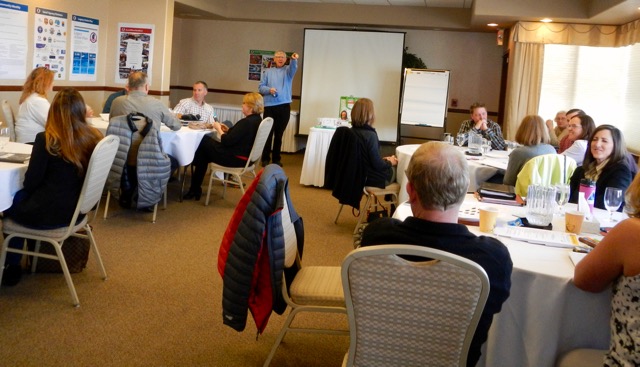
Ted Gaebler leads South Lake Tahoe officials Feb. 25 in a strategic planning session. Photo/Kathryn Reed

Sitting around four tables, individually they spent 10 minutes writing what they envision for the community – not just city government – by 2030. In other words, what can be accomplished in the next baker’s dozen decade. Then at their tables they consolidated the thoughts. And from there they were to develop a composite to represent the entire room. Then they went through a similar process, only they shuffled the seating.

With Lake Tahoe across the street, and the drapes pulled back to see that bowl of blue shimmering, it was easy to capitalize on what makes this place special and unique. Focusing on the area being a global or national treasure resonated with everyone.

Tangibles rising to the top were – improving the built environment and better public transit. Some want to take the dilapidated buildings and either get rid of them entirely or rehab them into something functional and profitable. With transit, a monorail and cross lake ferry were mentioned, as well as bike-pedestrian paths that reach areas people want to go.

If South Lake Tahoe is a global treasure, then it needs to be treated like one. That has not happened based on how the infrastructure looks and functions. Maintenance concerns for years were not considered and it shows.

Going forward, though, the sentiment will be: “We will reflect the national treasure in which we live.”

With saying “we” instead of “the city” the idea is this can be taken to agency partners to have them embrace the same vision.

Other ideas that many embraced included:

·      Being able to redevelop waterfront areas for more public access.

·      Events center on California side, even if it’s not in the city limits. And therefore, have more year-round events.

·      Face-lift for Highway 50.

·      Need new economy that works; to be part of the 22nd century in the 21st. This new economy will fund the projects they envision.

·      Having values to get to the vision.

·      Getting fiber optics in place to handle high-speed Internet and the growing demand for all things technological.

Another exercise was working on one- and five-year visions. From the four tables, consensus was to find a funding source for roads, perhaps via raising sales tax.

Other ideas included removing blighted hotels, enforce the sign ordinance, break ground on the recreation center, new communications system for public safety, update fleet, resolve 56-acre ownership-management with El Dorado County, solve vacation home rental issue, build Greenway bikeway, and define site for events center.

At the end of the day there was conversation about what is going on in town and thoughts from the Feb. 14 preplanning session:

·      A consultant is working with Harrison Avenue property owners regarding parking. The city’s redevelopment agency owns three lots on Riverside Avenue that could potentially be paved over if someone were to buy them from what is now the Successor Agency. However, there is actually someone interested in those lots for housing.

·      Regarding the collapsed building at Harrison Avenue, the owner intends to rebuild, but what and how remains to be determined.

·      Parking lots for trailer parking will have to be used just for that now that the lake is up and the ramp at Lakeview Commons can be used.

·      A desire to help the two South Shore chambers of commerce to play nice together.

·      Talk of how affordable housing is an issue for a variety of reasons, from commodities to lack of supply.

·      Tahoe Regional Planning Agency commodities were discussed.

·      A suggestion made to have more workshops to hash out specific topics.

From here a business plan will be developed by staff that the council will adopt this spring.



Nev. pressing forward with recreational pot

By Associated Press

Nevada officials are pressing ahead with a summer launch of recreational marijuana in spite of statements from the Trump administration implying an impending crackdown on the drug.

Any sale or possession of marijuana is illegal under federal law.

But Nevada voters decided in November to allow people age 21 or older to use pot recreationally — one of eight states to do so.

White House spokesman Sean Spicer said Thursday that the Justice Department will step up enforcement of federal law prohibiting recreational — not medical — marijuana.

Nevada Department of Taxation spokeswoman Stephanie Klapstein said Friday that the state is moving forward as planned to develop regulations governing the drug.

Their timeline would allow recreational pot shops to open in July.


Free movies at Minden Library in March

The Minden Library is showing movies every Saturday at 10:30am in the meeting room.

These movies are geared toward adults and teens (rated PG to PG-13). Free coffee and treats will be available

March’s theme is Westerns:

·         March 4:  “3:10 to Yuma”  (1957 version, not rated)

·         March 11:  “High Noon”  (rated PG)

·         March 18: “Shane” (not rated)

·         March 25: “True Grit” (1969 version, rated G)

The Minden Library is located at 1625 Library Lane. For more information, call 775.782.9841.