What’s next for Education Savings Accounts in Nevada?

By Thomas Moore, Las Vegas Sun

CARSON CITY — Some opponents of Education Savings Accounts say Nevada’s version of school choice is dead. But the Legislature continues to discuss the program’s budget, and two new bills — meant to shore up the ESA program — are anticipated to be introduced before mid-March.

The program, the first of its kind nationwide to be passed that doesn’t limit applicants based on income, would deposit upward of $5,100 in state education funds into a bank account to be used by approved families for private school tuition, tutoring and other expenses.

The program was put on hold last year after the Nevada Supreme Court ruled that ESA funding couldn’t come from the state school budget, but supporters are hoping to resolve lingering issues and revive it.

Read the whole story


Athletes regaining independence via High Fives

The High Fives Foundation is awarding Truckee-area residents Taylor Fiddyment, Jason Abraham and Jeff Andrews grants totaling $14,820 to aid in their respective recoveries.

Truckee resident Fiddyment was injured while riding a four-wheeler with friends in May 2011. Fiddyment’s goals have remained the same since entering the world of spinal cord injury recovery – to be the best person she can be, and spread joy and positivity to others.

“My recovery goal is to be strong in body and mind,” said Fiddyment. “I want to make other people’s down days better.”

Fiddyment received a grant for $4,560 to be used toward massage and chiropractic work to pair with her personal training at the CR Johnson Healing Center – program service of the High Fives Foundation.

Alpine Meadows resident Jason Abraham was skiing at Squaw Valley on one of the only powder days of the year in April 2015. He decided he’d take a free ski run on Main Chute on the Palisades. Toward the bottom of Main Chute, he caught an edge and was propelled onto his back. The impact resulted in the burst fracture of his C6 vertebrae, causing temporary paralysis from the shoulders down.

“My recovery goal is to become as independent as possible through diet and exercise,” said Abraham. “But my ultimate goals are to be the best father and husband I can be, and to watch my son, Ebbett, have a blast out on the hill with friends.”

Abraham received $2,200 in grant funding from the High Fives Foundation to be used toward massage at the CR Johnson Healing Center along with a new custom fit wheelchair back.

Andrews of Truckee is receiving his sixth grant from the Foundation following a 2014 spinal cord injury sustained in a snowboarding accident at Sugar Bowl.

The $8,060 will be used for two months of Neuro Kinetic Pilates at Body Wellness Hawaii in Maui. Andrews has previously worked with Alejandra Monsalve and the team at Body Wellness Hawaii and experienced tremendous gains from the Neuro Kinetic Pilates method. 

The High Fives Foundation supports injured mountain sports athletes through grant funding to be used toward reaching their recovery goals.


Learn about Mountain yellow-legged frogs

Imagine a world with no frogs. No longer would you hear frog melodies in the evening, algae would flourish, and entire ecosystems could change dramatically. This is a possibility in the Sierra Nevada because 90 percent of the Mountain yellow-legged frogs have been disappearing due to an amphibian pathogen and loss of habitat from fish introductions in our lakes.

An ambitious and promising effort is under way to recover these frogs, and this approach may be applied to conserving other threatened amphibians globally. Roland Knapp from the Sierra Nevada Aquatic Research Laboratory will talk  about the recovery effort on April 6.

Registration for this event is required. The program will begin at 6pm, with refreshments and no-host bar from 5:30-6pm at 291 Country Club Drive in Incline Village on the campus of Sierra Nevada College.

Seating is open at 5:30 p.m. to guests who have preregistered, open seating starts at 5:50pm. A $5 suggested donation will be collected at the door.


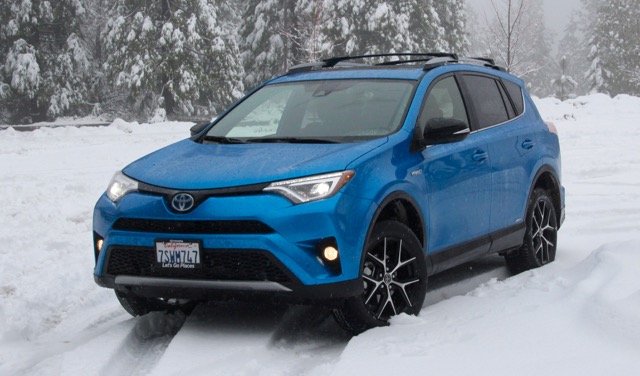
Road Beat: Toyota RAV4 hybrid — a complete car

The RAV4 AWD Hybrid is a good choice for snow country. Photos/Larry Weitzman

By Larry Weitzman

RAV4 is another Toyota success story, with continuous sales growth since 2011 (sales were 132,000) to its best year ever 2016 when U.S. sales topped 350,000 for the first time. The bestselling car in America, the Toyota Camry, had sales approaching 390,000 (Camry was fourth in overall sales behind three pickups, 1. Ford F-150, 2. Chevy Silverado and 3. Dodge Ram). Toyota is definitely doing something right, very right.

This new compact CUV RAV4 is in its fifth year of the fourth generation. Styling remains ruggedly pleasant, certainly superior to the Honda CRV which actually outsold the RAV4 by about 5,000 vehicles. Perhaps its best styling feature is the high belt/character line which creates a horizontal shelf out of the tail lights. Size remains the same at 180 x 73 x 66 inches in length, width and height. Wheelbase is still 105 inches.

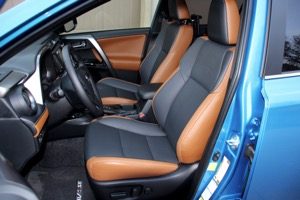
Toyota’s biggest improvement is the interior. When I opened the door for the first time I remarked to myself, wow! What an improvement and a very nice change. It wasn’t until I checked out the specs after a few days that I learned what I thought was leather was actually SofTex, Toyota’s name for the superb vinyl. My tester was done is black and a saddle tan, which is either called cinnamon or nutmeg. It was stunning and my tester was not even the top of the line model, the Limited. Mine was an SE model. There were more soft touch materials even the lower dash trim was done in the seating materials with some nice stitching. Even better was the comfort level of the front chairs, excellent.

Under the hood of my hybrid tester was Toyota’s 2.5L, DOHC, 16 valve inline four, but in the hybrid’s case it runs as a high compression (12.5:1) Atkinson cycle engine which improves efficiency by increasing the ratio between the compression and expansion cycle. But some peak power is lost as instead of 176 hp this motor puts out a peak hp of 150 hp at a slightly lower 5,700 rpm. Torque is still a healthy 152 pounds of twist which follows the rule of one pound of torque per cubic inch of engine displacement.

Adding to the RAV4’s thrust is the hybrid component which has electric motors that help drive the front wheels and a separate electric motor that drive the rear wheels. The gas engine is not connected to the rear wheels, there is no driveshaft. The rear wheels are driven by the rear mounted electric motor only and is an on-demand system. It’s a clever AWD system. While the motors have a rating of a max power output of 141 and 67 hp respectively, the combined hp of all power systems is a still respectable 194 hp. The limitation is the max output of the Nickel-Metal Hydride battery system which is limited to about 33 kWh or 44 hp.
Specifications
Price $ 32,185 to about $37,000
Engine
DOHC 16 valve Inline four-cylinder gasoline 150 hp @ 5,700 rpm
152 lb-ft of torque @ 4,400 rpm
Electric power 44 hp
Combined hp 194 hp
Transmission
CVT automatic
Configuration
Transverse front mounted engine/AWD
Dimensions
Wheelbase104.7 inches
Length 179.9 inches
Width 72.6 inches
Height 67.1 inches
Ground clearance 7.0 inches
Track (f/r) 61.4/61.4 inches
Weight 3,950 pounds
GVWR 4,960 pounds
Fuel capacity 14.8 gallons
Tow capacity 1,500 pounds
Cargo volume (rear seat down/up 70.6/35.6 cubic feet
Wheels 7.0×18 steel/alloy/alloy
Tires P235/55×18
Turning circle 36.7 feet
Steering lock to lock 2.68 turns
Performance
0-60 mph 7.08 seconds
50-70 mph 4.09 seconds
50-70 mph uphill 5.95 seconds
Top speed Who cares?
Fuel Economy EPA rated at 34/30/32 mpg city/highway/combined. Expect 31 mpg overall in a combination of all driving and 33-34 mpg on the highway at legal speeds.

Throttle response is quite snappy recording a 0-60 mph elapsed time of 7.09 seconds or almost a second and a half quicker that the standard RAV4 with a similar 2.5L engine 176 hp. Passing performance also improves significantly with a 50-70 mph simulated passing run of 4.09 seconds and the same run up a six-seven percent grade slowing that time to 5.95 seconds which is a pickup of about a half a second and a second and three quarters. Another huge performance improvement. The standard RAV4 had times of 8.51, 4.57 and 7.73 seconds. And this performance improvement (and fuel economy, see below) is in spite of a weight penalty of about 350 pounds over the conventional RAV4.

And this staggering performance improvement comes with significantly improved fuel economy. EPA rates the RAV4 Hybrid at 34/30/32 mpg city/highway/combines. The reality of my 310 miles of varied driving showed 31 mpg overall with a two-way level highway run at 70 mph returning 33.5 mpg. The conventional RAV4, while returning an average of 32.7 mpg at 70 mph, only averaged between 25-26 mpg overall. The hybrid version will offer significantly improved performance and a 5-6 mpg boost in overall fuel economy. Is there a drawback? About the only niggle with the hybrid is the auto stop engine feature which at times could be felt restarting upon brake release. But the integration of the electric motors are extremely smooth and basically imperceptible. And with the ability to run pure electric up to about 45 mph under very light throttle, the RAV4 becomes unbelievably smooth and quiet. One very small negative is the fuel tank shrinks by about a gallon to 14.8 gallons; probably due to the battery.

Handling is very good as RAV4 has serious creds. The electric power steering rack is very quick at 2.68 turns lock to lock. Suspension is MacPherson struts up front and a state of the art double wishbone holding up the rear with a ground clearance of 7 inches. Wheels are 18 x 7 inch alloys shod with some pretty meaty 235/55 series rubber. It adds up to sporty driving with strong cornering power with crisp turn in. It handles the twisties with aplomb. It will not disappoint.

Ride quality is smooth, handling both large and small imperfections with ease keeping its occupants coddled. Head tossing is kept to a minimum and jumping from a sports sedan to the RAV4 would be almost imperceptible. There is no tack, but based on vehicle quietness, rpm at 70 mph should be somewhere around 2,000 rpm. There is some road noise on coarser roads, but the RAV4 is reasonably quiet. There is no wind and engine noise unless there is aggressive use of the throttle. In EV mode it is silent.

Four wheel discs are almost a foot in diameter and are strong and of course the RAV4 has all the acronyms including lane departure assist with steering assist. LED headlights were excellent especially on low beam and the automatic high beaming dimming system worked perfectly. Just leave it in automatic and let it work. A big safety feature that sometimes dimmed the highs when reflecting off a large, new reflective sign which actually helped as the reflection from these headlights sometimes was pretty bright. Going to low beams was an improvement in forward vision. It’s a great feature, standard in the middle trim level of an SE.

Inside, as said above, is a trick interior. Instrumentation is complete except for a tach which is replaced by a power meter which reflects power usage. The trip computer is complete and the sound system and HVAC is easy and simple to use, no three-unit college course is required. Rear seating is spacious and comfortable. Cargo capacity is large with over 70 cubes behind the front chairs and about 36 cubes with the second row up.

Pricing for this bullet proof RAV4 is a deal. The base price for an SE Hybrid AWD is $32,185, plus $940 for the boat ride from Obu, Japan. But here is the deal. The premium for AWD in conventional RAV4s is $1,400, but with the Hybrid it is standard. So, the price differential between a RAV4 SE AWD and the RAV4 SE AWD Hybrid is just $800. Buying the RAV4 with AWD it becomes a no brainer to buy the hybrid. For that $800 you get significantly better fuel economy and performance with no downside. Oh, you worry about the battery and hybrid system. Toyota hybrids have the highest reliability ratings, even higher than conventional cars and their battery system is as close to fail safe as a battery can be. Toyota has tested its batteries to over 150,000 cycles with no loss of efficiency and performance.

Larry Weitzman has been into cars since he was 5 years old. At 8 he could recite from memory the hp of every car made in the U.S. He has put in thousands of laps on racetracks all over the Western United States.



High-tech race to make adventure sports safe

By Steven Kotler and Jamie Wheal, Outside

In their new book Stealing Fire ($28; Harper Collins) Steven Kotler and Jamie Wheal investigate the many ways people are now seeking out the heightened awareness of flow states—those ecstatic zones of pure focus where humans achieve ultimate performance. Some use psychedelics, others meditate or dance, and daring athletes practice extremely dangerous adventure sports. In this exclusive excerpt, the authors recount the tragic death of BASE-jumper Dean Potter, question why he and others are willing to risk everything in the pursuit of elevated consciousness, and explain how innovative technologies enable us to reach the same state without the without the life-and-death stakes.

The why was never in question. What happened? How it happened? Those answers remain unclear. But the why? For Dean Potter—it was never in doubt.

It was May 16, 2015, in Yosemite Valley, California, a nice spring evening, right on the edge of dusk. Potter, a record-breaking rock climber, slackline walker, and wingsuit flier, got ready for the evening’s adventure. He was 3,500 feet above the valley floor, standing on the summit of Taft Point. Alongside his friend and fellow flier Graham Hunt—considered one of the best young pilots around—their goal was to leap off the edge, zip across the canyon below, and sail through a V-shaped notch in a neighboring ridge, above an ominously named cliff, Lost Brother. 

Read the whole story


Letter: Arts community supports Bread & Broth

To the community,

Local arts organization Tahoe Art League has long been serving Tahoe artists and promoting the arts to feed hearts and minds in the South Shore. On Feb. 20 the Art League fed the hungry of our community by sponsoring Bread & Broth’s Monday meal at St. Theresa Grace Hall.

At the Monday meal, current and past Art League board members Connie Clark, president; Barbie Crawford, secretary; Janet McDougall, vice president; and Robert Schimmel; past president, volunteered their time and provided incredible service to the B&B volunteers.  these wonderful volunteers helped serve a heartwarming shepard’s pie served with green beans, salad, peaches and yummy desserts donated by local stores.

Taking a break from serving, Schimmel shared his comments. “We are grateful to have the opportunity to serve those who have less and so appreciate this ministry. It is humbling and very gratifying to help the B&B crew and personally see the good that is done at the Monday meals.” 

Thanks to generous Adopt A Day sponsors like Tahoe Art League, B&B has been very fortunate to provide meals to those in need for over 27 years.  Our incredible financial donors and their sponsor crews, who donate their time to work side by side with us, are an appreciated and integral part of B&B’s Monday Meal program.

For more Bread & Broth program information, go online.

Carol Gerard, Bread & Broth


Stateline casino revenues increase in January

Stateline casinos kept pace in January with the state when it came to gaming revenue.

Statewide the casino win last month was 12 percent higher than January 2016 at $1.04 billion. This was the highest win since February 2013.

Stateline casinos posted a 10.8 percent increase. The South Shore five have are up 8.9 percent in the last three months, with plenty of winter – and March Madness – still to come.

However, casinos on the North Shore posted a January year-over-year drop of 29.9 percent at $1.7 million.

— Lake Tahoe News staff report


Wet weather may bring more invasive weeds

This wet weather brings the probability of increased noxious weeds, which are invasive weed species that can be detrimental or destructive to Nevada’s landscapes.

Nevada is bringing attention to the weeds now because this is National Invasive Species Awareness Week.

“Invasive noxious weeds species like perennial pepperweed and purple loosestrife, grow well in wet soil conditions and can spread rapidly during flooding events,” Sean Gephart, the Nevada Department of Agriculture’s noxious weed coordinator, said in a statement. “It is extremely important for landowners to keep an eye out for weeds like these on their property to reduce the risk of spreading.”

he Nevada Department of Agriculture provides numerous resources such as the Nevada noxious weeds quick reference guide, which highlights the most effective control measures for common species. In addition, staff is available to assist landowners when needed. The NDA website also provides a list of licensed control companies that help eradicate weed invasions.

 Week is Feb. 27 through March 3.


Mice invasion in parts of Lake Tahoe

By Kathryn Reed

It’s not just people’s homes that have been flooded in the Tahoe area. All that water is making mice seek higher ground, too.

“It’s the worst I’ve seen in decades,” Jim Cecil, owner of Boulder Exterminator in South Lake Tahoe, told Lake Tahoe News of the rodent infestation.

Mice are the biggest issue, with chipmunks and squirrels next. The latter are more prone to get into

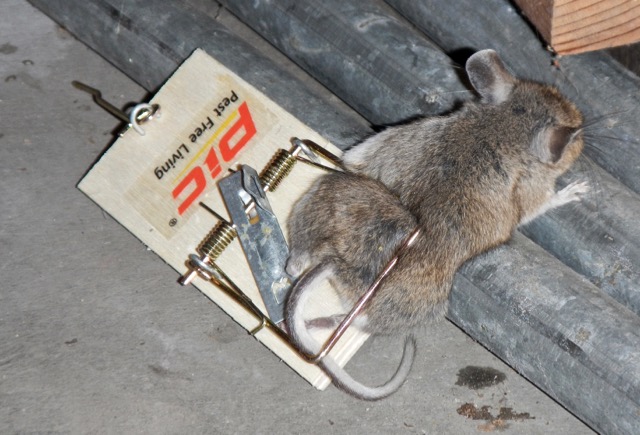
One less mouse in as South Lake Tahoe garage. Photo/LTN

walls, while mice scamper about garages and inside houses.

A large number of calls have come from the Tahoe Keys area because it’s on such a high water table. All the rain has flooded the burrows where the critters had been spending the winter. They want someplace dry, and that someplace is where people live.

Ben Gardner, service manager for Lakeside Termite & Pest Control, said he’s getting calls from around the lake about rodent problems.

“The rain flushes them out of their hiding spots or where they make their nest or home. They are being more aggressive about getting into homes,” Gardner told Lake Tahoe News.

The goal is to find where they are coming in from and to seal up that location. That’s hard to do because mice, even chipmunks, can squeeze through a quarter-inch opening.

And it’s never just one. They bring their family and friends. The females can leave a scent behind. This draws the guys. Mice can have upward of a dozen babies. Then it’s pretty much an infestation.

For Joe DeCasper, owner of Paragon Pest Control in Tahoe City, he was getting more rodent calls two years ago with the drought conditions. Normally in winter mice are pretty lethargic creatures. But when it was a warm, dry spring the mice were more active and much friskier.

He did say in the last couple of weeks there has been a mouse outbreak in his region.

Mice don’t discriminate – they hit up residences and commercial structures.

All of the pest control businesses Lake Tahoe News spoke with said poison is frowned upon. Some is still used, but not like the old days.

As of July 1, 2014, California banned the sale of most d-Con products. The federal Environmental Protection Agency reached an agreement with manufacturer Reckitt Benckiser that production stop nationwide on a dozen d-Con products in 2014, with distribution prohibited after March 31, 2015.

“Bait stations are required for consumer products to protect children and pets from contact with bait pellets,” according to the EPA.

Some Tahoe pest control businesses use live traps; some have traps that kill.

For the do-it-yourselfers, steel wool can be a good plug for holes. Mice have scissor teeth, so it’s hard for them chew through it. Check for gaps around interior plumbing. Anywhere there is daylight under doors a mouse can come in. Outside vents can be another entry point.

While some people are reporting ants as being an issue, that’s usually more of a spring problem in Tahoe. Carpenter ants are the issue here.

“We get little sunshine and they think spring,” Cecil said of ants. “Right now all you can do is bait.” This is because the best solution is an outside treatment, and that’s impossible with all the snow.

Spiders are also making their way indoors. The pest guys say to call them for help.


Opinion: Sanctuary state bad idea for Calif.

By Ted Gaines

In its continued quest to lead the nation in irresponsible governance, the California Senate is moving forward with Senate Bill 54. The bill completely dismisses the millions of citizens who follow the law and want safe communities for their families and businesses. It’s also the latest embarrassing example of the Legislature’s cult-like devotion to ignoring the fundamental responsibilities of government while obsessing over issues allowing for maximum moral grandstanding.

Ted Gaines

SB54 effectively would turn California into a “sanctuary state,” making it harder for state and local officials to turn over violent, illegal alien criminals to federal officials for deportation. California would be the safest haven for these felons and predators and would instantly become a magnet for every illegal alien criminal in the country.

We don’t need more. Even ardent supporters of the bill acknowledge that if SB54 is passed and signed into law up to 20,000 violent criminals will be shielded in Los Angeles and Orange counties alone.

Recently ICE conducted a standard immigration sweep in Southern California that resulted in more than 160 people being taken into custody. About 120 of those detainees had been previously convicted of serious, violent crimes such as robbery, assault and sex offenses. California shouldn’t allow illegal alien rapists, murderers and gang-bangers to be sent back to your neighborhood, mine or anyone’s neighborhood to commit more crimes, but they are all but guaranteeing a new set of victims by making us a sanctuary state.

SB54’s author said during a hearing on the bill, “Any individual, irrespective of who they are and where they come from, who commits a heinous crime, we don’t want them in our neighborhoods, don’t want them in our communities, don’t want them in our state, we don’t want them in our nation. Period.” 

Then, with no sense of irony, he presented a bill to protect them from deportation.

Meanwhile, the 200,000 people fleeing a potential mega-flood in Oroville are probably scratching their heads wondering why the state government is working on harboring illegal alien criminals, mandating background checks for ammunition purchases, pumping out laws and rules about a microscopic universe of transgendered, or wearing out their throats screaming about President Trump, when the state is falling apart?

Oroville threatens unimaginable damage. We haven’t built major state water storage since the late 1970s even though our population has roughly doubled since that time. That’s malfeasance.

Our roads are a crumbling mess. We pay some of the highest gas taxes for potholed streets that feel like they’re paved with cobblestones and cramped highways that stretch commutes and keep us from moving goods around the state.

Our schools continue to be some of the nation’s worst even though K-12 education spending is checking in at more than $70 billion this year, up around $25 billion since just 2011. Is this what taxpayers should expect for that massive investment?

With our dams threatening disaster, roads falling apart and schools failing our children, would your first thought as a politician be: “Quick, let’s ban plastic grocery bags!”?

Californians are getting the worst possible civic deal. They’ve got a government that is diving down the Progressive rabbit hole, reaching into every aspect of their lives and charging them an arm and a leg to do it. At the same time, government is neglecting the very basic infrastructure that every citizen depends on. With public safety, they are fighting to actually make it worse.

The once-golden state is falling apart because government is ignoring the issues of the many for the issues of the few. To help all its citizens, California must repair and expand the state’s physical capital. It’s time to get building.

Ted Gaines represents the 1st Senate District, which includes all or parts of Alpine, El Dorado, Lassen, Modoc, Nevada, Placer, Plumas, Sacramento, Shasta, Sierra and Siskiyou counties.