Star Guide: Gigantic clouds of the Milky Way

By Tony Berendsen

On Earth we can look out in the sky and see clouds in our atmosphere. They are mostly made of water molecules in a gaseous state, and can be as large as a continent. They orbit the Earth as we are carried from day to night each day. From them we receive liquid water as rain.

In the evening, away from city lights through a telescope, we can see clouds in the Milky Way; molecular clouds. They are mostly made of molecular hydrogen in a gaseous state and are the largest objects in the Milky Way. They orbit the center of our galaxy every 250 million years. From them we receive stars.

The process of water precipitating from earthly clouds and the gravitational condensing of molecular hydrogen to form stars in space are very different processes. The water in a terrestrial cloud, under the right atmospheric temperature and pressure, condenses and falls to the Earth as rain. Within the arms of the Milky Way galaxy, in the extreme cold regions of molecular clouds, gravity works with destiny to form stars. As new stars begin their life of fusion, the resulting outward pressure disperses the remaining cloud around them and they emerge into view.

Orion Nebulae in the constellation of Orion. Photo/Simulation Curriculum

Molecular clouds are very cold, having temperatures ranging from about minus 440 to minus 370 degrees Fahrenheit, and their size can vary from a just a few light years up to 600 light years (one light year is about 6 trillion miles) with a total mass reaching several million solar masses. Molecular clouds with dimensions of more than about 15 light years are called giant molecular clouds.

Astronomers study molecular clouds to understand the process of star formation and the ever evolving state of mater in our galaxy. Sun like stars formed from clouds of hydrogen return about 50 percent back into the galaxy as planetary nebulae, giant stars release huge amounts of heavier elements as super novas, small stars hold on to their matter for great lengths of time, possibly as long as our galaxy has existed. Scientist believe about 95 percent of the matter from molecular clouds is recycled in a repeating process of forming generations of stars.

There are many molecular clouds easily within reach of a gaze of a telescope. But, there is one 1,500 light years away that can be seen in very dark skies with the naked eye or binoculars; it’s called the great nebula of the constellation of Orion — M42. It’s located in the sword of the great hunter Orion just below his belt and is a favorite object for amateur astronomers.

M42 shines at a magnitude of 5.0, so it’s pretty bright. But since it’s a diffuse object you need an extremely dark sky to see it with the naked eye. You can find it with binoculars even if you are in a moderately light polluted area. To find it look in the early evening above the southern horizon about 8pm this time of year. The distinctive line of three stars of the belt will help guide your way, and as always the star gazing app Sky Portal is an essential resource to finding your way.

Once you have found the belt, look for a smaller vertical line of stars just below and a slight glow object within them. That glow is a giant molecular cloud, the Orion Nebulae, a member of the largest objects in the galaxy, and the birthplace of stars. If you have a telescope, the small group of stars in the middle of the nebulae are stars emerging from the cloud as the star cluster Trapezium.

Tony Berendsen runs Tahoe Star Tours. He may be reached at 775.232.0844 or tony@tahoestartours.com.
Sierra snowpack well beyond historic average

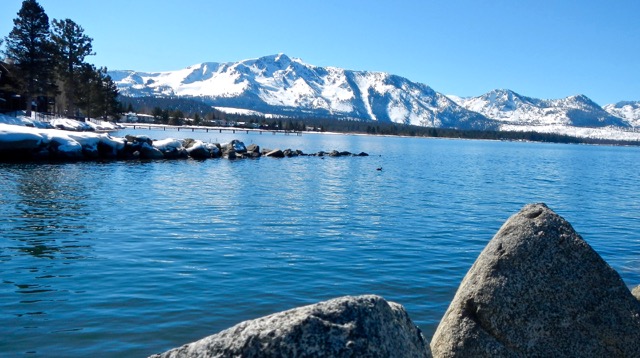
The entrance to Tahoe Keys is wide and deep — something that could not be said the last several years. Photo/Kathryn Reed

By Lake Tahoe News

In years’ past a March Miracle would mean a deluge of snow to make up for a dry winter. This year, a March Miracle for most people in Northern California would mean more sunny days than ones filled with moisture.

While the snowpack measurement on March 1 near the entrance to Sierra-at-Tahoe wasn’t a record, it is substantial enough that those downstream should not have to worry about water allocations this spring-summer.

The local measurements showed 113 inches of snow, with a water content of 43.4 inches. This is 179 percent of average. The record, set in 1983, is 56.4 inches.

The March 1 average at Phillip’s Station is 24.3 inches. The April average is 25 inches, so this location near Echo Summit has surpassed that marker. April is the last reading of the year.

“January and February came in with some really quite phenomenal atmospheric river storms, many of which were cold enough to really boost the snowpack,” said Frank Gehrke.

He performs this monthly ritual of hand collecting data for the state Department of Water Resources.

The snowpack is likely to get deeper this weekend.

Statewide, the water content of the snowpack is 45.5 inches, or 185 percent of average.

In February the water content was 28 inches, and in January it was 6 inches.

The snowpack provides water to municipalities and farms throughout California. And while Northern California has come out of the five-year drought, those in Central and Southern California can’t say the same.


Caltrans: More delays on Hwy. 50 for repair work

Caltrans is doing emergency work on Highway 50 in the American River Canyon that will mean more delays for travelers.

The highway in Silver Fork between Weber Mill Road and Wildwood Way will be under daytime one-way reversing traffic controls Monday through Saturday for two weeks or more. Crews will be putting in two culverts under the highway and clearing a drainage inlet. The work started March 1.

A section of the No. 2 westbound lane in Fresh Pond will closed beginning Thursday in order to stabilize the slope off the highway. This is a four-lane section of Highway 50.

The section of the highway at Bridal Veil Falls will continue to be reduced to one lane in each direction. The plan is to build a 600-foot retaining wall, which is expected to take several months.


Snippets about Lake Tahoe

·      Republican Rep. Tom McClintock is having a town hall meeting March 4 at 10am at Oak Ridge High School gymnasium, 1120 Harvard Way, El Dorado Hills.

·      Truckee has revamped its website.

·      Katchafire plus Inna Vision and Mystic Roots Band will be at Blu Nightclub at MontBleu on April 22. Doors open at 9pm. Must be 21. Advance tickets are $20, otherwise $25 that night.

·       2014 Douglas High grad Colton Waggoner is now a deputy with the Douglas County Sheriff’s Office.

·      Washoe County Sheriff’s Office has two new K-9s on the force – Kyago and Speed.


Don’t dismiss Cabs from the foothills

By Mike Dunn, Sacramento Bee

My turnaround on Cabernet Sauvignon from the Sierra foothills began one day last fall as I stood at the tasting counter of Hart 2 Hart Vineyards at Pilot Hill in El Dorado County.

Dominic Mantei was pouring tastes of wines he makes on the premises, some bottled under the brand Hart 2 Hart, others released with the label Everhart Cellars.

I was impressed by how fine, fresh and frisky the lineup was, but when he got to the Everhart Cellars 2013 Pilot Ridge Reserve Cabernet Sauvignon ($45) I realized by the wine’s authority and balance that I needed to revisit Cabernets from the foothills, which never have been closely identified with the varietal.

Read the whole story


Caltrans’ Donner Pass chief tweets a blizzard

By Adam Ashton, Sacramento Bee

Dave Wood

With a white helmet and ash-gray beard, Caltrans Superintendent Dave Wood exudes old-fashioned charm from his post at the snowy summit of Donner Pass. But his favored method of communicating with drivers is decidedly modern.

He’s the voice behind regular mountain traffic updates dispatched on Twitter by Caltrans, where Wood provides a close-up look at the nasty conditions that can snarl Interstate 80 in an instant. He’s often funny, and always himself.
 
“If you drive your car on the roof, we can’t keep this road open. Please slow down,” he implored in a video post this week.

Read the whole story


Nev. cops putting extra effort in to catch speeders

More than two dozen law enforcement agencies in Nevada will be joining forces March 1-14 to crack down on drivers exceeding speed limits or driving too fast for road conditions.

Speeding is a contributing factor in approximately one-third of fatal crashes on the nation’s roadways. Exceeding the speed limit is considered aggressive driving, just as weaving in and out of traffic and failing to yield to other motorists.

According to National Highway Traffic Safety Administration, the consequences of driving too fast include:

  • Greater potential for loss of vehicle control
  • Reduced effectiveness of occupant protection equipment
  • Increased stopping distance when the driver perceives a danger
  • Increased degree of crash severity leading to more debilitating injuries
  • Unexpected economic and psychological implications of a speed-related crash.

Joining forces enforcement is paid for by Nevada Department of Public Safety — Office of Traffic Safety.


Signups available for SNC summer arts workshops

Registration is open to the public for Sierra Nevada College’s 33rd annual Summer Visiting Artist Workshops.

This is a chance to learn from masters of their craft at the Holman Arts and Media Center in Incline Village.

Choose from a variety of disciplines, including: ceramics, painting, drawing, printmaking, digital art, sculpture, glasswork, paper and bookmaking, and more. Workshops are affordable and flexibly scheduled, with most offered in June and July.

Anyone 16 and older may take workshops for personal enrichment or college credit. Tuition includes some materials, possible kiln firings, equipment rental, and more.

Spouses, parents, children and friends are welcome to visit the studios before and after classes and attend meet the artist Tuesday nights.

For more info or to register, go online.


Sierra’s terrain enhances learning experience

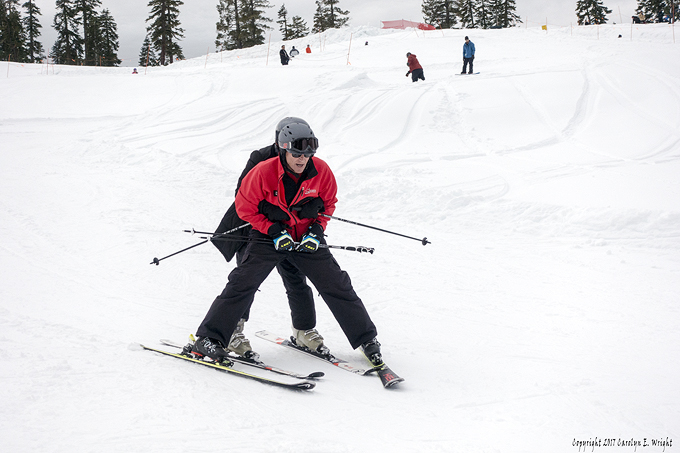
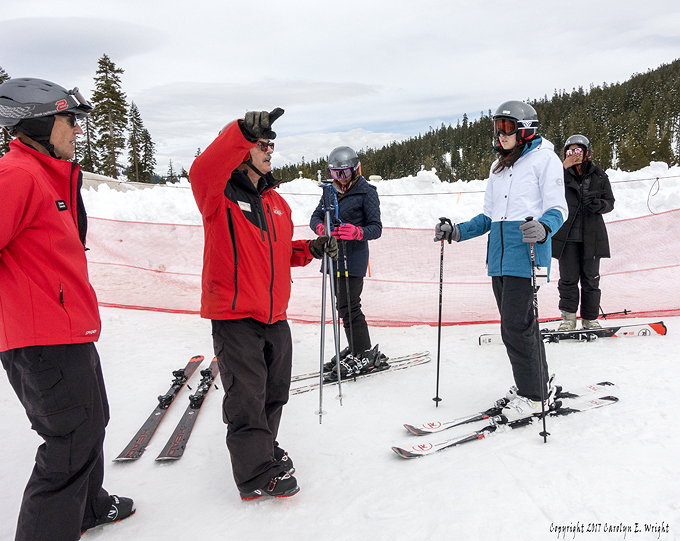
Sierra-at-Tahoe instructors Claude Gunsch and Neal Hamilton explain the basics. Photo Copyright 2017 Carolyn E. Wright

By Kathryn Reed

TWIN BRIDGES – Straight-lining isn’t an option for newbies learning to ski at Sierra-at-Tahoe. And that’s a good thing because turning is often one of the most difficult things to learn.

A serpentine has been built into the slope of Broadway to ease first-timers into turns in a more controlled environment.

“Sometimes the most rewarding thing is when they come up and can barely walk, and they go down this and smile,” Claude Gunsch told Lake Tahoe News. This is Gunsch’s 28th season instructing at Sierra, something he has done part time all these years. “The serpentine gets people skiing automatically.”

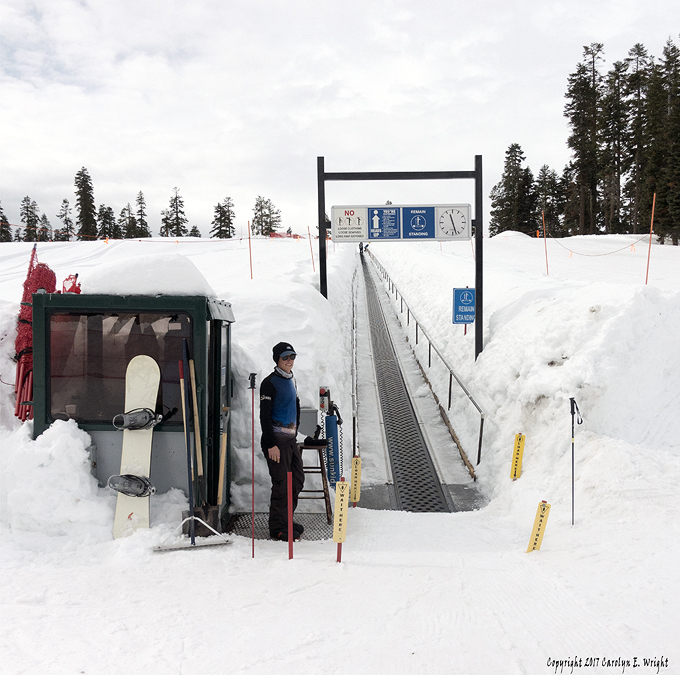
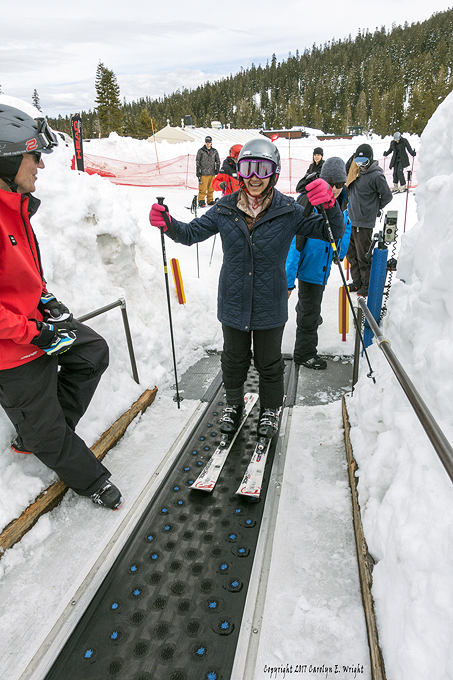
Sana Pandey takes to skiing — and the magic carpet — fairly quickly. Photo Copyright 2017 Carolyn E. Wright

In many ways it is less daunting than the main ski hill where it’s wide-open, full of lots of people and turning is optional. Snowplowing – or making a pizza or wedge in today’s vernacular – eases beginners into the turn.

“You have the need for speed and the need for control,” Gunsch said in explaining why it’s necessary to make different size wedges.

All the basics are still part of the lesson – it’s just the terrain that makes this so unique.

Terrain-based learning is what it’s called, and aptly so. The terrain is as much a teacher as the person in charge. It’s about a 3 to 5 percent grade, a football field or longer depending on what the groomers developed.

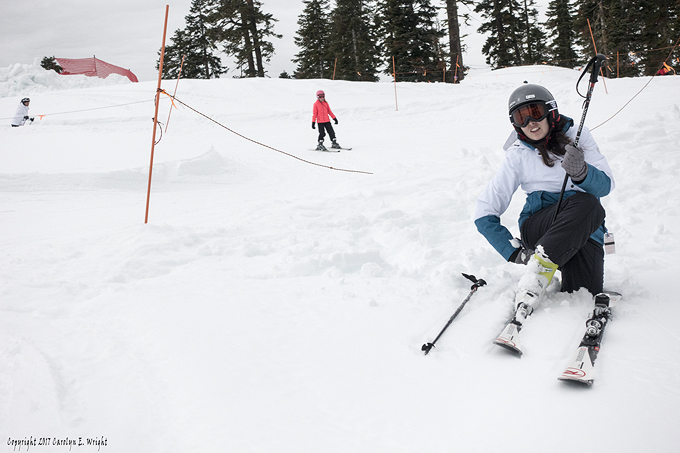
Courtney Ceccato went through the rope instead of around the curve. Photo Copyright 2017 Carolyn E. Wright

For Sana Pandey, 14, of San Jose having ice skated before helped her immensely with balance and the sense of gliding on snow.

“I love it. It’s so much fun. It’s different than other sports,” Pandey told Lake Tahoe News after descending the serpentine. Her first day on skis was last month. She was quickly getting the feel for how to maneuver the two planks strapped to her feet.

Courtney Ceccato, 24, of Sacramento was happy for powder off to the side because that’s where she landed after taking one of the turns too sharply.

Claude Gunsch helps Sinda Potluri make it through the serpentine. Photo Copyright 2017 Carolyn E. Wright

“I just have to learn how to get my balance and how to stop,” she said with a smile as she was also learning how to get up after falling.

Even though it’s possible to get to the serpentine from the Easy Rider chair, the initial route is via the magic carpet. If a group progresses well, the chairlift is an option. The advent of these “carpets” allows for more actual ski time and no longer having to walk up the slope.

This area is reserved for teens and adults, while younger kids are on the other side of Sierra’s base lodge. They, too, have contoured routes to learn on, but scaled down.

The magic carpet makes it so beginners have more time actually skiing. Photo Copyright 2017 Carolyn E. Wright

While most people might think a honeymoon is supposed to mean being locked together with your spouse, not so for Wendy Kodur. The 30-year-old from Newark was excited to be on the bunny slope.

“He got me the lesson. I want to be able to catch up to him,” Kodur said of her husband.

Sinda Potluri, 29, of Tampa might be sticking to warm weather sports. After the initial instruction of going down the smallest halfpipe ever built she was having a hard time getting the feel of the skis and balancing. And this was before the serpentine. “I keep falling,” she said, so she wasn’t sure if she liked skiing.

But as anyone who has skied knows, falling is part of learning.

With the serpentine, the theory is it’s more fun and a faster progression to more advanced terrain.


How to choose the right snow shovel

By Jay Bouchard, Outside

Growing up in Goffstown, N.H., I watched my dad obsess about shoveling. The area gets approximately 70 inches per year, and my dad delights in getting rid of it. He estimates that he moves about 3,600 cubic feet of snow each winter and has hucked roughly 108,000 cubic feet since he moved there in 1987. For him, it’s a source of pride to have one of the cleanest driveways on the block. My dad also has no desire to “disrupt the environment with a small, loud, emission-spewing machine,” otherwise known as a snowblower.

My dad’s go-to shovel is “whatever’s on sale at the local hardware store.” He’s not a brand-conscious shovel purchaser, but he’ll typically use a plastic, straight-shaft shovel with a metal strip across the front of the blade (to chop through ice).

But I wanted to know what the pros prefer. To find out, I called up some experts in the snow-removal industry.

Read the whole story