Skunk Harbor on snowshoes — breathtaking

Snow looks like frosting on the top of rocks at Skunk Harbor. Photo/Kathryn Reed

By Kathryn Reed

In the distance a deep sapphire blue Lake Tahoe looked majestic. Up close the emerald cove was more rugged as the white caps hit the shore.

Seclusion mixed with vast views of Lake Tahoe – that’s what the trek to Skunk Harbor is all about.

If only it had been warmer. But warmth and snowshoeing in winter are often elusive. Lingering on the beach this time of year is much different than in summer, not so inviting. Ice hangs from some of the rocks along the shore. About a foot-wide stretch of sand is exposed.

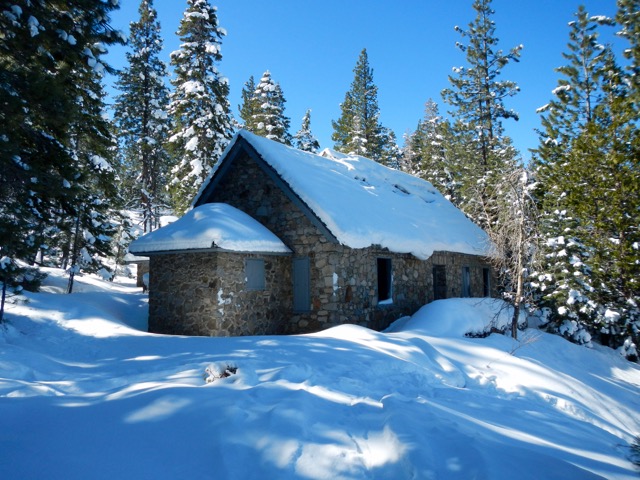
The structures at Skunk Harbor are not open to the public. Photo/Kathryn Reed

Remnants of Skunk Harbor’s past are visible. While the U.S. Forest Service now owns this swath of land on the East Shore, that wasn’t always the case. Stone buildings near the waterfront once belonged to George and Caroline Newhall. They used it as a second home for their San Francisco friends in the 1920s.

George Whittell then became the land owner. He once owned most of the East Shore down to Zephyr Cove.

Pilings for what once was a pier protrude from the water.

Last weekend there was no clear starting point with all of the snow. It was a pretty steep first 15 feet, then it flattens out.

Lake Tahoe in the distance near the start of the trail. Photo/Kathryn Reed

Fortunately, a snowmobiler had laid a track for us, as had other snowshoers and cross country skiers.

While I try not to go off trail for erosion reasons when it’s dirt, with all this snow it was so inviting at times to break trail, traipsing through the virgin snow. Sometimes it was fluffy, other places it was crunchy.

No matter where one looked, it was a winter wonderland. It doesn’t take long for Lake Tahoe to come into view. The openness of the trail in many ways made me feel like I was much farther removed from civilization than I was.

Tracks led up a knoll that we scampered up to get what was a stunning view of much of the lake.

It’s unfortunate such a lovely place has such a smelly name.

It’s a gradual 1.5-mile descent from the highway to the beach. The uphill ascent doesn’t feel so gradual. The elevation change is 560 feet.

Sue Wood makes her way through mounds of snow down to Skunk Harbor. Photo/Kathryn Reed

—-

Getting there:

From South Lake Tahoe go east on Highway 50, up Spooner Summit.

Turn left onto Highway 28.

Parking is on the left in 2.4 miles. Nevada Department of Transportation clears the area so parking is not right on the highway.


Opinion: Developers may no longer control EDC

By Larry Weitzman

Salary and benefits paid to the El Dorado County Community Development Agency now exceed $30 million a year. It employs about 300 individuals with a number of high-ranking employees being paid $200,000 a year and many taking home well in excess of $100,000.

Just type in an employee’s name at Transparentcalifoirnia.com. I did that for the employee who made the Dixon Ranch subdivision presentation at the Feb. 14 Board of Supervisors meeting, Roger Trout. As the Development Services Division director, Trout was paid $241,000 in salaries and benefits for 2015. For 2016, that number will probably top a quarter million dollars. Big money.

Larry Weitzman

You can bet that the many of Trout’s deputies are paid close to or more than $200,000 and the CDA department head total compensation for 2015 was $247,000. The head of long range planning whose title is the assistant director of community development grossed, over $185,000 in 2015 and the transportation division director was paid $195,000 in 2015. All those numbers would be up in 2016 when the final 5 percent (of the 15 percent) raise took full effect.

In other words, we spend millions of dollars for the CDA to do its job, of which one is to protect EDC in dealing with new developments. Their job is to make sure new developments pay their “fair share” in the costs and impacts of their development on current county residents and homeowners, especially when the developer wants to change property zoning from low density to high density, as much as 10 times the density as in Dixon Ranch.

Dixon Ranch, which required a general plan amendment to drastically increase housing density and traffic, was denied its proposed subdivision at the aforementioned BOS meeting by a 3-2 vote. The two dissenting supervisors wanted the matter essentially continued off calendar so the developer could “repair” its two essential financial documents, the development agreement and the financial impact analysis, a document that is supposed to show the financial impact to the county and its residents.

CDA’s job is to review and negotiate on EDC’s behalf to make sure the development doesn’t cut county services or impact traffic flows for its current residents. Prior to the BOS meeting these documents were recommended by the CDA as being “adequate,” with the county receiving a benefit from the development fees for the more than 600 new homes off of Green Valley Road.

Back in August, EDC’s auditor examined the documents (the DA and FIA) and sent email after email that the development agreement was not good for the rest of the county, that the FIA had incorrect assumptions and that the FIA was sorely deficient in its analysis of this development. The auditor, in August, also sent emails to the developer saying the same thing. But that didn’t stop the developer from saying at the hearing “the DA and FIA came at us pretty hard” trying to look like he was blind-sided and looking for pity from the BOS. The FIA was admittedly prepared by the developer. They claimed it was prepared by a professional consultant. The problem is that our CDA who “negotiates” and is supposed to examine and review the document are a bunch of amateurs, highly paid amateurs.  

Without boring you with the details of this deal, our new CAO had this to say at the meeting when asked about the sufficiency of the documents and how this development would affect EDC’s position in providing its necessary services to its existing residents: “I have concerns with the financial components of this project. …The county is taking a risk that I would not encourage. … If started over, I would do it differently.”

But CDA ineptness is nothing new. Back in May of last year Trout presented to the BOS for approval some 50 units for development in Serrano, but their review was so bad that Trout and the rest of the staff recommended the project not knowing that the development agreement underlying this project had expired eight years ago, and had no force and effect. At the Planning Commission meeting six months’ prior, there was also no mention by the CDA that the DA had expired and they too approved the additional 50 lots. Without a valid existing DA, the Planning Commission and the BOS had discretion to make new demands on the developer for more road money or parks. They were not locked in to the expired DA. A new deal should have been required and renegotiated that would have been much more beneficial to the county. Did anybody lose their job over that deal? Of course not, mediocrity and assisting out of town, west-end developers are the norm for our CDA. There is no penalty for doing a bad job.

There were huge questions over the Green Valley corridor with respect to the Dixon project, but our Transportation Division director, who makes about $200,000 a year just rubber stamped whatever the developer did. In fact, the Transportation Department within the CDA in December 2016 presented a series of 34 safety improvements on Green Valley Road (20 percent of all improvements within EDC relate to Green Valley Road), yet the Developer wasn’t asked to pay for any of them. Why?

Our county auditor reviewed these documents, wrote several emails about the deficiencies and perhaps the CDA staff thought they could slide Dixon Ranch through. Even certain Planning Commission members said knowing what they know now with respect to the FIA, that perhaps their recommendations would have been different.

These issues go back well before CAO Don Ashton was appointed some seven months ago, they go back to the days of Kim Kerr when she ran CDA and packed it with ineptness, to CAOs Terri Daly, Pam Knorr and Larry Combs who help shepherd Dixon Ranch through the county. We are still paying that price.              

Speaking of still paying, where are all the hours that should have been billed to the developer or this project review and examination? There should be hundreds of hours billed by the CDA, CAO’s office and the county counsel who also signed off on this fiasco. However, under Terri Daly, Pam Knorr and Larry Combs it was not their practice effectively subsidizing developers, this one included (no problem subsidizing developers, just cut road maintenance). All these documents were done prior to a December 2015 Planning Commission meeting, a January 2016 Planning Commission meeting and were approved for a March 2016 BOS meeting. There was essentially no billing done by CAO’s office or county counsel. Why?

District 2 Supervisor Shiva Frentzen spoke of obtaining “operational efficiencies.” Here is a suggestion, maybe the entire CDA should be eliminated and these jobs should be hired out to contractors that we can do something about like sue them for a bad job. Who do we sue here? If it weren’t for the auditor and the CAO’s comments, Dixon Ranch probably would have been approved in spite of significant public opposition.

New flash:  Somebody (at least CAO Don Ashton) is getting it as on the Feb. 28 BOS calendar was Item 30, to reorganize the CDA at the top with was appears to be the elimination of two net high ranking positions in the Planning and Building Services area, Department of Transportation, Environmental Management, and Community Development Services. It will create new job specs, bargaining unit designation, salary schedules and perhaps most important, these new positions will be at will. And it will save EDC almost half a million dollars annually. Ashton’s proposal passed 5-0. Maybe EDC can fix some potholes now. More on Item 30 in my next column.

Larry Weitzman is a resident of Rescue.



New York-owned ski resorts to go renewable

By Antonio Olivero, Adirondack Daily Enterprise

New York’s state-owned ski resorts will use 100 percent renewable energy by 2030, Gov. Andrew Cuomo said Friday.

Along with Whiteface, other ski resorts operated by the state Olympic Regional Development Authority — Belleayre Ski Resort in the Catskills and Gore Mountain in North Creek — have pledged to be part of the Climate Reality Project’s “I Am Pro Snow” campaign.

The governor’s office is touting that this initiative is part of Cuomo’s Clean Energy Standard, which intends, by 2030, to have half of electricity used in the state to come from renewable sources.

Read the whole story


Panel: Undocumented immigrants boost Nevada economy

By Chris Kudialis, Las Vegas Sun

Deporting large numbers of unauthorized immigrants would hurt families and the U.S. economy, leaders of a national advocacy group for Hispanics living in the United States and Latino community members said in Las Vegas on March 3.

“Unauthorized immigrants pay more than $12 billion in Social Security taxes each year alone,” Nevada Tax Commission member and UNLV law Professor Francine Lipman said. “But their value to our tax system goes even beyond that.”

The panel, led by Washington-based leaders from the National Council of La Raza, said if all undocumented immigrants were deported in Nevada, the Silver State’s gross domestic product would drop by $5.7 billion annually.

Read the whole story


Calif. flood control called a life and death crisis

Water flowing from the eroded overflow spillway of Oroville Dam in February. Photo/California Department of Water Resources

By Sean Cockerham, McClatchy

Experts say California’s Oroville dam crisis demonstrates the life-and-death urgency of federal spending to upgrade aging dams. But there are doubts about whether President Trump will agree.

California Natural Resources Secretary John Laird told the U.S. Senate Environment and Public Works Committee on Wednesday that further deterioration of the nation’s aging flood control and water infrastructure systems will put lives at risk.

“We should use the opportunity presented by this situation to invest in existing infrastructure and fund innovative projects that leverage science to meet the challenge of extreme weather,” he said.

Trump told Congress on Tuesday that he would ask for a $1 trillion package “financed through both public and private capital” to improve the nation’s infrastructure.

Read the whole story


Fair to bring nonprofits, volunteers together

On  March 15, Live Violence Free will host the Helping Hands volunteer fair at Lake Tahoe Community College.

Service organizations and nonprofits in need of volunteers will inform locals of their services and how they can get involved in what they do.

The fair is designed to connect those in the South Tahoe area with skills, time, and passion to give with organizations that most need community support.

It will be from 3-5pm in the commons area of the main building.

Nonprofits and service organization wishing to participate may register or rent a table online.


Bill would put an end to California fire fee

A bill introduced this week would kill the fire fee many people in rural California have to pay, including those in parts of the Lake Tahoe Basin.

This is not the first time state Sen. Ted Gaines, R-El Dorado, has tried to do away with a measure that was approved in 2011.

“This fire tax is illegal and unfair – plain and simple,” Gaines said in a press release. “Many rural property owners already pay local fire agencies for protection so it is clearly double-taxation and it is being dumped on the backs of rural Californians when parts of my district still have a more than 10-percent unemployment rate and families are struggling to make ends meet.”

Senate Bill 9 would reverse the annual $152.33 fee for fire prevention services charged to property owners located in state responsibility areas designated by CalFire.

Their property taxes already contribute to the service contracts that counties have with CalFire.

“The answer to fire protection in California is not illegal taxes, but budgets that invest in core government services that protect every citizen in the state – rural, urban and suburban,” Gaines said.

— Lake Tahoe News staff report


Hard Rock looking for local bands to compete

Lake Tahoe Hard Rock casino and Hard Rock Café are looking for emerging musicians to take the stage for its annual Hard Rock Rising Battle of the Bands competition.

The winner will perform at Hard Rock Stadium in Miami Gardens during halftime.

Locals may register online until March 30.

There are local and regional competitions. The top three acts and one wildcard “winner” in each market will perform at the local Hard Rock between May 18-25.


Report: End federal ban on sports betting

By Richard N. Velotta, Las Vegas Review-Journal

When President Barack Obama rolled out his March Madness college basketball bracket predictions on television every year, he acknowledged his participation in an illegal activity commonly enjoyed in workplaces nationwide.

Now, a nonprofit Washington think tank is criticizing the federal ban on sports wagering, joining the chorus of organizations seeking repeal of the Professional and Amateur Sports Protection Act of 1992.

The libertarian-leaning Competitive Enterprise Institute planned to issue a 14-page report Thursday that questions how alcohol and tobacco consumption are banned in most businesses while another “sinful” activity, sports gambling, is embraced by workers and their CEOs, especially around Super Bowl Sunday and the kickoff of the NCAA tournament.

Read the whole story


Snippets about Lake Tahoe

·      Magician Chipper Lowell returns to the stage at The Loft in South Lake Tahoe from March 16-28.

·      Coldwell Banker Residential Brokerage Community Cares Foundation gave back to the Sacramento, Tahoe and Truckee communities in 2016 with cash donations of more than $50,000, while agents and offices provided additional estimated contributions of materials, supplies and labor for a total donation of more than $100,000.

·      The Douglas County Public Library is participating in the In-N-Out Burger Cover to Cover Reading Program from March 4-April 15. Children ages 4-12 are eligible to earn a certificate for a free cheeseburger or hamburger for every five books they read. Each child may earn up to three certificates. Sign up for the program at the Minden or Zephyr Cove libraries.

·      Jacks Valley Road in Douglas County has a temporary speed limit of 30 mph. It is scheduled to be fully reconstructed in late spring between Genoa Lane and the Upper James Canyon Loop.

·      Rock Tahoe Half Marathon is June 17. It sells out every year. More info online.