Kings Beach gearing up for annual Snowfest

The annual Kings Beach Snowfest Parade will take place on March 11, 11:30am-12:30pm along Highway 28 starting at Secline Street and ending at the Coon Street roundabout.

It will feature entries from more than 30 community nonprofit organizations, government agencies, service groups, and local businesses.

There will be an announcing stand in front of the King Building on Highway 28 near the Bear Street roundabout. The parade will take place snow, rain, or shine.

Motorists should be aware that Highway 28 in Kings Beach will be closed between Highway 267 and Fox Street for the parade starting at 11:25am. Detour routes will be available.

Before and after the parade as there are many events. For a complete schedule of Snowfest events, go online.


Bill would increase Nevada craft beer production

By Sean Whaley, Las Vegas Review Journal

CARSON CITY — A bill seeking to increase the amount of beer craft breweries can produce annually ran into a foamy wall of opposition from large liquor interests during a legislative hearing last week.

Senate Bill 130 from Sen. James Settelmeyer, R-Minden, would increase the allowed production capacity from 15,000 barrels to 45,000 barrels a year. A barrel is the equivalent of 31 gallons.

Settelmeyer said his proposal is aimed at helping small businesses in Nevada grow.

Read the whole story


Gaming industry steering clear of pot business

By Richard N. Velotta, Las Vegas Review-Journal

When Attorney General Jeff Sessions explained how and why the Justice Department would address pot smoking, for both medical and recreational purposes, it sent a wave of trepidation through Nevada, where voters in November approved legalizing marijuana consumption.

One place where it was business as usual after the announcement was within the office of the state Gaming Control Board, which in November reminded companies in the casino industry to stay away from the marijuana business because state gaming agents intend to continue to treat pot possession and distribution as a felony.

 A directive from Control Board member Terry Johnson in May 2014 essentially told licensees to make a choice: Either participate in gaming or in marijuana distribution because you can’t do both. In November, after Question 2 legalizing marijuana was passed, Nevada Gaming Commission Chairman Tony Alamo repeated Johnson’s message.

Read the whole story


Mothership Classic benefits High Fives

The third annual Mothership Classic on Squaw Valley’s infamous chairlift KT22, also known as The Mothership, will be March 26.

The Mothership Classic is a pledge-driven event benefiting Truckee-based High Fives Foundation.  Participants will spend the day lapping KT22 as many times as possible with friends wearing skinny skis, retro snowboards and other throw back gear. 

Prior to the event, participants are encouraged to reach out to their network for pledges and donations. All funds raised will go directly to the High Fives Foundation and their efforts to support athletes that have suffered life-altering injuries.

Go to register.


Nevada gas prices keep creeping up

It’s not your imagination, it really is costing more money to fill up the gas tank in Nevada.

In the last week prices have gone up 3 cents. The average, according to GasBudy.com, is $2.60 a gallon.

A year ago drivers in the Silver State were paying 57 cents less per gallon. Even a month ago a gallon of gas was 12 cents cheaper.

GasBuddy attributes the rise to refineries doing maintenance.

— Lake Tahoe News staff report


Guided snowshoe trek at Spooner Lake

Rangers will lead a two-mile snowshoe hike at Spooner Lake State Park on March 12 from 10am-noon.

The hike is fairly easy and all skill levels are welcome. Participants should bring snowshoes, water and dress in layers as temperatures can vary. Dogs are also welcome if on a leash.

Meet in the parking lot to the right after the driveway splits. The event is free, but park entrance fees apply. Entry is $7 per vehicle, Nevada residents receive a $2 discount.                                               

For more info contact Josh Rhein at 775.831.0494 or spooner.ranger@gmail.com.


Flood insurance a crapshoot for Tahoe homeowners

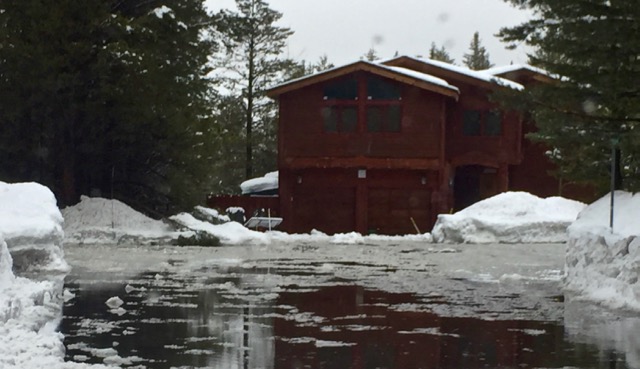
Water from flooded South Lake Tahoe streets entered several houses this year. Photo/LTN

By Bre McGee

At the far end of Christmas Valley, there are at least two members of Reds and Julie Regan’s household enjoying the detriments of flooding that recently effected many homes around Lake Tahoe. Having had to rip up flooded carpet and move furniture from the Regans’ dining and living rooms has left a new play area for the couple’s two dogs.

“They love running on the concrete floor. We’re trying to keep them out of there because of the debris, but it’s like they have a new race track,” Julie Regan said while talking about one small benefit of now living in a slowly progressing construction zone.

The Regans’ story is a familiar one around the Lake Tahoe Basin. Many residences and vacation rental properties were flooded due to a string of rain storms earlier this year that melted snow and obstructed sewer drains, resulting in water seeping into the lower levels of homes around the area. Even though the Regans carry homeowner’s insurance, their policy does not cover damage ensued by flooding.

According to Carson City-based AAA insurance agent Mike Johnson, the majority of homeowners opt-out of the voluntary flood insurance policy.
My home flooded. Now what?

1. Thoroughly read your flood insurance policy to find out the extent of the coverage.
2. Take photos of any damage to your home and belongings.
3. Begin writing a list of damaged property for the insurance claim’s adjuster.
4. Separate the damaged from the undamaged property; maintain control over the damaged property (keep it in the back yard or garage or shed if possible so thieves do not remove it).
5. If your carpet is damp, pull the carpet loose, remove the pad and dry the floor.
-or-
If your carpet and pad have been saturated by the floodwater, cut and remove the carpet and pad; save a small (2-feet by 2-feet square) piece of the carpet to show to the adjuster.
6. Keep air conditioner (or furnace in cold months) running, to aid in drying out of the property. Use fans (and open windows in warm months) to speed up the drying process.
7. Clean floors, walls, cabinets with mixture of 1-part bleach, 4-parts water. If removing water lines, take photos of interior and exterior water line depth.
8. Check any effected appliances for damage. If necessary, schedule a service technician to clean, service and provide repair estimate for flood-damaged appliances.
9. Call for heating company to have technician clean, service and provide repair estimate for flood-damaged heating/cooling equipment.
10. Decide if repairs need to be adjusted to avoided similar damage in future (swapping carpeted floors for tiled floors).
11. Even without an existing flood insurance policy, it’s good practice to inquire about the extent of your homeowner’s insurance policy. Sometimes clean-up may be covered.
Source: National Flood Insurance Program

“The majority that do carry it are forced into it by their lender. I would say maybe one in 10 carry a policy. With the requirement of a lender, maybe three of 10 carry it,” Johnson told Lake Tahoe News.

Homeowners insurance was originally developed as a policy to safeguard insureds against the financial burdens from fire damage. According to Tally Meek, vice president of Personal Insurance at Sierra Insurance Associates in Truckee, more pieces were added to the original type of homeowner’s policy.

“The insurance agencies then became unable to make enough money from premiums due to the rising amounts of damages insureds were seeking payments for,” Meek said. “In turn, separate policies were created for damages from natural disasters including floods, earthquakes, hail and hurricanes.”

In 1968, the National Flood Insurance Program (NFIP) was created by Congress to issue flood insurance protection to both homeowners and renters. All flood insurance policies are written through NFIP as an optional add-on to existing insurance. While it may seem like a costly addition, it can prove to be worthwhile.

Summit Partners Insurance Services agent and flood insurance specialist Jim DeGraffenreid, explains just how important flood insurance can be. “Next to nothing is covered without an existing flood insurance policy,” DeGraffenreid said. “Almost every regular homeowner’s insurance policy excludes flood insurance.”

Without a flood insurance policy, neither the structure of a home, nor the contents inside, are covered. However, not all water damage is covered equally. Depending upon the source of the water, you could be covered without a flood insurance policy.

“Did it escape from an interior plumbing device? Did it back up from a sewer drain? Or did it seep up from the ground water through the foundation? Is it coming from the street and coming into your house? It really depends where the source of the water happened,” Meek said. “Once they [the insurance company claims adjuster] find the source of the water, they interpret the policy to determine if there’s coverage in the policy.”

Each flood insurance policy is written on a case-by-case basis because there is not a one-size-fits-all policy. Similar to homeowner’s insurance, various elements affect the annual cost and deductible. The location of insured property is the biggest factor. There are several types of flood zones mapped out across the Lake Tahoe Basin by the Federal Emergency Management Agency (FEMA) which determine the amount of risk in any given location.

The Lake Tahoe area features special and non-special flood zone areas. In South and North Lake Tahoe, special flood hazard areas (SFHA) begin with the letter “A.” According to the NFIP, a Zone A is a high-risk area with at least a 25 percent chance of flooding during a 30-year mortgage. Most lenders require a flood insurance policy to cover the price of the home in order to write a mortgage to homeowners in this zone.

The next most common flood zone in Lake Tahoe, according to DeGraffenreid, is Zone X, a non-special flood hazard area (NSFHA), carries a moderate- to low-risk of flooding. The NFIP reports that homeowners in these areas submit more than 20 percent of flood insurance claims and receive one-third of federal disaster assistance for flooding. While flood insurance is not required in this zone, it is recommended to all homeowners and renters.

“For most properties in Zone X, a policy costs between $400 and $500 a year at the maximum amount of insurance ($250,000),” DeGraffenreid told Lake Tahoe News. Properties in Zone X are considered to be less expensive to insure than those in Zone A because it’s less likely to flood in NSFHAs.
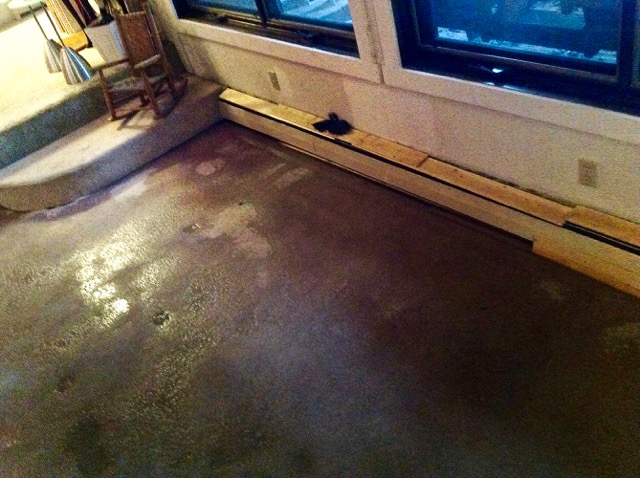
The carpet of Julie and Reds Regans’ living room was saturated with water during rain storms the second week of February. Photo/Provided

Though it’s recommended, the dilemma many homeowners and renters struggle with is deciding if flood insurance is worth the investment. Insurance agents around the area have seen a surge of flood insurance inquiries. Meek has had only one inquiry turned in a purchased policy this year. She believes this is associated with cost and a mandatory, 30-day waiting period required by the NFIP to ensure there are no preexisting damage at the insured property. The policy Meek wrote insures a high value home in a Zone D flood area, an undetermined flood hazard area, in Truckee at $2,100 annually. Though this particular home is valued at more than $1 million, the maximum amount of flood insurance coverage, as mandated by the NFIP, protects $250,000 of structural home damage and $100,000 of contents inside the home.

While an additional flood insurance policy may seem costly, NFIP’s website, floodsmart.gov, explains the expensive consequences of not having it. It states that California’s average flood insurance claim totaled $28,253 in 2014. An interactive flood cost estimate tool on NFIP’s website indicates that 1inch of water in a 2,000-square-foot home could cost an uninsured homeowner up to $20,000, depending on the extent of the damage.

Even though there are high-risk flood areas around Lake Tahoe, there are few flood insurance policies written for the area. According to FEMA, there are only 95 total policies written for South Lake Tahoe; 42 policies written for high-risk (A) zones and 53 policies written for low-risk (X) zones. There are even fewer policies written for Truckee; only 16 policies for high-risk zones and 28 in low-risk zones.

According to Johnson, between 20 and 30 percent of clients carry flood insurance, including those required to carry it by their lender.

“It’s just something that doesn’t come to mind. It’s not cheap. Up here where we live, there’s just not a lot of historic flooding. More people would say earthquake insurance would be more important than flood insurance,” Johnson said. “The majority of people think that flood insurance is going to be $50 or $100. Flood insurance is written though NFIP and it’s not an easy process. It takes me a couple of days to do one flood policy.”

Meek said, “Homeowners, in my experience, have only purchased it when there is a loan on the house and the lender is requiring flood insurance for the loan. It’s only been recently, with all the current flood threats that we’re having that I’ve had an increase in inquiries about flood insurance that were generated because the mortgage is requiring it.”

The Regans’ pre-flooding plan to update their home included removing the 1970s trademark sunken living room and updating the carpet to hardwood floors. Without an existing flood insurance policy prior to experiencing extensive water damage, the couple won’t be able to recoup any repair costs to their home.

“It was definitely on our homeowner’s ‘to-do’ list and now it’s moved to the top of the list, by matter of necessity,” Julie Regan said. “I think we’ve learned now. We were contemplating hardwood at one point but I think we’re going with ceramic tile just in case we end up in this situation again. I think we’re definitely going to look at it [flood insurance] in the future.”


Opinion: eBikes solve transportation problems

By Dave Heighway

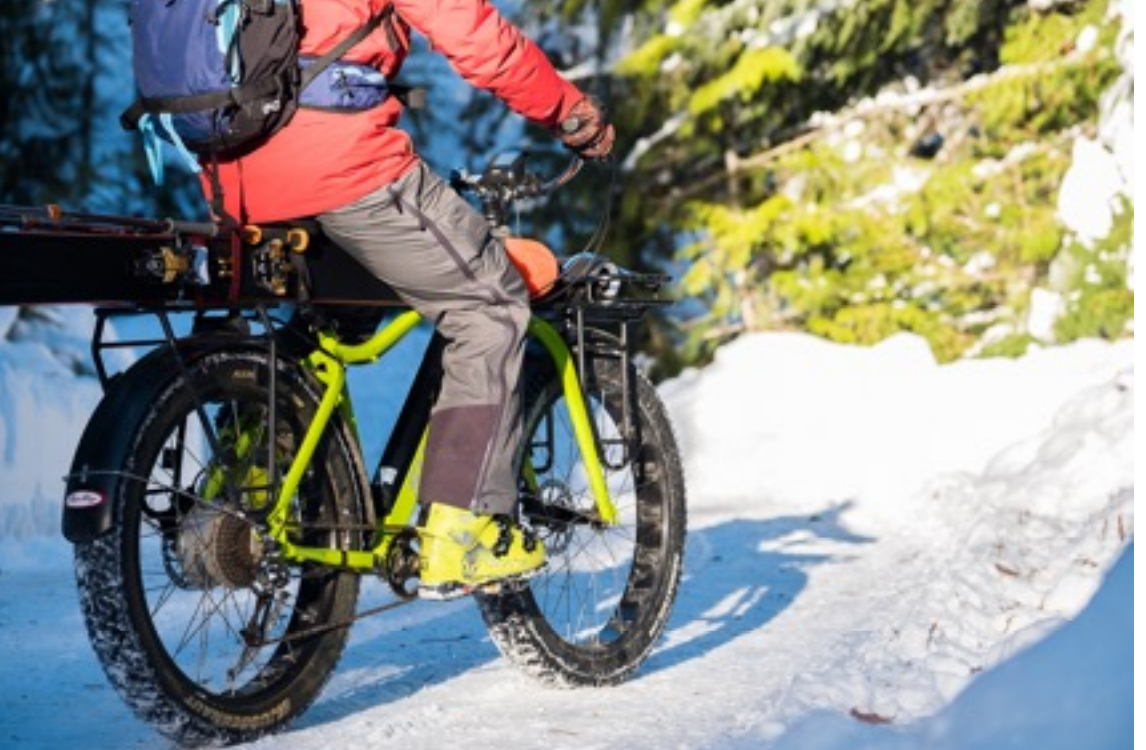
You get some funny looks when people see you riding to the mountain on a fat bike with skis strapped to it, wearing your ski boots and goggles. Quite a few nods, smiles and thumbs up from people driving by, seemingly supportive of the idea. Of course, occasionally it’s not a thumb people have raised, but a different finger, which I assume is also a sign of support. Let’s chalk it up to cultural differences, after all Whistler is an international destination.

The fat bike I’ve been riding is actually an eBike. It’s part of an ongoing experiment in alternative transportation that started in 2012 when my buddy Rosie and I made the two-hour drive down to Vancouver to buy a couple that had just arrived at the warehouse of a company that was moving into eBikes and away from ATVs and dirt bikes.

Snow is not a problem for eBikes. Photo/Cory “Rosie” Leis

Of all the grand schemes the two of us have hatched on the chairlift over the years – and there have been many  – the electric bike stands out because it really has become a game changing “life hack” for us; one of those clever ways peoplediscover to short-circuit the system and achieve their goals. In this case, we’ve managed to “hack” automobile transportation.

What makes an eBike so effective is the convenience: you park where you want and set your own schedule, you can carry what you need and still ride up hills without working up a sweat. For us that means we’ve mostly eliminated our need for a car, thereby drastically reducing our CO2 emissions and saving us thousands of dollars on repairs, insurance as well as the price of the car itself.

I personally get a lot of pleasure riding past the Husky station and not handing over 75 bucks for fuel. It’s a small – but genuine – divestment from the fossil fuel companies.

I know what you’re thinking: You’re being a hypocrite if you think you can claim to care about the environment and continue to live in a ski town like Whistler. After all, it’s CO2 emissions everywhere you look: open outdoor fireplaces, groomers, taxis, sleds-on-pickups and of course all those jets that bring the long-haul visitors. And it’s the visitors who’s dollars keep a resort like Whistler functioning. No fossil fuels, no happy resort town in the mountains, and no billion dollar annual boost to the provincial economy.

I won’t argue, I see the hypocrisy, and know it to be absolutely paralyzing if you strive to be eco-conscious. But there’s no denying the climate crisis is urgent and we need to find ways to move beyond paralysis and start enacting solutions. I think the environmentalist and Guardian columnist George Monbiot offers a way forward: “Hypocrisy is the gap between your aspirations and your actions. Greens have high aspirations – they want to live more ethically – and they will always fall short. But the alternative to hypocrisy isn’t moral purity (no one manages that), but cynicism. Give me hypocrisy any day.”

Here’s my interpretation: there’s some middle ground between living in a cave eating dirt and doing nothing about global warming, so do what you can.

So, riding a bike around town instead of driving isn’t going to solve the climate crisis, but it’s a meaningful step in the right direction, and one the Resort Municipality of Whistler (RMOW) agrees is a priority. According to the latest tally,Whistler is exceeding their GHG reduction targets in every category except transportation, where they’re actually going up. According to their website, “[r]educing personal car use is the most significant action individuals can take to reduce climate change in Whistler.”

But Whistler is not unique, there’s a lot of potential for bikes and eBikes to reduce carbon emissions across the continent, much as they have in Europe and Asia.According to the U.S. EPA, 25 percent (in Whistler it’s more than half) of total CO2 emissions come from transportation, and it’s estimated that half of all trips are less than 5 km (American Bicycle League). In Copenhagen and Amsterdam for example, 30 to 40 percent of all trips are made by bike, something like a wet dream for urban planners.

“Copenhagenizing” our communities in North America is a worthy goal, and technologies like eBikes that make riding a bike easier and more convenient will help us achieve it. Already there is growing evidence that a biking renaissance is under way. The good news is that you don’t have to go “Gonzo” like Rosie and I did. You can start turning the tide of growing emissions by simply replacing a couple of your car trips each week with a bike trip. It’ll make a significant and meaningful difference in your personal footprint, and perhaps more importantly, you’ll be sending a message to the people in your community that getting around by bike is normal. And when riding becomes normal, as it is in Copenhagen, we’ll be well on our way to low-carbon future.

Dave Heighway and Cory “Rosie” Leis live and ride in Whistler, B.C., and are the co-owners of iCleanCommute.com, a company that promotes eBiking as a way to bikify North America.


Olive oil prices to squeeze wallets

By Associated Press

From specialty shops in Rome to supermarkets around the world, lovers of Italian olive oil are in for some sticker shock this year, with prices due to jump by as much as 20 percent.

The combination of bad weather and pests hit the harvest in Southern Europe, most of all in Italy, where production is halved from last fall. That’s pushing up Italian wholesale prices by 64 percent as of mid-February compared with a year earlier, which translates to shelf price increases of 15 to 20 percent in Italy. 

In other countries, the ultimate price increases will depend on several factors – such as how much retailers take on the costs themselves and the change in currency values. The U.S., for example, is likely to see a more modest rise in price as a stronger dollar keeps a lid on the cost of imports.

Italy’s harvest was especially hard hit by the combination of early rains that knocked buds off the trees and the threat of an olive fly that forced an early harvest, further cutting yields. Wholesale prices of olive oil from Spain, the world’s largest producers, are up a more modest 10 percent, with yields similar to last year’s.

Vincenzo Iacovissi, the owner of the Sapor d’Olio olive oil shop in Rome, says sales have dropped, though he’s tried to ease the shock for customers by explaining why prices have gone up.

“When there are increases of 15 to 20 percent there is some impact on sales. However, explaining the reasons for this increase has in part helped to make up for this,” Iacovissi said.

Italians collectively consume about 20 percent of the world’s olive oil, leading Spain at 16 percent, and that affinity makes them pretty resilient as consumers. The U.S. is the third-biggest market, consuming 10 percent of the yearly total. 

The vast majority of the olive oil consumed in the U.S. is imported, with Italy and Spain being the top two sources of imports, according to the North American Olive Oil Association. The group notes that imports from Italy are not necessarily Italian olive oil but may be bottled there.

Flaminia Leoni, a 50-year-old mother of four, buys 80 to 100 liters of olive oil a year for her family and says that at most she will consider substituting lower quality olive oil for extra virgin for cooking — but not on the table, where olive oil is a staple giving accent to pasta, meats, salads and vegetables.

Cedric Casanova, the owner of an Italian grocery in Paris, said he was hoping to get 30,000 liters of olive oil delivered, but received just 8,000 liters. He will have to rely on leftover stock from last year to help make up for the remaining difference — and absorb some of the price increase himself.

“I’m working with a standard price, by trying to assume the cost myself,” he said.

With global stocks down just 14 percent, no one is predicting general olive oil shortages, even with a 75 percent increase in consumption of olive oil over the last 25 years as demand pushed into non-traditional markets. The market for olive oil in the period has grown by two-fold in the United States, seven-fold in Britain and 14-fold in Japan, according to Italy’s Coldiretti farm lobby, even if continental Europe remains by far the largest market.

Italian olive oil is more vulnerable than that of other major producers to climate shifts and pests due to its varied topography, from hills in the north to larger groves in the south. This also lends great variety to Italian olive oil, where unique flavors are derived from a combination of the terrain, topography and the more than 400 olive varieties, according to Nicola Di Noia, an olive oil expert for the Coldiretti farm lobby.

“We have hundreds of different varieties of olives that are more difficult to defend compared with Spain or northern Africa, where there are big groves that are easier to manage,” Di Noia said.

He said the challenge is educating consumers about why they pay for quality.

“We need to learn to choose oils with awareness. Extra-virgin is the juice of a fruit. The primary material from which it derives is very important. Therefore, oil should be tasted and smelled,” he said.


Tips to create a life that matters

By Pete Bissonette

Are you doing what matters most to you?

Does your work give your life meaning?

I’m not asking whether you are happy, but whether your life has meaning.

A study in the Journal of Positive Psychology examined attitudes toward happiness and meaning. It showed a meaningful life and a happy life overlap in certain ways, but are ultimately different.

“While happiness is an emotion felt in the here and now, it ultimately fades away, just as all emotions do,” wrote Emily Esfahani Smith about the study in The Atlantic. “The amount of time people report feeling good or bad correlates with happiness but not at all with meaning. Meaning, on the other hand, is enduring. It connects the past to the present to the future.”

Another study confirmed this, she said, “People who have meaning in their lives, in the form of a clearly defined purpose, rate their satisfaction with life higher even when they were feeling bad than those who did not have a clearly defined purpose.”

Giving your work meaning can be a simple shift in perspective, as it was for me.

Back in the 1990s the focus of our company, Learning Strategies, was to sell more audio programs and enrollments. We were sales oriented as were most companies.

Then we switched our mindset from selling to helping more people experience their potential, and two things happened. First, I felt more fulfilled and happier, and second, our business grew significantly. The level of meaning in my life increased considerably as did the success we enjoyed.

My colleague Stewart Emery and his co-authors of the book Success Built to Last interviewed two hundred of the world’s most successful people and uncovered the same experiences.

“Above all else, no matter where they have chosen to excel—in business, the arts, sports, social service, community, or family—each has achieved success by focusing on the things that matter most to them,” he said.

“Enduringly successful people follow their hearts, aligning their thoughts and actions with their passions,” said Stewart. “They become energized by their work and stay on purpose and committed in the face of setbacks and challenges.”

I couldn’t agree with him more. During our company’s long-term success, there have been some extremely difficult times. But as long as we held fast to our vision to serve others, we really never had to worry. It fueled everything we did.

To create a life that matters to you, consider the following:

  • What gives your life meaning? What brings you the greatest joy? Loving what you do and who you are is the greatest motivator for building lasting success. Just shifting our company focus from sales to impacting people, gave me and our staff meaning, and it continues twenty years later. Is there a shift like that you can make?
  • Are your thoughts toxic or supportive? Are negative thoughts and self-doubt or the criticism of others drowning out that voice inside of your head—that whisper or “silent scream” telling you what really matters? Learn to responsibly manage your thoughts in ways that keep you on track to your goals, despite obstacles or burdens you will undoubtedly face.
  • Are you taking action? What are you doing to bring you closer to your goals or attract into your life people and activities that will support you? While meaning drives success, meaning without action will get you nowhere.

When you align your thoughts and actions with what gives your life meaning, you magnify your passion and impart greater clarity to your purpose than ever before.

Pete Bissonette is author of the forthcoming novel “Breakfast Tea & Bourbon”, where living a meaningful and joyous life weaves through the story. He is the president of Minneapolis-based Learning Strategies, a personal development training and publishing company founded in 1981.