Letter: LTCC helps at Bread & Broth

To the community,

“Lake Tahoe Community College (LTCC) is committed to serving our community and it was an honor to be able to be a part of Bread & Broth,” commented Michelle Sower, dean of instruction. 

Sower was a sponsor crew member for the LTCC Advance Adult Education program at their Adopt A Day dinner on May 21. LTCC’s new Advance program is geared to provide free training for adults who are interested in improving their job skills and looking to advance in their careers, and is just an extension of the many ways the college is providing support to our local community members.

Joining Sower on the sponsor crew team were fellow LTCC members Steve Berry, director of enrollment services; Brad Deeds, dean of workforce development;

Shelly Hansen, director of human resources’ and Michelle Risdon, vice president of instruction. The LTCC crew members brought their professionalism and compassion while giving of their time to help to make the dinner a positive experience of sharing food and community.

“While it is so hard to see our neighbors in need, Bread & Broth is a wonderful resource,” said Michelle Risdon. “LTCC and Advance are proud to partner with B&B in our joint efforts to meet these needs.”   

B&B is grateful to LTCC for their efforts in providing a dynamic educational environment and also for their concern for providing the basic needs to those who struggle with hunger.

Carol Gerard, Bread & Broth


Tired driver wakes up in Lake Tahoe

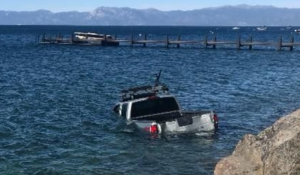
The driver survived plunging into Lake Tahoe. Photo/CHP

By KCRA-TV

Officials are warning drivers to slow down and not to drive tired after sharing a photo Thursday of a truck adrift in Lake Tahoe.

The driver, who was tired at the time, almost hit another driver before crashing into the lake, the Placer County Sheriff’s Office said.

Read the whole story


Brown OKs permanent residential water restrictions

By Taryn Luna and Alexei Koseff, Sacramento Bee

The drought may be over, but California residents should prepare themselves for new and more permanent restrictions on water use.

Gov. Jerry Brown signed a pair of bills Thursday to set permanent overall targets for indoor and outdoor water consumption.

Assembly Bill 1668 by Assemblywoman Laura Friedman, D-Glendale, and Senate Bill 606 from state Sen. Bob Hertzberg, D-Los Angeles, give water districts more flexibility than the strict cuts mandated under Brown’s emergency drought order and will eventually allow state regulators to assess thousands of dollars in fines against jurisdictions that do not meet the goals.

Read the whole story


Writers to read from ‘Permanent Vacation II’

“Permanent Vacation II: Eighteen Writers on Work and Life in Our National Parks” will launch June 13 at 7pm in the Aspen Room at Lake Tahoe Community College.

The second volume of this popular collection features writers from national parks all over the country, including locales like Cape Cod and Hawaii Volcanoes National Park. The event is free and open to the public. 

Authors reading at the event include Mary Emerick, Andrea Ross, Elizabeth Van Zandt and Tahoe local Joseph Flannery, reading of his encounters with bison in Yellowstone. There will be a short Q&A after the readings.

A second reading will be at Word After Word Books in Truckee on June 25 at 6pm. Authors at this event will include Flannery and John Q McDonald on the powers of Pele. This event is also free and open to the public.

“Permanent Vacation II” may be pre-ordered online. Books can be purchased locally at Gaia-Licious and Dharma Love in South Lake Tahoe and Word After Word.


Snippets about Lake Tahoe

·       The annual Wagon Train will be coming to Zephyr Cove on June 2, then from Zephyr to Amacker Ranch on June 3, from Meyers to Tamarack Pine on June 4, eventually reaching Placerville on June 9.

·       Donner Lake Triathlon is July 21-22. For more info, go online.

·      The Village at Squaw Valley will welcome a Shown-n-Shine with Nevada based Hot August Nights on June 9. It’s free for spectators. Event is from 9am-3pm.

·      Douglas County Public Library will be hosting a Lego Build on Tuesdays from June 12-Aug. 7 at the Minden Library. Listen to a story and recreate it using Lego bricks from 3-4pm. Lego bricks and building materials will be provided by the library. Lego Build Tuesdays are for children ages 4 and up.

·      Douglas County Public Library will present storytime at Lampe Park in Gardnerville on Wednesdays at 10am from June 13-Aug. 8. Crafts will be included; children of all ages are welcome. 


Study: Drugged driving on the rise

By Nathan Bomey, USA Today

Drugs are being detected in a growing share of drivers responsible for fatal crashes, according to a new study by the Governors Highway Safety Association.

Although it’s difficult to tell when drugged driving is a cause of accidents, the findings provide fresh reason for concern that marijuana and opioids are driving a growing safety crisis on American roadways.

Some 44 percent of drivers killed in crashes in 2016 who were tested afterward had drugs in their system, according to the GHSA study.

Read the whole story


Tahoe casinos post gains in April

Casinos on both ends of Lake Tahoe posted gaming wins for April.

Stateline casinos were up 12.6 percent compared to 2017 at $14.9 million. Slot play was the big factor, which was up 21.3 percent, according to the Gaming Control Board.

On the North Shore the win was a modest 1.2 percent increase over a year ago at $1.6 million,

Statewide the win was $67.1 million, for a 7.57 percent rise from April 2017. This was the first time in 2018 the state didn’t hit the $1 billion mark.

— Lake Tahoe News staff report


Road Beat: Elantra Eco, a hybrid of a different sort

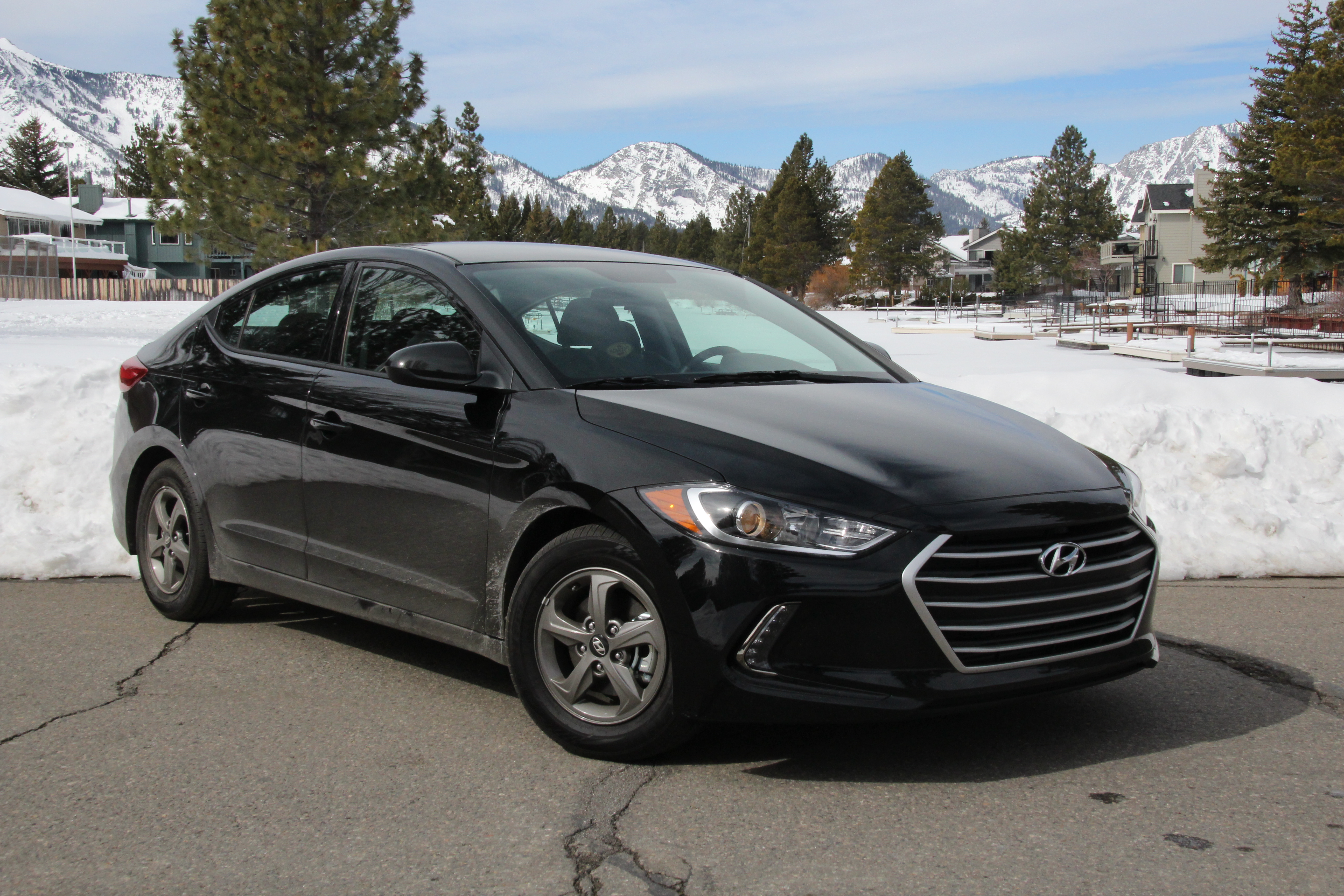
The 2018 Elantra Eco will impress, especially based on the price. Photo/Larry Weitzman

By Larry Weitzman

Most people will think from the headline that the new 2018 Elantra Eco is a battery hybrid, but it’s not. It goes about its business combining a small, 1.4L DOHC 16 valve four-cylinder engine with turbocharging and direct injection. It connects the engine to the front drive wheels via a slick, extremely efficient seven-speed dual clutch automated manual transmission to create one of the most efficient power trains in motordom. While the EPA rates this Hyundai at 32/40/35 mpg city/highway/combined in their prescribed test cycle, real world numbers far exceed those predictions.

With the new Elantra body which continually evolves in a good way (this is a great looking ride with a strong, aggressive grille and front end, smooth, flowing lines culminating in a muscular rear end), this makes for more than the run of the mill econobox, it makes for stylish, fun motoring that is anything but boxy and boring. Eco is a bit exciting.

And while the Eco exterior dimensions are clearly in the middle or slightly smaller than other compact cars (180L x 71W x 57H inches) it has a long 106-inch wheelbase qualifying Eco as a mid-size car under EPA guidelines at 110 cubic feet of interior volume, including a large, well-shaped 14 cubic foot trunk.

More about that diminutive power plant. It packs a bit of a wallop, belting out 128 hp at a low 5,500 rpm and a massive 156 pounds of twist from 1,400 to 3,700 rpm. And that number is important as while the peak hp is nothing spectacular, 156 pounds of twist at 1,400 rpm is. It equates to 42 hp at just off idle. That is huge when it comes to initial acceleration, especially when driving through that slick seven speeder. Zero to 60 mph arrives in a quick 7.70 seconds, making the Eco the second quickest of base compacts only being bested by a 1.5L turbo Honda Civic. The Eco plays with some heady company.

Specifications
Price $21,560
Engine
1.4L 16 valve, DOHC, turbocharged inline four 128 hp @ 5,200 rpm
156 lb.-ft. of torque at 1,400-3,700 rpm
Transmission
Seven-speed dual clutch automated manual
Configuration
Transverse mounted front engine/front wheel drive
Dimensions
Wheelbase 106.3 inches
Length 179.9 inches
Width 70.9 inches
Height 56.5 inches
Track (f/r) 61.5/61.9 inches
Ground clearance 5.3 inches
Fuel capacity 14.0 gallons
Trunk capacity 14.4 cubic feet
Passenger cabin volume 95.8 cubic feet
Weight 2,857 pounds
GVWR 3,880
Steering lock to lock 2.7 turns
Turning circle 34.8 feet
Wheels 15-inch alloys
Tires 195/65/15
Coefficient of drag 0.27
Performance
0-60 mph 7.70 seconds
50-70 mph 4.01 seconds
50-70 uphill 6.30 seconds
Top speed Well into triple digits
Fuel economy EPA rated at 32/40/35 mpg city/highway/combined. Expect 35-40 mpg in rural country driving with some stop and go. 48 plus mpg on the highway at legal speeds.

Passing performance is also quick with a 50-70 mph simulated pass coming up in 4.01 seconds and the same pass up a steep grade (6-7 percent) only slowing that time to 6.30 seconds. That is satisfying, solid performance that responds without any noticeable turbo lag. You completely forget that the Eco has a turbo motor.

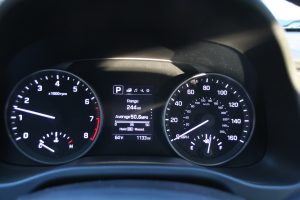
But when you find that your gas gauge doesn’t hardly move, you might think that the Eco is a partially battery powered hybrid. Overall, I averaged over 40 mpg with my 200-mile round trip from Placerville to Carson City averaging 44.4 mpg. Highway mileage averaged 48.2 mpg at 70 mph in a two-way highway run. Eco easily outperforms its EPA numbers by 10 percent or more. With its bigger than average 14-gallon fuel tank, just think of the possibilities, a cruising range of nearly 700 miles. Because hybrids have smaller fuel tanks, the Eco will outlast them with the only limiting factor being your own internal tank. Coefficient of drag is excellent at 0.27.

Handling is secure if not a bit sporty. Its credentials are not something to write home about, Tires are 195/65 mounted on 15-inch alloys. While it has MacPherson struts up front it uses a semi-independent torsion beam in the rear and it only has one stab bar up front. But its electric power steering rack is very quick at 2.7 turns lock to lock, is nicely weighted and it has a track of 62 inches front and rear.

Notwithstanding, the Eco still handles quite well with good cornering power. Perhaps its light weight of 2,857 pounds reduces its underpinnings load and requirements. Turning circle is a tight 35 feet. Eco handles nicely.

Eco is also quiet, especially on smooth roads only getting a bit noisy on coarse roads, but its ride is quiet and bumps transmits little if any noise. On the highway there is no wind or engine noise as this little engine that can only spins 2,200 rpm at 70 mph.

While the Eco gets front ventilated discs, the rear brakes are drums. But not to worry ABS and all the other braking acronyms are standard and since the front brakes to 80 percent of the braking rear brakes are not that important. And Eco exhibited strong braking performance. Many other small compacts also use standard drum brakes. Rear cross traffic alert and blind spot detection is also standard as are an array of other safety acronyms. Headlights are good.

Eco’s interior features comfortable seats with spacious dimensions. All trim materials are of first rate quality down to its nicely padded instrument panel. Instrumentation is excellent with a large tach and speedo flanking an info center/trip computer. Well done. The center stack is another picture of simplicity and ease of use. The large color screen is touch controlled except for volume and tuning (done with knobs) and the dual HVAC is simple knobs and buttons.

The price of admission makes the Eco a bargain. My tester stickered for $20,550 with only one “option” the obligatory carpeted floor mats which added $125. Shipping from its Montgomery, Ala., assembly plant is $885 bringing the total to $21,560. Eco is one of the highest value cars in production and its fun to drive, uses gas like its being siphoned through spaghetti and goes like stink. I would drive one every day.

Larry Weitzman has been into cars since he was 5 years old. At 8 he could recite from memory the hp of every car made in the U.S. He has put in thousands of laps on racetracks all over the Western United States.


LTN Book Club: ‘Doomsday’ brings clarity to nuclear war

By Kathryn Reed

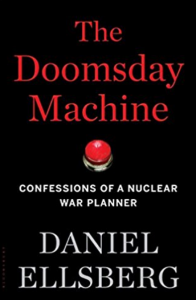
Sobering. Scary. Eye-opening. Educational. Thought-provoking. Those are just a few of the ways to describe “The Doomsday Machine: Confessions of a Nuclear War Planner” (Bloomsbury 2017) by Daniel Ellsberg.

If the author’s name sounds familiar, it’s because he is the person who released the Pentagon Papers, which were the subject of the 2017 movie “The Post.”

The now 87-year-old worked for the RAND Corporation as an analyst on nuclear strategy and then for the Defense Department through the 1960s.

What is so alarming is how inaccurate the information was about the destruction that would occur from the use of nuclear weapons. And then who knew what and when is incredible. The facts that were kept secret from those making decisions is downright frightening. The lack of trust between the military and civilians – including the president and his advisors – is stunning.

Scientists for decades didn’t understand about nuclear winter being a reality if there would be an all-out war. The fires and then smoke that would follow the bombs’ detonation weren’t part of the calculations at the get-go. This would eventually lead to worldwide starvation because plants wouldn’t be able to grow without adequate sunlight.

The fact the United States for years had only one plan for all of its nuclear missiles was startling. They were to be used to wipe out the then Soviet Union and China. Both. There was no other plan. The fact that all of the bordering countries would be severely impacted was of little consequence to the war planners.

The segment on the Cuban missile crisis is like none I ever learned about in school or have read about until now.

I read and listened to “Doomsday” based on my schedule. It took longer to read because I would reread parts. It’s complex. I wanted to make sure I had read things correctly. I feel like I should reread or listen to it all again down the road to fully comprehend everything Ellsberg shares.

Yes, it’s a history book of sorts. But it is so incredibly relevant to today because we have even more weapons that can wipe out life as we know it on Earth – as do the Russians and others.

Ellsberg makes a strong case for getting rid of these weapons of mass destruction. It would be hard to argue otherwise. The ethical and moral use as well just the possession of these weapons is worth a serious discussion.

—–

Notes:
·      The next book will be “Emerald Bay and Desolation Wilderness” (Arcadia Publishing 2018) by Peter Goin. The review will be published July 1.


Opinion: Kafka can’t believe California housing

By Frank Kafka (as told to Joe Mathews)

I keep hearing you Californians calling your state’s housing crisis Kafkaesque.

You are far too kind: I never imagined a nightmare this cruel, absurd, and surreal.
Joe Mathews

I don’t know exactly how I got to California. But I appeared here some weeks ago, in the form of an insect, like my protagonist in “The Metamorphosis.” And I’m glad I did. If I’d known weather like this in my lifetime, I might not have died of tuberculosis in Prague in 1924 at age 40.

In my prime, I was a master of conveying oppressive and intangible systems that trap humans. California, and its housing markets, do indeed fit that bill. But I couldn’t have conceived of a wealthy and beautiful place of 40 million people that claims it is welcoming to the whole world, while refusing to house people.

You Californians talk a big game about how you support the environment. But by a surreal trick, the laws that supposedly protect the environment also make it so difficult to build housing—especially near your transit hubs—that housing is pushed  to the periphery, where environmental costs are higher.  

And while I am proud of my ability to create nightmares of labyrinthine illogic, I never managed to dream of anything so diabolical as your California Environmental Quality Act. One lawyer, Jennifer Hernandez, writes about CEQA with scary flair: “Imagine spending five years and $5 million to defend against a lawsuit challenging a plan for where to put critically needed housing and related public services—and then to get sued again, and again, and again, and again, for trying to implement the plan ….”

That surpasses my most chilling passages!

Californians have forgotten just how fundamental housing is—not merely as shelter from life’s cruelties but as a space to think. As I once wrote, “It is not necessary that you leave the house. Remain at your table and listen …. The world will present itself to you for its unmasking, it can do no other, in ecstasy it will writhe at your feet.”

I portrayed the paradoxical isolation of an overcrowded city in “The Trial.” Your state is reminiscent of that, but at an overwhelming scale—of escalating homelessness and an estimated shortage of 2.5 million homes.  

And oh, the terrible price you pay! I had some real health problems in my life—migraines, insomnia, constipation, boils, and clinical depression. But your housing crisis is making you sicker than I ever was.

Millions of you have moved far from your jobs to find affordable housing that suits your family, but now your commutes are ruining your health. I know about commuting—while writing literature, I worked for insurance companies—but I couldn’t imagine the traffic or the hyper-crowded BART cars you endure.

All these pressures can put households in, well, Kafkaesque predicaments. I know about families—my father was a tyrant. In my story “The Judgment” a father won’t make any room in the world for his son, who jumps off a bridge.

But many younger Californians can’t even have a child. So many of you delay marriage and child-rearing (in part because you can’t afford a home) that your state’s birth rate is at the lowest level ever recorded. And good luck educating kids while paying your giant mortgages. Your schools don’t capture the full value of today’s high housing values because you have constitutionally limited your property taxes.

Housing makes most of you prisoners in your own homes. Yes, I once described an apartment as a prison in my unfinished novel “Amerika.” But by not building enough housing you’ve created such a run-up in prices that most of you couldn’t afford the place where you’re currently living if it came on the market.

Even worse, the ideas that your state officials propose (Mandatory solar! Affordable housing requirements! Rent control!) would only make housing more costly. When listening to your legislators, I thought of an old line of mine: “It’s only because of their stupidity that they’re able to be so sure of themselves.”

If you don’t address the crisis more forcefully, I fear you Californians will lose your taste for your sweet land, just as the salesman-turned-insect in “The Metamorphosis” loses his taste for his favorite foods: bread and milk.

I’d suggest that Californians read my posthumously published novel “The Castle,” in which the protagonist K arrives in a village but can’t get the permission to live there.

I never wrote the ending, but I planned to have the village grant him the right to have a home only when he was on his death bed.

California, do you really want an ending as Kafkaesque as that?

Joe Mathews writes the Connecting California column for Zócalo Public Square.