Shiffrin top dog in GS at Squaw Valley
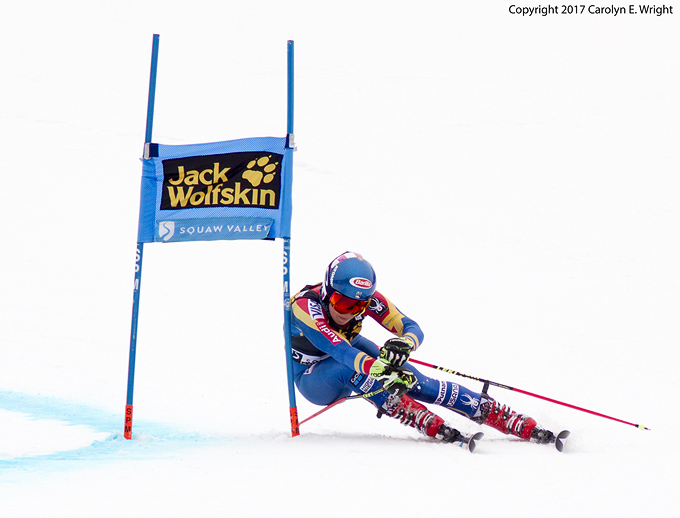
Mikaela Shiffrin speeds around a gate in her first run of the giant slalom on March 10 at Squaw Valley. Photo Copyright 2017 Carolyn E. Wright

By Kathryn Reed

OLYMPIC VALLEY – Mikaela Shiffrin tamed the Red Dog giant slalom course at Squaw Valley on Friday much like she has been doing throughout the world this season.

Three days shy of her 22nd birthday, the Colorado native on March 10 won with a time of 2:16.42. This was 0.07 seconds ahead of Federica Brignone of Italy. Tessa Worley of France rounded out the podium, 0.86 seconds off first place.
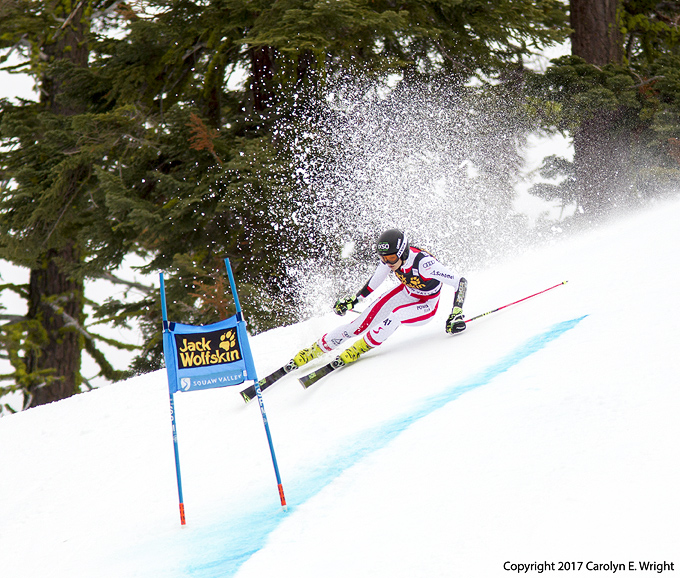
Elisabeth Kappaurer of Austria kicks up snow near the top of the course. Photo Copyright 2017 Carolyn E. Wright

Ninety athletes representing 19 countries are in town competing in the Audi FIS Ski World Cup GS and slalom. The slalom course will also be off Red Dog chairlift, with races at 10am and 1pm on March 11.

After coming out of the starting gate fast in her second run, Shiffrin lost time in the middle of the run, but was able to make it up near the last third of the course.

“In the middle pitch I got bumped around. I tried to change that in the last eight gates,” Shiffrin said.

Known more for her prowess as a slalom racer, Shiffrin has been making a concerted effort to be on the podium in GS as well. The training has paid off.
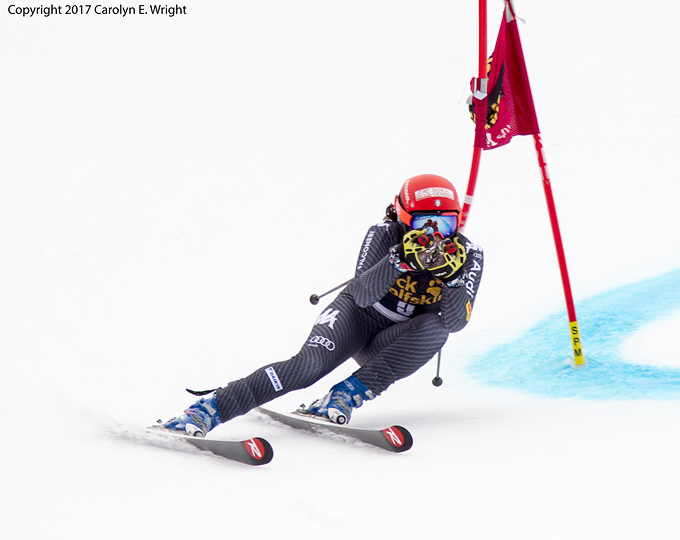
Federica Brignone of Italy takes second March 10 in GS. Photo Copyright 2017 Carolyn E. Wright

“I definitely feel my GS has picked up a lot. Getting that repetition is going to be huge,” Shiffrin said. “I know what I have to do to be fast. Now it’s a matter if I can do it every single day. In my training I feel very good.”

It will come down to next weekend’s races in Aspen, Colo., to determine the overall winner of the GS this season. Worley is leading in points with 80 more than Shiffrin.

With the win on Friday, Shiffrin solidified her lead for the overall World Cup title. Ilka Stuhec of Slovenia, who crashed on the bottom third of the course during her first run, is in second place for points.
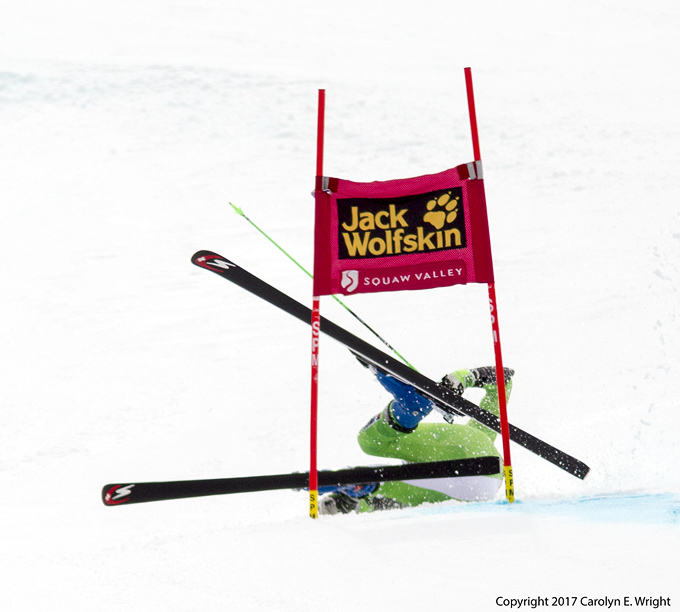
Ilka Stuhec of Slovenia crashes on the first run. Photo Copyright 2017 Carolyn E. Wright

Fierce competition

On Friday all eyes were on Shiffrin. This was her fourth career GS win. The crowd was definitely on her side, with numerous U.S. flags in the stands and along the race course.

She was one of three U.S. racers. Megan McJames of Park City finished in seventh. Resi Stiegler of Jackson, Wyo., did not qualify for the second run.
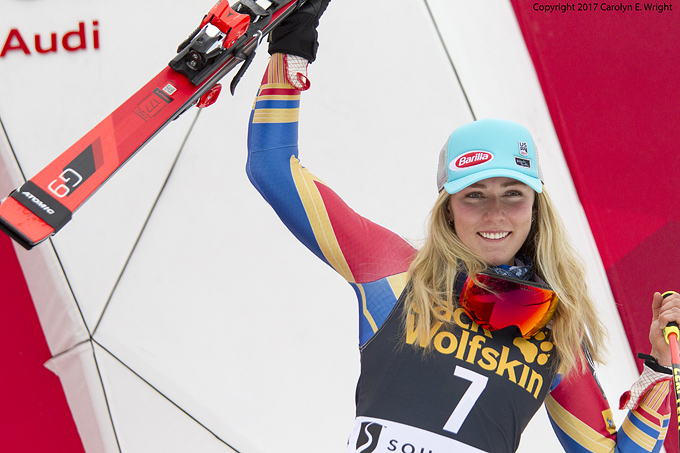
Mikaela Shiffrin is joyous after winning the GS. Photo Copyright 2017 Carolyn E. Wright
Right out of the giant slalom starting gate you gain speed across No Name Face, a relatively easy pitch but no indication of what’s to come. Less than 15 gates into the race you hit the Dog Leg where each turn keeps getting steeper and steeper. This is where the athletes encounter the steepest part of the course. Within five giant slalom turns it goes from relatively flat to extremely steep and it’s quite challenging for athletes to create a rhythm due to the technical terrain and changing trail directions. After the upper portion of the Dog Leg, there’s a false flat at the top of Far East Express. This is where the Slalom course starts. Right from the false flat, athletes are forced to tackle a big change in direction at Coaches Corner. The course bends around to the left and there’s a saddle before you exit Coaches Corner, onto The Face, which has a view straight to the end of the course, the finish and the base village.
—Trevor Wagner, director of snow surfaces for Squaw Valley

After the first race Stiegler told Lake Tahoe News, “I need to let it go on this hill and be charging all the way to the bottom.”

Italy has been a powerhouse on the circuit this season. They made their presence known at Squaw, with four racers making it in the top seven.

“In our country everything starts with GS. We are pushing each other. You don’t want to lose even in training,” Brignone said.

Racers started the giant slalom course at the top of Snow King Peak – elevation 7,250 feet. It’s 1,267 feet to the finish line.

Red Dog is where the women competed in slalom and giant slalom in the 1960 Olympics. It is considered one of the most difficult courses on this year’s tour. It has four major sections: No Name Face, Dog Leg, Coaches Corner, and The Face.

World Cup back in California

The last time an Alpine World Cup event was in California was in 1988 at Mammoth.

1969 was the last time Squaw hosted a World Cup event, which came nine years after the resort first became known to the world when it hosted the Winter Olympics. Snow was a huge factor in 1969 just like it has been this year. Nine feet fell in three days. So much that the men’s downhill was canceled. (Billy Kidd, who took gold in slalom that year, was on hand Friday to watch the women.)

“It looked way different Monday,” Andy Wirth, CEO of Squaw Valley, told Lake Tahoe News on Friday morning. Four feet of snow had fallen and the winds were howling that day. It’s been a record season, with more than 600 inches falling – and more to come.

The resort’s chief admitted to Lake Tahoe News that he was skeptical when Julia Mancuso first brought up the idea of having a World Cup event at Squaw. While Mancuso hoped to be a contender on her home slope, she is still recovering from hip surgery that has sidelined her the entire season. She did speak to the crowd in between the two races Friday.
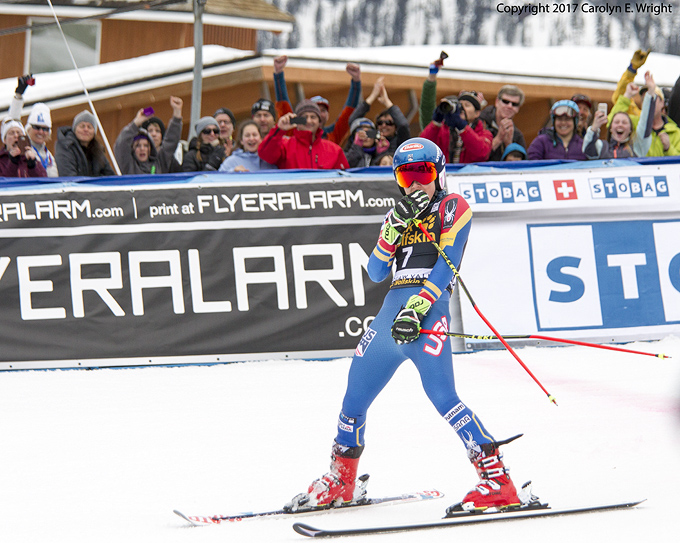
Mikaela Shiffrin in a rare moment of exuberance at clinching the GS. Photo Copyright 2017 Carolyn E. Wright

“It’s atypical to see a midseason World Cup in the States,” Wirth said.

The skiers all praised the conditions even though spring suddenly showed up, with temps reaching 50 degrees and the snow starting to melt.

“We injected 10 days ago and re-injected it Tuesday and Wednesday,” Wirth said. The point of this is to make it consistently slick.
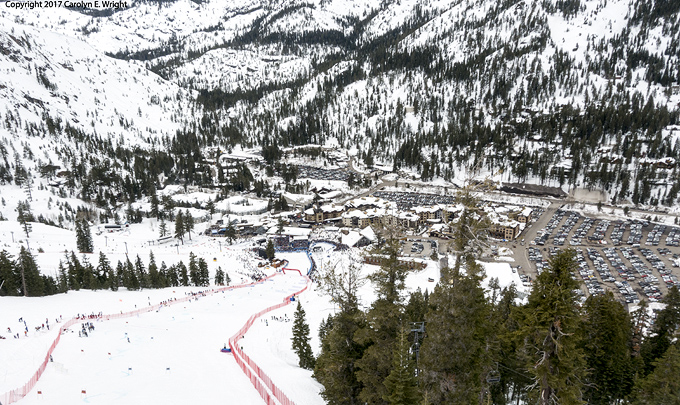
This is the first time in 48 years that Squaw has hosted a World Cup event. Photo Copyright 2017 Carolyn E. Wright

Prepping for World Cup

Bringing the World Cup to Squaw has been quite an undertaking. It started about 2½ years ago, got more intense in the last nine months, with Tuesday of last week beginning the final push.

According to Wirth, teams have been working practically around the clock since Monday.  

“The most visual preparation has taken place over the last four weeks as our team has been hard at work to prepare the Red Dog course and finish area, including the removal of huge amounts of snow from the course in order to restore its naturally challenging contours,” Liesl Kenney with Squaw told Lake Tahoe News.
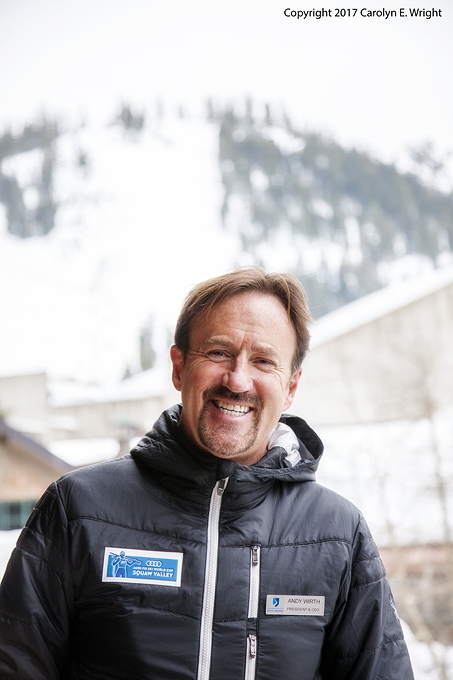
Squaw Valley CEO Andy Wirth is proud to bring World Cup back to the Tahoe area. Photo Copyright 2017 Carolyn E. Wright

Last month the groomers started to build up the natural features. It is groomed without the tiller so there is no corduroy. Red Dog is extremely steep and takes tremendous skill to maneuver the snowcat. The pitch at times is 33 degrees.

“Under these circumstances where we actually have to remove snow from the course to rebuild the natural contours, we are pushing the extra snow off into the woods,” Kenney said.

Crews removed two to three feet from more than 250 yards of the course. With a base of more than 20 feet, there’s a lot of snow to contend with.
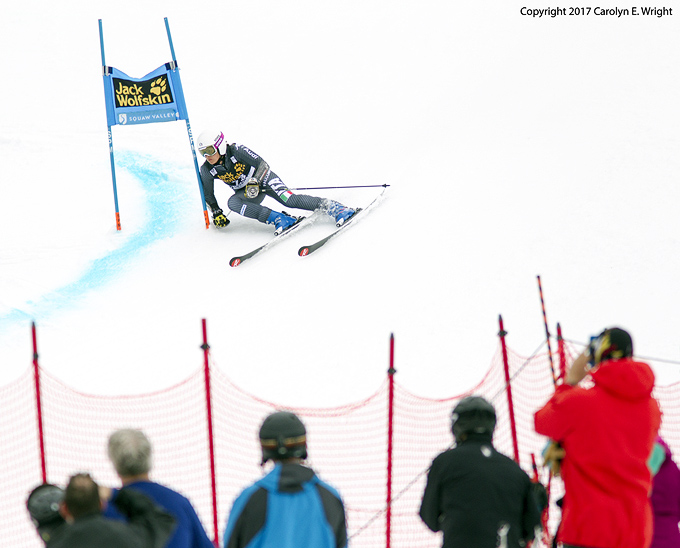
Irene Curtoni of Italy flies around a gate. Photo Copyright 2017 Carolyn E. Wright

Grooming came to a halt four days before race day. In the last few days everything has been done by hand.

In many ways the course is like an ice rink. Crews used hoses from the snowmaking system.

 “A designated coach from one of the competing countries drills in the gates using a laser range finder to maintain a specific range for the distance between gates and the ‘offset,’ or how big the turn is. After that, paint goes down to highlight terrain changes and direct the racers in poor visibility for flat light conditions,” Kenney explained.
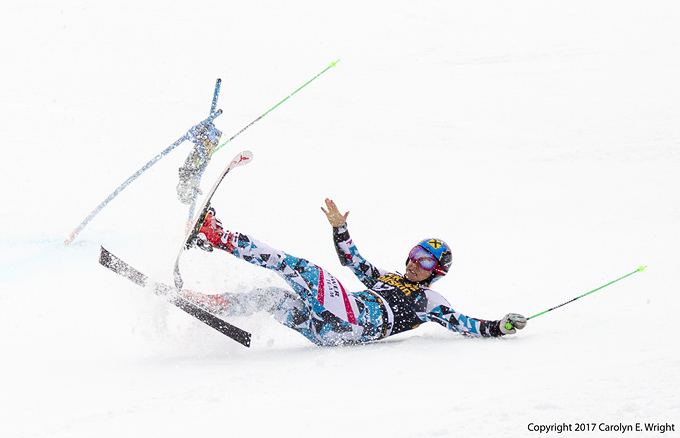
Katharina Gallhuber of Austria is unable to navigate the course. Photo Copyright 2017 Carolyn E. Wright

Last summer finish area pylons and underground conduit went in, as well as upgrades and additions to the timing and race services buildings.

It’s not just the two days of race event planners have to contend with. There are four days of free events that run through Sunday. Designing the course, putting in signs, coordinating transportation, and dealing witha cadre of media, spectators, and coaches are part of details many take for granted.

Wirth highlighted traffic not being an issue, saying this coordinated effort should happen every weekend. But then again, during the 1984 Olympics in Los Angeles traffic wasn’t a problem, but returned to its normal gridlock two weeks later.

On top of the event, the mountain is still open to the general public, so there are all the normal operations to contend with. However, Red Dog and Squaw Creek chairlifts are closed to the public through March 12.


Money Matters: 5 reasons to plan for the unknown

By Rick Gross

When you plan for the future, you may think about positive events such as marriage, starting a family, retirement or grandchildren. Yet there are other life changes such as job loss, illness, disability, or the need to care for a family member that can take an emotional and financial toll.

Rick Gross

While it’s natural to avoid thinking about these difficult events, it’s short-sighted to ignore the possibilities. Here are five compelling reasons why it’s better to prepare your finances for the unexpected rather than simply cross your fingers.

Challenging life events are hard enough to manage. Financial decisions made in a moment of crisis may not be the soundest ones and could have consequences for years to come. If you have financial contingency plans in place, you may have less to worry about or distract you from the issue at hand. You can be free to focus on pressing personal situations when it matters most.

You’ll have more choices. Planning when things are going well will give you more options for protecting your finances. Certain options that guard against financial loss may not be available when tragedy strikes. For example, it’s too late to buy insurance after a kitchen fire or a family member becomes ill. Planning ahead can give you peace of mind that you’ll be ready for these types of events.

Careful planning takes time. When you face an unexpected situation, you may not have the time or energy to consider your options carefully. With time on your side, you can be more deliberate, thorough and informed. For example, you can make multiple appointments to meet with tax, medical, financial planning and legal professionals to get advice and recommendations. These professionals can help you with a variety of tasks to prepare for the unexpected, such as updating your will, researching and comparing prices on financial products or insurance, establishing a trust or completing a healthcare directive. All of these arrangements can be complex, requiring a certain amount of your time and attention to get them in order.

It’s the considerate thing to do. Imagine the burden to family members if you’re incapacitated and your finances are in disarray. Having your financial dealings in order makes it easier for a loved one to step in and help, as needed. Make sure a trusted family member knows where key financial documents are and how to contact the professionals who help with your finances.

Action beats fear. Conventional wisdom urges us to ‘hope for the best and prepare for the worst.’ It’s good advice, and having a plan in place is empowering. You may not be able to prevent every unpleasant occurrence in life, but you can soften the blow of a personal hardship by putting safety nets in place. A financial advisor can help you identify options to prepare for life’s uncertainties.

Rick Gross is a financial advisor and private wealth advisor with Ameriprise Financial Services in South Lake Tahoe.


Polar plunge to benefit Special Olympics

Special Olympics Northern California & Nevada will host the annual South Lake Tahoe Polar Plunge on March 18 at Zephyr Cove Resort.

The Plunge will be featured during a full weekend of events and activities to benefit Special Olympics.

To kick off the plunge weekend, Special Olympics Nevada will host a Tip-A-Cop happy hour from 6-9pm  March 17 at Hard Rock Café inside Harveys.

The “space odyssey” themed Polar Plunge will kick off at 10am March 18. Plungers are asked to raise a minimum of $100 to participate and take the chilly dive for charity. Registration includes a Polar Plunge long-sleeve shirt and admission into the Post-Plunge Party at MontBleu, featuring a hot buffet, no-host bar, music and awards. Costumes are encouraged. Supporters not up to the plunge itself may also raise money as a “chicken” and receive the shirt and admittance into the Post-Plunge Party. Registration and sponsorship opportunities are available online.

All proceeds from the South Lake Tahoe Polar Plunge and the weekend’s activities will benefit Special Olympics Nevada.


Global warming is slamming California

By Sean Cockerham, McClatchy

The drought has been declared over in most of California, with heavy winter rains sending water over the Oroville dam and forcing the evacuation of nearly 200,000 people.

But climate change is still in the air, and the recent weather pattern is a harbinger of what’s to come. The abrupt shift to record rainfall is the kind of extreme weather forecast for a warming planet.

Parched earth could soon return, say climate scientists, who predict a worsening spiral of intense California drought followed by periods of flooding as the planet gets warmer.

The extreme weather is making it increasingly difficult for California to manage its flood-control and water management infrastructure.

Read the whole story


Fiber-optic cable now connects Nevada

By Nicole Raz, Las Vegas Review-Journal

Rural communities between Las Vegas and Reno have a better shot at boosting and attracting business.

Valley Communications Association of Pahrump, which is a member of the co-op Valley Electric Association, and Churchill County Communications finished 11 months of work at the end of January installing more than 450 miles of fiber-optic cable connecting Northern and Southern Nevada.

Switch funded the installation to connect its data centers in Las Vegas and Tahoe-Reno. It also made fiber available for Valley and Churchill to expand into rural areas.

Read the whole story


Truckee workshop to focus on special events

The town of Truckee and Truckee Chamber of Commerce are having a community workshop March 16 from 6-8pm about special events and quality of life in Truckee. It will be at the airport.

This hands-on workshop will provide an opportunity for people to weigh in on what aspects of special events are most important to the Truckee community. The chamber will introduce an annual Truckee quality of life survey, a baseline study to measure citizen sentiment and core values

In 2015 the town convened a Special Events Policy Development Committee to consider possible revisions to the town’s special events policy. Staff subsequently hosted three stakeholder workshops that focused on the nuts and bolts of special events policy and permitting.

At the workshop community members will have an opportunity to weigh in on how Truckee will balance the benefit of special events—such as enhancing arts and culture, outdoor recreation, and economic benefit—with the potential challenges—such as traffic congestion, road and trail closures, environmental degradation, and constrained parking.


Whistler acquisition a bonus for Vail earnings

By Dan Caplinger, Motley Fool

Investors in ski-resort operator Vail Resorts wait longingly each year for the winter months to come around, because that’s when the company makes most of its money. Even with a small operation in Australia, where winter comes during the Northern Hemisphere’s summer months, Vail Resorts still relies on North America for the vast majority of its revenue and profit.

Coming into Friday’s fiscal second-quarter financial report, Vail Resorts investors had high expectations for growth, thanks to the recent purchase of the Whistler Blackcomb resort in British Columbia. Vail’s results were even stronger than most had anticipated, and that helped lead the company to reward shareholders with a big dividend boost.

Vail Resorts’ fiscal second-quarter results were extremely favorable. The company reported revenue of $725.2 million, which was up 21 percent from the year-ago period, topping investor expectations for 18 percent to 19 percent top-line growth.

Vail’s net income grew even faster, climbing 27.5 percent to $149.2 million, and that worked out to earnings of $3.63 per share. That exceeded the consensus forecast among those following the stock by $0.22 per share.

Read the whole story


Storm water goals being met in Tahoe

By Kathryn Reed

The quality of roads in the basin and Lake Tahoe’s clarity may be more closely tied together than previously believed.

That is the belief of El Dorado County officials.

On the day the Lahontan Regional Water Quality Control Board voted to approve the next five-year Lake Tahoe municipal storm water permit for South Lake Tahoe, El Dorado County and Placer County, there was talk of looking at new ways to curb the sediment load.

“There is some new information we have showing roads contribute upward of 30 percent of the sediment into the Lake,” Russ Wigart with El Dorado County told the state agency.

The county does a significant amount of in-house research. The plan is to study the relationship between the pavement index condition and runoff. The pavement index condition goes from 0-100, with 100 being the best. Tahoe’s roads are anything but the best.

“Our roads this year were completely annihilated,” Wigart said. Winter weather has made some still impassable.

The plan is to study different surfaces to see what might be best for Tahoe.

While this is actually the 25th anniversary of the Lake Tahoe storm water permit program, the current iteration with the credit system just completed its first five-year cycle, which also incorporated the total maximum daily load requirements.

The atmosphere at the March 9 meeting was 180 degrees different than in December 2011. At that meeting the hostility was palpable between the jurisdictions and Lahontan. All five El Dorado County supervisors stood at the podium to denounce the plans.

At Thursday’s meeting the jurisdictions and Lahontan had praise for each other. While the jurisdictions still believe money will be an issue to accomplish the goals and that they are not easy measures to meet, they believe in the cause.

Despite the animosity at the start, all three locales met their goals. South Lake Tahoe needed 190 credits and achieved 209, El Dorado County needed 163 and hit 164, and Placer County needed 260 and earned 277. These credits equate to a 10 percent sediment reduction from the 2003-04 base year.

One credit is equal to 1.0 x 10 to the 16th fine sediment particles with a diameter smaller than 16 micrometers.

This permit that was just approved mandates another 15 percent reduction.

According to Lahontan’s staff report, “To achieve the transparency standard, estimated fine sediment particle, phosphorus, and nitrogen loads must be reduced by 65 percent, 35 percent, and 10 percent, respectively. Given the magnitude of the needed load reductions and the current available understanding of load reduction options, achieving the load reductions needed to meet the transparency standard is expected to take 65 years. A 20-year interim transparency goal, known as the Clarity Challenge, requires basinwide pollutant load reductions to be achieved within 15 years, followed by five years of monitoring to confirm that 24 meters of Secchi depth transparency has been reached. Implementation efforts must reduce basinwide fine sediment particle, phosphorus, and nitrogen loads by 32 percent, 14 percent, and 4 percent, respectively, to achieve this goal.”


Opinion: McClintock’s tactics are scary

By Marcos Breton, Sacramento Bee
 
Despite being a self-righteous poser and a carpetbagger, Rep. Tom McClintock deserves credit.

Unlike some of his congressional colleagues, the Elk Grove Republican, whose district is nowhere near Elk Grove, is game enough to continue presiding over town hall meetings where he is the piñata.

But instead of candy pouring out of McClintock when his constituents hit him – with tough questions and heartbreaking testimonials – intolerance pours out of him instead.

At a town hall meeting in El Dorado Hills on Saturday, McClintock told a young woman that she should go back to where she came from – El Salvador – even though she was brought to the U.S. as a child and raised here. He told a pair of gay teenagers that their concerns were not his.

Read the whole story


Truckee’s Laplante third in slopestyle

By USSA

SEVEN SPRINGS, Pa.  – Caroline Claire (Wilmington, Vt.) swept the Toyota U.S. Revolution Tour slopestyle events at Seven Springs this week, topping both podiums. The overall Toyota U.S. Revolution Tour champions were also crowned, with Claire winning for the women and Ryan Stevenson (Washington, N.J.) for the men.

Cal Carson (Winter Park, Colo.) and Cody Laplante (Truckee) also found the Rev Tour podium, placing second and third, respectively, for the men on Tuesday, while Nikita Rubocki (Boise, Idaho) was second for the women on Wednesday.

Wednesday’s event also served as the final stop of the FIS NorAm Cup Tour. Ethan Swadburg (Dillon, Colo.) was third in the NorAm Cup overall standings. Phillippe Langevin of Canada was first overall and his countryman Patrick Dew in second. The Canadian women swept the overall standings: Sofia Tcherntsky taking the top spot, Emma Stevens was second and Megan Cressey was third.