SLT clerk releases partial info, withholds own texts

By Kathryn Reed

The release of some of the public records that were requested of the South Lake Tahoe city clerk only muddies the waters.

Suzie Alessi, who is quitting effective next Friday, provided Lake Tahoe News on July 25 with some of the documents that had been requested earlier this year. Normally a public agency has 10 days to provide the records. This took months.

Her email stated, “For the record, my cell phone is my personal cell phone and I do not receive a stipend from the city. I do not have a city cell phone as you erroneously reported and am not providing my text messages pursuant to your request.”

Not releasing the records is against state law.

At a public records training on April 30 at which Alessi attended attorney Leah Castella of Burke, Williams and Sorensen showed a slide that stated, “The California Supreme Court ruled in 2017 that information related to the public’s business retained on private phones, computers and other personal devices and accounts of public employees and officials is a public record.”

In other words, doing public, aka city business, on a personal phone regardless of a stipend is a matter of public record.

Interim City Attorney Nira Doherty, who works for that same law firm, agrees.

“You will receive all public records which are responsive to your request. I anticipate you will receive them (Friday), and if not, you will receive them within 10 days,” Doherty told LTN.

Lake Tahoe News has been speaking with an attorney about suing to get the records, which the city is aware of. If LTN were to prevail in court, the city would have to pay LTN’s legal costs.

While Alessi has powers as an elected official that she would not have if she were a city employee, she is not above the law.

Alessi’s email went on to say, “There are no text messages that were retrieved from Tracy Franklin cell phones.”

Tracy Franklin, aka Tracy Sheldon, is the public information officer for the city. Alessi is saying that between August 2017 and April 2018 the woman whose job it is is to communicate with everyone has no text messages. That is not true because this reporter has texts from her during that time period.

It is not known why Alessi is protecting Sheldon. The deletion of texts raises more questions.

Sheldon was called out in an LTN column this week. On Lake Tahoe News’ Facebook page she wrote, “You have just earned yourself a lawsuit Ms. Reed. You can’t publish false information.”

There was nothing false in the column. As the spokeswoman for the city, her words are supposed to reflect the sentiment of the city.

Mayor Wendy David emailed LTN to say, “Tracy Sheldon’s comments do not reflect the position of the city or that of the City Council.”

However, Sheldon’s boss, interim City Manager Dirk Brazil, has been silent as to what his thoughts are about Sheldon’s comment or Alessi’s lack of transparency. So it’s not known if Sheldon went rogue with her threat of legal action.

The texts Alessi released from David and Councilman Austin Sass’s were rather benign because most were redacted.

“I redacted information in the text messages that were provided to me. Text messages were extracted from cell phones by the police department. On city-issued phones, I only redact information which is privileged, i.e. information that implicates privacy rights, attorney-client privilege, etc. On personal devices, I redact information which is privileged and which is unrelated to city business,” Doherty explained.

However, it was Alessi who first had access to the documents. The attorney didn’t see them until after Alessi had read through them, so it’s not known what may have been removed by the clerk.

Most of Sass’s texts were between whoever was city manager at the time, with most having been redacted. A few were to his wife and some to his ski buddies.

The only slightly interesting one was from former City Manager Nancy Kerry to Sass on Feb. 5 saying, “I was calling to let you know Bob Hassett wants to call you re Cody [Bass] (space) I sent him your contact info (space) He is concerned about councils [sic] possible position re Cody /mj license.”

The few texts of David’s left intact were not interesting.

Alessi did not answer why it took her so long to release so little.

When the remainder of the documents are released that may shed some light on why she has been stalling.

Each of the council members was asked what they thought about Alessi’s refusal to release her own texts. Only Councilmembers Tom Davis and Brooke Laine responded.

Laine told LTN, “I am very disappointed that the city clerk has failed to fulfill this public records request, as required by law. This situation marks an unfortunate way to end an otherwise honorable career.”

Davis told LTN, “I’ve known Suzie for many, many years and she has had a great career. I don’t know what happened in the last couple months about the public records. I told her it was embarrassing to the city. Then she gave you partial stuff. I’m frustrated with her. It’s not just you, but the public has a right to know.”



Opinion: Welcome to the Bay Area, Tahoe City!

By Joe Mathews

Welcome to the Bay Area, Merced!

And welcome as well to Modesto, Sacramento, and Yuba City. Looking south, you’re invited, too, Santa Cruz, Monterey, and Salinas. And while you’re almost in another state, don’t worry, Tahoe City. The bay waters are warm.

Joe Mathews

This expanded notion of the Bay Area’s reach isn’t a joke. It reflects the biggest thinking about California’s future. If you’re in a smaller Northern California region that can’t quite compete with the advanced grandeur of the Bay Area, why not join forces with the Bay Area instead?

The Bay Area would benefit too. It is one of four connected Northern California regions—along with the greater Sacramento area, the Northern San Joaquin Valley, and the Central Coast triumvirate of Monterey, Santa Cruz and San Benito counties—that struggle with severe challenges in housing, land use, jobs, transportation, education, and the environment. Since such problems cross regional boundaries, shouldn’t the regions address them together as one giant region?

The Northern California Megaregion—a concept developed by a think tank, the Bay Area Council Economic Institute—includes 12 million people and 21 counties, extending from the Wine Country to the lettuce fields of the Salinas Valley, and from the Pacific to the Nevada border.

The places of the Megaregion are integrating as people search a wider geography for jobs, housing, and places to expand their businesses. The trouble is that this growth is imbalanced. The Megaregion is home to the mega-rich in San Francisco and poor cities like Salinas, Stockton and Vallejo. As high housing prices push people out of the Bay Area, they flee deep into the Megaregion, only to find they are too far away from their jobs and schools. The results: brutal traffic that produces more greenhouse gases and longer commutes.

Figuring out how to rebalance the Megaregion and solve such problems is a high-stakes challenge, and not just for Northern Californians. The entire state relies heavily on the growth and tax revenues generated by the Bay Area, which represents about one-third of California’s economy. And the Megaregion concept offers a vision for how the Golden State might spread out its prosperity, creating a better distributed version of the California dream.

This doesn’t mean allowing the Bay Area to colonize its neighbors. Ratherm, it’s a mega-rethinking so that planning and development is widened to enable the Megaregion’s pieces—Bay Area technology, Sacramento government, San Joaquin Valley logistics and Monterey area farming—to magnify each other.

To pick one example: If new state research-and-development tax credits from Sacramento were to target inland companies, an infusion of technology could allow the Northern San Joaquin to make its logistics industry more efficient and less polluting as it moves green vegetables from Salinas to expanded ports in Stockton or Oakland.

A Bay Area Council Economic Institute report and its co-author, Jeff Bellisario, a man whose colleagues call him “Mr. Megaregion,” suggest that Megaregional planning could create more high-tech jobs and companies outside of the Bay Area, by better connecting universities, laboratories, and research institutions with local entrepreneurs.

Such planning should be performed by new economic development entities that extend across the Megaregion; companies that now leave the Bay Area for Austin might be redirected to Sacramento or Santa Cruz. Such an effort would be strengthened if Bay Area entities jointly lobbied Sacramento to boost lower education levels in the Northern San Joaquin.

Of course, making such a shift would require a well-integrated set of transportation connections from one end of the Megaregion to the other. Suggested changes include more service on Amtrak’s Capitol Corridor between San Jose and Placer County east of Sacramento, an extension of rail service to Salinas, and support of planned expansions of the ACE (Altamont Corridor Express) train to Merced and Sacramento. (A political note—the controversial gas tax increase produces $900 million for these ACE expansions.) These changes would make the actual completion of high-speed rail more urgent, since the first segment, from Bakersfield to San Jose, would connect with this expanded Megaregional transit system.

It is easy to mock such mega-visions. For years real estate interests have done silly things, like touting a major housing development in San Joaquin County as being in the “Far East Bay.” (One local joke: Is that nearer Singapore or Hong Kong?)

But if the Megaregion could harness its joint economic and lobbying power, much of this seems possible. It could even inspire imitators. Could Los Angeles, San Diego, and Las Vegas further integrate into their own Megaregional triangle? Might Tijuana and Mexicali join their planning mix?

If it built a record of success, the Northern California Megaregion could even expand, extending down the San Joaquin Valley to California’s fifth-largest city.

Welcome to the Bay Area, Fresno.

Joe Mathews writes the Connecting California column for Zócalo Public Square.


Calif. funds dams to protect against future drought

By Kurtis Alexander, San Francisco Chronicle

For the first time since California’s dam-building boom ended nearly a half century ago, state officials on Tuesday approved a windfall of cash for new water storage projects, setting the stage for at least a mini-resurgence of reservoir construction.

The historic $2.7 billion of voter-approved bond money will go to elevating two Bay Area dams, at Los Vaqueros Reservoir near Livermore and Pacheco Reservoir east of Gilroy, as well as to the development of two much larger dams in the Central Valley. Funds also will go to four less traditional endeavors that store water underground.

Read the whole story


Report: Lake Tahoe warmer than ever

By Benjamin Spillman, Reno Gazette-Journal

Water in Lake Tahoe was warmer than ever last year – and the average temperature of the Tahoe Basin is expected to keep getting warmer.

That’s according to the latest yearly report on water and climate conditions at the world’s second largest alpine lake.

The findings show climate change is putting the squeeze on the environment at the lake, a situation that highlights the urgency of efforts to make the lake’s ecosystem more resilient to global warming.

The “Tahoe: State of the Lake,” report published Thursday.

Read the whole story


Nevada marijuana sales in May set record

By Wade Tyler Millward, Las Vegas Review-Journal

April showers bring May flowers, as the saying goes — and in Nevada’s case, that flower comes from marijuana.

The state posted another record monthly sale of the once illegal plant.

Recreational sales in May reached $43.74 million, exceeding the previous $41 million monthly record set in March, according to state Department of Taxation data released Thursday.

Read the whole story


Missing woman may be in Tahoe area

Jessica Youssi

By Katelyn Stark, Fox 40

The El Dorado County Sheriff’s Office says Jessica Youssi’s family reported her missing Wednesday when they could not contact her and she stopped being active on social media.

She was last seen Saturday leaving her Modesto home. That same day the 40-year-old nurse posted to a social media account that she was going to the Tahoe area.

Read the whole story


Nevada named one of the worst states to retire

By Jason Hidalgo, Reno Gazette-Journal

Nevada just can’t seem to catch a break this year when it comes to rankings for retirement.

After being named one of the worst states for retirement by a report in February, the state ranked poorly in yet another list that came out this month.

Nevada was the ninth-worst state in the nation for retirement according to a report by personal finance company Bankrate.com. The state received a favorable top 10 ranking in only one out of seven categories: taxes. Nevada earned the fifth best rating in the nation for its favorable tax climate.

Read the whole story


Road Beat: Volvo XC40 has room for improvement

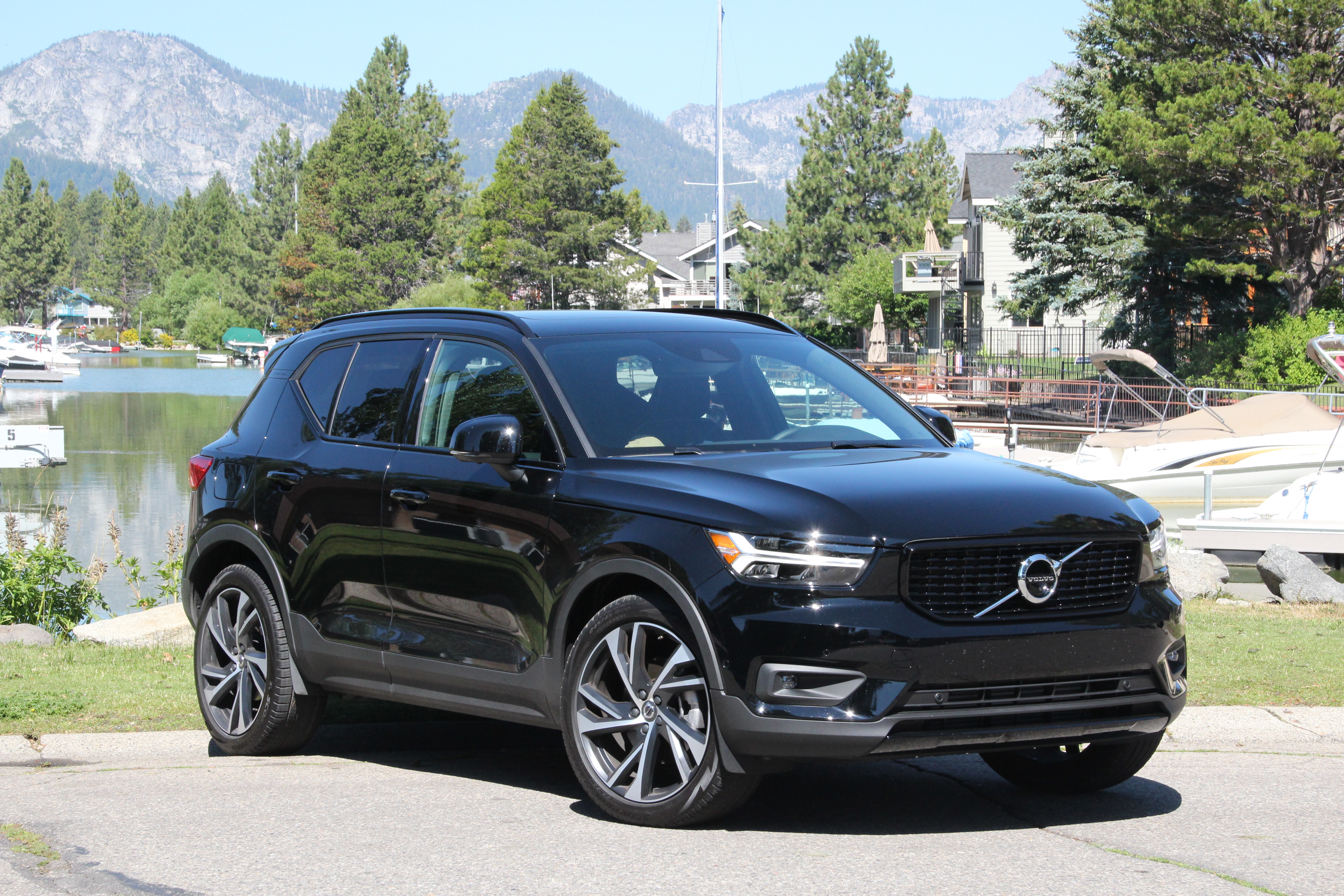
Volvo XC40 has great looks and design, but disconnected. Photos/Larry Weitzman

By Larry Weitzman

Volvo has been on a serious roll with some new product that is off the charts like the new S90, V90, XC90 and XC60 and their sales growth indicates renewed customer enthusiasm. But now we have the new XC40 which was rewarded recently with the European Car of the Year for 2018. So, it was with much anticipation that I awaited the arrival of the new XC40.

Its boxy design didn’t disappoint with a crisp, up right two box look with very pleasing lines especially in black as the rear cabin behind the side window is always in black giving the all black car a more cohesive appearance. XC40 is a small vehicle (174 inches) about half a foot shorter than your average compact car. At 65 inches tall it looks even shorter. It is beamy at 73 inches. But with that wide girth, front and rear tracks measure a very wide 63 and 64 inches respectively which bodes for excellent handling.

Under the hood of my T5 AWD R-Design is the familiar Volvo 2.0L DOHC, 16 valve turbocharged inline four-cylinder engine knocking out 248 hp at a low 5,500 rpm and 258 pounds of twist at 1,800 rpm connected to an eight-speed torque converter auto cog-swapper. All four wheels get driven but it is an on-demand system with a front bias, but there was absolutely no torque steer. This same engine with the addition of mechanical supercharging in Volvo’s larger models belts out about 320 hp with a commensurate increase in twist.

Performance is hampered by lag, either by throttle mapping (to improve fuel economy) or turbo lag or both. In normal driving XC40 is a bit of a dog taking 8.23 seconds to achieve 0-60 mph. Fifty to 70 mph runs level and up a steep grade averaged 4.40 and 6.76 seconds respectively. Pretty sloggy performance for a $38,000 compact near luxo CUV. However, there is a way to change the driving dynamics by selecting the drive mode button inconspicuously place among the climate control button which allows you to go from eco, comfort normal or dynamic driving which consists of a remapping of the powertrain and sharpens up the response although there is still some lag at tip in. Times dropped to 7.45/4.16/6.27 seconds respectively making the Volvo times more respectable in the dynamic mode.

Specifications
Price $37,700 to about $45,000
Engine 2.0L DOHC, 16 valve, turbo charged, direct injected inline four 248 hp @ 5,500 rpm
258 lb.-ft. of torque @ 1,800 rpm
Transmission
Eight-speed torque converter automatic
Configuration
Transverse mounted front engine/AWD
Dimensions
Wheelbase 106.4 inches
Length 174.2 inches
Width 73.3 inches
Height 65.0 inches
Track (f/r) 63.0/64.0 inches
Ground clearance 8.3 inches
Max wadding limit 17.7 inches
Weight 3,825 pounds
GVWR 4,960 pounds
Fuel capacity 14.25 gallons
Steering lock to lock 2.7 turns
Turning circle (curb to curb) 37.4 feet
Wheels 20X8 inch alloys
Tires 245/45X20
Cargo capacity (rear seats up/down) 47.2/20/7 cubic feet
Max trailer tow weight 4,629 pounds
Performance
0-60 mph 7.48 seconds
50-70 mph 4.16 seconds
50-70 up (6-7 percent grade) 6.27
Top speed Imagine a Volvo with a factory top speed of 143 mph?
Fuel economy EPA rated at 23/31/26 mpg city/highway/combined. Expect about 23-26 mpg in rural/suburban driving and 33 mpg on the highway at legal speeds.

Driving the Volvo is different. Every time the brake is applied coming to a full stop a brake hold remains in place until the throttle is applied. And it can be abrupt. The car will not creep forward in drive or backwards when in reverse making control a bit disconcerting. There is noticeable engine or turbo lag not experienced with the turbo-supercharged version of this engine. Once underway, say from 10 mph, XC40 feels pretty sprightly. Hard throttle produces some engine noise, sometimes coarse, and certainly not pleasant.

EPA rates the XC40 at 23/31/26 mpg city/highway/combined. With the engine spinning a low 1,900 rpm at 70 mph, it is inaudible under light throttle conditions. In a two-way run it averaged 33 mpg and overall 23-26 mpg was the norm. In a 200-mile trip to Carson City the XC40 averaged 26.4 mpg but it was in a 45-minute traffic jam so it should have averaged at least an mpg or more even though it has an automatic engine stop feature which I could not disable even pushing the button to stop the auto stop feature. One other disconcerting feature of this auto engine stop feature was auto A/C stop feature which wasn’t exactly pleasant in 100-degree weather, especially in my all black XC40.

Handling is quite sharp bolstered by state of the art four-wheel independent suspension, wide track, quick steering at 2.7 turns lock to lock and big 20-inch wheels shod with serious 245/45 x 20 inches. The 20-inch wheels are an $800 upgrade over the standard R-Design nineteens. Changing directions in this 3,825-pound ride should be easy but it is impeded by electronic intervention which I couldn’t seem to turn off. Everything in this car, including the owner’s manual is contained in the computer operated by a large 12-inch touch screen which sometimes didn’t respond to my touch. I guess I didn’t have the “right” touch. Most if not all systems are handled through the center touch screen. Maybe Volvo is trying to save trees.

Back to handling and while there was significant cornering power when pushing the XC40 hard especially near a painted line in the road, you could feel the steering wheel slightly vibrating or counter steering on its own. Very disconcerting. I couldn’t find a way to turn it off.

Ride quality was good, being smooth as long as the throttle isn’t more than half way down and then noise will intercede. It rides very smooth and takes bumps very well.  There is no wind and little road noise.

Safety is almost overdone. Yes, it has every acronym and safety feature known to man and Martians alike. But sometimes intervene too early. Brakes are powerful except for the brake hold feature then they are too powerful. LED Headlights are excellent.

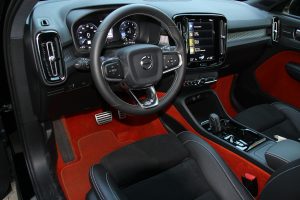
Inside is a different Volvo interior. Always of the highest quality and best leathers, my tester looked like the San Francisco Giants with its Nappa black leather super comfortable seats and bright orange/reddish carpet. Instrumentation is all electronic with a big speedo and tach, but in Volvo’s effort to be different, the trip computer is in the lower part of the tach and needs to be activated with a button push on the steering wheel. Other wise only average fuel econ is displayed. I prefer more info.

Rear seating is comfortable with good room, but while the cargo space appears very large the numbers provided by Volvo aren’t at 47 cubes behind the first row and about 21 cubes behind the second row. It might be due to Volvo’s measuring system. Fuel capacity is also small at 14.25 gallons.

Pricing for the T5 AD R-Design $37,700 plus $995 for boat from Europe. Three packages and some other options drove the Monroney to $45,340.  Enough said, too much electronic intervention hurts an otherwise outstanding design.

Larry Weitzman has been into cars since he was 5 years old. At 8 he could recite from memory the hp of every car made in the U.S. He has put in thousands of laps on racetracks all over the Western United States.


Money Matters: Financial plans help achieve bucket lists

By Rick Gross

We spend a lot of time daydreaming about and planning how to achieve our goals. Charting a new career, creating a bucket list, helping a loved one reach success and other goals all have

financial implications that deserve consideration. This is where a financial plan comes in. The goal of a plan is to lay out what success looks like to you, and how you can position your finances to help you get there.

Rick Gross

A well-crafted financial plan is:

1.     Personalized. Your plan should contain the details of your current financial situation and outline your life goals, both near-term and extending into retirement. Using actual data can ground your plan in reality and help you see what you need to do to stay on track. Generally, there are four areas you should address:

·       Covering your essentials. Essentials are the monthly expenses that keep your life running, such as mortgage payments, utility bills and insurance premiums. Your financial plan should provide advice and solutions to cover your day-to-day needs while also providing for your necessary living expenses in retirement.

·       Maintaining your lifestyle. Lifestyle refers to the things you want to do and how you want to live, today and in the future. If you dream of purchasing a second home or retiring in a warmer climate, your financial plan should quantify the costs of these goals and outline action steps to help you achieve them.

·       Preparing for the unexpected. Life is not without its surprises. Your financial roadmap should include contingency plans to help you stay on track financially when something unexpected happens to you or a loved one. This may include establishing an emergency fund and insurance coverage to help offset damaged property or lost wages.

·       Leaving a legacy. Your legacy is the impact you make on people, charities and causes that are important to you – now, in retirement and after your death. Key components are naming beneficiaries on key accounts, building charitable giving into your financial life and estate planning to determine how you want your assets to be distributed to your heirs.

2.     Comprehensive. All the bases of your financial life should be covered within your plan, from insurance to investments, cash flow, retirement, estate planning and everything in between. Include your financial obligations and goals, no matter how big or small they are. Seeing your full financial picture in one place makes it easier to adjust course or test scenarios as your priorities change down the road.

3.     Dynamic. A financial plan is not a static document you create once and never revisit. Rather, it puts a stake in the ground that can inform future decisions. Your financial plan should be updated as your life goals and circumstances change.

4.     Trackable. Without a plan, it is difficult to determine if you will be prepared to meet your anticipated retirement date, whether you have sufficient sums saved to put a child through college, or if you’ve taken proper steps to protect your family. In this way, your financial plan can help you stay accountable to your financial future.

5.     Useful, no matter your net worth. Turning your goals into reality without a financial plan is a lot like driving in an unfamiliar place without a GPS. Regardless of how much you make or have saved, a financial plan can help you be strategic with your dollars.

If you have not yet had a comprehensive financial plan prepared for you and your family, consider working with an advisor who can help you get started. Together, you can identify doable steps to help you work toward your financial dreams.

Rick Gross is a financial advisor and private wealth advisor with Ameriprise Financial Services Inc. in South Lake Tahoe.


Aggressive mountain lion in Desolation

By Benjamin Spillman, Reno Gazette-Journal

Backcountry ranger Shannon Maguire is used to seeing evidence of mountain lions in Desolation Wilderness.

But a report of a lion encounter went well beyond what Maguire considers typical for the popular hiking and backpacking area near Lake Tahoe.

Maguire said on July 15 hikers reported an odd feeling while hiking from Camper Flat to Middle Velma Lake.

Looking around, they spotted a mountain lion.

Read the whole story