Tahoe nutritionist touts plants over animals

By Kathryn Reed

The link between food and health was underscored this month in a nutrition presentation before the South Lake Tahoe City Council.

Registered dietician June Denney promoted a plant-based diet in her talk with physician Greg Bergner. Her message was that food can cause and prevent disease.

Citing the 2015 Global Burden of Disease Study, Denney said, the No. 1 cause of premature death and disease is food.

Diet-related chronic diseases include:

·      Obesity

·      Cardiovascular disease

·      Hypertension

·      Diabetes

·      Cancer

·      Osteoporosis.

Denney provided information from multiple studies showing the benefits of eating vegetables over meat.

Stats included:

·      Strawberries are the most powerful anti-angiogenic food

·      1 serving per month of kale or collard greens reduces the risk of glaucoma by 69 percent

·      Beets and arugula decrease blood pressure, improve COPD, peripheral artery disease and improve fitness performance

·      One banana a day can decreases the chance of stroke by 40 percent.

One of the problems people have in the United States is with serving sizes. Three ounces of cooked red meat is a serving. Most hamburgers, though, are the equivalent of two servings. So, not only are people eating foods that are bad for them, the quantities are more than most people realize.

With most African nations not adopting a Western diet, they don’t have the same diseases at the United States.

Denney shared:

·      1 in 3 Americans die of cardiovascular disease

·      1 in 1,000 Africans die of cardiovascular disease

·      Some hospitals in Africa have not seen a single case of colon cancer

·      Kenya sees 20 times less breast cancer than the United States.

“We are doing something wrong,” Denney said.

The presentation was in recognition of March being National Nutrition Month.


Tahoe specialty plate losing popularity

By Kathryn Reed

TAHOE CITY — The specialty license plate benefiting the California Tahoe Conservancy sells well in the winter, but not in summer. The goal is to ignite sales year-round.

The program funds non-motorized trails in the Lake Tahoe Basin on the California side.

Since 2011-12 the revenue has been declining or has been flat. That fiscal year $1.172 million from plate sales came to CTC, while in 2015-16 the revenue was $991,000.

Winter sales are boosted by Tahoe area skiers and snowboarders donating their time to the cause for ad campaigns and then ski resorts giving tickets as an incentive to random license plate owners.

The goal is to create a summer campaign from Memorial Day to Labor Day. A “plates for projects” initiative is in the works. The CTC would partner with an organization or two that needs funding. The group(s) would apply for a grant. In exchange they must promote the license plate program.

Grants are likely to be in the $7,000 to $20,000 range. The campaign would be marketed to groups that are already interested in Tahoe such as mountain bike organizations, Jeep trail riders and others.

Pete Fink, who was at the March 16 CTC meeting, said TAMBA would be interested in working with the CTC.

This summer would be the pilot campaign, and if all goes well, it could be expanded in future years.

Of the various specialized plates, the CTC one is the seventh most popular based on sales. The one that surged ahead of all others is the old style black and yellow plates that came out in 2015. There are more than 230,000 of those plates on the streets, while there are about 23,000 CTC plates, and it has been around since 1992.

Car dealers are not allowed to sell any specialty plates. This is a California Department of Motor Vehicles rule. CTC member Karen Finn said she would look into changing that regulation.


K’s Kitchen: Sweet potatoes on a salad

By Kathryn Reed

Nutritional and pretty. What more could you want?

Sweet potatoes can be cooked in so many ways. Having them as fries is how I am most familiar with them. Clearly, not my healthiest choice.

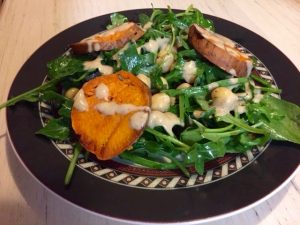
Adding them to a salad brings a bit of sweetness. The dressing used here is a bit nutty and tangy, which all together provides a lovely complement of flavors.

Any greens for the salad would be fine. Arugula has a distinctive peppery flavor. I miss the days of growing it this time of year when I Iived in Sonoma County. Thank goodness for grocery stores!

Greens with Sweet Potatoes and Chickpeas
2 small sweet potatoes

¼ C almond butter

3½ T warm water

3 T fresh lemon juice, divided

2 T olive oil, divided

1 15-ounce can chickpeas, drained

5 ounces arugula-spinach mix

¾ tsp kosher salt

1 tsp black pepper

Peel potatoes. Prick them all over with a fork; then microwave for about 5 minutes, or until tender. Cut into quarter inch-thick rounds.

Whisk together almond butter, water, and 1 tablespoon lemon juice. Set aside.

Heat a large skillet over medium-high with 1 tablespoon oil. Cook potato slices until golden brown.

In a large bowl combine chickpeas, salad greens, salt, pepper, remaining 2 tablespoons juice, and 1 tablespoon oil. Divide salad mixture between four plates; top with sweet potato slices. Drizzle with almond butter sauce.


Snippets about Lake Tahoe

·      Plans are afoot to rename McCarran International Airport in Las Vegas to Harry Reid International Airport.

·      Douglas County 911 emergency services was approved as an Emergency Fire Dispatch Center of Excellence by the Board of Accreditation of the International Academies of Emergency Dispatch. It is the 36th emergency fire dispatch accredited center in the world and the first in Nevada. It is also the first dual accredited fire and medical accredited center in Nevada.

·      Cheech & Chon plus special guest Shelby Chong will be at MontBleu in Stateline on Aug. 18 at 8pm.

·      Here are the El Dorado-Tahoe and Sierra roadwork schedules from Caltrans for the week.

·      Nevada Equality Day in Carson City is April 4. For more info, go online.


Calif. preparing for future full of extreme weather

By Michael Rios, PBS News Hour

Two straight months of heavy rainfall have effectively ended five straight years of drought in California. But with parts of the state reporting more than 100 inches of precipitation since last fall, the rain activity has also caused floods, road closures, infrastructure damage and evacuations in many areas.

As a result of the unpredictable nature of California’s climate, state officials have begun to prepare for what they expect to be continued extreme weather conditions. The Climate Prediction Center predicts lingering drought conditions will persist in parts of Southern California through June even after what it called a “phenomenal wet season.”

State officials also expect variable weather patterns to continue in the future, which could extend droughts, increase flood risks and threaten the sustainability of the Sacramento-San Joaquin Delta.

Read the whole story


Tahoe polar plunge sets a fundraising record

A toe dip was enough for some people as opposed to the full plunge many others opted for.

The space odyssey themed Polar Plunge kicked off at 10am March 18 at Zephyr Cove Resort.

The annual event raises money for the 23,000 Special Olympics athletes in Northern California and Nevada. More than $150,000 was raised on Saturday – a record.

Hundreds of people showed up in an array of costumes. Some went in fully clothed, others had traditional swimwear. Most had an expression of being speechless – like the cold water literally took their breath away.

— Lake Tahoe News staff report


EDHS teacher arrested on sex crimes

By Bill Lindelof and Nashelly Chavez, Sacramento Bee
 
 Placerville police have arrested an El Dorado High School teacher on suspicion of sexual misconduct with students at the school.

Math teacher Daniel Mummy, 33, was arrested on suspicion of seven misdemeanor counts of annoying or molesting children and a count of sexual battery by a person of authority.

His bail has been set at $95,000.

Read the whole story


Soggy forecast for start of spring

Roads in Tahoe could be tricky to navigate for the better part of this week. Photo/LTN

It seems so typical, the calendar says spring and everyone in Tahoe starts scratching their heads wondering why it isn’t true here. Winter is set to return Monday – the first day of spring.

According to the National Weather Service in Reno, “The first system arrives late Monday evening into Tuesday with precipitation starting as rain, but changing to snow in the mountains. Snow levels will start at around 7,000 – 8,000 feet Tuesday morning, falling to around 6,500 feet Tuesday evening. The heaviest precipitation is expected to be on Tuesday into Wednesday morning.”

Keep the rain and snow gear out because the wet weather is going to be here the entire week.         

— Lake Tahoe News staff report


Waterhouse provides lines for adventure seekers

A flat Grass Lake is the easy start and finish for Waterhouse. Photo/Kathryn Reed

By Kathryn Reed

With 1,800 vertical feet to ride and features built into the environment, no wonder Waterhouse is such a popular destination for skiers and snowboarders.

Even better for them it’s not much of a hike from the vehicle to where the climb begins.

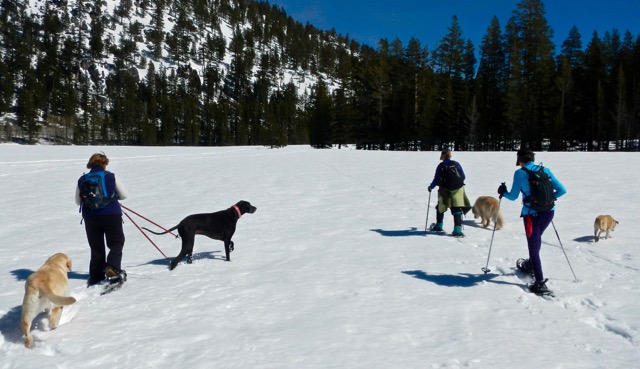
The eight of us (four humans, four canines) aren’t into back country adventures of that kind, but we did explore this terrain last weekend on snowshoes – a first for all of us.

After traipsing across Grass Lake it’s all uphill. Waterhouse (9,497 feet) and Powderhouse (9,380 feet) are next to each other. When facing the mountains from Grass Lake, Waterhouse is to the left – our desired destination. They are both popular with skiers/snowboarders.

Always be aware of snow conditions. The freeze, thaw, fresh layer cycle can create variable conditions in the Sierra. The Sierra Avalanche Center is a good resource for information.

A snowboarder finds natural jumps down Waterhouse. Photo/Kathryn Reed

It’s one of those routes without a route, so to speak. Plenty of people (snowmobilers, hikers, snowshoers, skiers with skins) had gone before us, but still we weren’t always sure which path to choose. Some lines went straight up, others zigged, and sometimes we chose to zag.

The beauty of being surrounded by all those pines in all of that snow was breathtaking — or maybe it was the steep terrain taking our breath way. Mother Nature’s splendor never gets old. And on this warm late winter day short sleeves could be worn.

A group of snowboarders crossed our path. When they told us it was probably another 90 minutes to the top we decided we’d had enough for one day. This was like a scouting mission to know how much time we’d need to complete the trek and see the conditions for ourselves. Maybe it would make a good summer hike.

Blue-green-white — the natural beauty of playing in the Tahoe area. Photo/Kathryn Reed

—–

Getting there:

From South Lake Tahoe, go west on Highway 50. Go left onto Highway 89 in Meyers. Park at the top of Luther Pass; there are several cut outs to make it safe. Walk across Grass Lake and start the climb.


Opinion: Fundamentals of trade being ignored

By Jerry Nickelsburg

Every American knows that if you want to spend more than you earn, you either must liquidate some assets or you must borrow. And if you have been borrowing a lot, stopping will result in much less consumption.

Which is why it boggles the mind that experts in Washington, D.C., including the president’s economic advisor Peter Navarro, fail to understand this fundamental principle as it applies to tariffs and border taxes. What they advocate—tariffs, currency adjustments, and other protectionist measures—is no different from Sisyphus pushing a rock up the hill only to have it roll back on top of him.

Trump’s protectionists believe that by closing the trade gap and bringing manufacturing back, the U.S. will grow. Navarro’s argument was presented in a Trump policy paper written with Wilbur Ross, “Scoring The Trump Economic Plan.”

“Suppose the U.S. had been able to completely eliminate its roughly $500 billion 2015 trade deficit through a combination of increased exports and decreased imports rather than simply closing its borders to trade. This would have resulted in a one-time gain of 3.38 real GDP points and a real GDP growth rate that year of 5.97 percent.”

This is so far off the mark that it begs explaining why.

Trump claims China is a currency manipulator. Let’s suppose he convinces China to increase the value of the yuan. Presumably a yuan of higher value would make American goods less expensive for Chinese and Chinese goods more expensive for Americans. And a tariff on Chinese goods would presumably make them more expensive, discouraging imports. But trade’s realities would complicate those plans.

China’s purchases of American goods and services are mostly airplanes, machinery, earth-moving equipment, food, scrap, and education. Will the Chinese buy more airplanes if they are less expensive? Perhaps, but not many; it’s hard to integrate airplanes into an airline. Earth-moving equipment? That depends much more on China’s infrastructure needs—and not that much on Caterpillar’s price. Food? Yes, the Chinese will buy more, but that in turn will drive up food prices for Americans.

The point: It would take a very large increase in prices to bring trade back in balance from the Chinese side.

But couldn’t we sell consumer goods to Chinese households that they do not as yet buy? Yes, but in practice, for Chinese households to buy more goods, they would have to reduce their savings. That won’t be easy. China does not have the social safety net of the United States. So Chinese families save for retirement, to care for their parents, and to pay for their child’s education, and marriage. No matter how cheap North Carolina furniture is in Shanghai, Trump is trumped by the prospect of a grandchild.

What, you ask, about the U.S. purchases of Chinese goods? Yes, were the yuan to appreciate, these goods would become more expensive and we would purchase less. But a rise in the yuan would make textiles, toys, and electronics from Malaysia, Vietnam, Indonesia and Bangladesh—all countries with lower labor costs than China—more attractive. We would not close the trade deficit—we would just make U.S. consumers pay to cover the costs of moving factories into Southeast Asia.

Simply put, tariffs or currency changes are only going to produce marginal changes to the trade deficit because you cannot tweet away the fundamental problem: Americans do not save enough.

U.S. households on average save a bit over 5.5 percent of their disposable income. Add corporate savings and tax collections, and you have 18 percent of GDP available for investment and government spending. Investment accounts for most of that 18 percent—approximately $3.1 trillion. The rest is government.

And the rest is not enough to pay for all federal purchases and transfers. In fact, the U.S. is more than $400 billion short annually of the money it needs for federal spending. Where do we get that money? From people who sell more than they consume—like the Chinese. If we didn’t have a trade deficit, we couldn’t cover our spending.

Remember Navarro’s argument. He says that economic growth will solve our problems—and cover the deficit. To achieve an additional $1 trillion of private saving to cover a $1 trillion deficit by 2023, GDP would need to double. That would require a sustained growth rate of 10.2 percent. Ludicrous.

Is there another way? Yes, you could, like Argentina, raise tariffs to make imports prohibitively expensive, disrupting globally dependent industries and sending the economy into a tailspin.

Appropriate economic policy is to institute long-term reforms boosting domestic saving and reducing the federal deficit. Bellicosity and tariff mongering are not long-term reform. They are an exercise in futility.

Jerry Nickelsburg, an economist at UCLA Anderson School of Management, writes the Pacific Economist column.