Snippets about Lake Tahoe

·      Zephyr Cove Elementary School is having a food drive March 27-31 for the Backpack Buddies Program.

·      Plans are under way to build a new lodge at Tahoe Cross Country Ski Area in Tahoe City.

·      Reno Philharmonic will be at Sand Harbor on July 17 at 7:30pm. Tickets range from $60-$130. For more info, call 800.747.4697.

·      ElectroSwing Burlesque dance revue returns to The Loft in South Lake Tahoe on March 29 from 8-10pm.


K’s Kitchen: Soup — because winter won’t end

By Kathryn Reed

Sometimes it’s necessary to improvise when cooking, especially when living in a small town – no matter the number of grocery stores.

The store only had green Fresno chilis so that is what I cooked with. The red would have made it look so much better. The color is usually a matter of how long the chili was left to ripen.

It’s possible to use a different protein besides tofu. Cook it separately and then add it near the end.

When buying ginger, it’s OK to break off the size you need. The easiest way to take off the outer husk is to use a spoon using the motion you would peel a potato.

Asian Noodle Soup

2 tsp sesame oil

1/3 C green onions, chopped, divided

6 garlic cloves, minced

1-inch piece ginger, thinly sliced

3 C vegetable broth

2 ounces uncooked soba noodles

2 tsp honey

2 tsp chile paste

14 ounces firm tofu, cubed

4 tsp green curry paste

1/3 C mung bean sprouts

1 red Fresno chile, sliced

Heat oil in a medium saucepan. Over medium heat cook half the green onions, garlic, ginger and tofu until tofu is slightly browned. Add stock; bring to a simmer. Reduce heat to medium-low and cook for about 10 minutes. Cook noodles according to package directions. Combine honey, chile paste and curry paste. Stir this mixture into the stock. Add noodles. Ladle into bowls and then sprinkle with green onions, mung bean sprouts and Fresno chile.


Practical tips for gardening with containers

By Melinda Myers

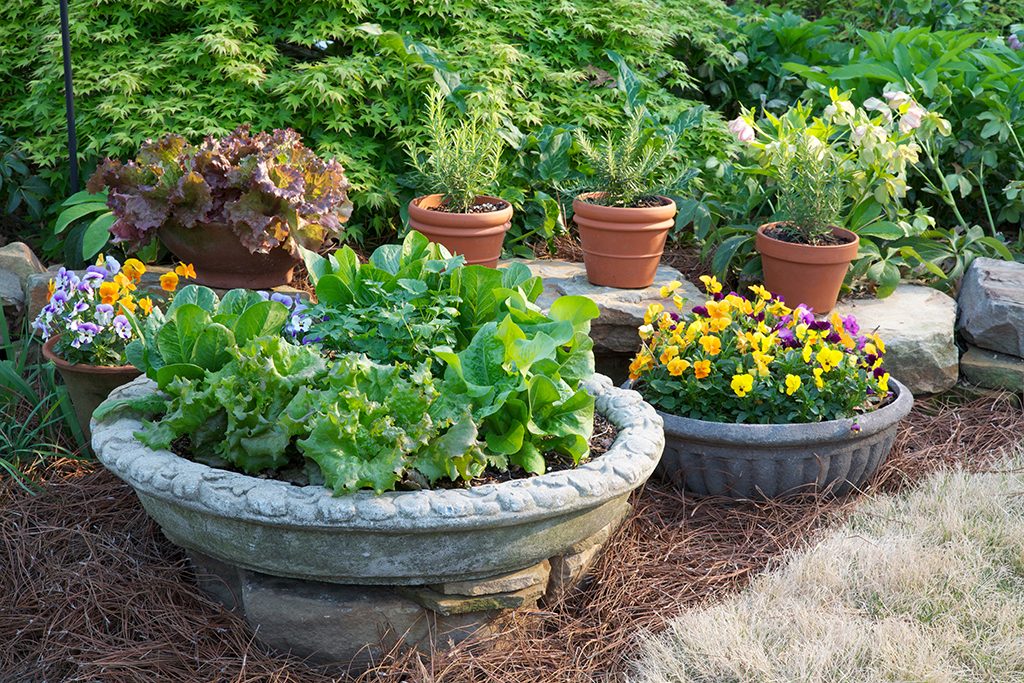
Container gardens allow you to easily dress up your balcony and patio, create a colorful welcome for guests and keep edibles close at hand for cooking and entertaining. They’re also a terrific way for new gardeners to get their start. Increase your success growing vegetables, herbs or flowers in a container with these tips.

Proper plant selection. Select the right plants for the container and growing conditions. Closely check the plant tags for this and more information to help with your decision. Create attractive combinations with plants that look good together and require the same growing conditions.

And don’t be afraid to mix flowers, herbs and vegetables. This is a great way to have both beauty and flavor on your patio, deck or balcony. Scour gardening magazines and the internet for free container planting plans like those featured on the Bonnie Plants website.

Selecting the right container. Further increase your success by selecting a container large enough to accommodate your plants. The bigger the pot, the more moisture it can hold, maximizing the time between watering. A small pot with a large plant will need to be watered several times a day during hot weather and fertilized more frequently.

Container gardens are an easy way to incorporate color, edibles and interest into the landscape. Photo/Bonnie Plants

Use a container with drainage holes made from material suited to your gardening style and climate.  Even if you could provide the exact amount of water your plants need, nature may intervene with an extra dose or two. Drainage holes prevent water from building up in the bottom of the pot, leading to root rot.

Those in areas with hot summers should avoid black and metal pots that can heat up in the summer sun and damage tender plant roots. Terra cotta pots are a traditional favorite. They are attractive, heavy and dry out more quickly than some other materials. Glazed pots are beautiful, but tend to be pricey and heavy to move. Plastic pots are affordable, come in a variety of styles and don’t dry out as quickly as terracotta. Then there’s the sturdy half whiskey barrel. This planter is a longtime favorite, but be sure to drill drainage holes in the bottom if it doesn’t already have them.

Potting mix. Next, invest in a quality potting mix that holds moisture, yet provides adequate drainage. These are usually a combination of peat moss, compost or coir to hold moisture, and perlite or vermiculite to aid in drainage. Leave garden soil in the garden where it belongs, not in containers.

Watering. Check the potting soil moisture in your container gardens at least once a day and more often if the pots are small or temperatures high. Water thoroughly when the top inch of soil is dry and allow the excess to run out the drainage holes.  This shows you have moistened the potting mix, top to bottom, encouraging a robust root system to develop.

Extend the time between waterings with the help of self-watering pots. Their built-in water reservoirs provide water to the plants as the soil dries. Fill the reservoir as needed and make sure there is a weep hole. This allows excess water to drain out of the reservoir instead of saturating the soil and leading to root rot.

Fertilization. Lastly, incorporate a slow release fertilizer into the potting mix at planting. This type of fertilizer provides small amounts of nutrients over a longer time period. Follow label directions and make additional applications as recommended on the fertilizer label.

As your container plants continue to thrive and you enjoy the flavorful vegetables and herbs and gorgeous flowers they provide, you’ll soon be looking for more spaces to incorporate container gardens into your landscape.

Melinda Myers has written more than 20 gardening books, including “Small Space Gardening” and the “Midwest Gardener’s Handbook.”


LTUSD suing company responsible for STMS field

Updated 9:45am:

By Kathryn Reed

The nearly 10-year-old artificial turf field at South Tahoe Middle School is substandard and the manufacture knew this at the time of sale, according to a lawsuit.

Lake Tahoe Unified School District is suing FieldTurf for breach of contract.

According to court documents, “Between 2005 and 2012, FieldTurf sold and installed approximately 1,700 artificial turf fields throughout the United States, which generated reported revenues of $570,000,000. Unfortunately for its customers, the fibers that FieldTurf used to make its artificial turf was defective – and FieldTurf knew it.”

The knowledge stems from FieldTurf suing its supplier of artificial fibers in 2011. That lawsuit was settled in 2014 for an undisclosed amount.

Lake Tahoe Unified School District’s lawsuit contends FieldTurf kept the money it received and did nothing to repair the fields that it knew had substandard fibers.

FieldTurf stopped using the product in 2012.

STMS defects include breaking, splitting, and thinning of the individual fibers. Those inadequacies are the same reasons FieldTurf sued its supplier.

“When you look at the fiber it was laying down and it had been for a couple years,” LTUSD Superintendent Jim Tarwater told Lake Tahoe News. Sweeping it, which is part of the regular maintenance of the field, did not make it stand up.

There is no danger to anyone using the field. It’s about the quality and lifespan of the field.
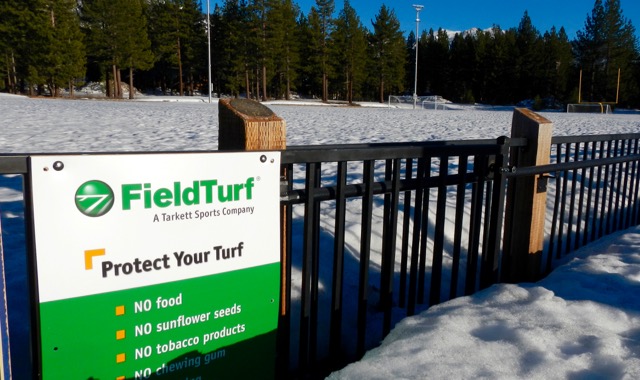
LTUSD believes it was sold a substandard artificial field and is suing for compensation. Photo/LTN

FieldTurf is the same company that was used for South Tahoe High School’s field three years ago, though it had a different supplier. The community ball field, which is being replaced by Lake Tahoe Community College, is a different manufacturer.

The original cost for the 92,104 square feet of Duraspine artificial turf field at STMS was $471,300. The contract was signed in March 2007, and the field installed the following August. Part of the agreement was a guarantee of eight years of premature wear and ultraviolet degradation. The field was supposed to have a “useful” lifespan of more than 10 years.

LTUSD didn’t know it was sold a substandard product until December 2016 when media in New Jersey exposed the FieldTurf story.

Internal FieldTurf emails that are part of the court filings show the company knew it was installing a less than durable product and that the fields were failing prematurely.

The district believes it is owed at least $500,000 from the turf company. This would compensate LTUSD for “the loss of the soccer field, costs to investigate these damages, costs to replace the defective field, attorneys’ fees and other economic and special damages.” The district said it would amend damage totals if need be prior to going to trial.

Montreal-based FieldTurf told Lake Tahoe News, “We strongly disagree with the representation of the facts in this complaint. Since we first became aware of the issue with Duraspine, we have tried to be forthcoming with our customers and we have not hid from this problem. Additionally, it is important to note that the issue with Duraspine has not impacted safety – only how a field looks as it wears.  We are committed to honoring our warranties and working with our customers to address any issues if they arise.”

“South Tahoe Middle School’s field was installed in 2007 and is still in use.  This means that the school has gotten roughly a decade of use from the field – well beyond the standard eight-year warranty term.” 

FieldTurf is a big company – having provided turf for 21 out of the 32 National Football League stadiums. The company recently hired Ted Wells, the attorney who led the National Football League’s investigation into New England Patriots quarterback Tom Brady in what was called Deflategate. In addition to the LTUSD lawsuit, FieldTurf faces seven other fraud lawsuits. More lawsuits are possible.

The LTUSD lawsuit was filed in U.S. District Court in Sacramento in February.



Opinion: Second homeowners as villians

By The Economist

When owning one home seems like a struggle, resenting those with two comes easily. Second-home ownership is uncommon: in 2010 around 4 percent of houses in America were second homes; 1 percent of English homes are second properties of people living in England. But they still arouse passions.

Norway and Denmark limit second-home ownership, and in 2012 the Swiss voted to restrict second homes in places where they were most common. Australia has also clamped down on foreign purchases of residential property. Latest to the barricades is St Ives, a seaside town in south-west England, where a quarter of houses are second homes or holiday lets. Last year 83 percent of St Ives’s voting residents decided that newly built homes should be off-limits to non-residents. It is unclear if the vote is enforceable. It is certainly wrong-headed.

In some cases antipathy to second-home ownership simply reflects an ugly dislike of outsiders; in others, the NIMBYism of second-home owners themselves, keen to preserve the exclusiveness of their holiday patch.

Read the whole story


Kids like reading paper books more than screens

By Teresa Welsh

It seems like you can’t go anywhere in public these days without seeing a child with his or her face glued to a screen. But despite the proliferation of electronic devices, kids still prefer reading actual physical books.

A study by researchers in Australia found that kids who had access to e-readers like Kindles and iPads tended not to use the electronic devices for reading. Even children who reported being daily readers didn’t use electronics as books.

The study also found that the more electronic devices a child had access to, the less they read in general.

Read the whole story


Asia air pollution increasing smog in West

By Doyle Rice, USA Today

Air pollution from China, India and several other Asian countries has wafted across the Pacific Ocean over the past 25 years, increasing levels of smog in the western U.S., a study finds.

Smog, also known as ground-level ozone, is harmful to human health, because it can exacerbate asthma attacks and cause difficulty breathing. It also harms sensitive trees and crops. It’s different than the “good” ozone up in the stratosphere, which protects life on Earth from the sun’s harmful ultraviolet rays.

Scientists measured ozone levels recorded at springtime for the past 25 years in 16 national parks in the western U.S., including Yellowstone, Yosemite and Grand Canyon. The parks’ locations farther away from cities, where smog is typically expected, made them ideal spots for the study.

Read the whole story


100+ housing bills introduced in California

By Liam Dillon, Los Angeles Times
 
California lawmakers have introduced more than 130 bills this year that try to tackle the state’s housing affordability crisis.

Reams of statistics support the depth of the problem: California’s homeownership rate is at its lowest since World War II, a third of renters spend more than half of their income on housing costs and the state has nearly a quarter of the nation’s homeless residents — despite having 12 percent of the overall U.S. population.

William Fulton, director of the Kinder Institute for Urban Research at Rice University, said he has never seen such interest in housing in the three decades he’s been tracking the issue in California.

Read the whole story


Hamilton Chautauqua coming to Incline

Alexander Hamilton is headed to Sand Harbor this summer.

Hal Bidlack will assume the persona of Hamilton in a Chautauqua-style encounter that brings history alive.

The intellect, wit, humor and humanity of this famous United States founding father will come to life in Tahoe.

The event is Aug. 14 at 7:30pm. Tickets range from $24-$69. For more info, call 800.747.4697.


Russian slot hackers focusing on new targets

By Todd Prince, Las Vegas Review-Journal

An international syndicate of Russian hackers that cashed out millions from slots in U.S. casinos over the years is focusing its efforts on South America and Europe after busts in Missouri and Singapore.

The Russian syndicate most recently struck in Peru, a security consultant to slot-makers told a group of U.S. regulators at a conference Thursday at the Luxor in Las Vegas organized by Gaming Laboratories International. Wired magazine first reported the story about the syndicate last month.

 The existence of the Russian group, which may have been operating for as long as a decade, was first spotted in Missouri in May 2014. The FBI made its first arrests later that year. Singapore police caught syndicate members cheating in May 2016. Details about the group are still emerging, Carlson said. It may consist of between 40 and 70 individuals with a headquarters in St. Petersburg, Russia.

Read the whole story