Road Beat: 2017 Kia Soul: An exciting Exclaim

The 2017 Kia Soul is a fun vehicle to drive. Photos/Larry Weitzman

By Larry Weitzman

Modern engineering and machines have allowed automakers to produce cars that are a bit out of the three-box mainstream design. While Kia may have started off with its less than exciting Sephia over 20 years ago, under its new president and chief design officer, Peter Schreyer, Kia has gone to the forefront in automotive design with the Optima, Cadenza, Forte and new Stinger due out in a few months. Within this new design philosophy came the Soul, which has been with us for about eight years and created a new kind of sub-compact utility vehicle.

Soul received more soul in 2014 with marginal one inch increases in length, width and wheelbase now measuring 163 x 71 and 101 inches, respectively. It also received structural enhancements with more bending and torsional resistance and minor design changes with a squarer front end and new taillight treatments. Overall it is still unmistakably a Soul, only improved in its design and utility. There is no question the hipster hamster contingency is happy with the new Soul and for 2017 several new additions and improvements might even dazzle a few humans.

New for 2017 and under hood of this new top of the line Exclaim (!) is a new high powered version of Kia’s 1.6L direct injected turbo four cranking out a whopping 201 hp at 6,000 rpm and a strong 195 pounds of twist from 1,500 to 4,500 rpm. It is connected to a quick shifting and smooth seven-speed dual clutch automatic (also new for 2017) that transmits the energy to the front wheels. Kia does not offer an all-wheel drive option, but if it did it might eat into its compact CUV sales as the buyer demographics for the Soul are surprising, with the average buyer being a 41-year-old female, not a 23-year-old hipster. Maybe the 41-year-old female is a hot cougar. Whatever the buyer, the Soul is a smart buy in so many ways.
Specifications
Price
$15,896 to about $28,195
Engines
1.6L 16 valve DOHC (CVVT) inline four 130 hp @ 6,300 rpm
118 lbs.-ft. of torque @ 4,850 rpm
2.0L 16 valve DOHC (CVVT) inline four 164 hp @ 6,000 rpm
151 lbs.-ft. of torque @ 4,000 rpm
Transmission
Six speed manual
Six speed torque converter automatic
Seven speed dual clutch automatic
Configuration
Transverse mounted front engine/front wheel drive
Dimensions
Wheelbase 101.2 inches
Length 163.0 inches
Height 63.0 inches
Width 70.9 inches
Track (f/r) 61.4/61.9 inches
Ground clearance 6.5 inches
Weight (1.6/2.0) 2,714/2,837 pounds
Weight distribution (f/r) 60/40 percent
Steering lock to lock 2.85 turns
Turning circle 34.8 feet
Wheels (opt) 7.5X18 inch alloys
Tires (opt) 235/45X18
Fuel capacity 14.2 gallons
Cargo volume (rear seats down/up) 61.3/24.2 cubic feet
Passenger volume 101.0 cubic feet
Performance
0-60 mph 9.15 seconds
50-70 mph 5.34 seconds
50-70 mph uphill 8.67 seconds
Top speed Well into triple digits
Fuel economy EPA rated 23/31/26 mpg city/highway/combined. Expect 27 mpg in rural country driving 32-33 mpg on the highway at legal speeds.

First is its performance, which is rockin’ with 0-60 mph times averaging 6.48 seconds. It could have been quicker but even with huge 235/45 series rubber, hook up was a problem and it would shift into second too quickly because of wheelspin. With a bit more experimentation it might have broken the six second barrier.

Passing performance backed up the 0-60 mph numbers with a 50-70 mph pass requiring just 3.74 seconds and the same run up a steep (6-7 percent) grade only slowing that time by a second to 4.79. There is a hint of turbo lag but once on boost it becomes a rocket sled.

Fuel economy is rated at 26/31/28 mpg city/highway/combined by the EPA. Interestingly, of the three Soul engines offered, a 1.6L 130 hp four, a 2.0L 161 hp four and this diminutive turbo powerhouse, the powerhouse returns the best EPA fuel economy numbers by about an mpg. Overall I averaged 28-29 mpg and on a level highway at 70 mph in a two-way run the Soul averaged 32.8 mpg with the engine spinning 2,200 rpm. A taller seventh gear might have improved that highway mileage by an mpg or two. While the fuel tank is 14.2 gallons, a bit bigger would be better.

Wheels are good looking 18 x 7.5 inch alloys shod with the aforementioned big rubber and while state of the art MacPherson struts are up front, a semi-independent torsion beam holds up the rear. Steering is an electric power rack with just 2.85 turns lock to lock. You might not think of the Soul with its tall 63 inch stature as a handler, but it is. It’s almost go-cart like as it has track of nearly 62 inches front and rear giving it the ability to make short work of the twisties. In fact, when examining the overall design, the Soul has little in front and rear overhangs as the wheels are located at its furthest most points. Turn in is crisp and understeer is quite mild. It may look like a mini ute, but it handles like a sports sedan.

Another enduring quality is the quiet and smooth ride. It exceeded my expectations with a very quiet engine, no wind and tire noise. When driving, you have to remember the Soul’s roots which are sedan based and not a truck.

Also for 2017 safety has been improved with larger front ventilated disc brakes now exceeding a foot in diameter. They are strong and of course all the acronyms are present like ABS, TCS, ESM, VSM and more. Also, new in the Exclaim (!) are standard HID headlights which are excellent in low and very good in high beam. Even the new well located (on the center console) starter button is a nice feature.

Because of its literal two box design, the Soul as a subcompact car has the volume of a large size car with 101.2 cubic feet in the first two rows and 24.2 cubic feet behind the second row. Behind the front seats are over 61 cubic feet of room for camping or the Home Depot. Having a Soul is not just spiritual thing, it’s way practical.    

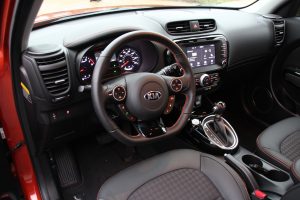
And those front chairs are nicely done and quite comfortable in their leather and cloth trim. Sure, the interior is highly styled with the way the speakers are done, but the dash is about perfect with clear legible business like gauges consisting of a big tach and speedo divided by an info center and trip computer. The center stack is also easy to use.  Practical. Rear seating is also good for even three, thanks to Soul’s excellent shoulder room.

Now for the best part, the price. My top of the line tester with power windows, doors, locks, cruise, trick leather wrapped D shaped steering wheel and a whole bunch more stickers for a paltry $22,800 plus $850 for the boat from Korea. This is a tricked out, very practical ride that oozes with cool and style for the price of an ordinary econo-box. And it goes like a scalded dog on steroids while passing most gas stations. A paltry price, practical ride that you can park anywhere with style. And then there is the five year/60,000 mile overall warranty plus 10 years and a 100,000 mile warranty on the powertrain.

If your needs aren’t to run like a scalded dog and maybe just a nice retriever suits your needs, a base Soul starts at just $16,100 plus $850. Never has so little bought so much cool. You could sell your refrigerator and turn off you’re AC.

Larry Weitzman has been into cars since he was 5 years old. At 8 he could recite from memory the hp of every car made in the U.S. He has put in thousands of laps on racetracks all over the Western United States.


Group exploring options to solve housing dilemma

Publisher’s note: This is one in a series of stories about affordable housing in the Lake Tahoe-Truckee region. All articles may be accessed via the home page under Special Projects, 2017 Affordable Housing.

By Kathryn Reed

Tackling the South Shore housing crisis from as many fronts as possible is the goal of Progress for Tahoe.

Members of this South Lake Tahoe grass roots group recognize no one solution will solve the problem, but instead are entertaining as many ideas as possible. But they also want to be action oriented. For now, they are still in research mode.

At a meeting last week of the housing subgroup, Bill Roby with the El Dorado Community Foundation talked about his desire to create a land trust that would assess every property that is sold in South Lake Tahoe 3 percent to fund the land trust.

He pointed to other locales on both sides of the United States with similar programs.

Roby’s analysis shows that a 3 percent surcharge to every property sold in the city would bring in between $5 million and $7 million a year. That money could be used to buy old hotels and turn them into deed restricted apartments.

Voters would have to approve having the equity in their home be spent on paying for someone else to have a place to live instead of being able to take what is rightfully theirs. Then there would be the issue if someone is upside down on a property; they’d be losing even more. Roby is taking his idea to more than a dozen groups in the next few weeks. He was asked to come back to the Progress for Tahoe group to report in what others think of the idea.

El Dorado County Supervisor Sue Novasel wondered if taxing only higher end properties would be better so those who are in affordable housing would not be punished.

Doug Williams, who has worked in the mortgage industry, said sellers will essentially pass this on to buyers via a higher price.

Michael Ward, the consultant working with Novasel’s housing task force that is separate from this group, said land trusts work. But he worries an assessment like what Roby is proposing would be a punishment for owners.

“It could crush some purchase for locals,” Williams warned of the assessment.

David Orr with Tahoe Mountain Lab brought up the idea of a vacancy tax that would be applied to second homeowners. His calculations are this could generate about $20 million a year with about a 1 percent tax.

However, California’s Proposition 13 would probably now allow for a vacancy tax.

This group has not clearly defined what affordable housing means to the members. They interchanged affordable and work force housing. Technically, there is a legal definition to affordable housing that involves income levels.

An issue throughout the basin is that there will always be limited supply because there is only so much land that can be developed.

Novasel said this is why area plans, like the one in Meyers that is yet to be completed, should have regulations that allow for higher density. This would help developers be able to build affordable housing.

Some members of the group will be talking to city staff this week to find out what happened to the silent second mortgage program. Others want to address the possibility of neighborhood zones for vacation home rentals.

Troy Mathews, who is on the Lake Tahoe Unified School District board, wants land the district owns to be developed for teacher housing. Students could be working in a vocational setting to learn a trade as the housing is constructed. The problem is the district has limited developable land.

While getting rid of the rundown motels that are labeled single room occupancy or SRO is desirable, it was pointed out that they are profitable for owners. People living there don’t have the means for first and last months’ rent, plus a deposit so they stay in this SROs.

The Tahoe Regional Planning Agency’s commodity regulations is another barrier – for developers and getting rid of SROs. Instead of having a truly free marketplace TRPA has put a value on each hotel room, every residential unit and all commercial floor area – and then has decided how many or much of each is available. Changes to the bi-state regulatory agency’s rules are at least a couple years away, and even then there is no guarantee the next incarnation will be transformative.


Opinion: Time to end Calif. public pensions

By Daniel Borenstein, Bay Area News Group

Last month, I wrote that Gov. Jerry Brown’s 2012 attempt at pension reform has failed.

CalPERS, the nation’s largest pension system, immediately responded on its website declaring that “Pension Reform Has Made a Difference,” and claiming that my column “greatly oversimplifies and needlessly discounts the real impact” of Brown’s plan.

Californians for Retirement Security, the unions’ pension propaganda arm, led by labor leader Dave Low and political consultant Steve Maviglio, followed with a commentary proclaiming that “these reforms are producing savings now, and will continue to do so for decades.” 

Come on folks. Let’s get real.

Read the whole story


Doctors can help stop the spread of fake food news

By Kiera Butler, Mother Jones

When journalist and physician James Hamblin investigated the world of gluten-free products, he found a $23 billion industry of “detox courses,” custom blood tests, and specially formulated foods. What he didn’t find was medical evidence that avoiding gluten is good for people who don’t have celiac disease.

In fact, the many gastroenterologists that he interviewed agreed that gluten-free diets can actually be less healthy than those that contain gluten. So how did the craze take hold if there’s essentially no science to back it up?

That’s one question that Hamblin attempts to answer in his new book, “If Our Bodies Could Talk: A Guide to Operating and Maintaining a Human Body,” and during our interview on Mother Jones’ food politics podcast Bite. Hamblin, also a senior editor at the Atlantic, argues that the gluten-free trend—along with many other health fads—is “a symptom of a real problem within the medical establishment.”

Up until a few decades ago, he explains, patients regarded their doctors as the ultimate health authorities—they trusted physicians to make recommendations based on the latest science. But “as the ethical principle of patient autonomy has gained recognition, medicine has lurched toward patient-doctor collaboration,” Hamblin writes.

Read the whole story


Drones credited with saving lives

By Don Reisinger, Fortune

Drones aren’t always mentioned in the same breath as saving lives, but a report from one drone manufacturer says they should be.

Civilian drones have been used to save at least 59 people in 18 different incidents around the world since 2013, DJI, a China-based company that manufacturers popular civilian drones, said in a statement. The company added that 38 of those individuals were saved within in the last 10 months thanks to rescue teams and civilians employing their unmanned aerial vehicles (UAV) to aid people facing life-threatening emergencies.

Now, DJI says a drone is saving nearly one person’s life a week on average.

Read the whole story


Technology IDs gamblers who disguise their location

By Todd Prince, Las Vegas Review-Journal

Backing up about 100 feet from the California border near the Fashion Outlet in Primm, Nev., a reporter is finally able to log into the World Series of Poker application on an iPhone.

The reporter is here to test the accuracy of the geolocation service used by the poker application to ensure people physically outside Nevada cannot access the game. WSOP uses the geolocation technology of Vancouver-based GeoComply, a 5-year-old company that also serves daily fantasy sports company Draft Kings and MGM Resorts.
 
Geolocation and age identification services have been at the heart of the debate over legalizing online gaming. Opponents have sought to ban online gaming in part on the basis that neither technology is fool-proof.

Read the whole story


Sierra gardening expert, author to give talk

Gary Romano, owner of Sierra Valley Farms, presents his newest book “July & Winter: Growing Food in the Sierra” next month.

Romano will divulge his knowledge from decades of experience growing food in the Sierra Nevada. Despite the challenging mountain climate and soil, he has successfully grown food on his 65-acre organic farm.

He will share hard-earned tips essential for home gardeners and small farmers.

The free talk is presented in partnership with the Friends of the South Lake Tahoe Library and the UCCE Master Gardeners of Lake Tahoe.

It will be April 8, 2pm at the library, 1000 Rufus Allen Blvd. 


Douglas County OKs $10M for road repairs

Douglas County roads – especially those in the valley – are a nightmare. So much so that they need more than $10 million to be fixed.

At the March 16 Board of Commissioners meeting the electeds approved a five-year plan that includes the millions needed to fully rebuild of Jacks Valley and Dump roads and Centerville and Tillman lanes.

This winter’s storms have wreaked havoc on the asphalt. There were times when many roads had standing water or such large pot holes that the roads closed.

The main focus of the meeting was to discuss the county’s strategic plan. The top priorities are: infrastructure, organizational sustainability and financial. The final plan is expected to be adopted at the April 20 meeting.

— Lake Tahoe News staff report


‘All the Missing Girls’ — clever writing

By Kathryn Reed

Secrets – everyone has them. What people know could destroy more than just themselves.

Your best friend goes missing at 18. Ten years later another young woman from the same small North Carolina town disappears.

“All the Missing Girls” by Megan Miranda (Simon & Schuster 2016) is full of suspense and intrigue.

This is what my book club read for March. Unfortunately, I can’t make it to the meeting so I don’t know what the others thought of it. We rank books based on whether we liked – which I did, but not a great deal; if we’d recommend it – I would to people who like this genre; and literary merit – not a high mark from me.

I would not have picked this book on my own. I’m much more of a non-fiction reader. While it dragged on in places, there were just enough twists to have me keep turning the pages. That’s always the sign of a good murder mystery.

I like how the story was told more than the story itself.

Miranda writes the story backward; in that over a two-week period the chapters go from the past to the present. When there were several days in between reading the book I was a bit lost at times – maybe I would have been no matter what I did. A little tighter editing may have made the format be cleaner.


Tahoe firm’s climbing method cuts summit times in half

By Eben Novy-Williams, Bloomberg

When Brooks Entwistle, a partner at Everstone Group in Singapore, climbed the sixth-tallest mountain in the world, the 26,8000-foot-tall Cho Oyu, he didn’t take the typical seven weeks. He took three weeks off and sandwiched the 17-day ascent between a board meeting and a parent-teacher conference.

That timeframe was unheard of in guided high-altitude mountaineering until recently, when Lake Tahoe-based Alpenglow Expeditions began offering its first “rapid ascent” climbs up some of the tallest peaks in the world. In April, the outfitter will guide a group to summit the 29,000-foot Mount Everest in 42 days, nearly half the time of most expeditions. Later this year, Alpenglow will take another group up Argentina’s Aconcagua, the tallest mountain in the western hemisphere, in 14 days instead of the usual 20-plus.  

For decades, climbing the world’s highest peaks has been an opportunity reserved for those long on money and athletic ability. But for those who have both, the biggest factor is time. For about 3o percent more than the normal price, Alpenglow streamlines the process in various ways: expedited permits, aggressive scheduling, and, sometimes, flying directly to base camp in a helicopter instead of multiple days of trekking in on foot.

Read the whole story