Bodie becomes temporary terrain park

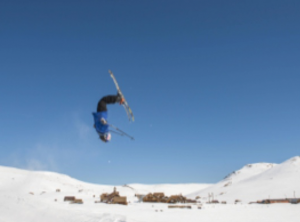
Freestyle skier Cody LaPlante rattled the ghosts of Bodie has he turned the ghost town into a terrain park.

Assisted by a safety and State Parks team, LaPlante and the crew built a dream ski park within the eerie buildings this month. They traveled 13 miles via snowmobile.

More than 17 feet of snow turned Bodie into a unique ski location for Cody LaPlante. Photo/Provided

The 15-year-old who is originally from Truckee became the youngest person to stomp a triple flip on skis and was offered a spot on the U.S. Freeskiing Slopestyle Team. He expects to compete for a spot on the 2018 Winter Olympic team.

Dating back to around 1859, Bodie is frozen in a state of “arrested decay.”

“Doing interesting and urban skiing projects like this really helps progress the sport and I want to be a part of that,” LaPlante said in a statement.

— Lake Tahoe News staff report


Meeting to highlight construction of Hwy. 28 path

An update on construction of the Highway 28 shared-use path and highway safety, accessibility and water quality enhancement project will be provided on March 30 by NDOT.

The multi-year project that started last year includes a three-plus mile shared-use path from the south end of Incline Village to Sand Harbor State Park. The public meeting will provide project updates and schedules for this summer’s construction, and offer virtual reality tours of the future path.

Last year, crews excavated approximately 10,000 cubic yards of material to construct an underpass  near the Flume Trail. Work also began on three parking areas located near the Ponderosa Ranch and Tunnel Creek Café to provide safer options for the 1 million recreationists who visit the area each year. In addition, a sewer pipe was relocated near Hidden Beach.

The next phases of construction will include initial path construction, retaining wall, and water quality and erosion control improvements.

The public meeting will be from 4-7pm at the Chateau, 955 Fairway Blvd. in Incline Village, with an informational presentation at 5:30pm.


National Guard helps Mammoth with its snow

By Los Angeles Times

Hey, Mammoth Lakes, add this group shot of the National Guard to your winter scrapbook.

Burdened with removing the 44 feet of snow that had fallen this season, the village of 8,200 called in the National Guard earlier this month to help cart 4,000 tons of it away. The five-day offensive, involving 17 air and Army troops, will be just one of the many memories in this winter of monster, record-setting snows.

The SOS — shovel our snow — was issued after the village and Mono County declared a state of emergency to seek help in handling the piles that lined homes and streets.

Read the whole story


Snippets about Lake Tahoe

·      Homewood Mountain Resort will be closing April 16.Nevada Division of Tourism has hired Susan Mowers as art director, and promoted Teri Laursen to director of sales and industry partners.

·      Nevada Department of Transportation has just launched a redesigned website.

·      The Douglas County Public Library is hosting the live action movie “Alice in Wonderland” (rated PG) on April 1 at 2pm in the Minden Library meeting room. The movie and popcorn are free. 

·      Washoe County Sheriff’s Office issued 150 speeding citations and 61 citations for cell phone use during a two-week, multi-agency Joining Forces traffic safety campaign in early March.

·      Nevada County Transportation Commission has hired LSC Transportation Consultants Inc. to study public transit in the Truckee/Donner Summit area. The community survey is available online.


TART bus routes cut because of driver shortage

A lack of bus drivers is forcing bus service on the North Shore to be cut back.

Tahoe Truckee Area Regional Transit will not be able to provide all of its expanded winter routes for the rest of the winter schedule.

TART’s half-hourly service between Tahoe City and Crystal Bay will now run hourly. In addition, the below winter route times have been canceled:

  • 7:30am route from Crystal Bay to Tahoe City
  • 8am route from Tahoe City to Squaw Valley
  • 5:35pm route from Squaw Valley to Tahoe City
  • 6pm route from Tahoe City to Crystal Bay .

All other winter services, including added night and daytime routes, will operate as scheduled through April 9.


Fire crews working to make Tahoe basin safe

By Kathryn Reed

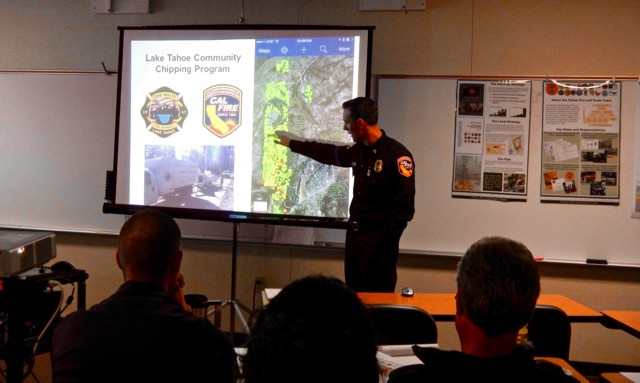
MEYERS – In an effort to get ahead of the fire season, crews from various fire agencies in the Lake Tahoe Basin have been gathering to talk about a united approach.

“Wildfires are becoming more problematic because of the changing landscape and more homes are where fires burn,” Forest Schafer with North Lake Tahoe Fire Protection District said. “We want human communities to co-exist with fire so it is not a disaster.”

Shafer was speaking at a meeting this month to fellow fire officials at the main Lake Valley station.

Creating fire adapted communities and working to thin the forest where it interfaces with developed areas are ways to achieve those goals.

A fire adapted community “can survive a wildfire with little or no assistance from firefighters. These communities are characterized by homes that are built of fire resistant materials and where vegetation and flammable items have been reduced around the home to provide good defensible space. They are buffered by fuel breaks where flammable vegetation has been modified to slow the spark of flames and provide a zone where firefighter can aggressively fight a fire.”

Chris Anthony with CalFire talks about fuel reduction in the Lake Tahoe Basin. Photo/LTN

Last fall’s Emerald Fire was used as an example of how fire behaves when the forest has been treated. It had similar characteristics to the devastating 2007 Angora fire that reduced 254 houses on the outskirts of South Lake Tahoe to ash. The winds and humidity were comparable. Both started in the forest and ran toward subdivisions.

The big difference is the amount of treated forest was much greater in the Emerald terrain. Firefighters just finished studying the effectiveness of fuels reduction in that area off Highway 89 between Camp Richardson and Emerald Bay.

“There is a big change in ember production if we can keep it on the ground,” CalFire Division Chief Chris Anthony said.

That’s not to say a thinned forest won’t have crown fires, but the likelihood decreases and the negative impact can be less.

Money is needed to keep the thinning going forward. (Since 2000 nearly 47,000 acres have been treated in the basin on private, local, state and federal lands.) Agencies continually apply for grants, with the Southern Nevada Public Lands Management Act being a primary source.

With June marking the 10-year anniversary of the devastating Angora Fire, the horrors of a wildfire are very much on the minds of fire officials.

The good that came out of that inferno was the creation of the Nevada Fire Safe Council. While it went bankrupt amid lots of controversy, in its place is the Tahoe Fire and Fuels Team (TFFT). It is comprised of 20 agencies and has more of a basinwide approach.

TFFT recognizes three distinct geographic regions in the basin – the South, West and North shores. The group looks to identify the areas in most need of fuels treatment regardless of ownership.

TFFT is able to cross state, county and city lines. Many grants can be used throughout the territory. The team aspect is very real and not in name only. This is important because a fire doesn’t see boundaries.

Van Sickle Bi-State Park and land owned by South Tahoe Public Utility District are two of the more troublesome locations that will be addressed this year.

There is also money ($150 million) in the recently passed Lake Tahoe Restoration Act for fuels reduction. The problem is Congress has not allocated the money.

Coming up on March 27 is the third annual Nevada Network of Fire Adapted Communities Conference in Reno. Participants will include stakeholders in Nevada’s wildland urban interface, including members of wildfire-prone communities; local, state and federal agencies; and Community Emergency Response Team volunteers from Carson City, Douglas and Washoe counties.


Opinion: L.A. is too good to host the Olympics

By Joe Mathews

Los Angeles should drop its bid for the 2024 Olympics—before it gets chosen.

Paris is the heavy favorite to be awarded the 2024 games during a vote coming up in September. But the contest has changed, with all other contenders for 2024 having dropped out (Budapest bailed last month), leaving L.A. as the only challenger. And when you look at the L.A. and Paris plans, L.A. has the stronger bid; it’s far more likely to produce exciting games while avoiding the organizational problems and cost overruns of previous Olympics.

Joe Mathews

What’s most promising about L.A.’s bid is also what makes it perilous. L.A. is bidding not merely to hold the Olympics, but to transform them. Specifically, L.A. pledges “to create a new Games for a new era.”

There’s much transforming to be done. The Olympics over the last generation has become more associated with corruption than sport: doping, vote-buying by bid cities, displacement of poor people by Olympic construction, propagandistic use of the games by human rights violators from Russia to China, and overspending that leaves Olympic cities with debt and dead infrastructure.

All of which begs these questions: How can we be sure that Olympic corruption won’t sully our reputation? And, if L.A. succeeds in hosting a “clean” Olympics, what’s to prevent the Olympics’ wheeler-dealers from exploiting a triumph here to take advantage of other cities for future Games?

Such questions may sound peculiar, but California has a peculiar relationship with the Olympics. While the rest of the world has soured on the corrupt Olympic movement, we remain an island of Olympic love. One L.A. survey showed 88 percent support for the Games.

California’s Olympics love is rooted in nostalgia for the famously well-run and profitable 1984 Games, when L.A. embraced a vision of itself as an international city. But the Games we’re bidding for now are not those Olympics. Today’s Games are bloated, with too many sports and expenses.

They also come with more baggage. The most recent Summer Olympics, held in Brazil last summer at twice the anticipated cost, were a disaster for that developing country, contributing to economic and political turmoil, and leaving behind useless infrastructure. The budget for the 2020 Games in Tokyo is now projected at four times the original estimate. The 2014 Winter Games in Sochi, Russia, were beset by state-sponsored doping and massive construction corruption. The 2008 Games in Beijing provided a pretext for China’s rulers to crack down on dissent and demolish important neighborhoods

These recent games centered on the “Development Model” of Olympics—using the bid to transform cities by building. L.A.’s bid is a welcome departure; it relies on existing facilities for nearly everything, containing the projected budget at $5.3 billion. (Sochi spent a reported $50 billion).

There’s a strong case that the Olympics serves L.A.’s self-interest. California’s economy depends so heavily on international trade and tourism that an Olympics could advertise our global connections and openness, particularly as much of America turns isolationist. Plus, a 2024 Games would allow L.A. to show off civic improvements, including its expanding transit system. 

And the Olympics would be fortunate to have us host. No city in the world is better suited to the games, from our good weather to our expertise in handling mega-events. “Make Los Angeles the permanent host of the Summer Olympics,” the sports economist Andrew Zimbalist advised last year.

Some news reports have suggested that President Trump and his bans on travel and refugees and immigrants could hurt L.A.’s chances of winning. But the French have their own anti-immigrant racist populist—the leading presidential contender Marine Le Pen—to defend.

No, the real question about L.A.’s bid is whether we’re too good for the Olympics. Our association is likely to sully us, and require moral compromises. The New York Times reported recently that the U.S. Olympic Committee was soft-pedaling its response to the Russia doping scandal because of fears that a hard U.S. line could hurt L.A.’s Olympic bid.

If L.A.’s bid wins, our Games could become an Olympic version of the “The Bridge on the River Kwai,” a 1957 film classic about Allied prisoners of war who dutifully build a railroad bridge that serves the interests of their Japanese captors. In the same way, an Olympic movement, restored by Los Angeles’ dutiful work, would be newly free to go back into the world and grant the Games to repressive regimes and developing countries that can’t really afford it. Do we really want to make that possible?

Nope. It’s not California’s job to save the Olympics. L.A. should preserve its Olympic ideals by dropping its bid and, yes, handing the 2024 Games to the French. C’est la vie. But we’ll always have 1984.

Joe Mathews writes the Connecting California column for Zócalo Public Square.


Giving up alcohol not a guarantee for weight loss

By Jane E. Brody, New York Times

People trying to lose weight — or not gain weight — are frequently advised to “lay off the booze.” Although organizations like Weight Watchers offer ways to drink wisely within their plans, alcohol, with seven calories a gram and no compensating nutrients, is commonly thought to derail most efforts at weight control.

After the winter holidays, I often hear people blame alcohol for added pounds, not just from its caloric contribution but also because it can undermine self-control and stimulate the appetite and desire for fattening foods.

Yet you probably know people who routinely drink wine with dinner, or a cocktail before it, and never put on an unwanted pound. Given that moderate drinkers tend to live longer than teetotalers, I’d love a glass of wine or a beer with dinner if I could do so without gaining, so I looked into what science has to say about alcohol’s influence on weight.

Read the whole story


Veteran EDC supervisorial assistant gone

Judi McCallum, longtime assistant to the District 5 supervisor in El Dorado County, abruptly left her job.

Judi McCallum

She worked for the county from March 26, 1991, to March 20, 2017.

McCallum’s resignation letter is not being made public. However, those inside the county said the separation was not McCallum’s idea.

McCallum and Supervisor Sue Novasel have had a touchy relationship. McCallum was used to working for Norma Santiago, who when she was supervisor, did not require McCallum to come into work every day and instead would allegedly work from home. Novasel put an end to that practice.

According to the Human Resources Department, “There are two types of recruitment that may be conducted. When an open recruitment is conducted, any eligible applicant can participate in the recruitment process. When a county promotional recruitment takes place, it is open to all current county employees and those who meet qualifications for the job participate in the process.”

— Lake Tahoe News staff report


Community dance party at Harrah’s

Tahoe Arts Project is presenting Audio Threat on March 31.

This all ages dance party will be at the Harrah’s South Shore Room beginning at 7pm. Audio Threat features Tahoe native Nikki Grant, Jared Hren and disc jockey Dyna “Mic” Duo.

Tickets are $10 for adults and $5 for children. Doors open at 6:30 and admission will be at the door.

Audio Threat will be performing in the South Shore schools the week of March 27-31.