Poetry and politics with the Indigo Girls

By Kim Wyatt

STATELINE – Indigo Girls Amy Ray and Emily Saliers played a tight 22-song set at Harrah’s Lake Tahoe showroom March 24 to a full, devoted house. Lyrically rich songs of self-discovery and political anthems spanning 30 years of songwriting punctuated the intermission-free 90-minute show, and by the end an inspired crowd was on its feet.

The Georgia-based duo showcased a mix of tunes old and new from their folk/rock catalog. Violinist Lyris Hung added spice to a full quiver of stringed instruments: acoustic and electric guitar, banjo, mandolin and dulcimer were switched up in between most songs by guitar wrangler Aron Michalski who seamlessly delivered the right tools at the right time.

The Indigo Girls play to an appreciative crowd March 24 at Harrah’s Lake Tahoe. Photo/Lotte Colbert

Almost 30 years after their eponymous breakout “Indigo Girls” Ray and Saliers are still working out their lives in song. There is something comforting about seeing a band that carries on, that shows up, that does its job and we are richer for it, the benefactors of life lessons and heartbreak. The world has been a rough place lately, and the Indigo Girls, wielding focus and sincerity, healed some Tahoe folks with their specific alchemy.

With Ray on the mandolin, the reflective toe-tapper “Yield” from their 2002 release “Become You” kicked off the show, followed by “It’s Alright” and “Three Hits,” featuring Ray’s powerful vocals. Ray’s tunes have a harder edge than Saliers’, but this only complements their body of work: Ray deals in injustice, Saliers in metaphor and unrequited love—together, they lay it all out there and then make us feel like we’re going to be OK.

The Indigo Girls are known for activism—they co-created the nonprofit Honor the Earth with Winona LaDuke—but rather than banter about their political causes they let the music speak for itself. Ray-penned songs “Go” and “Shame on You” packed spark and power, the latter featuring the crowd-pleasing line, “They say we be looking for illegal immigrants can we check your car/I say you know it’s funny I think we were on the same boat back in 1694.” From their latest album, “One Lost Day” they offered “The Rise of the Black Messiah,” a song Ray wrote about a member of the Angola 3 still in solitary confinement. Just as the weight of the world began to sink in, the Saliers’ tune “Power of Two” made it all a little less scary; although her voice was worn, the harmonies carried the night.

The show ended with “Galileo,” and the audience remained on its feet for a two-song encore of “Share the Moon” and “Closer to Fine.” The mixed crowd—women and men, young and old, and everyone in-between—knew all the words. After a week of political chaos, it was good to be at a singalong. Anytime you need a righteous pick-me-up, the Indigo Girls are there. 

Kim Wyatt is the owner of Bona Fide Books in Meyers.



Opinion: Cost of living, availability of jobs tough on families

By Joe Mathews

Californians used to envy residents of our beautiful, wine-and-wealth-drenched Central Coast. Now we have reason to pity them.

And not just because Nicole Kidman is producing a TV series about women murderers in Monterey.

The past year has brought calamity. Last summer’s Soberanes Fire burned a vast swath around Big Sur for 83 days, fouling the region’s air and becoming the most expensive wildfire to suppress in U.S. history. Central Coast communities suffered some of the most severe water shortages in the state during the drought. And when this winter’s rains came, the Central Coast was hit with landslides, and the failure of a vital bridge.

Joe Mathews

Then there’s this: a new report from the Public Policy Institute of California (PPIC) shows the Central Coast is California’s capital of child poverty.

Santa Barbara County, of all places, had the highest poverty rate for young children (30.8 percent) in California from 2012-14, the years for which the most recent data was available. Other Central Coast counties—Monterey and San Benito—had the second-highest child poverty rate.

Such statistics run counter to the usual narratives of California poverty, which involve the Central Valley, Inland Empire, or the North State. But don’t be shocked. The geography of California poverty has been flipped by coastal prosperity itself.

More advanced methods of measuring poverty—by accounting for differences in the cost of living and the use of safety-net benefits across regions—have captured regional shifts in poverty. In the process, they have revealed greater poverty on the Central Coast.

The region’s very high cost of living leaves even people who earn well above the traditional poverty line quite poor. Consider, for example, the poorer person living in Santa Barbara who considers moving to the poor San Joaquin Valley community of Tulare.

In Tulare, the cost of living would be lower. But you’d be less likely to be working, and you’d be making relatively less when you work, which would leave you relying more on social services to support your family.

In Santa Barbara, you’d more likely to get a job that pays more than you’d make in the valley. But you’ll still be well short of what you need to cover housing, medical bills and the overall higher cost of living. And your higher income might make you ineligible for safety net programs that would help.

“In the Central Coast counties, cost of living is higher and social safety net receipt is lower,” says PPIC research fellow and labor economist Sarah Bohn. “So both factors are driving up poverty rates there, relatively speaking.”

The Central Coast’s predicament contributes to an updated picture of the stresses of a state in which poverty and wealth are neighbors. Most poor children in California live in families with at least one working adult. And, even in an era when California’s job growth leads the nation, working people are struggling to keep up with the rising cost of living. Child poverty rates in the state are still substantially higher than before the Great Recession.

And such families don’t have enough help. Eligibility for social programs is still tied to a federal poverty line—$11,770 for a single person, $20,090 for a family of three—that lags reality in California’s regions. The California Poverty Threshold—which varies for regional costs—is $14,787 for a single adult and $26,492 for a family of three in Santa Barbara County. The Self-Sufficiency Standard—covering basic needs—is $27,000 in Santa Barbara County, and $59,000 a year for a single parent with two children.

As a result, poverty programs don’t have all that much impact in places where it’s expensive to live. This should trigger two responses. First, California’s wealthier jurisdictions must get better at reaching those eligible for programs. Second, more programs should be adjusted to make eligibility easier—and benefits more generous—in costlier regions.

The Central Coast’s child poverty also speaks to the scandalously minimalist response by governments to California’s housing shortage. The huge run-up in housing prices here—the median home price in California is two-and-a-half times the national average—is not merely a financial headache for the ambitious. It’s a poverty issue. And you can see it in the excessive overcrowding in high-poverty neighborhoods from Santa Maria to Salinas.

It’s a cruel irony that many of the coastal California cities and counties that have imposed tight restrictions on new housing and development also are home to levels of poverty that don’t get enough attention. Such communities should be aggressively challenged. Their NIMBYism, rationalized as “preserving community character,” is actually making people poorer.

None of these changes will come easily or quickly. In the meantime, say a prayer for the kids of the Central Coast.

Joe Mathews is California and innovation editor of Zócalo Public Square.


Does recess need coaching?

By Sumathi Reddy, Wall Street Journal

Schools across the country are revamping recess.

Some have it two or three times a day in shorter increments. Others bring in recess coaches to facilitate games. Many now have activity zones—all to encourage more physical fitness.

The shift is a turnaround after many schools in the U.S. cut back or eliminated recess due to space constraints and demands for more class time.

Read the whole story


Senate votes to repeal Internet privacy rules

By Alina Selyukh, NPR

The U.S. Senate has a lot going on: confirmation hearings for a Supreme Court nominee, negotiations on repealing the Affordable Care Act, votes on gun sales regulations and bear-hunting rules for Alaska.

But a big telecom matter found its way into the schedule: privacy rules for Internet service providers. In a party-line 50-48 vote Thursday, senators approved a resolution to undo sweeping privacy rules adopted by the Obama-era Federal Communications Commission. If it becomes law, it would also prevent the FCC from setting similar rules again.

Those rules have not gone into effect, but they require ISPs to tell consumers what information is being collected and how it is being used or shared. Most notably, the rules require ISPs in some cases to get users’ explicit consent, for example to sell information such as geolocation or browsing history for advertising.

Read the whole story


Ganong third in super G at U.S. Championships

By USSA

CARRABASSETT VALLEY, Maine  – Laurenne Ross (Bend, Ore. – U.S. Ski Team) and Ryan Cochran-Siegle (Starksboro, Vt. – U.S. Ski Team) claimed the top of the podium in Saturday’s super G at the U.S. Alpine Championships at Sugarloaf.

After some fresh snowfall Friday night, the course crew at Sugarloaf had their work cut out for them for Saturday’s super G. Though the fresh snow and fog led to delays, it didn’t seem to bother Ross – who snagged her second U.S. Championship title in super G – or Cochran-Siegle, who grabbed his first career title.

For both the men and the women, it was the U.S. Ski Team athletes who shined bright, with no big podium surprises and some really good skiing. Rounding out the podium for the women were Stacey Cook (Mammoth Lakes – U.S. Ski Team) and Megan McJames (Park City, Utah) – tying for second, 1.05 seconds off the pace, and Alice McKennis (New Castle, Colo. – U.S. Ski Team) – reigning Sugarloaf 2015 National Champion – in third. Nina O’Brien (Edwards, Colo. – U.S. Ski Team), who won the U.S. national giant slalom title in 2015 in Sugarloaf, finished fifth and won the junior women’s U.S. national super G title.

For the men it was a tighter race, with Jared Goldberg (Holladay, Utah – U.S. Ski Team) taking second, .26 off the pace and Travis Ganong (Squaw Valley – U.S. Ski Team) in third, 0.44 seconds out.

All eyes were on Sugarloaf local Sam Morse (Sugarloaf, Maine – U.S. Ski Team) – Carrabassett Valley Academy grad and 2017 Junior World downhill champion – who ended up fourth, just 0.12 seconds off the podium. He’ll walk away as top junior of the day, which is an honor not foreign to Morse.

“Being top in the country is cool – being top in the world is even cooler,” reflected Morse following Saturday’s super G. “To be part of the next generation of American downhillers is really exciting. I’ve been super fortunate to have older guys who are really friendly – they could be jerks, but instead they’re always really accommodating to us – teaching us and showing us. I’m really thankful to them for making it an enjoyable process.”

Ross – one of the best downhill and super G skiers in the world – remarked on how special it is to stand on the top of the podium. “I want to be the fastest skier out there, so it still does mean a lot to be able to be the National Champion and win a race,” she said. “It doesn’t matter if it’s a FIS race or a World Cup – just being the fastest racer is really special.”

Athletes praised the World Cup-like prepped surface and the good vibes that U.S. Alpine Championships provides. “It’s sweet to come out to nationals to see all the kids and everyone’s all fired up to see ski racing again,” noted Ganong. “They’ve been watching us on TV all year, so they can see us now in person, and get some face time with us. It’s fun to come and do one last race of the year – a fun run to end the season; no pressure.”

Three-time national title holder Cook shared similar sentiments, and also took time to praise the course crew on the hill prep. “The conditions were really good today,” said Cook. “I’d love to go ski it again. It was really fun to have a perfect surface like that at an event that’s not a World Cup. I’m amazed by how perfect it was on the slope.”


Calif. setting up a full-out war with Trump

By Chris Megerian, Los Angeles Times

Wielding the same authority created decades ago to fight smog, California regulators on Friday moved forward with tough new pollution-reduction requirements for automakers selling cars in the state.

The rules set escalating targets for reducing greenhouse gas emissions from 2022 through 2025, and officials are planning tougher steps after that. There’s also a requirement for automakers to sell more zero-emission vehicles and plug-in hybrids in the state, with a goal of more than 1 million on the road by 2025.

The decision to push ahead with cuts to greenhouse gas emissions came even as President Trump has begun rolling back federal rules intended to battle global warming over the next several years.

California has a long history of pushing the envelope to reduce tailpipe pollution, and the latest move signals the state is prepared to do battle with Trump’s White House.

Read the whole story


Snippets about Lake Tahoe

·      Shannon Laney has been promoted to lieutenant within the South Lake Tahoe Police Department. He earns his stripe in April. He replaces Brian Williams who retired last week.

·      Angela Swanson is no longer on the South Lake Tahoe Planning Commission because of an interpretation of a state regulation saying that appointment and being on the Lake Tahoe Unified School District are a conflict. She chose to resign from the city position.

·      On April 1 sales tax rates go up in a couple nearby areas: Truckee from 8.125 percent to 8.25 percent and Placerville from 7.75 percent to 8.25 percent

·      Northstar is having a canned beer festival April 8 from 1-3pm at the Lodge at Big Springs Guests can try 10 select IPAs, lagers and more for $30 (plus tax and fees), including a souvenir cup and surprise gift.

·      The Minden Library is showing movies every Saturday at 10:30am in the meeting room. They  are geared toward adults and teens (rated PG to PG-13). Free coffee and treats will be available. April’s theme is classics. April 1: “Gaslight” (not rated), April 8: “Singin’ in the Rain” (rated G), April 15: “Splendor in the Grass” (not rated), April 22: “Mr. Smith Goes to Washington” (not rated), and April 29: “Cool Hand Luke” (rated PG).


Gas explosion at Kirkwood residence

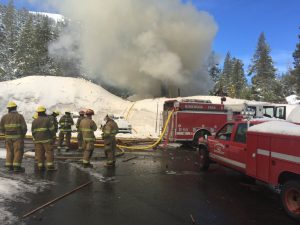
A house in Kirkwood caught fire from a gas explosion. Photo/CHP

A gas line exploded at a house in Kirkwood this morning.

No one was home at the time and there were no injuries.

It occurred March 25 near Fremont and Merrill streets.

No one from Kirkwood Fire Department was available for comment so the extent of damage is not known nor if snowload was the cause.

Smoke could be seen from quite a ways away.

— Lake Tahoe News staff report


EDC Grand Jury in need of members

The El Dorado County Grand Jury is looking for people to serve on the panel for 2017-18, with the start date being July 1.

Applicants must be U.S. citizens, 18 or older, be an El Dorado County resident for at least one year  and cannot be an elected official.

A required training session will be on  July 6-7 in Placerville.

The grand jury typically examines systems and processes, and is not a criminal jury involved in trials.

Members receive $15 per meeting and are reimbursed for mileage.

Applications are due May 5; and are available by emailing sthurman@eldoradocourt.org or calling 530-621-7414.


First wolf sighting in Nevada in 95 years

At least one of the Shasta pack wolves has been seen in Nevada. Photo/ CDFWS

By Henry Brean, Las Vegas Review-Journal

State wildlife officials have confirmed the presence of a wolf in Nevada for the first time since 1922.

The Nevada Department of Wildlife announced Friday that a wolf from the Shasta Pack in Northern California crossed into the Silver State in early November, but there is no evidence that the animal was here to stay.

The wolf was caught on video near Fox Mountain, about 150 miles north of Reno, prompting an investigation by state wildlife officials.

Read the whole story