Nevada eyeing annual legislative sessions

By Sandra Chereb, Las Vegas Review-Journal

CARSON CITY — Legislators would meet every year for limited times and be paid on a regular basis under a proposed constitutional amendment introduced Monday in the Nevada Senate.

Lawmakers have tried for years without success to change the state Constitution to allow for annual sessions.

The Constitution limits the Legislature to meeting in odd-numbered years for no more than 120 calendar days. Sessions begin on the first Monday in February.

Read the whole story


U.S. has a $4 trillion infrastructure time bomb

By James Cook, BBC News
 
On the banks of California’s Feather River, way below the tallest dam in the United States, is a ballet of steel and stone.

The dancers are huge earth-moving machines, their costumes bright yellow. The movement at the Oroville dam is constant and mesmerizing.

The average age of the 90,000 dams in the United States is 56 years. By 2025, seven out of 10 of them will be more than half a century old.

The American Society of Civil Engineers (ASCE) warns that “many dams are not expected to safely withstand current predictions regarding large floods and earthquakes”.

Overall, says the society, $4.6 trillion will be needed by 2025 to bring U.S. infrastructure to an acceptable standard. Less than half that amount has so far been allocated for the work.

Read the whole story


February gaming revenue drops throughout Nev.

Most gaming venues in Nevada reported declines in February compared to 2016, with the statewide gaming win down 4.5 percent or $945.6 million.

Stateline casinos were off 6.93 percent at $15.053 million. North Shore casinos were down 3.66 percent or nearly $2 million.

Downtown Las Vegas was the only market of the 19 in the state to report a year-over-year gain for February, the state Gaming Control Board reported Tuesday.

One difference between this year and last is that 2016 was a leap year so it had an extra day.

— Lake Tahoe News staff report


Letter: Douglas surplus should go to water systems

To the community,

It is good news, indeed, to hear that Douglas County has a $2 million so-called surplus and now needs only to figure out how best to spend it. Shall we hire more staff? Give everyone a raise? Or fix the museum roof?

The idea of a so-called budget surplus that can be spent on new entitlements for the county is a complete non sequitur. Not only is this short sighted and illogical, but it defies pressing fiduciary obligations of our Board of Commissioners.

Given the vast overhaul proposed by the county’s newly released preliminary engineering report on county-owned water utilities, can there be any real question about how to allocate this so-called surplus? What thought has been given to prioritizing the county’s obligation to bring its own substandard water infrastructure up to par?

After 27 years of running our water system at the lake, we now face a staggering price tag, fast approaching $50 million, to fix our rundown infrastructure. Our fragile and porous system is a byproduct of years of patch and fix mentality that endangers whole communities, leaving us vulnerable to complete system collapse, fire hazard, and prohibitive rate increases for the foreseeable future. And the county wants to launch a new storm water program?

The county needs to get serious about its real unmet obligations and liabilities. Some of its spending suggestions will add millions in future county budget expenditures, far beyond the present so-called surplus.

Consider this. If the Board of Commissioners chooses to squander its $2 million so-called surplus on new obligations and fails to address the real water crisis they own at the lake, future property tax income will decline precipitously, and the county’s next conversation will be how to handle the resulting budge deficit.

Dana Tibbitts, Cave Rock


Federal grant would help STPUD with meters

By Kathryn Reed

South Tahoe Public Utility District is in line to get a $297,606 grant from the Bureau of Reclamation to be used for its water meter project.

California is mandating most water districts install meters by 2025. The original thinking was that this would get people to lower their use of water.

Comments are being taken until April 7 on the bureau’s draft environmental assessment regarding the grant.

The money would be used to install the smart metering system radio towers, receiving equipment, and software. If awarded, it would mean the district could borrow less money from the state.

Nearly three years ago the district applied for a $21.5 million loan from the state that it thought was going to come with a zero percent interest rate. The State Water Resources Control Board changed the rules, saying that rate was for districts with 10,000 or fewer customers.

STPUD tried to appeal that ruling, but the state chose not to hear the appeal.

The meters being installed this construction season are being paid for with the loan that has a 1.6 percent interest rate for 20 years.

“The future phases for the final 5,000 meters, currently under review in the state’s legal department, is at 1.8 percent for 30 years. For this future contract, the district is eligible for ‘green reserve funds’, up to a maximum of $4M, which would be a principal forgiveness grant,” Richard Solbrig, STPUD executive director, told Lake Tahoe News. “We will not know if we receive this until they issue the actual contract from their legal department, hopefully within the next month.”


EDC wineries open doors to four-legged visitors

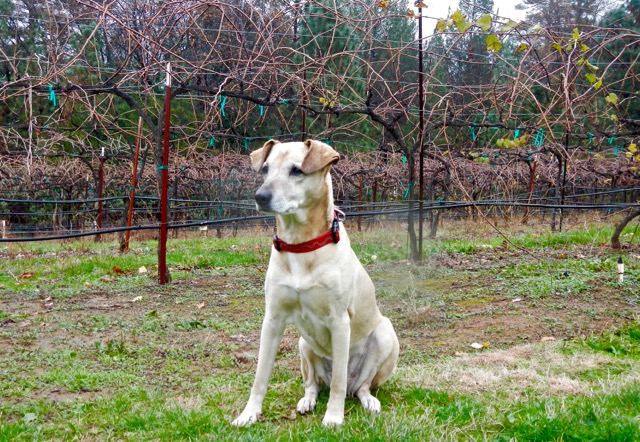
AJ could get used to regular trips to wine country. Photo/Kathryn Reed

AJ could get used to regular trips to wine country. Photo/Kathryn Reed

By Kathryn Reed

CAMINO — Wine is always better shared with friends – even if the friend has four legs.

AJ was an instant hit at the handful of El Dorado County wineries she visited. She got treats, was petted and there were water bowls already set out for her.

At Findleton Estate Winery people were showing off pictures of their dogs on their phones. One guy had photos of his pups in his wallet.

Owners Tom and Pam Findleton have always allowed dogs. They even had a sweet 16th party for their dog last year.
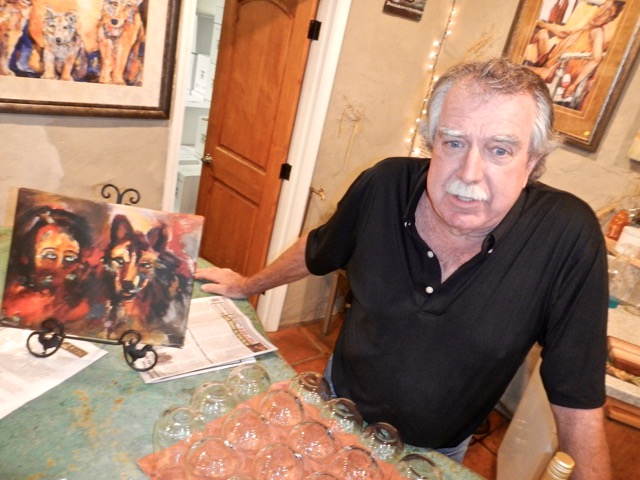
Tom Findleton talks dogs and wine at his Camino winery. Photo/Kathryn Reed

Tom Findleton talks dogs and wine at his Camino winery. Photo/Kathryn Reed

Pam Findleton creates all the labels for the winery. A painting is already done with Tom Findleton and their dog Grizzly. It’s likely to show up on future Bordeaux blend label.

Across the way in the Camino Wine Tasting Plaza is the Chic Photo Boutique. They do screen printing of people’s dogs and then Findleton will use it as a personal label for customers on one of their bottles of wine.

The Findletons are such dog lovers that they do an annual fundraising event for the SPCA and El Dorado County Animal Control.

“The more, the better” is Boeger Winery’s philosophy when it comes to dogs.
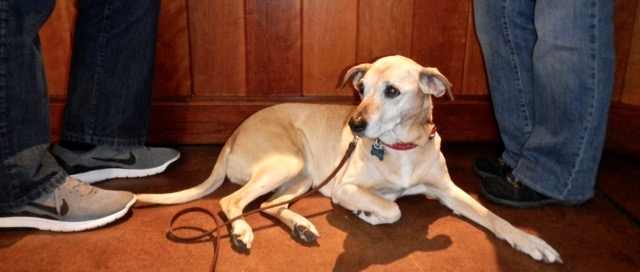
AJ makes herself at home at Boeger Winery. Photo/Kathryn Reed

AJ makes herself at home at Boeger Winery. Photo/Kathryn Reed

“Dogs make everyone else happy,” Yvonne Kendler, who works at Boeger, told Lake Tahoe News.

She said pet owners are good about taking their dog outside if the animal starts to bark or becomes disruptive in some other way.

With ample acreage, there are many places for wine to be enjoyed outside at Boeger if the four-legged companion would rather be outdoors.

Boeger sells the dog treats they hand out to the animals. AJ quickly gobbled up the goodie from Pawsperity Bakery. The Applegate-based business has treats in a variety of flavors; all made with natural ingredients. She won’t have a problem finishing the bag before the expiration date comes.

Over at Wofford Acres Vineyards it’s a one dog at a time policy inside the tasting room. Once dog No. 2 arrives, it’s time for all of them to go to the patio area.

This is a small tasting room, so more than two would be quite a distraction.
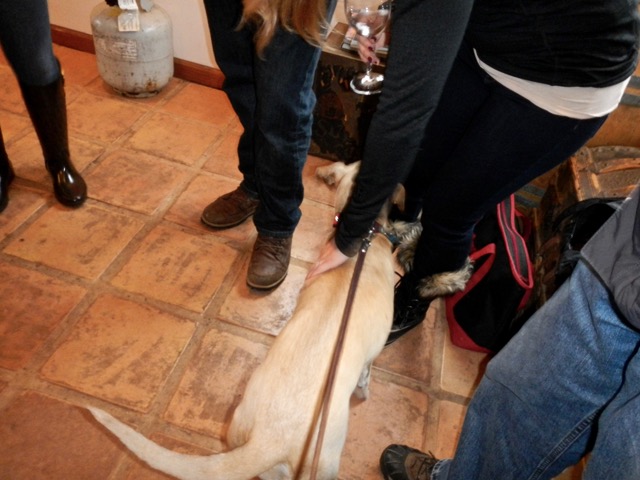
AJ becomes the center of attention at Wofford. Photo/Kathryn Reed

AJ becomes the center of attention at Wofford. Photo/Kathryn Reed

“My goal is to get people focused on wine. As soon as you bring a child or dog in, the focus changes,” Ann Wofford told Lake Tahoe News. She is one of the three owners of the winery.

AJ proved her theory correct. Other tasters started paying attention to her, petting her and then sharing their dog stories. Wine suddenly became secondary.

Even so, AJ got people who might not otherwise have talked to one another to do so. And we all still found time to keep sipping.

Not all wineries allow dogs inside the tasting room. Some allow them only in the picnic area. Check a winery’s website or give them a call to find out before you trek all that way with your four legged family member.


Letter: Moose Lodge assists with weekly meal

To the community,

“On behalf of the SLT Moose Lodge No. 1632 and Women of the Moose, Chapter 408, we would like to take this opportunity to thank the volunteers who coordinate the Bread & Broth dinners,” wrote Women of the Moose member Angie Keil. “It is a pleasure to have been a part of these efforts in helping our brothers and sister in the community.”

Keil and fellow Moose members Kim Blanck, Scott Blumenthal (SLT Moose Lodge governor), Christi Olmstead and Dana Tucker donated three hours of their time to represent their Moose Lodge members at the organization’s March 20 Adopt A Day of Nourishment sponsorship. B&B volunteers welcomed the incredible service that the Moose Lodge members provided with the dinner’s setup, serving and cleanup.

But service is nothing new to Moose Lodge members who regularly commit to helping others in the community. This nonprofit, fraternal organization enjoys bringing members together at their local lodge headquarters for social gatherings and sharing their commitment to helping their community. Thank you to the SLT Moose Lodge and Women of the Moose for being a wonderful example helping others.

Carol Gerard, Bread & Broth


Wyoming passes skier safety statute

By Ski Area Magazine

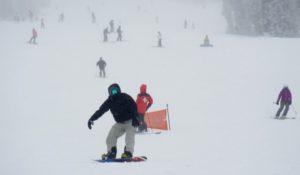
Wyoming has become the 29th state to adopt ski safety legislation after Gov. Matt Mead signed the Wyoming Ski Safety Act into law earlier this month.

According to an NSAA report, the bill defines inherent risks involved with skiing and snowboarding, immunizes ski areas from claims resulting from these risks, and places operational requirements on ski areas to improve mountain safety.

Previously, Wyoming’s ski areas had been covered by the state’s Recreational Safety Act, which is meant to govern claims for injuries resulting from inherent risks of several different activities, such as skiing, rafting, horseback riding, etc.

Snowboards and skiers enjoy good coverage on limited terrain at Heavenly on Nov. 23. Photo/Kathryn Reed


Tahoe shoreline history subject of talk

Peter Goin, author, photographer, and UNR professor, will speak on One Hundred Years of Shoreline: Rephotography and Lake Tahoe.

Travel in time through photographs as the 1916 Lake Tahoe shoreline reappears.

One hundred years ago, photographer H.T. Cowling’s 150 photographs showed conditions on the shores of the lake with the water at its maximum level and helped property owners present their complaints about the lake’s elevation. There are places where the beach is different, creeks enter the lake at different locations and the shorelines have been mediated by property owners.

The April 14, 5pm talk is free at the Tahoe Maritime Museum in Tahoe City.


Poker tables keep decreasing in Nevada

By Regina Garcia Cano, Associated Press

When the Monte Carlo casino closes its eight-table poker room in about a month as part of a $450 million overhaul, the Las Vegas Strip will be down nearly a quarter of the tables it had a decade ago.

Casinos constantly adjust their floors to meet customer demand. Some casinos have made their poker rooms smaller. Others have eliminated them entirely.

“Casinos added more tables in response to popularity, and once it became less popular, they took away the tables,” said David Schwartz, director of the Center for Gaming Research at the UNLV. The peak of the poker room was 2007.

Read the whole story