K’s Kitchen: Fresh asparagus in tacos

By Kathryn Reed

Asparagus is my go-to vegetable this time of year. It is soooo fresh and lovely.

And it’s so versatile. It can be steamed, sautéed, roasted, barbecued; put in soups, salads, stir fries, or be eaten by itself; and served hot, cold or at room temperature.

I had planned to barbecue the asparagus, green onions and mushrooms, but the starter wasn’t working and I didn’t feel like solving that problem at that moment. So, I roasted the veggies at 400 degrees, and then had them under the broiler briefly at the end.

If you barbecue the veggies, leave them whole and cut them into the 1-inch pieces after they are done. And add the cilantro at the end.

Asparagus-Mushroom Tacos

Canola oil

7 cloves garlic, minced

3 tsp chili powder

1 T lime juice

½ C cilantro, chopped

1 bunch green onions, cut into 1-inch segments

½ lb. asparagus, cut into 1-inch pieces

8 ounces portabella mushrooms, sliced and cut in half

Tortillas

Salsa verde

Preheat oven to 400 degrees.

Place onions, asparagus and mushrooms in oven proof glass dish. Add garlic, chili powder, cilantro and lime juice. Drizzle with oil so vegetables are lightly coated. Mix well.

Cook for about 15 minutes. Test by making sure the asparagus is done; it should be tender. Then put under broiler for a couple minutes to char them a bit.

Heat tortillas.

Divide veggie mix into tortillas, add salsa.


Traffic ticket amnesty available in Calif.

California Department of Motor Vehicles’ traffic amnesty program ends April 3.

The program provides relief for many drivers whose licenses were suspended because of failure to appear in court or have outstanding court debts. The fines can be reduced by 80 percent depending on income.

Applicants should contact the Superior Court in the jurisdiction where they received the traffic ticket to determine whether they are eligible to participate in the amnesty program. This program does not apply to parking tickets, reckless driving, or DUI offenses.

Courts, counties, and other authorized collection agencies may charge a $50 amnesty program fee.  Also, if reinstating your driver’s license, the DMV will charge a $55 reinstatement fee.


Jitloff second in GS national title race

By USSA

SUGARLOAF, Maine – In the final race of the U.S. Alpine Championships Tuesday in Sugarloaf, Hig Roberts (Steamboat Springs, Colo.) edged out seven-time national champion Tim Jitloff (Reno – U.S. Ski Team) for the giant slalom national title.

Roberts, a former U.S. Ski Team and Middlebury College athlete, showed courage and strength in rugged conditions – powering through the thick fog to his first national title. Jitloff was second, just 0.14 seconds off the pace and 2016 national giant slalom champion Kieffer Christianson (Anchorage) finished third, 0.29 seconds out. Tanguy Nef, who hails from Switzerland and competes for Dartmouth, was the top junior of the day, grabbing eighth.

Ryan Cochran-Siegle (Starksboro, Vt. – U.S. Ski Team) who grabbed the national title in this year’s super G, posted the fastest time in a rainy, challenging first run, but did not finish his second run. Roberts was well-aware that Cochran-Siegle and Jitloff would be charging second run and “sent it for Murph” – his brother, who passed away last August – to come out on top. Though he was ecstatic to win, he wished Murphy were there to cheer him on.

“These days are awesome … but It’s very tough,” said Roberts. “I believe that I’m doing this for a reason, and I’m doing well right now because I’m keeping him close to my heart and I’m not letting that special bond and push he always had for me go away.”

“I do have an affection for the hill,” Jitloff reflected. “I’ve obviously had some great results here. National titles aren’t that easy to get. I have seven of them, and each one of those was hard work to get – it wasn’t an easy thing to do.” But he gave credit where credit is due, congratulating Roberts on his victory. “I think Hig can be pretty proud of himself today. He skied great in very challenging, difficult conditions.”

Christianson – who, like Roberts, skis independently – was happy to share the podium with Roberts after a challenging season. “We both skied independently this year,” Christianson said, “and had to do our own logistics and find our own training – so to share the podium here at U.S. nationals is just awesome.”


LTCC on quest to enroll more local students

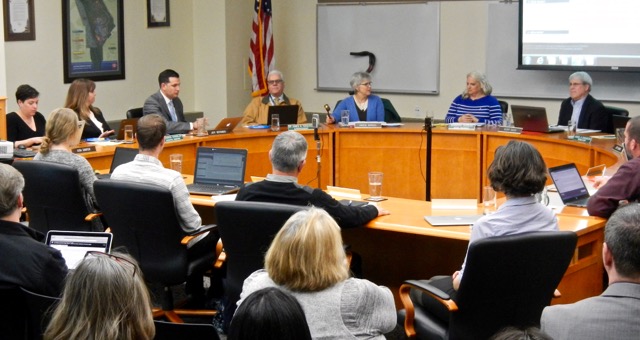
The LTUSD and LTCC boards at their annual meeting on March 28. Photo/LTN

By Kathryn Reed

Lake Tahoe Community College wants to see more local students enrolling in the two-year institution.

From Lake Tahoe Unified School District’s class of 2012 66.4 percent went to LTCC the following fall; class of 2013 – 66.5 percent; 2014 – 60.7 percent; and 2015 – 56.4 percent. It was noted that with the district having about 260 students graduating each year, it only takes a few students to skew the percentages.

This information was dispensed March 28 at the joint meeting of the two institutions’ boards. An agenda item was post-secondary enrollment trends.

The stats provided involve those who graduated from South Tahoe High School, Mt. Tallac High School and the Tahoe Learning Center.

What doesn’t show up in the numbers provided by LTCC is the students going to trade schools, using the knowledge they gained through the various career technical education paths STHS has.

LTCC picks up more local graduates after they have been out of high school for a year or two. Administrators would like to find ways to attract them from the get-go. One way is through promise grants.

The staff report says, “Typical of many promise programs, fees and tuition are covered for students who enroll in the partner college in the fall following graduation from high school.”

The college applied for a promise grant from the state, but was denied. LTCC President Jeff DeFranco said he’s looking at partnering with other entities – agencies and businesses – in the area to possibly create a promise program.

Another incentive for local kids to go to LTCC is having earned college credits while at South Tahoe High. LTUSD and LTCC have a duel credit program that continues to expand. Staff believe 25 percent of high school students taking college classes is a realistic goal. There is also the potential that one day they will earn a high school diploma, and the next they could receive their associate of arts degree; this is happening in other parts of the state.

The current sophomores could have about 30 LTCC credits when they leave STHS through the duel credit program that was launched last school year.

Part of the relationship between LTUSD and LTCC includes sharing facilities. This cuts down on having duplicate buildings and everything needed for programs.

DeFranco said LTCC is paying attention to what students are majoring in when they leave Tahoe. This data could be critical when the university center comes into being. This will be where four-year institutions come to campus to offer bachelor’s degrees without students having to leave South Lake Tahoe.

The primary reason LTUSD students (67.2 percent) from the classes of 2012-15 went to LTCC was to obtain a degree, certificate or transfer. The top declared majors were business, liberal arts, medical office assistant, criminal justice and natural science.

Jeremy Brown, director of institutional effectiveness for LTCC, went over the certificates LTUSD students earned at other institutions. They include corrections officer, general education, emergency medical technician, firefighter 1, leadership, massage therapy and medical assisting.

“The areas where we don’t have certificates may be potential areas for growth,” Brown told the boards.

The following are the number of LTUSD students who have gone on to higher education within one year of graduation and to what type of institution:

·      Class of 2012

Private or for profit – 7

Out of state public four year – 16

Out of state public two year – 3

California public four year – 37

Other California community college – 21

LTCC – 123

(Total – 207)

·      Class of 2013

Private or for profit – 6

Out of state public four year – 18

Out of state public two year – 1

California public four year – 44

Other California community college – 26

LTCC –95

(Total 190)

·      Class of 2014

Private or for profit – 14

Out of state public four year – 16

Out of state public two year – 2

California public four year – 54

Other California community college — 24

LTCC – 84

(Total 194)

·      Class of 2015

Private or for profit – 12

Out of state public four year – 14

Out of state public two year – 4

California public four year – 29

Other California community college – 25

LTCC – 87

(Total 171).



Opinion: Calif. needs to stop abusing taxpayers

By Ted Gaines

From the same governor who brought you the illegal fire tax now comes a plan to blow the top off California’s spending cap and leave taxpayers on the hook for tens of billions in extra taxes. It’s a bad idea that fractures the faith between citizens and government and spells trouble for California’s fiscal future.

Ted Gaines

With California’s runaway spending, it’s hard to believe the state even has an expenditure limit. But in 1979, a year after signing off on the revolutionary Proposition 13, voters passed Proposition 4, implementing the “Gann Limit,” which would peg California’s state spending to the 1978-79 level and only let it grow adjusted for inflation and population. State revenues above the voter-approved limit actually had to be refunded to taxpayers, an event that would cause panic attacks in today’s money-hungry Capitol.

In 1986-87, a boon year for tax revenues, the state issued more than $1 billion in rebates to relieved taxpayers who finally had some protection from an insatiable Sacramento.

Alas, it was too good to go on forever. Proposition 111 in 1990 defanged the Gann Limit, weakening its terms, and it now rarely factors into budgeting decisions.

But, weak as it is, it’s still on the books, and there is no ceiling too high for the Democrats when it comes to government spending. Gov. Jerry Brown’s new budget proposal is straining against even the wilted Gann Limit, and he’s going to do something about it.

Is he going to cut spending? Is he going to refund taxpayers? Or is he going to manipulate the budget to carve out more room to spend?

If you went with manipulate, I’ve got a job in the California Department of Finance for you.

Brown proposes taking $22 billion off the Gann Limit books this year. The money would not be accounted for as state spending or as local spending, as required in the original proposition. For Gann Limit purposes it would just disappear, like the hopes of fiscal conservatives all around the state, if his scheme is successful.

In essence, he would open up an avenue for another $22 billion in spending by reclassifying the current $22 billion. He would not spend less, he would not adhere to the even the watered-down mandates of the 1979 Gann Limit reform, he would just trick his way around the spending cap.

Try this sort of deception on your tax return to see how the state normally views creative exemptions of the sort they are practicing now.

Spending is taxes. The two can’t be separated, and Gov. Brown’s bad-faith end-run around the Gann Limit guarantees a heavier load for California taxpayers and a California perpetually stretched to its fiscal limit.

I have a novel idea: Live up to the law. If taxpayers deserve rebates, give them rebates. Don’t twist and distort or outright ignore the law just because it lets taxpayers keep more of their money. They earned it in the first place; it’s not a gift that a benevolent government doles out.

If the state is bringing in too much money and spending too much, get rid of the illegal fire tax or cut the Vehicle License Fee. Cut tax rates. That would put more money back in people’s pockets without putting the government in the way as a rebate middleman.

The Gann Limit has been little more than a rumor for decades, but it is a rule passed by the people to protect them from just the kind of spending excess proposed by Gov. Brown. It’s a sad commentary on our state, but when it comes to raising your taxes, rules seem made to be broken.

Ted Gaines represents the 1st Senate District, which includes all or parts of Alpine, El Dorado, Lassen, Modoc, Nevada, Placer, Plumas, Sacramento, Shasta, Sierra and Siskiyou counties.


Whooping cough alert in Carson City, Carson Valley

An outbreak of whooping cough, or pertussis, in the Carson City and Douglas County areas has been reported by Carson City Health & Human Services.

CCHHS is reporting the outbreak as an isolated event, however, the health department is encouraging families in the community to take preventive measures.

Whooping cough is a very serious respiratory infection caused by the pertussis bacteria. It causes violent coughing you can’t stop. Whooping cough is most harmful for young babies and can be deadly.

If you believe that you or your child has signs and symptoms of whooping cough or have questions about the illness, contact your healthcare provider immediately or the health department at 775.283.7220 or CCHHSinfo@carson.org.

Whooping cough starts with the following symptoms:

  • Runny of stuffed-up nose
  • Sneezing
  • Mild Cough
  • A pause in breathing in infants (apnea).

After 1 to 2 weeks, coughing, which can be severe, begins. Children and babies may then begin to develop these more serious problems:

  • Coughing, very hard and continual.
  • Gasping for breath after a coughing fit. Babies may not cough or make this sound—they may gag and gasp.
  • Difficulty breathing, eating, drinking, or sleeping because of coughing fits. These coughing fits happen more at night.
  • Turning blue while coughing from lack of oxygen.
  • Vomiting after coughing fits.

Coughing fits can last for 10 weeks, and sometimes happen again the next time the child has a respiratory illness.

Whooping cough spreads easily through the air when a person who has whooping cough breathes, coughs, or sneezes. Almost everyone who is not immune to whooping cough will get sick if exposed to it. A person can spread the disease from the very beginning of the sickness (when she has cold-like symptoms) and for at least two weeks after coughing starts.

The best way to protect children against whooping cough is by having them get the diphtheria-tetanus-pertussis shot, also called the DTaP shot. For everyone 11 years of age and older, the Centers for Disease Control and Prevention (CDC) recommends the tetanus- diptheria-pertussis (Tdap) shot.


SLT working on bike trail, pot holes

South Lake Tahoe crews will begin preliminary work on the El Dorado Beach to Ski Run bike trail project this week.

If the weather cooperates, Sierra Nevada Construction will begin removing trees within the proposed bike trail alignment. The work may cause minor travel lane impacts on Highway 50 between Ski Run Boulevard and El Dorado Beach.

Public works employees will also continue temporary pothole patching. With the wet subsurface from high groundwater, the repairs are only temporary and will require a permanent patch when conditions are warm and dry enough.

Potholes can be reported to the department online.


Trump signs bill killing Obama rule on public lands

By Gary Martin, Las Vegas Review-Journal

WASHINGTON — President  Trump signed a bill Monday that kills a federal rule dictating planning on public lands in Western states — including 47.5 million acres in Nevada.

Conservationists and Democrats argued that the Obama administration regulation, known as the Planning 2.0 rule, protected Bureau of Land Management lands from commercial interests.

All GOP senators from Western states, including Sen. Dean Heller, R-Nev., were co-sponsors of a resolution calling for the repeal of the regulation. It was sponsored by Sen. Lisa Murkowski, R-Alaska, the chairwoman of the Senate Energy and Natural Resources Committee.

The Obama administration regulation changed a process at the Bureau of Land Management that had been in place for 34 years.

Read the whole story


Liberty Utilities promoting energy efficiency

Liberty Utilities will be at several community events between now and the end of April where customers can receive free LED light bulbs if they sign up for a free energy audit.

Energy experts will be at these events providing customers with the most up-to-date information about ways to reduce energy consumption and bills.

Events:

  • Business Expo, March 31 from 4:30-8:30pm at Harveys in Stateline.
  • Tahoe Truckee Earth Day, April 22 from 11am-5pm at The Village at Squaw Valley.
  • South Lake Tahoe Earth Day, April 29 from 10am-3pm at Bijou Community Park.

Customers may also go online, click on the “Smart Energy Use” link at the top to learn more about various energy efficiency and conservation programs offered to residential and commercial customers.


DCSD announces end of school dates

Douglas County School District has set dates for when students will end this school year.

Zephyr Cove Elementary and Whittell High schools end the year June 22, valley schools end June 8.

Snow days – of which there were five at the lake this winter – can extend the year.

— Lake Tahoe News staff report