Report: Tahoe estate sold for $29 million

By David Caraccio, Sacramento Bee
 
A historical and prominent estate in Lake Tahoe has sold for nearly $29 million, according to several reports.

The 10-acre property, known as the Drum Estate, on the north shore of Meeks Bay, boasts over 700 feet of shoreline, two piers and a compound of structures. A vintage main lodge dates back to the 1920s.

In 1923, John Drum, president of American Trust Co., bought the property and planned to create a Tahoe sanctuary for relaxation and entertaining, according to Tahoe Luxury Properties. Guests as famous as aviator Charles Lindbergh visited the property. It was purchased by Erik Jonsson, the founder of Texas Instruments, in 1961, Tahoe Luxury Properties said in an article about the sale.

The buyer is Drum Lodge LLC of Redwood City, according to the Sacramento Business Journal, and shares the same address as two foundations started by technology billionaire Thomas Siebel.

Read the whole story


Travel ban could cost $18B in U.S. tourism

By Bart Jansen, USA Today

President Trump’s temporary travel ban and an inhospitable political climate could punch an $18 billion hole in U.S. tourism by international visitors over the next two years, projections by travel analysts show.

Foreign tourism is a $250 billion-a-year business in the United States, and Trump’s original and revised executive orders temporarily banning travel from six majority-Muslim countries — put on hold by federal courts — have dampened interest worldwide in visiting the U.S., travel and tourism executives told USA Today.

“The U.S. has put an unwelcome mat at our front door,” said Henry Harteveldt, president of Atmosphere Research Group, which conducts travel research.

Read the whole story


Snippets about Lake Tahoe

·      Kim Wyatt’s essay “The Currency of Moons” was selected to appear in Best American Travel Writing 2017 by guest editor Lauren Collins of the New Yorker. The anthology will publish in October; the essay first appeared in Creative Nonfiction’s spring 2016 issue. Wyatt is the owner of Bona Fide Books in Meyers. 

·      Slow Food Lake Tahoe is offering its second annual Bone Broth for Optimal Health Skillshare on April 8 from 4-6pm. Victoria LaFont, a local certified nutritional therapy practitioner and certified GAPS practitioner, will teach the class how to make nutritious bone broth at home. Tickets are $20 and may be purchased online. The class will be at the Truckee Tahoe Community Foundation, 11071 Donner Pass Road, Truckee.

·      Lake Tahoe South Shore Chamber of Commerce’s next After Five Mixer will be April 27 from 5-7:30pm at Blue Angel Cafe and Chimayo Street Grill on Ski Run Boulevard in South Lake Tahoe. Cost is $10 for members, $20 for others.

·      Senior Citizens Inc., the group that operates the South Lake Tahoe Senior Center, is having an endless plate of spaghetti and meatballs fundraiser on April 2 from 5-8pm at the center. Cost is $8 for adults, $4 for ages 5-12, and free for kids younger than 5. Salad, bread and ice cream will also be served, with music provided by Dave Fabrizio. There will also be fund-raising dinner May 7.

·      Effective April 4, the Department of Veteran Affairs is moving from the Senior Center to 924 Emerald Bay Road in South Lake Tahoe. Services will be by appointment only April 4-11; call 530.621.5892.


As baseball season opens, money on Cubs to repeat

By Todd Dewey, Las Vegas Review-Journal

While many Cubs fans left Las Vegas after Sunday’s 22-4 rout of the Reds at Cashman Field with a futures ticket on Chicago to win the 2017 World Series, Kyle Hendricks left with a case of food poisoning.

The Cubs pitcher said he made a late-night stop at a taco restaurant here Saturday and called it a “bad decision.”

Hendricks made all the right moves in 2016, when he led the majors in ERA (2.13) and helped Chicago to its first World Series title in 108 years. With its core group of young stars returning, the Cubs are the 7-2 favorite to repeat as champs. The season opens Sunday with a tripleheader.

“They’ve got so many bats, with (Anthony) Rizzo, (Kris) Bryant, (Kyle) Schwarber and (Jason) Heyward, who had such a terrible season he can’t do anything but go up,” Red Rock sports book director Jason McCormick said. “It’s going to come down to their pitching staff. The whole package is there.”

After years of fans futilely betting on the Cubs to win the World Series, McCormick — a Chicago native and die-hard Cubs fan — said many of the winning futures tickets from 2016 still haven’t been cashed and probably never will be.

Read the whole story


Ren Faire returning to the South Shore

The Valhalla Renaissance Faire returns to Camp Richardson on June 10-11 with a fantasy-pirate theme.

The event did not take place in 2016 because of all the work the U.S. Forest Service was doing to the campground. Because of the venue’s extensive updates and changes organizers have decided to limit the 2017 event to one weekend, with an expected return to the full Valhalla Renaissance Faire two-weekend schedule in 2018.

This will be the 25th anniversary of the festival.

Adult tickets are $15. It will be open from 10am-6pm Saturday and 10am-5pm Sunday. For more info, go online.


Tahoe girls earn Div. 1 college hockey scholarships

Katie Sonntag, left, and Leah Marino pave the way for girls hockey in South Tahoe. Photo Copyright 2017 Carolyn E. Wright

By Susan Wood

If Katie Sonntag, 17, and Leah Marino, 16, were to hear “you hit like a girl,” that would be a big compliment in the world of sports.

These are no ordinary teenagers playing hockey. The local girls, who grew up and practiced their skills at the South Lake Tahoe Ice Arena, each scored Division 1 NCAA scholarships to play hockey back East.

Leah Marino, left, and Katie Sonntag grew up at the South Lake Tahoe Ice Arena. Photo Copyright 2017 Carolyn E. Wright

Profound indeed.

First, South Lake Tahoe is the land of skiers and boarders.

Second, it’s quite an achievement for anyone wanting to play a higher level of sports.

Third, they’re girls – unheard of to expect in most towns.

Leah Marino flies down the ice in South Lake Tahoe. Photo Copyright 2017 Carolyn E. Wright

When she’s done with high school, Marino will accept a full-ride scholarship at Robert Morris University in Pittsburgh – the home state of her parents.

Sonntag will attend Union College in Schenectady, N.Y. – one state over from Vermont where she was born and 45 minutes from relatives.

Their parents sometimes joke about whether they should have just stayed where they were given their daughters’ inevitable return to the East to achieve their hockey goals. After all, the duo has found it necessary to attend hockey academies in far flung places to be seen and hone their skill sets. Sonntag attends the Pursuit of Excellence hockey school in Kelowna, B.C., between her studies. Marino plans to spend six months at the North American Hockey Academy in Stowe, Vt.

“She can get more ice time there. Girls hockey is not a sport that’s readily available (at venues),” Leah’s father, Jim Marino, said, while joining his daughter on the ice at the South Lake Tahoe rink. He recalled how his family would make eight- to 10-hour round trips to San Jose from September to June to nurture his daughter’s hockey passion.

The two girls hit the ice last month when they came home for a break. It’s a good, familiar place to unwind as a family, given Marino coached hockey and Katie’s dad, Pete Sonntag, plays hockey when he’s not running Heavenly Mountain Resort.

Katie Sonntag is happy to be a role model for girls like her younger sister. Photo Copyright 2017 Carolyn E. Wright

If not for their family moves to Lake Tahoe, perhaps the two girls wouldn’t have met — gaining a friendship as solid as the puck they slap.

One could argue the teens’ achievements involve a destiny built on lifelong dreams of going to college and playing hockey.

“I think it was always a ‘what if.’ There are a lot of girls who would just stop (playing). We both knew what we wanted and pushed each other toward it,” Marino told Lake Tahoe News.

And there lies the dynamics of women in sport.

“It’s always been a dream of ours to play hockey,” Sonntag said.

Marino nodded, adding: “For women, college hockey is the NHL. There’s no equivalent.”

Katie Sonntag, left, and Leah Marino met at the South Lake Tahoe Ice Arena. Photo Copyright 2017 Carolyn E. Wright

Sonntag would also like to major in physics; Marino in sports medicine. Sonntag has a head start with the physics of manipulating a hard round object on a slick surface. She picked up the puck, tapped it a few times, then slapped it for fun at the glass barrier square in front of her father watching across the rink.

It was a thing of beauty. The two girls glided on the ice, practicing drills with an uncanny natural ability.

Being on this oval was like being on their home ice. As it should have been. Marino and Sonntag have spent many long hours through their childhoods at that ice arena, giving up traditional teenage girls’ pursuits along the way. Boys make up one of those pastimes.

“It’ll be my first time at prom this year,” Marino said.

Sonntag admitted to never having attended a school dance and essentially skipped the high school football games.

Leah Marino knows how to control the puck. Photo Copyright 2017 Carolyn E. Wright

The two girls began skating at about age 7 and started playing hockey shortly thereafter. When the Sonntags moved to Tahoe with Katie, Marino – a winger – was the only girl competing in the six various hockey leagues at the rink, she recalled. 

It was meant to be the duo would become close, supportive friends. Hockey isn’t necessarily a girls’ sport, so when Sonntag, a longtime center, excelled to becoming a captain of one of the leagues the boys weren’t thrilled.

“Now they look up to us,” Marino added of gaining the collegiate honor.

Sonntag hopes the boys they know won’t be the only ones looking up to the groundbreaking females. They’re the first from Tahoe to seize the D1 scholarships for the sport.

Katie Sonntag shows her agility on the ice. Photo Copyright 2017 Carolyn E. Wright

“Where we come from (in the Northeast), it’s not as big a deal, but it’s pretty crazy here,” Marino said.

Both girls want to be inspirational to young girls everywhere in pursuit of their dreams.

“I’d like them to know they can make it and can move away from home to get it,” Marino said.

 Sonntag is starting with support of her 12-year-old sister, Charlotte, who the older sibling admits “she’ll be better than me.”

“I want her to have the same opportunities I have,” Sonntag told Lake Tahoe News. “I’m humbled and honored by my opportunities.”

So maybe it takes a little brush with humility mixed with the drive to succeed to be a winner.

Leah Marino is used to putting the puck into the net. Photo Copyright 2017 Carolyn E. Wright

To achieve a D1 NCAA college scholarship, a student must maintain at least a 3.0 grade point average and undergo a strict protocol in the recruitment process.

Among the three NCAA categories, Division 1 schools generally have the biggest student bodies, manage the largest athletic budgets and offer the most generous number of scholarships. With nearly 350 colleges and universities in its membership, Division 1 schools field more than 6,000 athletic teams, providing opportunities for more than 170,000 student-athletes to compete in NCAA sports each year.

Getting there is no easy accomplishment. It takes a lot of hard work, talent and dedication. 

“It’s incredible what they have accomplished. It’s just nearly impossible to get there – NCAA D1. Think about it, only 35 Division 1 women’s teams, say 27 players per team, some 945 spots total. Of all the women hockey players across both the U.S. and Canada, Tahoe girls take two of them. From our small town, well, that’s the stuff of fiction,” Van Oleson, who owns Tahoe Sports and Entertainment, told Lake Tahoe News. The company operates the ice arena, so an emotionally-charged Oleson has watched Marino and Sonntag for years.

“These girls are pioneers, groundbreakers (who) have paved a way and made it clear what a girl from Tahoe can do,” Oleson said.


Opinion: Fixing the roads, sensible style

By Larry Weitzman

Bakersfield Assemblyman Vince Fong has introduced a sensible piece of legislation, AB496, as part of the legislative session for 2017. The winter-spring rain and snow demonstrated to California residents that our roads and culverts are in terrible shape, especially in El Dorado County where our Board of Supervisors in the last few years squandered our treasury (the 15 percent raise in 2013) of more than $50 million effectively on county salaries in the face of our crumbling roads. For all the analysts in EDC government, less would result in more.

Larry Weitzman

In an attempt to raise new revenue our supervisors have supported new taxes whether directly such as new taxes on hotels, increase in franchise fees and new sales taxes, and indirectly in the support of new state Senate and Assembly bills such as SB1 and AB1 which will raise gasoline and other fuel taxes and vehicle registration fees with the promise they will be used for new roads and maintain roads. What they didn’t tell us with respect to those bills is about two-thirds of the new revenue of about $7 billion would be siphoned off for other pet projects like high speed trains to nowhere. After public backlash, that support is in limbo.

The reason for Fong’s AB496 was because gasoline taxes and vehicle registration fees have already been siphoned for other purposes like to balance our already bloated budget packed with welfare for politicos, state employees and our failing pension system, never mind public welfare. In other words, for SB1 and AB1 it will be a continuation of the prior tax increases for roads, trust us (the government) with more of your money and watch what happens? Nothing, the roads will continue to decay.

What Fong’s legislation does is to ensure that vehicle registration fees, especially truck weight fees, gas taxes, money borrowed from the transportation funds, vehicle insurance fees, vehicle sales taxes and a whole lot more all get used for roads instead of going into the general fund. Analysts estimate this legislation will raise $5.6 billion annually and $2.2 billion in one-time revenue with absolutely no increase in taxes. SB1 and AB1 will simply raise gas, registration and other taxes and that money will probably get stolen from road maintenance, too. Certainly, a good portion of those potential funds are earmarked for the bullet train to nowhere.

A March 24 EDC board letter signed by Chairwoman Shiva Frentzen directly supported the principles AB496, but also added several twists by supporting a few propositions not contained in AB496. Three of which I am going to discuss here. In Frentzen’s letter it stated as one of the bullet points: “Invest Cap and Trade revenues in Greenhouse Gas (GHG) reducing road maintenance, transit, bicycle/pedestrian, and freight projects.” Frentzen makes an excellent point which along with new oil severance taxes of 5 to 10 cents a gallon are nothing more than hidden additional gasoline taxes probably totaling more than 25 cents a gallon. But these taxes are pass through taxes hidden from the end consumer that hurt the poorest of Californians who can least afford this necessary commodity. Frentzen is on the money here.

Next on the bullet points is: “Ensure that non-gas-diesel vehicles owners pay their fair share of roadway capital investment and maintenance.” Of course, the first question is what is a fair share? The reality is that electric cars are light vehicles anywhere from about 3,000 to 5,000 pound for a Tesla P100D. Consequently, road damage from these vehicles is negligible. Road damage is mostly caused by heavy trucks weighing 80,000 pounds or close to that. In the extreme, how much road maintenance is required from a motorcycle either gas or electric? The answer is effectively none.

And why should we be just another subsidy for electric cars? What should be done is to eliminate all subsidies for EVs. First is the elimination of the $10,000 tax credit on purchase of EVs from the federal and state government. Second is the elimination of zero emitting vehicle (ZEV) credits created by the federal government to the tune of about $10,000 or more per vehicle sold. Third is the elimination of heavily discounted electrical energy rates from utility companies like SMUD and PG&E which are currently discounted by half or more. In fact, SMUD offers for $599 unlimited charging for your electric car for two years. Lucky SMUD customers who don’t use electric cars are paying for that or about 99.9 percent of SMUD customers foot that bill. And the fourth subsidy is carpool lane passes. Car pool lanes are ridiculous to begin with (creation of a Gov. Jerry Brown appointment, Adriana Gianturco, which is a story unto itself) as they are paid for by drivers who can’t use them. All subsidies should be removed for electric cars. As to higher registration fees or a per mile tax, without the subsidies described above it wouldn’t be necessary as there would be no electric cars as there would be no market. 

Finally, Frentzen wrote: “Evaluate long-term equitable transportation funding sources like the Road Charge Pilot Program to replace the gas tax.” This would solve the gas tax issue with respect to EVs. Oregon has as pilot program. It is in addition to the gasoline tax and there is much doubt that a mileage tax would ever replace the gasoline tax. To make such a tax is fair it could be no more than a penny a mile as small cars which average 35 mpg would be paying about 35 cents a gallon like the current gas tax which is about 35 cents a gallon. But to make it fair the tax would have to be weighted based on vehicle weight, like big 80,000 pound trucks would pay 5 to 10 cents a mile and so on. And how would we tax out of state vehicle and trucks that use our roads? Gasoline taxes solve that problem, mileage taxes don’t.

What about California vehicles that go out of state, the odometer would still be counting yet they would be double taxed every time when buying gasoline out of state and interstate trucks buy lots of fuel out of state.

Gasoline taxes seem the fairest way. High fuel economy cars use less gas and large trucks use the most fuel. And they have weight fees. If we stop subsidizing EVs, they will become like in about 1910, a thing of the past again. Frentzen does support all of Fong’s ideas. These additional three items above are not Fong’s. In 1900 EVs had 38 percent of the market, by 1905 that market dropped to 7 percent. By 1911 when Charles Kettering invented the electric starter first used on the Cadillac, electric cars were sold next to the buggy whips.

Larry Weitzman is a resident of Rescue.


Eldorado Forest opening some seasonal roads

Native surface roads and trails in the Eldorado National Forest that are subject to the annual wet weather seasonal closure will reopen on April 1.

“Melting snow will continue to create moist conditions in some areas, so it’s important to use good judgement before driving on dirt roads,” Forest Supervisor Laurence Crabtree said in a press release. “Visitors will still be responsible for any resource damage they cause.”

The seasonal closure is designed to protect roadbeds and watersheds from damage and to protect water quality. To maintain flexibility, the timing of the dirt road closure is determined based on current conditions each year which may cause the closure to go into effect early or be extended. Due to heavy rains in November, this year’s seasonal closure began December 1.

The seasonal closure does not apply to the Rock Creek Recreational Trails Area near Georgetown, which has its own wet weather closure procedures.

Meanwhile, a series of heavy storms over the winter has led to other closures due to storm damage ranging from mud, rocks, and debris to roadbed failure in some locations. Storm damage assessment is still in progress, and some damage will not be known until the snow melts. Crews are working to prevent additional damage at sites not yet failed, and engineers are developing cost estimates for repairs. The following roads will be closed until storm damage repairs are completed:

  • Georgetown District – 11 Pines Road; Black Smith Flat Road; Pigeon Roost Road.
  • Pacific District – Jaybird Springs Road; Granite Springs Road; Weber Mill Road.
  • Placerville District – Forebay Road; Slab Creek Road; Plum Creek Road; Alder Creek Road; Bridal Veil picnic area.
  • Amador District – Salt Springs Road; Panther Creek Road; Ellis Road.


Brown lobbying for taxes, fees to fix Calif. roads

By Christopher Cadelago, Sacramento Bee
 
When Gov. Jerry Brown campaigned for his sales and income tax increase five years ago, he appealed to statewide voters by arguing it would cost them just “one penny more” for their cappuccinos.

In the Bay Area trying to build support for his $5.2 billion road-funding package, Brown acknowledged Thursday that convincing the Legislature to raise fees and taxes on motorists was more akin to feeding them green vegetables than sweet confections.

Brown and the leaders announced the deal Wednesday in Sacramento, setting off a political struggle to pass it in the Legislature. The plan would raise gas taxes and user fees on motorists, costing California drivers about $10 more per month, depending on the value of their cars and the miles they travel.

Read the whole story


Skier extracted from Desolation Wilderness

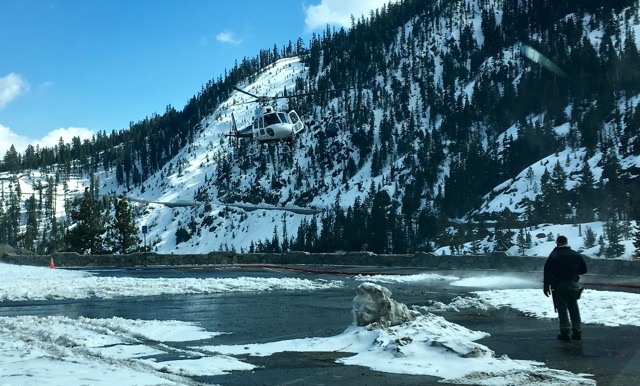
A CHP helicopter uses Vikingsholm parking lot as a landing zone. Photo/EDSO

A 24-year-old San Luis Obispo man had to be airlifted out of Desolation Wilderness on the afternoon of March 30 after injuring his leg.

A California Highway Patrol helicopter dropped El Dorado County search and rescue volunteers onto Jakes Peak. They then skied to the victim. Because he could not ski out a hoisting seat was used to lift him out of the back country to safety, and then he was transported to Barton Memorial Hospital.

Jakes Peak is located north of Emerald Bay.

— Lake Tahoe News staff report