NV Energy again meets its renewable energy goals

By Mick Akers, Las Vegas Sun

NV Energy has reached its mandated renewable energy goals for the seventh straight year.

In a filing with the Public Utilities Commission of Nevada, NV Energy reported it achieved a 22.2 percent renewable credit level last year in Southern Nevada and a 26.6 level in Northern Nevada.

The legislated requirement for 2016 was 20 percent, based on total retail energy sales. The requirement rises to 25 percent in 2025.

NV Energy said there are 43 renewable energy projects in Nevada from which its customers benefit.

Read the whole story


Liberty hosting electric vehicle summit

Liberty Utilities will host an electric vehicle summit April 24 featuring presentations by key stakeholders and displays of Tesla vehicles, a Proterra 40- foot electric bus, and a ChargePoint EV charging station.

Liberty Utilities is hosting this event to share information about an application to be submitted this summer to the California Public Utilities Commission. The proposed program would encourage electric vehicle use through the installation of EV charging stations at public locations and incentives for residential/commercial customers to install charging stations.

There will also be presentations by the Tahoe Regional Planning Authority to discuss the Regional EV Readiness Plan, ChargePoint and Clipper Creek to discuss the latest in charging technology, Tahoe Transportation District to share the Electric Bus Project, and Proterra to talk about the latest electric bus on the market.

Pre-registration is required as seating is limited. To register, contact Kathy.carter2@libertyutilities.com by April 19.

Check in at the North Tahoe Events Center in Kings Beach starts at 8:30am, with presentations from 9am-12:30pm, interaction with vendors and test drives from 12:30-2pm.


DCSO explorers earn slew of awards at competition

The Douglas County Sheriff’s Explorer Post No. 2105 walked away with 13 trophies at the Central Coast Law Enforcement Exploring Competition on April 7-9 in California. 

The DCSO Explorers competed against 21 police, sheriff and highway patrol explorer posts. The 19 scenarios included felony car stops, shooting skills, written exams, oral interviews, suspicious persons and physical agility. 

DCSO earned second place overall.


Nevada OKs $36.2M to build Incline trail

By Associated Press

Nevada transportation officials have approved $36.2 million to build a bike and walking trail at Lake Tahoe along a busy stretch of highway connecting Incline Village to Sand Harbor State Park.

Project manager Nick Johnson told the state transportation board on Monday the 3-mile-long shared use path will improve safety along Highway 28 where a number of accidents occur each year.

Read the whole story


Snippets about Lake Tahoe

·      The Roberta Mason Library at Lake Tahoe Community College has increased its e-book collection from 159,000 to 212,000 volumes.

·      El Dorado County has hired Carla Hass to be communications director.

·      The U.S. Forest Service is offering the public an opportunity to purchase used vehicles at an online auction starting April 17.  To find this auction, enter the sale number 91QSCI17001 in the search box on the web page.

·      South Tahoe Association of Realtors donated 80 Easter baskets to the Family Resource Center and Live Violence Free Center in South Lake Tahoe.

·      People can start moving into the 30 condos at Zalanta in South Lake Tahoe on May 1. Another 60 condos are scheduled to be built. The restaurant space is still vacant. Vail Resorts, which owns Heavenly ski resort across the street, will operate a 24/7 front desk and ski valet in addition to managing the homeowners’ association and vacation rental program.


Aspen-KSL buy Mammoth, 3 other Calif. resorts

By Jason Blevins, Denver Post
 
The new Aspen Skiing Co.-KSL Capital Partners alliance is buying Mammoth Mountain, June Mountain, Snow Summit and Bear Mountain, giving the nascent partnership more than 6,000 acres of Southern California ski terrain across four resorts that host more than 2 million visits a year. No price was announced, but in 2005 the resort traded hands for $365 million.

Rusty Gregory, the longtime manager and chief executive of Mammoth Resorts, in a statement called the move “the next logical chapter in the story of Mammoth.”

Dropping a mere two days after Aspen Skiing and Denver private equity firm KSL Capital Partners announced they were partnering on a $1.5 billion deal for Intrawest Resort Holdings‘ six ski areas — including Winter Park and Steamboat — Wednesday’s news is nothing short of a shot across the bow of industry giant Vail Resorts.

Read the whole story


Nev. might extend sex trafficking law to transporters

By Alison Noon, AP

Dumbfounded that Nevada law does not consider people who cart around the perpetrators of sex tourism as sex traffickers themselves, one trafficking survivor asked legislators Tuesday to extend strict penalties to the people who market and connect the illicit industry.

Kimberly Mull told the Senate Judiciary Committee that first she was pulled in to child pornography, and people traded photos of her underground before they began trading her. One person traveled across the country to “meet” her at age 13. She knew of children who were shipped off to sex events, and offenders who traveled to them.

Anyone who knowingly takes people to illegal prostitution rings or to watch child pornography in Nevada could be convicted of sex trafficking under Senate Bill 488.

Read the whole story


Heavenly tree removal could reduce bottlenecks

By Kathryn Reed

Congestion on the slopes at Heavenly Mountain Resort could be lessened in the coming winters via trail widening throughout the mountain – in both states, and inside and outside the basin.

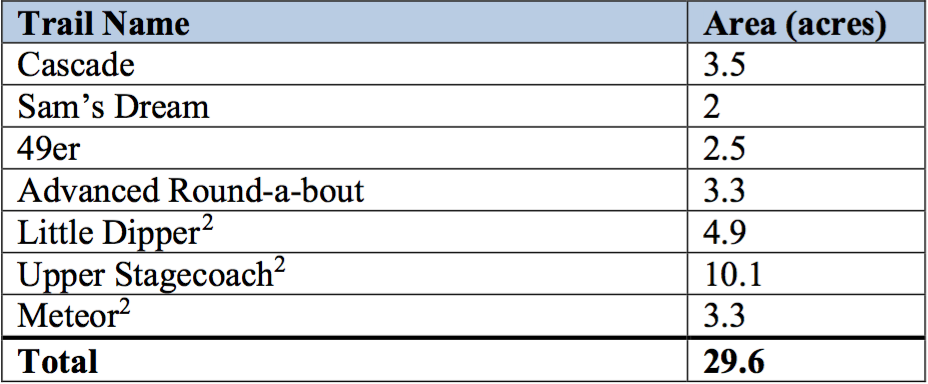
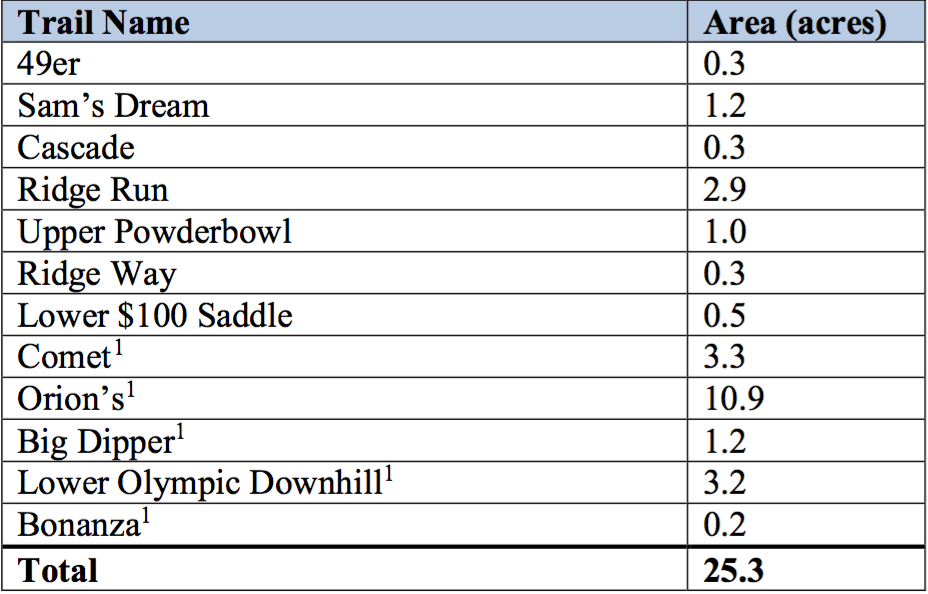
The resort has plans to remove hundreds of trees in a 25.3-acre area for widening, while another 29.6 acres would be part of a ski run hazard reduction area. The exact number of trees will be identified in future environmental documents.

“There are locations on select ski trails across the resort which are not sufficiently wide enough to accommodate the existing use. Based on use levels and patterns particularly in early-season and low-snowpack conditions, these trails are not providing a high-quality experience and cannot be opened on a consistent basis,” the U.S. Forest Service scoping document says. “In addition, there are also locations where boulders, stumps and other obstacles make grooming difficult and require a great deal of electrical energy and water through snowmaking in the early season.”

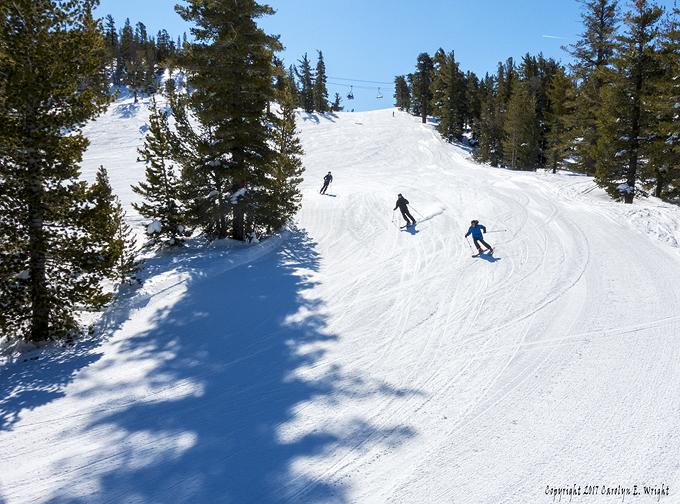
Widening trails could start in spring 2018 at Heavenly. Photo Copyright 2017 Carolyn E. Wright

The U.S. Forest Service, which owns most of the land the South Shore resort operates on, is seeking comments until April 28 on the scoping document. Later this summer an environmental analysis will be developed, which will give the pubic another opportunity to weigh in on the plans.

Matt Dickinson, acting planning staff officer for the Lake Tahoe Basin Management Unit, said most skiers and riders are not apt to notice the bulk of the likely forthcoming changes.

“Some people will notice it in the pinch-point areas where people stop and they’re all jammed together,” Dickinson told Lake Tahoe News. “People will be able to zip right past and not worry about crashing into someone else.”

The changes are part of Heavenly’s larger master plan that the USFS has approved. Each project, though, then needs approval.

The soonest the resort could start on the projects would be spring 2018. All improvements affect winter users of the resort, not summer. The amount of time for completion will be dependent on money and weather. It will likely be a multi-year project.

Kevin Cooper, spokesman for Heavenly, did not respond to questions about the project.

Today, the plan is to remove the trees over the snow. It’s possible some trees will be felled before it snows, but the extraction will be with snow on the ground.

Ski run reduction locations

                   Ski trail widening locations                        Source: USFS                    

“The snowcats have such a light touch on the ground. They really alleviates those (erosion and compaction) issues,” Dickinson said.

In areas where snowmaking lines will be affected, they will be relocated. It’s possible the resort will upgrade those devices where applicable.     

Another component of the project is to make snowmaking more efficient by getting rid of large boulders and downed trees that take several feet of snow to be covered. This is most troublesome in drought-like conditions when Mother Nature is not able to sufficiently cover them, especially in what resort officials and skiers would consider a timely manner.                                               

“The height of these natural features can require up to 5 feet or more of snow coverage before trails can be opened. During low snow years a great deal of energy and water resources is put toward making snow on these trails or else they can’t be opened,” the scoping document says. “Boulders would be capped — blasted with explosives — to a height of 12-18 inches and moved by hand or equipment. Stumps would be ground or cut to a height of less than 6 inches but would remain in place. Large diameter logs would be moved from the ski trail, chipped or used   along steeper sections of trail for erosion control.”


Notes:

·      Comments are due April 28.

·      Email comments to: comments-pacificsouthwest-ltbmu@fs.fed.us.

·      More information is available online.


Opinion: The dark void at the heart of globalization

By Gregory Rodriguez

When I was a gloomy 16-year-old grasping to find some meaning in the world, my father gave me a tattered copy of social philosopher Michael Novak’s “The Experience of Nothingness.” Seriously.

There have been times over the past few decades when I’ve considered this “gift” a few yards short of insensitive and maybe even borderline teenager abuse. But I’m quite certain dad’s intentions were no more malicious then than when he took me to see “Annie Hall” when I was 11.

The essence of Novak’s argument—and to some extent Woody Allen’s classic 1977 rom com—is that individuals can achieve some semblance of wisdom if they stop believing culturally sanctioned sentimental pablum about life (and love) and embrace the essentially tragic nature of human existence.

In my dad’s defense, Novak’s 1970 book was in no way a prescription for fatalism. Rather, it was an exhortation to find enlightenment on the other side of disillusionment. Accepting life’s despair and emptiness, Novak argued, was a prerequisite for becoming a liberated and fully conscious human being.

Novak knew that what he was prescribing was no easy task. “Because it lies so near to madness,” he wrote, “the experience of nothingness is a dangerous, possibly destructive experience.” Having no recourse to the comfort of broadly embraced cultural symbols and benchmarks requires inordinate doses of honesty, courage, and ethical self-reflection. 

Novak’s brand of transcendent nihilism was itself a response to a cultural breakdown caused by the rapid social change of the late 1960s. Neither nostalgic for tradition nor putting full stock in the coming of the Age of Aquarius, Novak’s push to accept the void was more a do-it-yourself guide to living in the void than it was a viable call to collective action.

I’ve been thinking a lot about nihilism lately, both because Novak passed away in February and also because I just finished reading Indian writer Pankaj Mishra’s brilliant new book, “The Age of Anger: The History of the Present.” Mishra offers a sweeping, textured, unified theory of our dysfunctional age and explains what angry Trumpites, Brexiters, and radical Islamists all have in common: an utter fear of the void.

Eschewing facile political or religious explanations for the rise of nihilistic social movements around the world, Mishra points to a crisis of meaning wrought by globalization. He sees the destruction of local, intimate, long-rooted systems of meaning as the opening of a spiritual Pandora’s box within which lies infinite doubt and disillusion. Mishra sees these negative solidarity movements as the psychically disenfranchised targeting what they see as “venal, callous and mendacious elites.” Brexiters railed against liberal cosmopolitan technocrats, as did Trump’s white nationalists. Radical Islamists loathe the hedonism and rootlessness of wealthy Muslims who’ve surrendered to Western consumer society. Rather than advocate for an agenda that would provide them tangible returns, they all cling to nostalgia for simpler times and rally around their hatred for those they see as the winners in a new world order.

In Mishra’s view, this new world order isn’t simply neoliberal capitalism allowing money, goods, and services to flow unimpeded across the globe. It’s also the attendant ideal of liberal cosmopolitanism first advocated in the 18th century by Enlightenment thinkers like Montesquieu, Adam Smith, Voltaire, and Kant. It’s the belief in a universal commercial society made up of self-interested, rational individuals who seek fulfillment.

Theoretically, modern global capitalism liberates individuals from the constraints of tradition, and encourages them to move about freely, deploy their skills, and fulfill their dreams. But the burdens of individualism and mobility can be as difficult to carry for those who’ve succeeded in fulfilling that modern vision as for those who cannot. A decade ago, one study found that a disproportionate number of Muslim militants have engineering degrees, a prestigious vocation in the developing world. So, while accepting the conventions of traditional society may leave a person feeling as if he or she were less than an individual, rejecting those conventions, in Mishra’s words, “is to assume an intolerable burden of freedom in often fundamentally discouraging conditions.”

What concerns Mishra most is that when personal freedom and free enterprise are conflated, the ambitions released by the spread of individualism overwhelm the capacity of existing institutions to satisfy them.  There are simply not enough opportunities to absorb the myriad desires of billions of single-minded young people. As Mishra sees it, today’s nihilistic politics are themselves a product of the sense of nothingness felt by growing numbers of uprooted outsiders who’ve failed to find their place in the commercial metropolis. “A moral and spiritual vacuum,” he writes, “is yet again filled up with anarchic expressions of individuality, and mad quests for substitute religions and modes of transcendence.”

Despite his call to harness the experience of nothingness, Michael Novak duly warned of its dangers and potential for destructiveness. Unfortunately, his exhortation to lean in and embrace the void strikes me as about as helpful to frustrated millennials as it was to me when I was an angst-ridden teenager. The answer to today’s nihilistic political movements clearly isn’t more hyper individualism. Nor is a violent return to a traditional past realistic. Clearly, no one knows how to escape from our current global age of anger. But I suspect that whatever answer there might be will first require us Western liberals to admit that we have finally reached the limits of the Enlightenment’s cult of secular individualism.

Gregory Rodriguez is editorial director of the Berggruen Institute and the publisher of Zócalo Public Square.

Douglas commissioners don’t want pot in the county

Douglas County commissioners this month said no to pot shops.

The ordinance prohibits “marijuana establishment uses, including cultivation, testing, product manufacturing, distribution and retail facilities in all Douglas County zoning districts.”

Even though voters in Nevada said yes to recreational marijuana, it is up to each county to set the rules.

Even so, the use of recreational pot in Douglas County will still be allowed, along with growing for personal consumption.

— Lake Tahoe News staff report