Grow a tropical paradise in a container or garden

By Melinda Myers

Add an exciting new look to your garden, poolside, patio or deck with elephant ears.  These easy tropical plants have tall stems and giant leaves that measure up to 2 feet across. You can use them to create an instant focal point in the garden, screen an unwanted view, or extend a bold welcome at the front door.

Elephant ears can be grown in containers as well as the garden, so if space is an issue, try some of the more compact varieties like Hawaiian Punch. You’ll appreciate the impact this 3-foot tall plant makes with its red stems and bright green leaves with dark red veining.

Or go big with 6-foot tall Black Stem. Its smooth blue-green leaves are displayed atop striking purple-black stems. Variegated varieties are another option. The unusual foliage of Mojito, is decorated with blue-black dashes and splashes. No two leaves are alike on this beauty. For even more color and drama, don’t miss Black Magic. Its dark, blue-black leaves measure 2 feet across and can grow up to 5-feet tall.

These are just a few of the many varieties that are well suited to home gardens. In warm areas (zones 9 to 11) elephant ears can be grown outdoors year-round. In cooler areas (zones 4-8) the plants are grown as annuals or can be brought indoors for the winter.

Elephant ears, like this Black Stem variety, can be grown in the garden or in containers. Photo/Longfield-Gardens.com

Give these bold beauties a space of their own or combine them with other interesting foliage plants such as caladiums, coleus, larger begonias, trailing sweet potato vines and other annuals. The fine leaves of ornamental grasses, such as shade tolerant Japanese forest grass and sedges, contrast nicely with the elephant ears’ bold leaves.

Elephant ears are tropical plants that need warm soil and plenty of moisture all season long. They are happy to grow in sun or shade, though in hot climates the leaves need to be protected from midday sun. Fertilizing every two to three weeks will help your plants reach their full potential.

Elephant ears are available as spring-planted bulbs or as potted plants. The baseball-sized tubers can be planted outdoors after all danger of frost has passed and the soil has warmed to at least 65 degrees. Prepare the soil by adding compost or other organic matter prior to planting. Dig a hole large enough to accommodate the tuber and plant it pointy side up. The top of the tuber should be about an inch below the soil surface.

If you live in a cold climate and want to get an early start on the season, plant the tubers in containers filled with well-drained potting mix and grow them in a warm, sunny window for four to six weeks. Move the plants outdoors when the soil is warm and the danger of frost has passed.

Your tropical paradise awaits. Just choose a few containers or locate some spots in the garden where you can include these bold-leafed beauties. Before you know it, you’ll be sipping your favorite beverage in your very own tropical garden.

Melinda Myers has written numerous books, including “Small Space Gardening.” She hosts the Great Courses “How to Grow Anything: Food Gardening For Everyone” DVD set and “Melinda’s Garden Moment” TV and radio program.



Nev, flirts with primaries; maligned caucus system prevails

By Yvonne Gonzalez, Las Vegas Sun

CARSON CITY — Long lines and frustrated voters that accompanied Nevada caucuses in 2016 were not enough to sway lawmakers toward a primary system.

Legislative efforts from both parties to return to presidential primaries have failed to gain traction over the years, with the most recent failed push marked by concerns that Nevada would lose political prominence nationally.

UNLV political science professor Michael W. Bowers, who took part in the 2016 caucuses, says it was a confused atmosphere for everyone. Volunteers struggled to handle the heavy turnout brought on by supporters of Sen. Bernie Sanders, I-Vt., he said.

Bowers said the primary system would give more people the opportunity to participate and increase voter turnout.

Read the whole story


Letter: Casino workers help at Bread & Broth

To the community,

Serving their first of two Bread & Broth Adopt A Day of Nourishment sponsorships for the year, the HEROs employee organization from Harrah’s and Harveys casinos hosted the Monday meal served at St. Theresa Grace Hall on April 17. Having the HEROs sponsor a B&B dinner is always a treat. Wearing their bright red HEROs T-shirts, the HEROs sponsor crew always shows up ready to help and bring smiles to the faces of the dinner guests.

“Thank you for the opportunity to serve our community,” wrote Darlene Winkelman, who has volunteered at many of the HEROs Adopt A Days. “This experience is very heartfelt. It was our pleasure to spend time assisting those less fortunate than ourselves. Thank you and God bless!”    

In addition to Winkelman, HEROs members Jacalyn Andrews, Jeff Colameco and Randall Sumner arrived early to pack the food giveaway bags and spend the next three hours working side by side with the B&B volunteers at the dinner event.

B&B would like to express our sincerest thanks to the long time and much appreciated support that the Caesars team members have so generously provided to our food outreach program. Feeding those who struggle with hunger and providing them with a safe, warm and welcoming place every Monday is truly an incredible act of kindness.

For more B&B information, join us on Facebook.

Carol Gerard, Bread & Broth


SLT seniors on losing end of city, county squabble

Seniors, foreground, on April 20 tell city and county officials that things need to change. Photo/LTN

By Kathryn Reed

While there are plenty of senior citizens on the South Lake Tahoe City Council and El Dorado County Board of Supervisors, leadership seems to be lacking – at least when it comes to how to manage a senior center.

Members of the two elected bodies, along with staff from both agencies met this week with seniors from the South Lake Tahoe facility. The seniors are tired of the squabbling between the two entities. They just want to be able get answers to some basic questions and know that they have a place to congregate for the indefinite future.

The conundrum is the county owns the building and the city has the lease to operate it. That lease expires in 2023. The lease says the city is supposed to handle routine maintenance. Defining “routine” is a stumbling block.

“Regarding the roof, we haven’t settled on who is responsible for it,” Supervisor Sue Novasel said. “We aren’t sure. We haven’t gotten to where we both agree.”

They’ve been talking for a year.

Ceiling panels are damaged from the leaky roof at the senior center. Photo/LTN

This winter was horrendous. Buckets were needed to catch the dripping water inside the building – which was still happening earlier this week. Ceiling tiles are damaged, so is the floor.

The city has said it will pay for the roof because it’s the right thing to do. The county – they haven’t offered to come forward with a dime for the structure; they just collect rent.

State law mandates the county provide certain programs. That’s their major contribution, even though each year when budget talks roll around there is the threat to dismantle Meals on Wheels.

Seniors mostly said they’d like the city to be in charge – even own the building. They know those people, have a relationship with them. This was obvious by the dialogue.

A bigger issue is what is to be done with the entire 56-acre parcel. It’s county owned, city run. This includes Campground by the Lake, Lakeview Commons, and where the library is.

The two government bodies this month entered into a $60,000 agreement to have a feasibility study done to determine the value of the land, assets, and money making capabilities. (The county didn’t want to rely on the city’s figures.) The two entities are sharing the costs, though city taxpayers get to pony up more of the money since they are also county taxpayers. The study is expected to be completed in 90 days.

The city and county have squabbled for decades, and this acreage is just part of the pettiness. While in the past the city has said it would like ownership and full control, that drum isn’t being beat so loudly anymore.

In the meantime, the seniors have a to-do list they’d like someone to approve. They have their own money, but the city can’t just say yes, the county wants to approve changes to its building – as most landlords would want. But government moves slowly – even more slowly than the average senior, and that is what has those using the facility so exasperated. This building is like a home to many of them. It’s where they meet friends, share what’s going on. It might be their only human contact on any given day. They want the powers that be to start treating this like the sanctuary they revere and not just some building.


Youngsters embrace the spirit of Earth Day

Fourth-grader Luke Davis carefully records his data. Photo/Frany Thorne

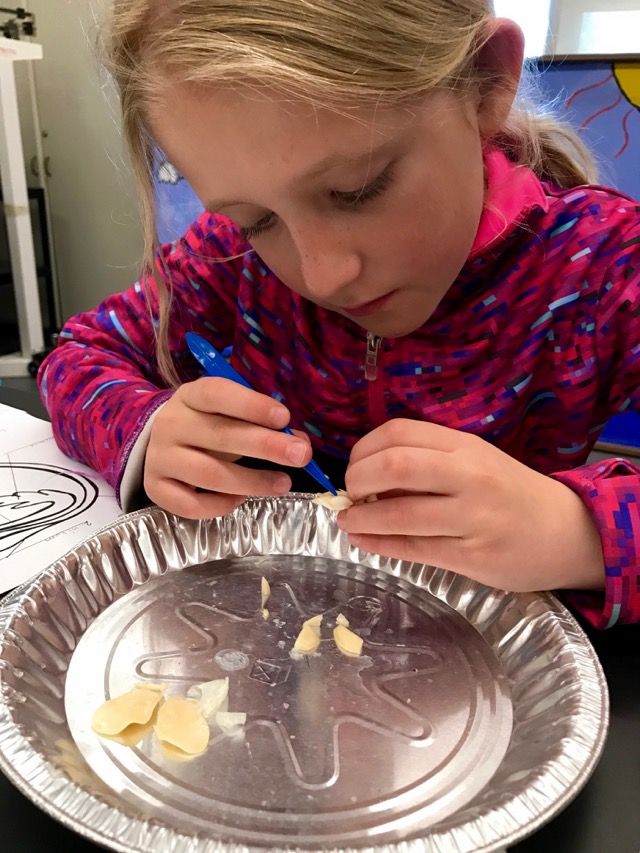
One day wasn’t enough to celebrate the Earth. At the magnet school in Meyers the students embraced a week of activities.

The theme last week was Plant Your Seed.

Earth Day has been celebrated on April 22 since 1970. It started in the United States; now more than 190 countries recognize this as an opportunity to take stock in what is going on environmentally with the world or in individual locations throughout the world.

Each day something different took place at the magnet school:

Monday: Students took an Earth Day pledge and each class participated in a school yard clean up.

Second-grader Briley Zlendick dissects a Lima bean. Photo/Frany Thorne

A letter to Mother Earth by second-grader Dylan Anton, who is in Frany Thorne’s magnet school class.

Tuesday: Book swap – students in each grade brought books to trade with others in a school-wide book swap.

Wednesday: Waste free lunch – This was a school-wide effort to reduce waste; students were encouraged to pack their lunches using reusable containers and fewer wrapped items.

Thursday: Lights out day – This was a school-wide effort to conserve electricity. Classrooms and hallways were filled with natural light from the windows, lessons took place outside, and each teacher made an effort to use less.

Friday: Labs – Each class participated in a hands-on science lab. Labs were carefully designed to follow the Next Generation Science Standards while also sticking to the Plant Your Seed theme.

“The goal of the week was to reinforce the importance of conserving our Earth. We had a very successful week and hope to foster the ‘Every day is Earth Day’ slogan in our actions,” second-grade teacher Frany Thorne told Lake Tahoe News.

— Lake Tahoe News staff report


Opinion: Golden Gate Bridge needs rail service

By Joe Mathews

If California is as serious about public transit as its leaders claim, why isn’t there rail service across the Golden Gate Bridge?

There’s no good reason why our state’s iconic span must devote its six lanes to cars. For more than 50 years, engineering studies have shown that the bridge could accommodate trains.

Joe Mathews

Today, there is no more glaring hole in California public transportation than the one across the Golden Gate Bridge.

North of the bridge, Sonoma and Marin counties are about to open the first phase, from Santa Rosa to San Rafael, of their SMART light rail service. SMART, which includes a bicycle-pedestrian pathway, will eventually serve a 70-mile corridor from Cloverdale to Larkspur, just 10 miles up the Highway 10 from the Golden Gate.

South of the bridge, San Francisco is spending billions to construct the Transbay Transit Center, a Grand Central Station of the West. Eventually it is supposed to be the northern terminus of high-speed rail.

But there is no plan for a train to connect the new SMART train with the new giant transit station. That’s a shocking failure for Bay Area do-gooders who love to lecture the rest of us on the need to go boldly into the future. What in the name of progressive enlightenment are you waiting for?

The idea of a Golden Gate Bridge train is not new. Such service was envisioned as part of the original plan for the BART system. Michael C. Healy, in his excellent new book “BART: The Dramatic History of the Bay Area Rapid Transit System,” recalls that Marin County leaders in the early 1960s badly wanted to be part of BART.

But in 1961, the governing authority of the Golden Gate Bridge balked at allowing trains, claiming that they would put too much stress on support cables. BART’s own engineering studies found that the bridge was plenty strong enough, but the bridge authority wouldn’t budge. In the end, BART dropped Marin from its plans, to the frustration of several county officials.

The dream didn’t die. In 1990, renewed talk of BART to Marin led to a study that found the bridge could handle trains. But the multibillion-dollar cost of taking BART to the North Bay ended the conversation.

In this history, there’s a lesson even more dramatic than the Golden Gate: There are huge costs when California skimps on infrastructure. A bridge train to the North Bay would have been easier and cheaper in the 1970s than now, and so for 40 years North Bay commuters have paid a rapidly rising price—in traffic, in tolls, time, and in the extortionate cost of parking in San Francisco.

There is real wisdom in the phrase that Healy attributes to Bill Stokes, the founding father of BART: “Build it now. It will never be cheaper.”

That’s why a train link over the Golden Gate Bridge would still make sense today. Yes, such a plan would be attacked—this is the Bay Area and this is California, after all. Preservationists would say an iconic American landmark is being sullied. Marin’s anti-growth zealots would argue a train would encourage new development in their idylls. Pointy-headed accounting types would cite the cost and point out that most commuters in the North Bay are going to jobs in the North Bay, not in the city.

And those who follow BART closely will argue that that system is at a difficult crossroads, and needs to focus on maintenance and other pressing projects, like a second tube under the Bay between Oakland and San Francisco.

To all such objections there is one answer: Why is the Bay Area thinking so narrowly and with so little vision for the future? As an Angeleno, I can’t resist pointing out to Bay Area friends that in the realm of public transit, we in Southern California are surpassing you, having passed sales tax increases to fund a transformational 50-year plan for a regional system that makes yours look like a disjointed joke. Are you really going to let yourself be embarrassed by L.A.?

Imagine how powerful a symbol of California’s connected future a Golden Gate Bridge-traversing train would be. It would draw commuters and tourists alike, making the planet’s greatest bridge even greater.

Such a train could be the inspirational showpiece for what the Bay Area badly needs: a new regional plan for transit that connects all nine of its counties. You’ve come to this bridge, California. It’s time to cross it.

Joe Mathews writes the Connecting California column for Zócalo Public Square.


Sales of existing U.S. homes rise to fastest pace in a decade

By Sho Chandra, Bloomberg

Sales of previously owned U.S. homes rose more than forecast in March to the fastest pace in a decade, signaling sustained momentum in the housing market despite higher prices and scarce supply, a report from the National Association of Realtors showed Friday.

Contract closings jumped 4.4 percent to a 5.71 million annual rate (forecast was 5.60 million), the highest since February 2007, after a revised 5.47 million the prior month.

Inventory of available properties fell 6.6 percent from March 2016 to 1.83 million, marking the 22nd straight year-over-year decline.

Read the whole story


Flood advisory for Truckee River area at Tahoe City

The National Weather Service in Reno has issued a weeklong flood advisory for the  Truckee River in Tahoe City.

In anticipation of runoff from the extreme snowpack in the basin water managers on April 21 increased the flow leaving Lake Tahoe through the dam in Tahoe City. The flows will be the highest they have been in 11 years.

This could cause minor flooding along the river from Tahoe City to Squaw Creek near the Squaw Valley ski resort, along bike trails and any low area.. 

The warning is in effect until April 27 at 9:45am.

— Lake Tahoe News staff report


Snippets about Lake Tahoe

·      Gary Romano, owner of Sierra Valley Farms presents his newest book “July & Winter: Growing Food in the Sierra” on May 20, 2pm at the South Lake Tahoe Library. Romano will share his knowledge from decades of experience growing food in the Sierra Nevada.

·      Taj Mahal and Keb Mo are touring together to promote their support first album together, “TajMo.” They will be at MontBleu in Stateline on June 24.

·      Wanderlust at Squaw Valley returns July 20-23.

·      Sixty-eight inches of new snow has fallen on the slopes of Sugar Bowl Resort in the month of April alone, bringing its season-to-date snow total to 782 inches. Resort officials have decided to extend the season until May 7. Daily operations will continue through April 23. Sugar Bowl will be open Friday through Sunday only, April 28-30 and May 5-7.

·      Placer County is asking people to take an online survey. The feedback will be used to develop a 10-year vision for recreation improvements.


Calif. city managers concerned pensions will be crippling

By Daniel Borenstein, Bay Area News Group

Lodi City Manager Steve Schwabauer worries about his town’s fiscal solvency — and estimates roughly a third of California’s municipalities are in the same position because of rising pension costs.

Nancy Kerry, city manager of South Lake Tahoe, says her community will avoid bankruptcy but will have to make severe cuts in services to do so.

Schwabauer and Kerry are among a small number of top administrators now publicly talking about the financial crisis ahead. They both say the only way to stave it off begins with reducing pension benefits for existing employees.

Read the whole story