Snippets about Lake Tahoe

·      South Lake Tahoe Building Department will give a presentation that highlights the California Code change update at Lake Tahoe Airport on April 27 from 5-6:30pm. For questions or more information contact Dave Walker at 530.542.6072 or dwalker@cityofslt.us

·      Barton Foundation’s annual golf tournament is June 23 at Lake Tahoe Golf Course in Meyers. For details, go online.

·      There will be a celebration of life for Ken Rollston on May 6 at 2pm at Lakeland Village’s pavilion South Lake Tahoe.

·      South Lake Tahoe Police Department is now on Twitter @SLakeTahoePD.

·      People may drop off their unwanted prescription meds at Safeway in Round Hill on April 29 from 10am-2pm.


Cave Rock water best in state of Nevada

For the second time in four years Douglas County has the best tasting water in Nevada.

Cave Rock Water Treatment Plant had won first place for the state’s best tasting water.  The service area includes Cave Rock, Lakeside and Skyland systems.  They get their water directly from Lake Tahoe.

Another Douglas County system, “Montaña,” was second.  This system represents a water well servicing homes near Jack’s Valley Road north of Genoa.

In 2014 Douglas County Utilities won first place for a well in Genoa.  The following year, Glenbrook Water Co. took first place for the state.  That year Glenbrook’s sample went to the finals in Washington, D.C., where it won first place in the United States against nearly 1,000 others.


Squaw hosting youth adventure games

Kids Adventure Games will return to Squaw Valley, June 23-25.

This for kids 6-14. Teams of two kids will navigate an adventure course that features biking, trekking, rope swings, mud pits, cargo nets, a giant Slip ‘N Slide and other obstacles. Competitors will strengthen physical and emotional bonds through a series of challenges centered on building grit and resilience among the natural terrain of the mountain.

Registration is under way online. Last year’s race sellout.

Racers also have an opportunity to participate in skills clinics prior to the races to practice and perfect skills including teamwork, biking, climbing and more. Costs are $150 for a team of two prior to May 15 and $180 until the race sells out. Skills clinics are optional and cost $60 per participant.

The competition is part of a nine-race series at ski resorts across the country.


Audit critical of UC system’s pay for employees

By Patrick McGreevy, Los Angeles Times
 
The administration of the University of California system pays top workers salaries significantly higher than that of similar state employees, has provided millions of dollars in benefits not typical to the public sector and failed to disclose to the Board of Regents and the public that it had $175 million in budget reserve funds, a state audit found Tuesday.

The audit triggered a dispute with UC President Janet Napolitano, who said charges of hidden funds were false, while two members of the UC Board of Regents charged recommendations to give the Legislature budget authority over the Office of the President encroached on UC’s constitutional powers.

The audit of the Office of the President also found that it failed to satisfactorily justify its spending on system-wide initiatives and “inappropriately” screened surveys submitted by auditors to campus officials.

Read the whole story


Search suspended for missing Truckee plane

Mark and Brenda Richard

By Nick Rahaim and Randi Rossmann, Santa Rosa Press Democrat

After six days of scouring a remote section of the northern Sierra Nevada, authorities announced Monday they had suspended their search for a missing Santa Rosa couple presumed to have crashed while flying from Truckee to Petaluma.

“They’ve exhausted the search,” said Sgt. Michelle Anderson of the Sierra County Sheriff’s Office, which worked with the Civil Air Patrol, the California National Guard, the California Highway Patrol and other agencies to locate the plane.

Brenda and Mark Richard flew out of the more than mile-high Truckee Tahoe Airport April 17 headed for Petaluma. At the time of their takeoff around 4pm, the temperature was 41 degrees with overcast skies and wind gusts exceeding 20 mph.

Read the whole story


State senator sponsoring student video competition

State Sen. Ted Gaines, R-El Dorado, is hosting a video contest for high school and college undergraduates who reside in his district.

The theme is How American Exceptionalism Made California Golden.

Participants must create a two- to five-minute video using the theme. The videos may feature live people, stills, animation – whatever best conveys the message. The contest encourages students to reflect on California’s history and ponder what’s in store for the future.

Videos are due May 26. Two winners – one high school and one college – living in or attending school within the 1st Senate District will be selected by Gaines. Each receive a $300 cash prize and be invited to the state Capitol for a meeting with the senator and a VIP tour of the building.

All details about the contest, including the rules and entry form are available online.


Radon expert to give talk in S. Lake Tahoe

South Tahoe Association of Realtors is hosting a class about radon on April 26 from noon-1pm.

The free talk will be at STAR’s office, 2307 James Ave. in South Lake Tahoe.

The guest speaker will be Jim Gorman of Tahoe Radon. Gorman is a licensed contractor and is certified by the National Radon Proficiency program. He will be covering radon in the Tahoe basin, the potential risks and how to mitigate them as well as create a safe environment.

Radon is a radioactive gas that comes from uranium-rich decomposing granite. Many Lake Tahoe homes have high levels of radon gas. After cigarette smoking, it is the second leading cause of lung cancer.


Loop road environmental documents released

By Kathryn Reed

A multi-million dollar transportation project on the South Shore has mushroomed into being a project that could dramatically change the state line area, with repercussions possibly extending beyond the Y.

The loop road would essentially flop how Highway 50 and the southern section of the current loop operate. Even though the same number of lanes would be in use, more land would be paved over. Alternative B includes adding 5.76 acres of asphalt with a roundabout on the eastern end in Nevada or 7.62 acres with a signal at that intersection.

Five alternatives were reviewed in the environmental impact study/environment impact report, with Alternative B the proposed project area. The final document will have the preferred alternative. (One alternative would create eight-lanes of traffic in some areas.)

The EIS/EIR was released Monday night. Tahoe Transportation, the lead agency on the project, hosted an open house April 24 that had many of the same spectators and the same photos and charts from previous gatherings.

The project area extends from a quarter mile southwest of Pioneer Trail in South Lake Tahoe to Lake Parkway in Stateline.

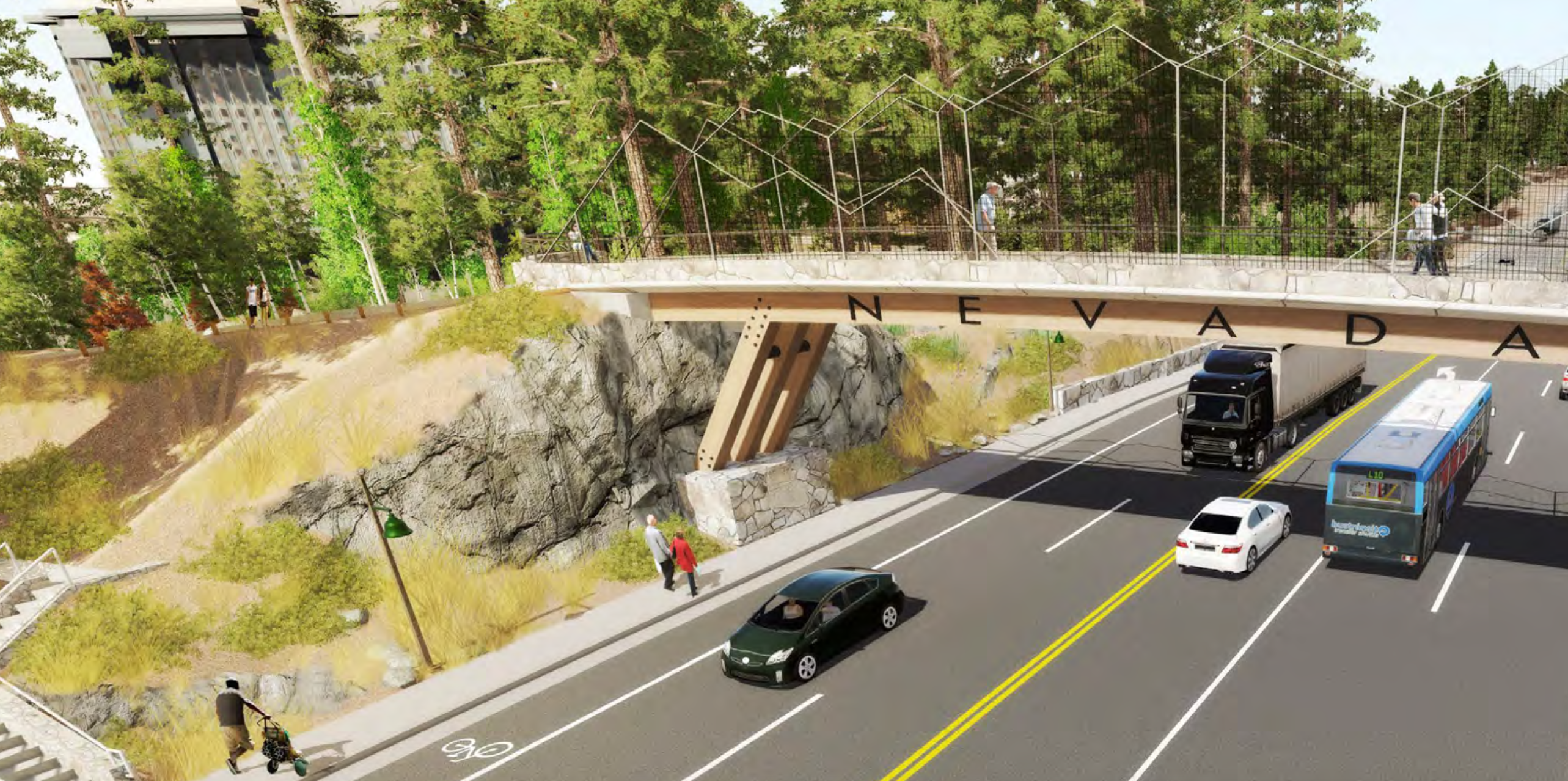
The proposed pedestrian bridge over the realigned Highway 50 near Van Sickle Park. Rendering/Ascent

Alternative B calls for four 11-foot wide travel lanes, 5-foot wide shoulders, and turn pockets at major intersections and driveways. Signals would be added at Heavenly Village Way and what is now the back entrance to Harrah’s.

Six- to 18-foot retaining walls would be built near Van Sickle Bi-State Park. The entrance would be reconfigured and there would be a signal there.

The draft EIR/EIS said noise from the highway will not be a nuisance for park users.

The current highway between Park Avenue and Lake Parkway would be one travel lane in each direction, with landscaped medians, left-turn pockets at major intersections and driveways, and new or upgraded bike lanes.

The EIS/EIR included three areas that were studied for affordable housing that together could accommodate 227 units. One of those sites is where Mike McKeen owns property.

“We will never do affordable housing,” McKeen told Lake Tahoe News. “They offered us incentives to do it, but we don’t want it.”

What he would entertain is condos or a second level of commercial. His land is likely to be the gateway, so to speak, where the new highway would begin on the western edge.

Beyond what was studied in the environmental document, TTD is looking at California Tahoe Conservancy land near the Y for affordable housing.

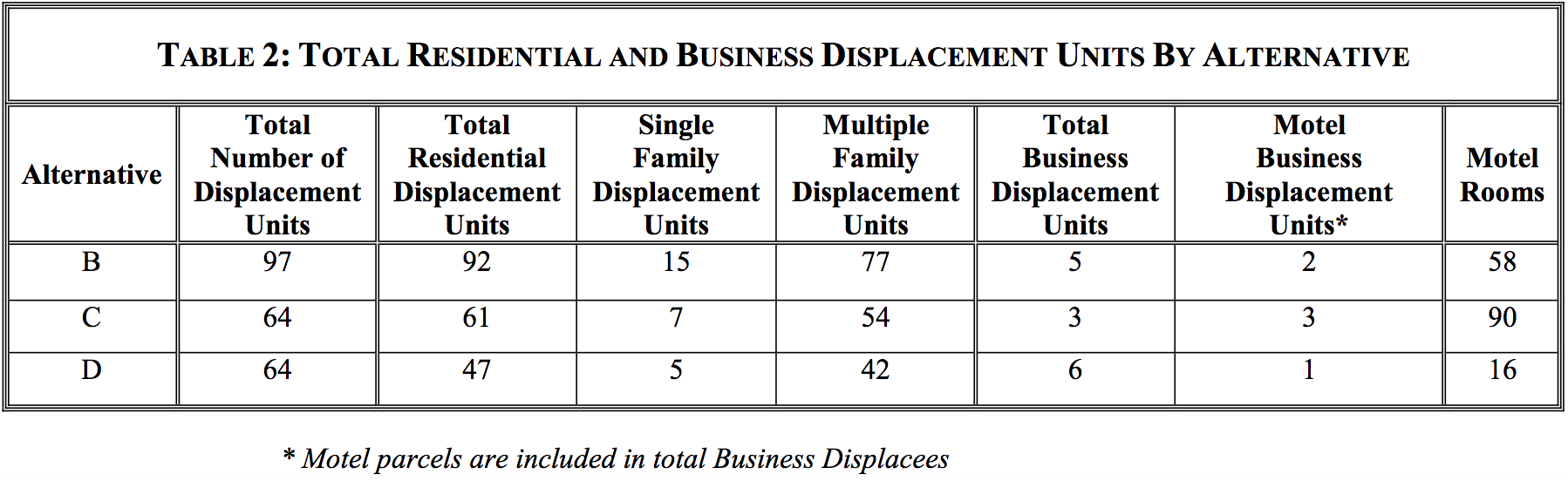
The agency is legally obligated to relocate the residents and businesses that would be bulldozed to accommodate the realigned highway.

The project started as a way to move the highway out of the casino corridor and turn that area into a city-county street. The new highway would travel behind Harrah’s and MontBleu.

While that is still the plan, all the renderings show a complete-street landscape, with wide bike lanes, and decorative vegetation mixed with the new commercial areas. A footbridge would span the new highway to link the casinos with Van Sickle Bi-State Park.

The belief is millions of dollars would be added to the local economy with more people opting to stop to shop-eat-recreate instead of driving through. Adding more transit options – which includes becoming more walkable and bikeable – the goal is to get people to stay longer

TTD had hoped for federal TIGER (Transportation Investment Generating Economic Recovery) funds to pay for the project. With a new administration in office, it’s not known if that will continue to be a funding source. TTD will be pursuing other avenues.

—–

Notes:

·      The draft EIR/EIS is available online.

·      People have 75 days to comment.

·      The final document is expected to be released in the fall.


Opinion: Full school day doesn’t make the grade

By Joe Mathews

Many mornings, I think my state senator has the best policy idea in California.

At other times, I think he’s missing the point.

The idea involves the sleep of schoolkids, and the state senator is Anthony Portantino, who represents the San Gabriel Valley.

Joe Mathews

Portantino has won plaudits for a bill requiring middle and high schools to start the school day later—no earlier than 8:30am. The bill is grounded in research showing that a later start would reduce tardiness and absenteeism, thus increasing school funding (which is tied to attendance) and improving academic performance.

My two older sons’ school starts at 8:10am. So, at 8:02am on many days, Portantino’s bill has such obvious appeal that I wonder why he doesn’t extend its protection to elementary schools.

Some days, just eight minutes before school starts, I must climb to the top bunk to wrestle my oldest son, a second-grader, out of bed, so we can race three blocks to his classroom. Sometimes I dive deep into the lower bunk to pull out my middle son, a kindergartner. I’ve strained my back with both maneuvers. Yes, I could wake them earlier—but this causes conflict, and doesn’t necessarily get them out of bed. I try to get them in bed at 8:30pm so they’ll wake up earlier, but they just stay up reading Harry Potter and Captain Underpants books. So another 20 minutes of wiggle room, courtesy of state law, sounds pretty good.

But then I remember that the real problem in California education is not how early the school day starts.

It’s how early the school day concludes.

Put simply, California’s idea of a full day of school is—in reality—far less than a full day. The state requires only half-day kindergarten, which amounts to just three hours and 20 minutes, about the length of a pro football game. And the full day for higher grades doesn’t equate to a full work shift for parents and other caregivers. First- through third-graders are required to have only four hours and 40 minutes per day. It’s five hours for grades four to eight, and six hours for high schoolers.

School districts are free to do more. But given funding challenges, they often can’t. The calendar at our local elementary school is thus typical. My kindergartner is with his teachers from only 8:10-11:30am. My second-grader is in class until 2:25pm four days a week; on Friday, there’s often early dismissal at 1:05pm. These shorter school days happen in a California that, following American tradition, guarantees just 180 school days a year.

This has the feel of hypocrisy (are children really our top priority?) and missed opportunity. Despite the low reputation of California education, our teachers and schools have made big gains in achievement over the past generation. So many of the teachers I’ve encountered in California schools are nothing less than magicians. Why can’t we give our kids more time with them?

The biggest answer is money: more days and hours of school would cost more, and California’s rickety school funding regime struggles to pay for the instruction we currently have. But extensive research shows we should find a way to fund more instructional time. Dozens of studies of campuses with longer school days and school years have found that such schools do better, especially in serving students considered to be at-risk. The chain of charter schools known as KIPP has become a national model by increasing learning time with a school day that extends more than eight hours, typically from 7:30am to 4pm.

Extending the school day would help address the state’s shortage of reliable childcare and might even blunt the effects of inequality, since better-off parents can fill off-school hours with enriching activities. My wife and I are fortunate to be able to spend more than $700 a month to put both boys in our district’s after-school program, and to plunk down another $1,500 for after-school enrichment classes in robotics and Mandarin. It’s unfair that other parents can’t do this.

Up in Sacramento, there’s talk about legislation to exempt teachers from some taxes. That’s fine, on one condition: it comes with an increase in the length of the school day and school year.

What would that look like? Well, 9 to 5 was good enough for Dolly Parton. And if a longer day means the kids come home tired, so much the better. Maybe they’ll get to bed on time, and wake up early enough that I don’t have to wrestle anyone out of his bunk.

Joe Mathews writes the Connecting California column for Zócalo Public Square.



Professional soccer team to play against LTCC

Lake Tahoe Community College men’s soccer team will play an exhibition game against the Reno 1868 FC professional soccer team under the lights at home on April 25 starting at 7pm.

There is no cost to attend.

The Reno 1868 FC team is a new Division II professional team that is affiliated with the professional Major League Soccer team San Jose Earthquakes. Professional scouts will be in attendance to watch the Reno team play to do call-ups to the Earthquakes.

“This is a great opportunity for them to see our campus, facilities, and the player talent we have at LTCC,” coach Nick Arbalaez said in a press release.

This will be the first professional soccer team to play in Tahoe. Reno 1868 FC players will sign autographs following the game.

Reno 1868 FC will return to LTCC on Aug. 22 at 7pm to kick off LTCC’s 2017 soccer season.