Sandoval pleads Nev.’s case with federal officials

By Yvonne Gonzalez, Las Vegas Sun

The state is moving forward with its plans to implement recreational marijuana and push back against plans to store nuclear waste at Yucca Mountain, Gov. Brian Sandoval told federal officials in Washington, D.C.

Sandoval spent time this week with Energy Secretary Rick Perry, Attorney General Jeff Sessions, Interior Secretary Ryan Zinke and Environmental Protection Agency Administrator Scott Pruitt.

Sandoval told reporters Friday that he disagrees with the Trump administration’s stance on Yucca Mountain as well as a proposed $230 million reduction in funding for the Southern Nevada Public Land Management Act, which has allowed for the sale of land to protect other areas. His conversations with federal officials covered these issues as well as marijuana, mining, immigration and infrastructure.

Read the whole story


SLT taking sign ups for youth summer camps

Registration for South Tahoe Adventure Recreation Camps opens May 1.

STAR Camp’s mission is to provide an active, healthy, and safe environment for youth to learn and play by focusing on inspiring a love for the outdoors through authentic Tahoe recreation experiences in the natural playground of the Tahoe region.

The structured programs include a strong emphasis on promoting and recognizing positive behavior, fostering meaningful friendships, and developing children’s self-confidence and leadership skills. 

Camps will begin June 26. Space is limited. Drop-ins are welcome on a space available basis only.

The camps are for those entering grades 1-6.

To register, go online. For more information, call 530.542.6056 or email RecreationInfo@cityofslt.us.


Sports bar to open soon in S. Lake Tahoe

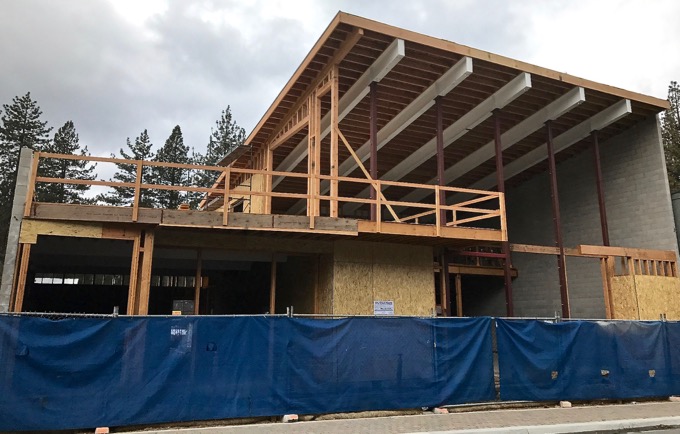
Pick 6 sports bar this fall will open on Harrison Avenue in South Lake Tahoe. Photo/LTN

Expect Pick 6 sports bar on Harrison Avenue to be open in time for the upcoming college and pro football seasons.

The two-story, 3,600-square-foot establishment will go where Rude Brothers once was in South Lake Tahoe.

Local property owners Mike McKeen and John Cefalu gutted the building and are essentially creating an entirely new venue. The roof and siding are expected to be completed by the end of June, with tenant improvements then beginning.

The bar owner, Matt DeLima, is a graduate of Lake Tahoe Community College. He also has a location in Pleasanton with the same name. Pick 6 refers to an interception in football, with the player running the ball back to score a touchdown for six points. A separate, smaller restaurant is also being leased by the same owners. Details about it have not been disclosed.

On the second floor of the sports bar will be a deck on the front. A slice of it will have a view out to the lake.

Expect wall-to-wall televisions to fill the sports bar, with patrons able to see an array of sporting events. Food will be available.

Even though the location only comes with 15 parking spaces, the plan is to have people park in the lot next to Tahoe Mountain Lab because it is rather vacant after 5pm, and then in other nearby lots as well. There is also a group looking at buying the two city-owned lots on Pasadena Avenue and paving them over. Harrison businesses are also looking at instituting a three-hour maximum for parking in the area.

— Lake Tahoe News staff report


Possible to have garden-fresh herbs all year

By Melinda Myers

Enjoy herbs all year. Harvest herbs now for garden-fresh meals and preserve a few for next winter.

Snip a few leaves or leaf-covered stems as needed. For the same intensity of flavor, you generally need two to three times more fresh herbs than dried except for rosemary which has an equally strong flavor fresh or dried. Continue harvesting herbs as needed throughout the growing season. And don’t worry about harming the plant because regular harvesting encourages new growth which means more for you to harvest. Just be sure to leave enough foliage to maintain plant growth.

You can remove as much as 50 percent of the foliage from annual herb plants. This is about when the plants near their final height. You can remove up to one-third from established perennial plants that have been in the garden for several months or more. Harvest when the plant has formed buds, but before they open into flowers for the greatest concentration of flavor. This is the perfect time to harvest herbs you plan to preserve.

Preserving herbs from the garden provides fresh-from-the-garden flavor all year. Photo/Bonnie Plants

Use a pair of garden scissors or pruners for faster and easier harvesting. Make your cuts above a set of healthy leaves to keep the plants looking good. Then preserve the flavor and zest of herbs with proper storage and preservation.

Store thin leafy herbs like parsley and cilantro for up to a week in the refrigerator. Place in a jar of water, like a flower arrangement, and loosely cover with a plastic bag. Keep basil out of the fridge to avoid discoloration and others on the counter for quick and frequent use.

Wrap dry thicker-leafed herbs like sage and thyme in a paper towel, set inside a plastic bag and place in a warmer section of the refrigerator.

Freeze sprigs, whole leaves or chopped clean herbs on a cookie sheet. Or pack clean diced herbs in ice cube trays and fill the empty spaces with water. These are great for use in soups and stews. Store the frozen herbs and ice cubes in an airtight container or baggie in the freezer.

Or bundle several stems together, secure with a rubber band and use a spring type clothespin to hang them in a warm dry place to dry. Make your own drying rack from an old embroidery hoop, string and S hooks. Visit Bonnie Plants do-it-yourself Herb Drying Rack project for detailed instructions.

Get creative and use some of your herbs to make a fragrant edible wreath. Use fresh herbs that are flexible and easier to shape into a wreath. They will dry in place and can be harvested as needed.

Speed up the drying process in the microwave. Place herbs on a paper towel-covered paper plate. Start with one to two minutes on high. Repeat for 30 seconds as needed until the herbs are brittle.

Store dried herbs in an airtight plastic or glass jar.

Keep enjoying these fresh-from-the-garden flavors throughout the remainder of the season. And consider preserving a few for you, your family and friends to enjoy throughout the winter.

Gardening expert Melinda Myers has written over 20 gardening books, including “Small Space Gardening” and the “Midwest Gardener’s Handbook.” She hosts “How to Grow Anything: Food Gardening For Everyone” DVD set and the nationally syndicated Melinda’s Garden Moment TV and radio segments.


Tennis pro at ZCTC eager to raise the level of play

By Kathryn Reed

Knowing why to hit which stroke when and how to execute those strokes are important to becoming a better tennis player.

Dave Nostrant believes what sets his tennis program apart from others is teaching more than just strokes. He adds a bit of philosophy. It’s not just the “how to” but explaining the “why” that differentiates him from so many other pros.

Nostrant has been a tennis pro for decades, but it’s being a student of the sport that allows him to continue to grow. And that growth is then passed on to his students.

He will be bringing his brand of tennis to Tahoe starting in mid-May as he takes over as the head pro at Zephyr Cove Tennis Club.

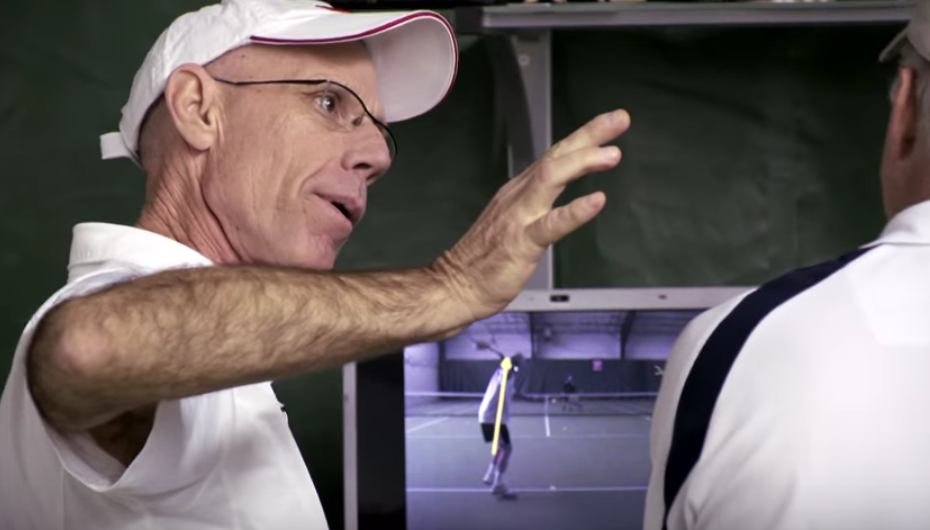
Dave Nostrant will bring video analysis to Zephyr Cove Tennis Club. Photo/Provided

Nostrant will be offering a variety of lessons for all ages and abilities – from the newbie to veterans of the game.

“With private lessons, something more unique is that I will be able to offer video analysis. This will be for anyone who will work with me consistently over the summer,” Nostrant told Lake Tahoe News. “Video bridges that learning gap. It makes learning so much faster.”

He doesn’t have a set schedule yet, but foresees being at the courts possibly seven days a week, maybe 10 hours a day if there is the demand.

So many pros are like a human ball machine – feed the ball, make the player run and call it a day. This is a good way to stay at the same level. This isn’t what Nostrant is about.

Nostrant learned from one of the greats – Vic Braden. It was Braden who started the tennis college concept. Nostrant uses many of those same techniques.

“I worked for Vic in Germany. I wanted to keep learning. So often in this industry you just work,” Nostrant said. That job led him to St. George, Utah, where he started the Vic Braden Tennis Academy. He then branched out on his own with Court Think Tennis, still based in Southern Utah, but with camps all over the country. In the last week he has renamed it Dave Nostrant Tennis.

(This reporter has twice been to his Utah camps and is a member of Zephyr Cove Tennis Club.)

A welcome party is being thrown for Dave Nostrant on May 27 starting at noon at the Zephyr Cove courts. The Viva La Tennis doubles mixer and barbecue is the club’s season opener for all levels and ages. Match play is free for members, $10 for guests. Memberships are available online or available that day.

Nostrant said it’s having worked with several players from Zephyr Cove that led him to want to pursue working in Tahoe. His contract is for one year, which is a way for both sides to see if it’s a good fit.

“”Dave is passionate about helping adults and juniors improve their tennis. We are lucky to have someone of his caliber as our teaching pro,” Carolyn Wright, president of Zephyr Cove Tennis Club Foundation, told Lake Tahoe News. Wright has been to two of Nostrant’s camps in Utah.

The foundation is the nonprofit group that oversees the six courts in Zephyr Cove through a multi-year contract with Douglas Club.

Nostrant is still a pro in Utah, but with the indoor courts there having been turned into a basketball facility, the summer heat is not conducive to enjoyable tennis.

In addition to his daily job, Nostrant is hoping to put on multi-day camps at Zephyr Cove that would be for locals and out-of-towners. His goal is to resume having camps in multiple locations.

“I would like to train some pros, especially for the junior program. Some pros are accepting to new info and some aren’t,” Nostrant said.

Nostrant is still an avid player, having won the 2016 Huntsman World Senior Games in St. George, and the open doubles championship in the 60- to 64-year-old bracket. 


Opinion: Census questions bring about different responses

By Jennifer Lee

Like most Americans, I spent most of my life not appreciating the herculean effort the U.S. Census Bureau undertakes every 10 years.

Since its inception in 1790, the U.S. Census has aimed to count every living person in the country, and the stakes are high. The results of the census determine the allocation of hundreds of billions of federal dollars, which affect every slice of American life.

In order to do so, the Census must ask Americans the right questions—and give them the right options for their answers. It seems relatively simple, but—as I learned in 2013, when I became a member of the Committee on Population Statistics of the Population Association of America—the undertaking is so enormous that the planning for the 2020 Census began even before the completion of the 2010 Census. In 2010, the Census Bureau launched the Alternative Questionnaire Experiment (AQE) to compare different Census questionnaire design strategies. Five years later came the National Content Test (NCT), in which different questionnaires were sent to a statistically representative sample of approximately 1.2 million households in the United States and Puerto Rico.

I had the opportunity to review the results of both tests and assess which questionnaire design results in the most accurate count of the U.S. population. That meant taking three interrelated components into consideration. The first is increased reporting: Which questions were people most likely to answer? The second is decreased non-reporting: Which questions were more likely to get groups who are susceptible to non-reporting (including poor families who get evicted, immigrants who do not read or understand English, and undocumented migrants who may fear government officials) to respond? The third is increased, detailed reporting: Which questions yield more information about the respondents?

The design of a question itself affects how people answer it. Take the race and ethnicity question. People who identify as Asian or Hispanic answer it differently depending on how it is presented on the Census form.

In the 2010 Census, Hispanic origin and race were listed as two separate questions. In both the AQE and NTC, the Census Bureau tested the option of combining race and Hispanic origin into one question, which they refer to as the “combined format.” In addition, they tested which combined format would elicit the most detailed reporting on origin.

One option was to list the racial categories only, with an option to write in their detailed origin. A second option was to list racial categories and also provide check boxes denoting examples of detailed origin, along with the option to write in one’s origin.

Figure 1 – Census Race 2010

Figure 2 – Census Race Combined With Write In Only

Figure 3 – Census Race Combined with Detailed Check Boxes

More than 70 percent of self-identified Hispanics said they were Hispanic when they were offered Hispanic as a race option (the combined option). When they are not presented with this option, as in the 2010 Census, self-identified Hispanics are more likely to check “some other race” or mark two or more races. In short, the combined option—in which Hispanic is listed as a race category—more easily allows Hispanics to accurately report their Hispanic identity. Moreover, when Hispanics are offered the combined option, they are significantly less likely to mark “some other race” or two or more races to self-identify. Both results indicate more accurate reporting on the part of Hispanics.

Moreover, Asians were most likely to mark their race, including their detailed race, when they are provided with a check box to mark their national origin (for example, Chinese, Filipino, Asian Indian, Vietnamese, Korean, Japanese). When these check boxes are removed, however, and Asians are presented with only a space to write in their national origin, they are less likely to report it. The difference is significant. The check-box format yielded a 97.4 percent response rate among Asian-Americans, and plummeted to 92.6 percent when they were provided only with a write-in option.

Detailed reporting among Asians is critical because it allows researchers to disaggregate data, which is essential to identifying health, educational, and economic disparities among Asian ethnic groups.

Such disaggregation may sound technical and mathematical, but it can have profound human impacts. For example, having data specific to different sub-groups on disease rates, health insurance coverage rates, and birth and death rates can allow policy makers and community organizations to make more informed decisions about how to best serve these populations.

Some Asian ethnic groups are more susceptible to certain health risks: Men and women of Vietnamese origin experience the highest rates of lung cancer among all Asian American subgroups, while men and women of Korean origin have some of the highest colorectal cancer rates. Such data can guide outreach on health insurance coverage; while 13 percent of Asian Americans lack health insurance, the rate is as high as 20 percent among Koreans.

In California, there’s been broad recognition of the importance of breaking out such data. Last fall, Gov. Jerry Brown, signed legislation directing the Department of Public Health to disaggregate data for the Asian American, Native Hawaiian, and Pacific Islander populations on or after July 1, 2022. Following suit, the University of California and California State University have agreed to begin releasing disaggregated data on admissions, enrollment, and graduation rates—data that will help to unveil the wide disparity in educational attainment among Asian Americans.

Data disaggregation is a powerful weapon to dismantle the dominant narrative of Asian Americans as the model minority, which has resulted in their exclusion from policy debates on poverty, health care, and education. While Asian Americans may be touted as academic high achievers, one-third of Cambodians, Laotians, and Hmong do not graduate from high school. Data disaggregation exposes these gaping differences among Asian ethnic groups, and points to the dire need for the federal resources to help boost the educational outcomes of these groups, which are essential to immigrant and second-generation integration.

If the 2020 Census provides only a write-in option to list one’s origin, we will lose a lot of disaggregated data, and be unable to identify the stark differences among U.S. Asians. We will also miss a great deal of information on the country’s growing and increasingly diverse Hispanic population.

Jennifer Lee is a chancellor’s fellow and professor of sociology at UC Irvine. In July, she will join the Department of Sociology at Columbia University.


EPA scrubs climate change data from website

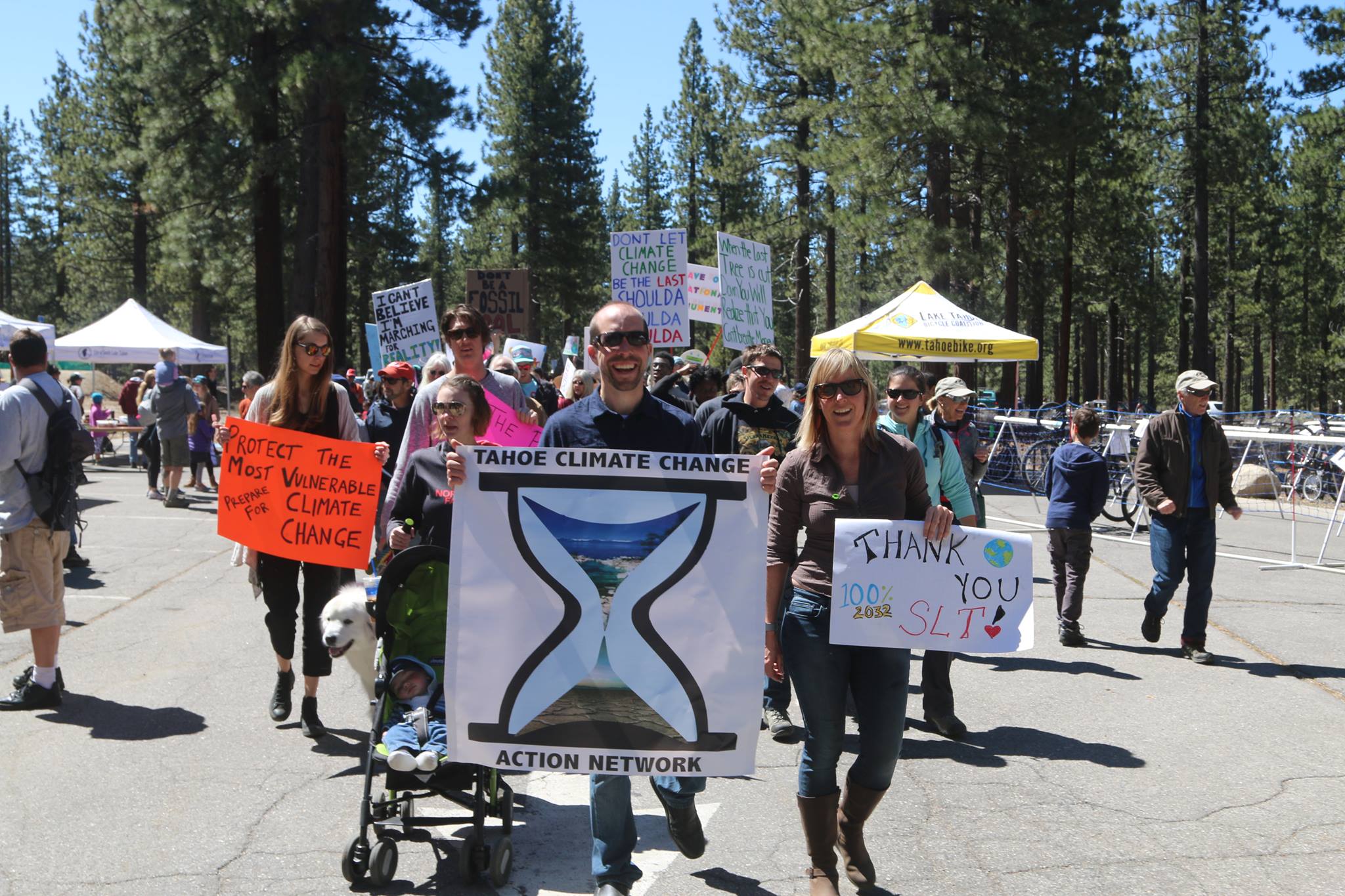
Hundreds march April 29 in South Lake Tahoe for climate change awareness. Photo/Tony Davies

By Michael Collins , USA Today

 WASHINGTON — The Environmental Protection Agency is updating its website and, in the process, has removed a page that explained the causes and effects of climate change.

The agency said Friday the website, epa.gov, is undergoing changes to reflect its new direction under President Trump and EPA Administrator Scott Pruitt.

The overhaul already appears to have impacted at least two of the agency’s websites – the EPA’s main climate change site and another regarding the Clean Power Plan, a rule put in place under former President Obama to reduce carbon pollution from power plants.

Read the whole story


Study: Running extends life expectancy

By Gretchen Reynolds, New York Times

Running may be the single most effective exercise to increase life expectancy, according to a new review and analysis of past research about exercise and premature death.

The study found that compared to nonrunners runners tended to live about three additional years, even if they run slowly or sporadically and smoke, drink or are overweight. No other form of exercise that researchers looked at showed comparable impacts on life span.

The findings come as a follow-up to a study done three years ago, in which a group of distinguished exercise scientists scrutinized data from a large trove of medical and fitness tests conducted at the Cooper Institute in Dallas. That analysis found that as little as five minutes of daily running was associated with prolonged life spans.

Read the whole story


Nevada gets $5.6 million to combat opioid abuse

By Sandra Chereb, Las Vegas Review-Journal

CARSON CITY — Nevada will receive $5.6 million from the federal government to help fight opioid addiction, Gov. Brian Sandoval announced Thursday.

The money is part of the 21st Century Cures Act, passed by Congress late last year, which included $1 billion in grants to help states deal with growing opioid abuse.

Sandoval in a statement Thursday said the federal grant “will provide significant resources aimed at combating the opioid crisis, a sweeping epidemic which is hurting families across Nevada and our nation.”

Read the whole story


Founder: Burning Man’s evolution far from over

By Linda Fine Conaboy

INCLINE VILLAGE – Burning Man founding board member Michael Mikel told Lake Tahoe News that Nevada is the last American frontier. “It’s the last place where there’s so much freedom, people can be themselves.”

Mikel is also known by his playa name, Danger Ranger. This month he gave a historical overview of Burning Man at a talk at Sierra Nevada College.

History comes easy to Mikel. His bio says he’s a historian and a futurist. He’s also, for the last two years or so, a proud Nevadan, having migrated to his turn-of-the-century Reno home from the Bay Area.

Mikel and other founding Burners thought Nevada was the ideal place, which is why in 1990 they packed up The Man and trekked him, ensconced in a rented truck, to the Black Rock Dessert, far from his fog-shrouded Baker Beach origins in San Francisco.

The Man, Mikel said, simply outgrew his coastal origins and the desert turned out to be his destiny, a fact proven by the number of people, whether they have attended the desert event or not, know who the tall guy is.

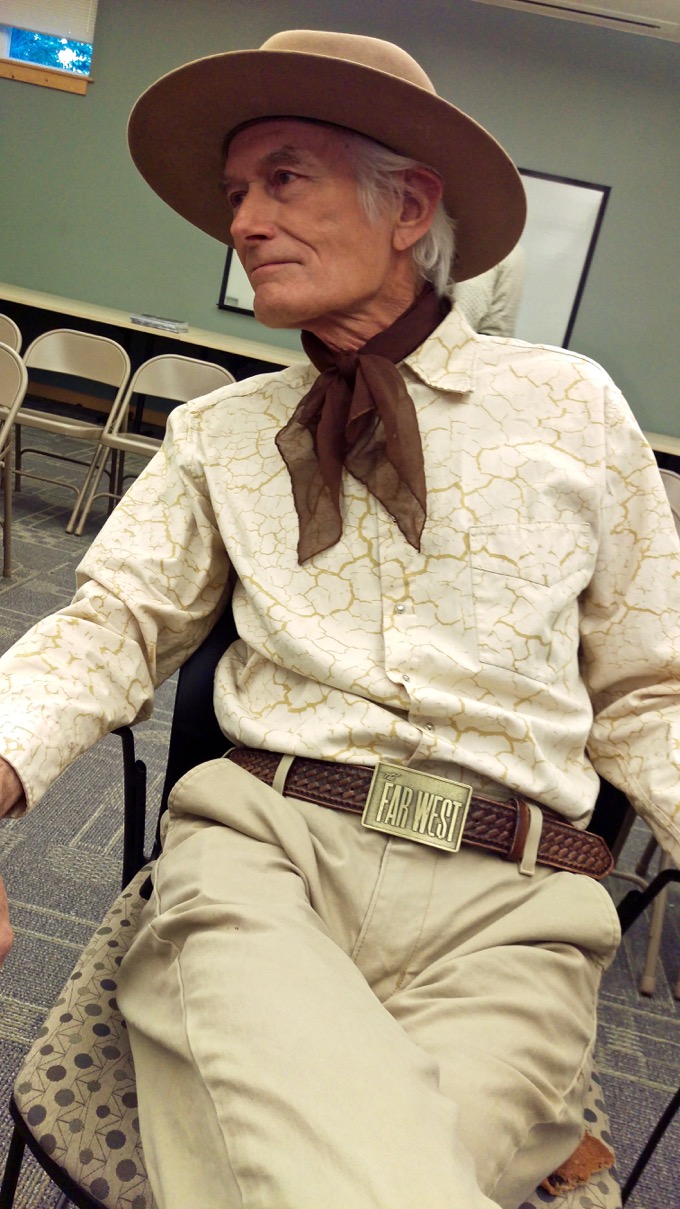
Mikel’s mission on this cold evening at SNC was to lay out for his audience what he calls the five ages of Burning Man. The evening was a most interesting trip through history related by Ranger Danger, who, true to his moniker, dressed as a ranger from his Mounties-style handsome hat to his brown boots, into which he tucked his trousers.

Around his neck, he tied a scarf, nattily offsetting his custom beige shirt with an imprinted pattern depicting the whorls of dry, parched clay that is the Black Rock desert.

Although others disagree with the evolution of Burning Man, according to Mikel, the story unfolds perfectly in five periods. They are: exploration; rapid growth; protectionism; outreach; and the age of scarcity.

The Age of Exploration, from 1986 to 1990, according to Mikel, was actually the precursor of today’s Burning Man, but nobody knew it. It became an underground event full of experimentation with a low barrier to entry—everybody was welcome—resulting in a high rate of participation.
Facts from Michael Mikel:
• Burning Man uses more propane than any other industry in the U.S.
• 6,000 portable toilets are emptied two times each day
• There are regional burns in 34 countries
• In July, Nevada Museum of Art opens a Burning Man exhibit. Upon closing in Reno, it heads to the Smithsonian Museum.
• 5,000 low-income tickets are sold annually at $195 each
• People sky dive in Burning Man, but so far, each has had a ticket
• 5,000 people volunteer at the event.

The first man was 8-feet-tall, doused in gasoline and pulled into place by humans before being set afire on Baker Beach during the summer solstice in 1986.

“It was like a family picnic,” Mikel said, “so the 20 or 30 of us there decided to do it again in 1987.” The following year, The Man was 30-feet -tall and more complicated, and in 1989, with a 40-foot-tall Man, the number of attendees quadrupled; in 1990, the authorities broke up the party and didn’t allow the beach burn.

The Age of Rapid Growth, from 1990 to 1996, saw Burning Man’s new beginnings at Black Rock. “It literally flew out of control,” Mikel said, although only 80 people participated in the first desert burn.

He said this enthusiastic group of desert neophytes had much to learn about life on the playa. For example, their first big lesson was that parachutes, which they erected for shade, are designed to catch the wind. And catching the first playa breeze, off they sailed.

That year (1990) saw people pulling the rope to raise The Man to his full height. In 1991 Crimson Rose, also a founding board member and board secretary, climbed The Man. Crimson Rose founded the Black Rock Arts Foundation as well as the Burning Man Project.

In 1992, there was music and the Black Rock Rangers were born. The group emulating the Texas Rangers, now numbers 800 people. This was also the year of government regulation—they were required to pull a permit. Today, Mikel said, it takes an entire staff to work with Burning Man’s federal landlords.

Subsequent years during this period, saw the first theme camp, which was inundated by extreme weather—lots of airborne dust followed by huge dumps of rain.

The population in 1993 was relatively small, leading to a mandated entry fee of $30 in 1994 to augment costs, the same year the lamplighter ceremony began, witnessed by a surge in population—2,000 people.

Other firsts during this period of rapid growth included the first café, the first communication with the outside world, the first art car and the first trash fence installed to snag garbage as it blew about the playa.

The population of Pershing County, the site of Burning Man, surged each September, making Black Rock City the county’s largest town. Unfortunately, disagreements grew during this era as did the number of auto accidents and resultant deaths.

Wired magazine featured Burning Man on its cover and serious art was becoming popular as was the flow of liquor. The founders decided at this point they needed to adjust the event’s course, shepherding in the Age of Protectionism from 1997 to 2000.

Attendance swelled to upward of 10,000 attendees. Protected boundaries became the norm, as did controlled access to the boundaries, which resulted in far fewer accidents.

Ticket prices increased again, this time to $50 in advance and $65 at the gate. County government became more involved, mandating street signs, fire protection system and numbered parking spaces.

To meet some of the restrictions, Black Rock City developed the now familiar semi-circle used for campers’ parking. A website was designed and even Google got into the act by developing a Burning Man Google Doodle. The leave- no-trace philosophy was implemented, one of the 10 tenets of Burning Man.

With 26,000 participants in year 2000 generating tons of trash, MOOP (matter out of place) patrols became the norm. Radar protecting the perimeter was installed and 2000 became the last year The Man was raised by ropes.

Succeeding ages included the Age of Outreach (2001-2010), which pretty much saw the event go on auto-pilot and the doubling of the population to include many mainstream folks, who perhaps formerly, eschewed the event.

The Age of Outreach also became the age of emergency services—medical and religious services were introduced. Talk about the largest city in Pershing County—2006 boasted a Burning Man population of more than 40,000.

Black Rock Solar, the first nonprofit solar company in the U.S. made its appearance during this age when a group of volunteers installed a 30 kilowatt array on the playa surface in Black Rock City, themed that year as The Green Man. Later, the team moved the array and installed it in Gerlach, donating the solar project to the town’s school system.

The final age, Scarcity, from 2011 to the present is certainly not the end of Burning Man, and certainly a sixth age awaits.

Now, according to Mikel, everybody wants to be a burner. The demand is huge with 70,000 tickets sold by computer via a lottery. “Scarcity raises the price of access,” he said, adding wryly, “sorry, the lifestyle you ordered is out of stock.”

As the founders of Burning Man age, Mikel confirmed that the old-timers are getting ready to turn over the reins to a younger cohort. “I believe the next generation will make us proud,” he said.

He added that although Burning Man has changed over the years, “It is still the most incredible thing on the planet, teaching people how to get along in peace and harmony.”