Opinion: Low-priced fruit demands workers cross borders

By Jerry Nickelsburg

Two hundred years ago this year, British economist David Ricardo published his monumental work “On The Principles of Political Economy and Taxation.” In it he outlined a theory of international trade based on the notion of comparative advantage. The idea is that each country does something, maybe many somethings, relatively well, and they can therefore specialize and trade with each other to their mutual benefit.

Economics has since gone well beyond Ricardo’s analysis. But it remains instructive when it comes to agricultural products. And that brings me to strawberries.

Everyone loves strawberries. They are sweet, they go well on ice cream and sponge cake, and, when covered in chocolate, they are a perennial favorite on Valentine’s Day.  There is even a website “strawberries.for.strawberry.lovers.com.” The red fruit, a commercial hybrid of the genus frageria, is primarily produced for U.S. markets in two states, California and Florida.

In my part of the country, the Southern California coast, the strawberry fields seem to stretch forever, running inland from the ocean onto the Oxnard Plain. As an economist, I look at the fields and think, “There is Ricardo’s comparative advantage.” Southern California has a mild climate, moist sea breezes and fertile soil: perfect for strawberry production.

The climate that makes Ventura County ideal strawberry territory does not end at the Mexican border (and that won’t change even with a big beautiful wall). On the Baja California Coast near San Quintín, you also find strawberries.  With the expansion of cultivation in Baja, Guanajuato and Michoacán, states, Mexican production and Mexican exports have been increasing in recent years.  One reason is the climate allows for Mexican produce, like its Californian counterpart, to mature through the winter.

The consequence of being blessed with good soil and weather for strawberries is that both countries are major exporters of the crop. According to the California Strawberry Export Report, farmers in the Golden State exported about $400 million of fresh and frozen strawberries in 2016.  Mexico exported approximately the same amount as California.

Here’s where things get interesting. Mexican exports tend to be to the United States; the United States exports to Canada and other countries. Why does the United States both export and import strawberries? One reason is the different harvesting season in Mexico, and the perishability of fresh berries.

But there’s another defining quality of strawberries: they are hard to harvest. Any hiker who has come across the wild version knows you have to stoop down and remove each fruit one by one. Machines, now used to pick some other crops, would damage the delicate berry and fail to separate ripe from budding fruits.  So it is up to people, typically immigrants, to pick strawberries.

According to the Los Angeles Times, a good strawberry picker in Southern California can earn $150 per day during the harvest season. That translates to $18.75 per hour, well above California’s current $10 per hour minimum wage.  According to the California Legislative Analyst’s Office, between 25 and 30 percent of all non-strawberry pickers in the same region earn less than $12.50 per hour.  So why are these less well-paid folks not clamoring for jobs in the strawberry fields?

They have good reasons. First, strawberry picking is seasonal labor and must be pieced together with other fieldwork, sometimes involving travel to nearby counties.  Second, and more important, it is back-breaking work.  So the higher wages earned by today’s strawberry pickers are not nearly high enough to attract other low-income earners.

Down in Baja, strawberry harvest workers—no surprise—make much less than they do in Southern California. Even after a successful labor action last year, strawberry pickers’ wages are a little less than 200 pesos, or about $11 per day.  

So if labor is cheaper in Mexico, why doesn’t more of the strawberry business move south across the border? Soil and climate quality in California are a factor. And the labor price differential isn’t yet so much as to force the move south. Strawberry farms here can still find people to work in the fields. But there is an issue: The people willing to pick strawberries in Ventura County for $18.75 per hour are not Americans.  They are Mexicans willing to brave the hazards of slipping across the border and living in the United States undocumented.

But the United States is changing. And so the delicate balance that allows both Southern Californian and Mexican strawberry operations to prosper is under pressure. The issue? The Trump Administration has vowed to deport undocumented residents. And where more effectively to deploy the limited resources of the U.S. Immigration and Customs Enforcement agency (ICE) than where there is a concentration of the undocumented: in the strawberry fields?

Whatever one thinks of Trump’s change in policy, it’s inarguable that it will impact California and the U.S. economy.

The immediate impact of deportations will be a shortage of labor.  This is what was experienced in Georgia when an employer verification law went into effect in 2012.  According to separate analyses by Forbes and NPR, farmers left up to 30 percent of peaches and blueberries unpicked in the orchards; farmers also engaged in a failed attempt to enlist prison labor to replace what was estimated to be up to 11,000 fewer agricultural workers.  So, California and the United States will have fewer strawberries picked and the berries in the market will command higher prices.

But this is just the initial impact. In the longer run, farmers will either pay pickers more, perhaps much more, or they will plant something else, specifically crops like wheat and corn that can be harvested by machines, and this means even fewer strawberries and even higher prices.

But that is not the end of the story.  The same people who have been picking strawberries up and down the California Coast will still be picking our strawberries.  They just will be doing it south of the border.

Let’s summarize the costs and benefits. The shift of the strawberry business farther south should be a real boon to Mexican agriculture, food processing and trucking. For the agricultural sector here in the United States, profits will be lower as land ideally suited for strawberries will be used to grow feed corn. There also will be less demand for goods and services in the U.S. communities now serving the undocumented, and the juicy red fruit will take more of our personal budgets at the checkout stand.

Finally, there is the unintended consequence of a larger trade deficit. President Trump campaigned on closing the deficit with Mexico. The deportation policy moves in the other direction as more profits from the strawberry trade accrue to Mexican land barons rather than California farmers.

So by itself, it is a policy of “choose your poison.” You can engage in mass deportations with consequent lower income for American farmers and their Mexican farm workers, and increase the trade deficit. Or you can forego mass deportations, thereby increasing the income of American farmers and their Mexican farm workers, and keep the trade deficit with Mexico no greater than it is today.  But you can’t do both.

If you’re willing to think beyond deportations, you’ll find other options. One option would be to normalize the status of undocumented farm workers, perhaps via a new version of the bracero program of 1942 to 1964 that permitted U.S. farmers to recruit temporary agricultural help from Mexico.  If lessons from that program’s history were kept in mind, a new guest-worker regime could correct the flaws of the previous program.  It also would have the side benefits of reducing illegal border crossings—U.S. farms would not be providing jobs to newly arrived undocumented immigrants—and this would allow undocumented immigrants already here to come out of the shadows.

Or there might be something akin to the 1981 Voluntary Export Restraint (VER) program between the United States and Japan that established a quota on Japanese exports of cars to the United States. A VER for strawberries from Mexico would take care of the trade deficit consequence of deportations, through limits on Mexican strawberry imports. But these limits on imports of Mexican strawberries would exacerbate the shortage of strawberries in our supermarkets and would make St. Valentine’s Day even more expensive.

And this is just strawberries. In 2015 Mexico exported almost $22 billion of agricultural produce to the United States. Strawberries are just the topping on the iceberg.

Jerry Nickelsburg, an economist at UCLA Anderson School of Management, writes the Pacific Economist column. He would love to hear from you at Jerry.Nickelsburg@Anderson.UCLA.edu or via Twitter @jnickelsburg.


This essay is part of an Inquiry, Does Global Trade Have to Be a Zero-Sum Game?, produced by the UCLA Anderson School of Management and Zócalo Public Square.


Hotel robe upgrades making the stay more worthwhile

By Abha Bhattarai, Washington Post

Most hotel rooms are a blur, says Maxwell Young. But there is one part of his stay at the Hotel Palomar in Northwest Washington that he will always remember: the leopard- and zebra-print robes hanging in his room.

“It was like I opened the closet and rays of sunshine poured out,” he said of the bathrobes, which he later raved about on Twitter. (“Snow may have put a crimp in our DC plans, but this zebra robe at @Kimpton Palomar Hotel is really lifting my mood.”)

Young, who works in marketing, spent the rest of his business trip working in his animal print robes. By checkout time, he’d made plans to buy a similar robe for a friend.

As hotel chains look for new ways to attract younger travelers, bathrobes have become one more way to add pizazz to an otherwise predictable stay. Gone are the one-size-fits-all robes of earlier decades. In their place: Seer­sucker, houndstooth and periwinkle blue, all perfectly suited for sharing on social media.

Read the whole story


National parks contributed $34.9B to economy

By Michelle Robertson, San Francisco Chronicle

More than 331 million people visited a national park in 2016, and they brought with them some serious spending power. 

The National Park Service just released its 2016 visitor spending effects report, which details the massive economic contributions of the parks and their visitors. 

In total, national parks generated $34.9 billion in economic output during the last fiscal year. And because visitors need lodging, food, and maybe a drink or two at the local watering hole, their dollars reverberate far outside the bounds of the parks.

Read the whole story


Mammoth snowstorms take toll on Sierra wildlife

By Scott Smith, AP

California’s mammoth snow drifts, a welcome sight following five years of harsh drought, have killed off dozens of endangered bighorn sheep, lengthened hibernation for bears and should cause some hikers to think twice before seeking high Sierra adventures, officials say.

“We’ve gone from flat-out dry conditions to just an overabundance of moisture,” said Doug Carlson, a spokesman for the California Department of Water Resources. “It shows the incredible variation of California’s weather.”

The iconic Sierra Nevada bighorn sheep, which butt their coiled horns on rocky cliffs, have not fared well. During the drought, they migrated to lush mountain peaks of the southeastern Sierra for food.

When harsh snowstorms came, more than 100 of the 600 protected animals may have perished.

Read the whole story


Star Guide: Jupiter easy to spot in Sierra sky

By Tony Berendsen

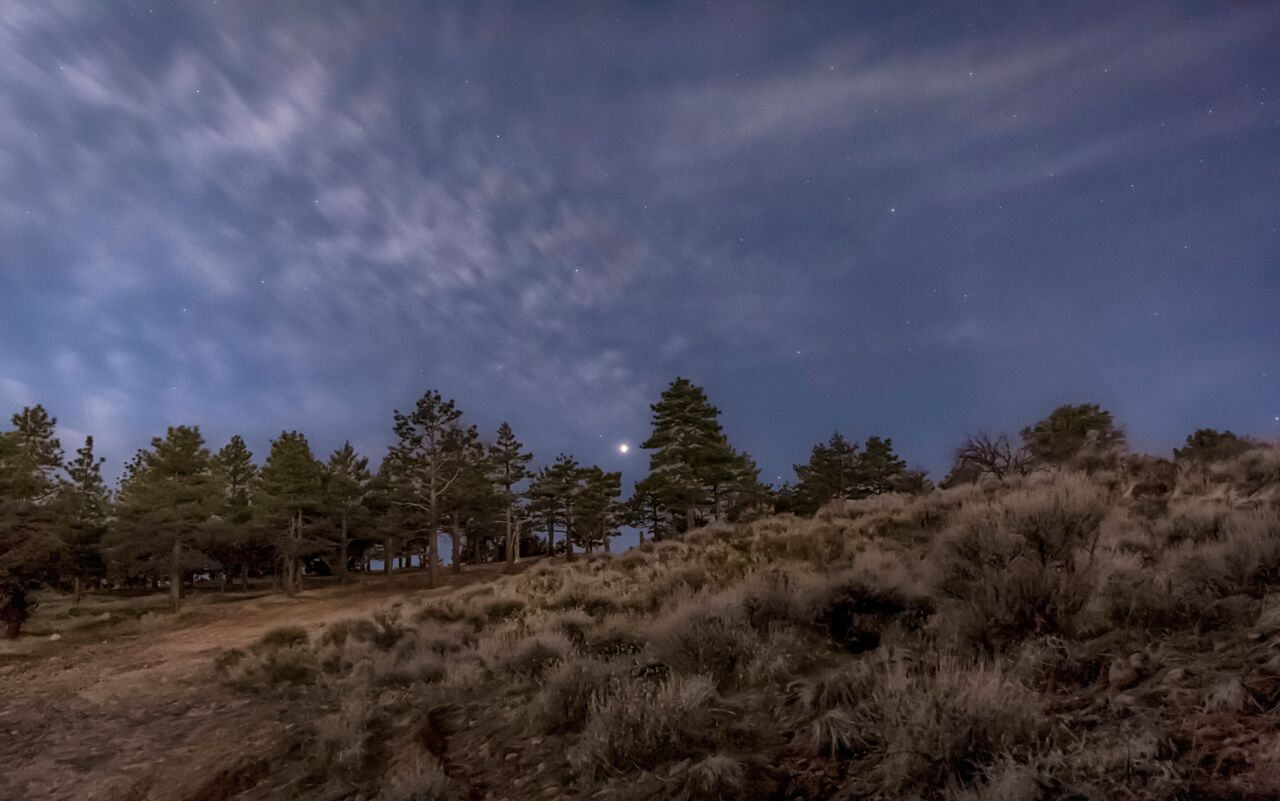
As the sun sets, stars begin to emerge in the darkening sky of the southeastern horizon and a peculiar bright star rises. We call it a star because at first it looks like all the other stars in the night sky, but it is different from the rest if you take notice of its lack of twinkling. If you gaze at it through a binocular or telescope instead of seeing a single point of light, you will see round bright disk with up to four points of light strung out from its side; the Galilean moons.

We call this star the planet Jupiter and it is very bright in our night sky, not because of its nearness to the Earth, but because of its size, and high albedo, reflecting about half the light it receives from the sun. Jupiter is a gaseous planet so large that its volume could fit all of the other planets and asteroids and still have about 30 percent left over, it is surely “an imperial star.”

Jupiter at the horizon. Photo/Ryan Berendsen

As the largest planet, Jupiter is a gravitational giant affecting the orbits of comets, asteroids and planets in the outer solar system. Its composition is mostly hydrogen, from gaseous to liquid, or event metallic near its core. If it were about 80 times larger, it might have been a second star in our system, but small in comparison to the sun, which is about 1,000 times larger.

Jupiter isn’t alone, in fact it is accompanied by 67 satellites in orbit around it ranging in size from larger than our moon to the size of a small asteroid. It’s like a solar system with in our solar system, with a huge variety of environments; some that may harbor the first forms of extraterrestrial life we will discover.

To find Jupiter in the night sky walk outside away from bright lights and look to the east just after sunset. As the sky darkens it will be the first starry looking object to appear. Take a smart phone or tablet with you armed with your favorite star gazing app (SkyPortal and SkySafari are my favorites) and point to that area of the sky. Jupiter will be just above the horizon with the stars Arcturus and Spica above and below. If you watch for a while, notice how long it takes the stars to appear, and how they twinkle in comparison to the mighty planet Jupiter’s steady shine.

If you have a telescope, watching the orbits of the four Galilean moons (Ganymede, Callisto, Io, and Europa) can be a lot of fun. Since the orbital plane of the moons are in line with the plane of the solar system we see them transit from time to time, and even see the shadow of the moons projected on the upper clouds of Jupiter. A great website to learn when these events will happen and to plan and plan to observe them is shallowsky.com/jupiter.

Jupiter will be with us in the night sky until September, so you have plenty of time to see the great planet. But if you have a chance take some time in the early evening over the next few weeks to look out over the hills to watch as a peculiar bright star rises in the east.

Tony Berendsen runs Tahoe Star Tours. He may be reached at 775.232.0844 or tony@tahoestartours.com.


Wet soil may delay grading season in basin

Grading season in the Lake Tahoe Basin may be delayed in some areas because of how wet the ground is.

The Tahoe Regional Planning Agency does not allow soil to be moved until May 1 for erosion reasons.

Officials warn if groundwater is hit while digging, then stop and call your project inspector.

Soil disturbing activities must be suspended during times of precipitation and are not allowed if soil at the project site is covered in snow, saturated, or muddy.

Grading season runs from May 1 through Oct. 15.

Projects that disturb more than 7 cubic yards of soil must apply for a grading permit. Forms are available online. Projects that disturb between 3 and 7 cubic yards of soil most notify TRPA with a qualified exempt activity form available online.


Snippets about Lake Tahoe

·      The following are dates for public hearings regarding the draft EIS/EIR for the loop road: June 9, 9:30am Tahoe Transportation District board; June 14, 9:30am, TRPA Advisory Planning Commission; and June 28, 9:30am TRPA Governing Board. All meetings are at the Tahoe Regional Planning Agency office, 128 Market St., Stateline.

·      El Dorado County Republican Central Committee will be celebrating Armed Forces Week, honoring local veterans, at a spaghetti feed on May 18 from 5:30-8pm at the Rescue Community Center, located at 4180 Green Valley Road. Tickets are $15 per person, $5 for children 8 and younger. Call Todd White at 530.417.0807 for tickets.

·      Here are the El Dorado-Tahoe and Sierra roadwork schedules from Caltrans for the week.

·      Gov. Jerry Brown appointed James O’Rourke, 46, of Shingle Springs to the Commission on Peace Officer Standards and Training.

·      Great Gatsby Living History Festival at the Tallac Historic is Aug. 12-13. For more info, go online.


Water content near Echo Summit 190% of average

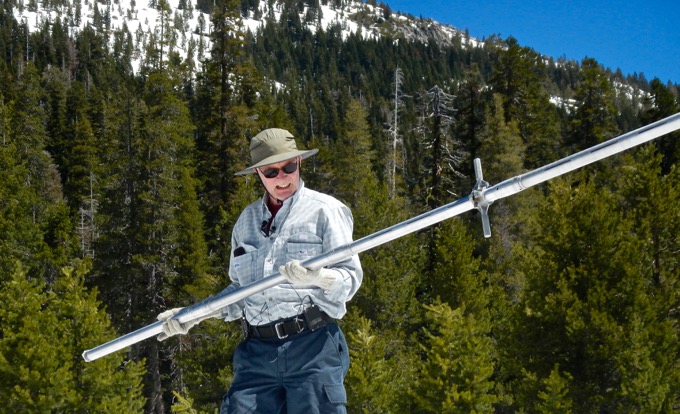
Frank Gehrke on May 1 measures the water content along Highway 50. Photo/Kathryn Reed

By Kathryn Reed

PHILLIPS STATION – Water is not going to be a problem in California this summer and fall.

At the final snow survey of the season near Echo Summit on Monday the numbers showed 27.8 inches of snow, with a water content of 14.6 inches. This is 190 percent of average.

The last reading along the snow field near the entrance to Sierra-at-Tahoe could not be obtained because it was under water. This isn’t unusual for the May reading. But the river of water flowing in the area was more widespread, a little deeper and flowing faster than most years.

During the drought there were times when there was no snow to measure in May.

Frank Gehrke, who does the manual readings for the Department of Water Resources, said the snow is melting at a rate of about one-tenth of an inch a day. At peak snowmelt, it will be about 1 inch a day. That should come later this month.

“The snowmelt is driven by the angle of the sun in the sky and how dirty the snow is,” Gehrke said.

With temperatures supposed to be in the 60s this week, the rate of melt will increase.

Statewide, the readings show the water content for May 1 being 42.5 inches, 196 percent of the average. The numbers compare to 2005 and 2011.

“It’s encouraging news in terms of surface water supply,” Gehrke said. With the abundance of water in reservoirs, it will give many areas the opportunity to allow the groundwater to recharge.

About one-third of Californians rely on this snowmelt for their drinking water or irrigation.

The important thing now is for water managers to monitor storage and flow to avoid flooding issues. Lake Oroville in Butte County is 91 percent of average for the date, Shasta Lake north of Redding is at 109 percent of average.


Craps champions swear it’s more mystique than math

By David Montero, Los Angeles Times
 
Richard Favela rested his hands over the wooden chip tray lining the craps table as the lights from above glinted off rings adorning his lithe, brown fingers.

Favela reached down for the dice and positioned them with great care. Turning them slowly. Methodically. Wholly unsatisfied until he had the white dots facing up the way he liked them. Six on one. Three on the other. They must add up to nine. Always nine. Otherwise the magic would surely end.

A dozen pairs of eyes fixated on him. The four dealers at the table were deferential toward the legend — identifiable to the trained eye by his blue shirt. He would not be rushed.

Read the whole story


Kings Beach streetlight program needs participants

Businesses and nonprofit organizations are encouraged to promote local events through the Kings Beach streetlight banner program.

North Tahoe Business Association wants to have rotating messages on the streetlights.

Banner applications for summer must be submitted no later than May 12 and no less than 90 days prior to requested installation date for the rest of the year. The design, manufacture and cost of banners and installation/removal are the responsibility of the banner applicant.

For more information and to apply, go online. For questions, contact Katie Korpi at 530.546.9000.