Fire ops this week in much of Tahoe basin

Weather permitting, North Lake Tahoe and Tahoe Douglas fire protection districts, California State Parks, California Tahoe Conservancy, and the U.S. Forest Service plan to continue prescribed fire operations beginning May 15. 

If conditions are favorable, operations may take place near Sugar Pine Point, Brockway Summit, Incline Village, Glenbrook, Lower Kingsbury Grade, Ski Run Boulevard, Lake Tahoe Airport, Fallen Leaf Lake and Meyers.  Operations may continue over the next several weeks. 

To receive prescribed fire notifications, send an email to pa_ltbmu@fs.fed.us.

Before prescribed fire operations are conducted, agencies post road signs around areas affected by prescribed fire, send email notifications and update the local fire information line at 530.543.2816. 

Smoke from prescribed fire operations is normal and may continue for several days after an ignition depending on the project size and environmental conditions.


Monterey Tides awash in ocean splendor

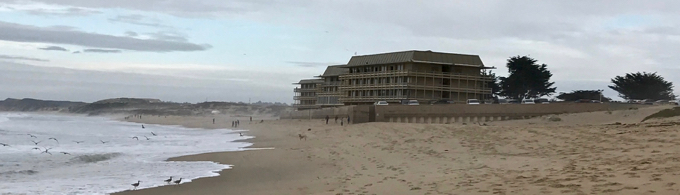
Monterey Tides’ selling point is its location right on the ocean. Photo/Kathryn Reed

By Susan Wood

MONTEREY – From the moment a guest enters the front lobby, waves of serenity and relaxation beckon.

This is how one knows the power of place.

In the case of staying at Monterey Tides, the 180-degree view of the crashing surf onto the beach just below makes it an ideal spot for ocean lovers and families seeking recreation and rejuvenation together. Being there is reflective of knowing that the ebb and flow of life’s ups and downs will roll away – if one adapts and learns how to go with the flow.

Location, location, location. The Tides, a Joie de Vivre hotel since 2015 when it ceased to be a Best Western, is nestled right on the beach off of Sand Dunes Drive. The 196-room boutique hotel comes with the distinction of being the only one smack dab on Monterey Bay. The views are out of this world.

“It’s a best kept secret,” said one hot-tubbing guest who returned for spring break with her Napa family. They rotate their time between the beach and the pool patio.

A San Jose woman used her time at the pool to reminisce about coming there as a little girl with her mother.

“They did a lot of renovation. The rooms are good now,” she said.
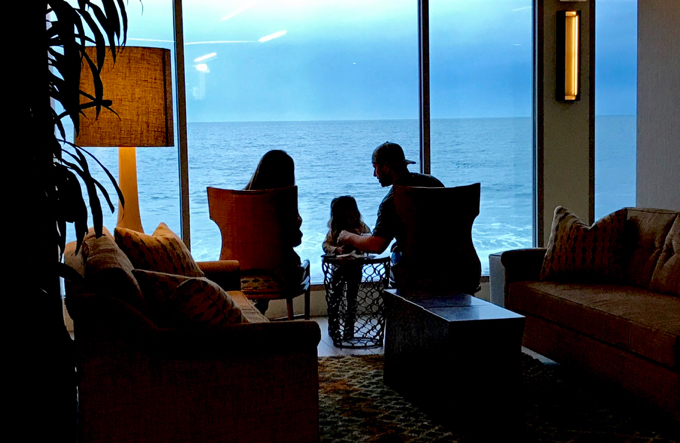
The bar area at Monterey Tides is family friendly; offering stellar views of the ocean. Photo/Kathryn Reed

The San Francisco-based hotel chain immediately embarked upon a $12 million renovation when it took over. The pool area of the hotel grounds is notable as it is warm, inviting and improved. This includes having a new privacy wall that serves as a windbreak from the parking lot. The chaise lounges have special cushions adjustable for either the back or head. Composite decking, the hottest, new surface combining wood and plastic, covers the patio. In early April, the heated pool may be a little too nippy for some – except if you’re comparing the water temperature to the ocean or you’re 10 years old and don’t care.

A few guests tried out the ocean with boogie boards in their wet suits before rinsing off with the convenient outside shower. Most guests opted for the welcoming hot tub at a comfortable 100 degrees considering the air temperature in the mid- to upper 50s can be pervasively chilling.

And that’s why staying at the Tides is highly recommended for May-June and September-October. The summer can be chilly with the inland heat drawing the fog in on the Pacific Coast.

Upgrades are most notable in the lobby and adjoining Bar Sebastian as well as the Vizcaino Waterfront restaurant.

New windows in the rooms should be added to the “to-do” list. The single-pane windows make it impossible to turn off the roar of the ocean and keep the room on the cool side. Or maybe it was just an inefficient heating system that had the thermostat perpetually turned to 80 degrees to maintain a livable room temperature.

As for the mechanical, two-layered blinds they were wonderful They allowed guests to watch the ocean, but no one could see in.

Escaping the cold dampness from the room requires good timing. Most who ventured into the bar next to the lobby had jackets on. But the lobby with its cushy seating and floor-to-ceiling full frontal view of the ocean is the place to be. One never knows when a seal, dolphin or even whale might cruise by.
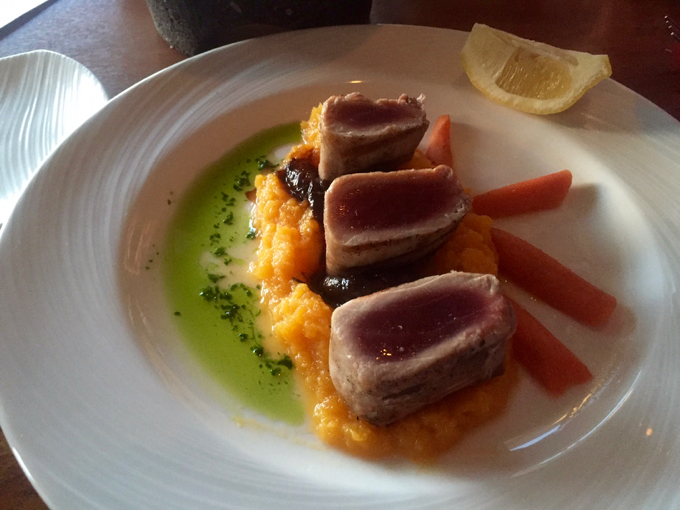
The ahi tuna at Monterey Tides is highly recommended. Photo/Susan Wood

Seeking a higher-level of culinary experience

The views continue to impress upstairs at the remodeled Vizcaino Waterfront Food + Drink, which made its debut on the fourth floor this year. Vizcaino was named after the Spanish explorer Sebastian Vizcaino, who in adding to Monterey’s extensive historical pedigree sailed into Monterey Bay in the early 1600s. The restaurant’s Spanish heritage was inspired with a tasteful décor, larger-than-life ocean view and one of its own at the kitchen helm — Chef Jose Velasquez.

“Chef started at the restaurant over 30 years ago and worked his way from dishwasher to the head spot in the kitchen. He brings his passion for the hotel and the food that he loves to cook to this exciting, new restaurant,” General Manager Brent McNally said.

The restaurant offerings for breakfast, lunch and dinner are innovative, influenced by the chef’s upbringing and, according to Monterey diners, attracts a local clientele.

The ahi tuna was perfectly seared and was delicious with the butternut squash lemon grass puree. And even for a red, the locally-grown Belle Glos Meiomi Pinot Noir paired well with the hardy tuna the server recommended.

The restaurant staff seems a bit rough around the edges, though.

Six interesting cocktails top the beverage menu, but the restaurant ran out of ingredients for two of them. What? Isn’t this Monterey? How about sending out a runner from the numerous staffers watching the open front door?

When asked about vegetarian options, the waiter’s response was: “I don’t know” — a cardinal sin to any restaurant. Apparently, for all the creative oomph the chef gives to the restaurant, he couldn’t have been asked to come up with a vegetarian dish thrown together at the spot? The 12-year server consequently pointed to the one vegetarian item on the appetizer list – the Jicama tacos. Albeit interesting with a beer-battered veggie tempura, they crumbled into a tray that a diner would question whether to eat off of.

At the start of the meal, it’s a nice touch the guacamole served with house made tortilla chips was made at the table – and came in a plentiful batch. Otherwise, the veggie-only diner at the table might have gone away hungry.

However, out of nowhere more than halfway into the meal, someone delivered bread to the table as if it was afterthought. Also forgotten was the beet salad – crisp and tasty – but heavier on the strawberries and lettuce than the main ingredient.

At the end of the meal, try dessert. The crème brûlée hit the spot for two.

A disorganized wait staff aside, the ocean view, décor adorned with old-style barn wood and quiet atmosphere add to pleasantries.
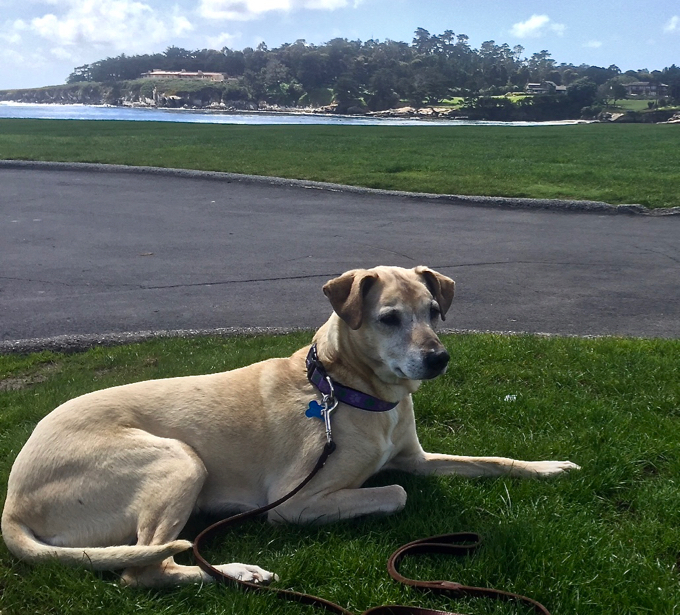
The Monterey area — even Pebble Beach — caters to dogs at hotels, parks and restaurants. Photo/Susan Wood

Monterey: It’s a dog’s life

Four-legged friends are not only welcome at the Monterey Tides, they thrive in and out of the hotel.

First, a welcome board with water and treat bowls for canines is set up near the front entrance. It’s definitely a sign of the times as more and more vacationers seek opportunities to travel with their pets.

Dogs at Monterey Tides have two playgrounds – one out the front door and another out the back. For the latter, watching a dog romping in the sand dunes is like returning to one’s childhood beach experiences.

Out front – which is situated next to Seaside State Beach, a pet area has been established for guests staying at Monterey Tides.

On the other end of the property, a ridgetop bike path that’s ideal for pedestrians giving their pet a change in scenery may take a walker south into town where a host of fun places to go and things to do await a Monterey visitor.

First on the list for a typical tourist is Monterey’s famed Cannery Row with Fisherman’s Wharf, named after its historic industry.

(Note: At Cannery Row, eat out at Louie Linguini’s for a tasty, pleasurable meal and feel free to take your pet.)

For those who appreciate the fine wines of Monterey County, venture into A Taste of Monterey for a flight of tastings by Cassie – who knows a multitude of varietals and wineries like the back of her pouring hand.
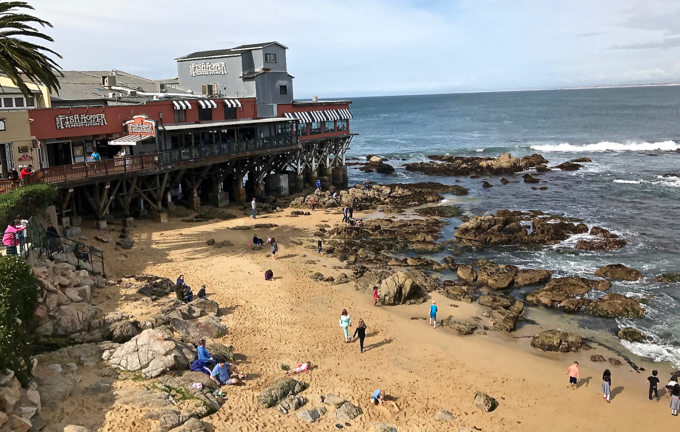
Several Monterey restaurants have outdoor dining with great views. Photo/Kathryn Reed

Out and about on the Central Coast

Beyond the world-renowned Monterey Bay Aquarium, many choices await a Monterey County visitor seeking activities besides eating, drinking and lounging.

Among them, cycling off Carmel Valley Road is always a favorite – with its scenic rolling hills dotted with barns, vineyards and quaint villages. If you’re without your bike, there’s no need to worry. Just call Bay Bikes Carmel off Carmel Valley Road, and they’ll accommodate you with a supply of road, mountain and cruiser bikes for reasonable rental rates.

Hiking is all the rage in the county. And this year’s wet deluge has made checking off waterfalls a sport. Fern Falls at the eastern edge of Garland Ranch Regional Park off of Carmel Valley Road to narrow, winding Hitchcock Canyon Road sets the scenario for one’s sense of adventure. (Note: You must register for a permit two days before from the Monterey Peninsula Regional Park District to enter the easiest way from the privately-owned Hahn Ranch trail easement.)

The 25-foot fall drapes the head of the box canyon and fills a small, crystalline pool at the foot of the cliff. Along the way, look out for newts, as the signs say they may be crossing. A babbling brook runs alongside most of the half-mile trail. 

This spring’s other notable quests with the wet winter are the wildflower hunts – with Monterey County write-ups promising a grand season.

Also at the midpoint of Garland Ranch, lupines abound on the 1.4-mile loop named after the colorful, purple flower.

The 3,464-acre park provides beautiful views and various terrains at the northern tip of the Santa Lucia Range. Terrain ranges from riparian forest to grasslands. Along the 50-plus miles of trails, historic landmarks such as farming and logging remains as well as homestead ruins dot the landscape.
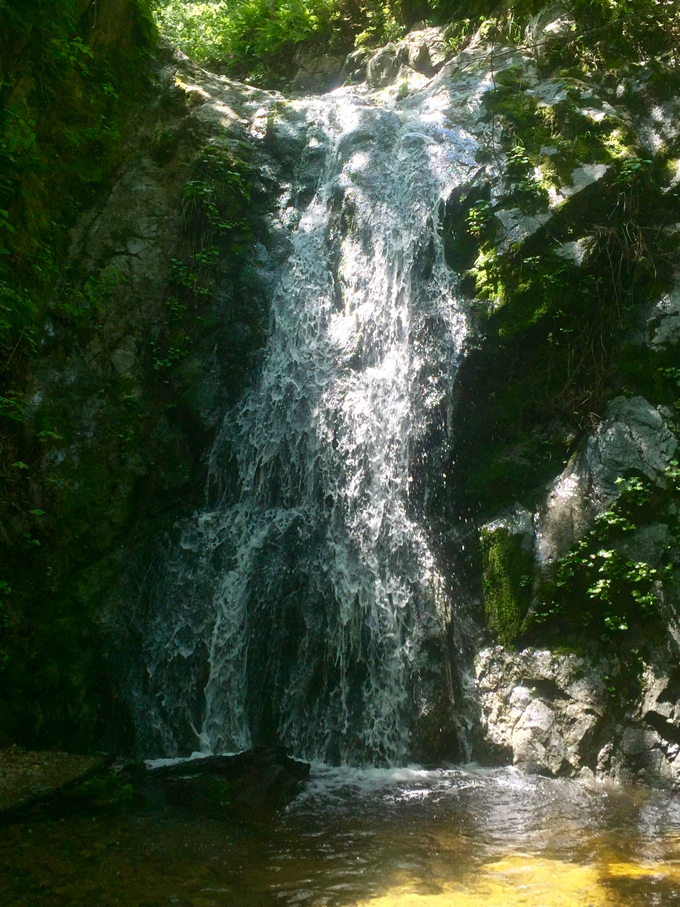
Fern Falls at Garland Ranch Regional Park. Photo/Susan Wood

—–

If you go:

·      Monterey Tides is located two hours south of San Francisco off Highway 1 at 2600 Sand Dunes Drive; call 831.394.3321.

·      Garland Ranch Regional Park is located 15 miles east of Monterey and Carmel off Carmel Valley Road; call the Regional Park District at 831.372.3196.


Opinion: Calif. was a leader in interstate system

By Daniel J.B. Mitchell

In June, Californians should be marking the 70th anniversary of the Collier-Burns Act. But you probably have never heard of it, even though Collier-Burns likely has an everyday impact on your life.

The Collier-Burns Act of 1947 created the California freeway system by substantially raising the gasoline and other motor-vehicle taxes and earmarking the resulting revenues for highway construction. If you drive on freeways, you are utilizing a legacy of Collier-Burns.

State Sen. Raymond Collier and Assemblyman Michael Burns played a part in enacting the law and received the titular credit for it. But the act would never have been passed without the leadership of then-Gov. Earl Warren.

Warren is well remembered, but not as the father of the California freeways. His career as a California state politician is largely eclipsed by his national service as chief justice of the U.S. Supreme Court and the landmark decisions of the Warren Court in desegregation, criminal justice, and political reform. To the extent that any governor is given credit for the California freeways nowadays, it is likely to be Pat Brown, our current governor’s dad.

But the true origins of Collier-Burns are worth knowing, as they bear on today’s difficulties with building and maintaining essential infrastructure.

The story of Collier-Burns takes us to the period immediately after World War II. California’s population had grown at a rapid pace in the 1940s, from 6.9 million in the 1940 census to 10.6 million in 1950. The state’s roads hadn’t kept up with growth, given the scarce tax receipts during the Great Depression and the diversion of public resources to the war effort.

Southern California in particular already had a reputation for heavy reliance on the automobile before World War II, but neither the north nor the south had a road system that matched their car-oriented reputation. The absence of modern roads in California in the 1940s wasn’t due to lack of planning. There were plans gathering dust in drawers for a system of limited access highways with maps that look similar to what we have today. The problem in implementing these grand plans was the cost of building roads.  You could float bonds to stretch out the expense. But eventually, the bonds had to be paid off. And apart from debt service, roads, once built, needed continuous funding for maintenance and repair.

—

The state financed major roads as one-off ventures; the Arroyo Seco Parkway, now known as the Pasadena Freeway, was partly financed by the federal government as a Depression-era jobs creation project and completed in 1940. But such financing was not enough to develop a system of roads.

Gov. Warren ran for re-election to a second term in 1946. Under the state’s then-existing cross-filing system, he won the nominations of both the Republican and Democratic parties in the primary, although he was a Republican. As the nominee of the two major parties, he had only token opposition in the general election. Armed with an overwhelming victory and evident popularity, he proposed a hike in the gas tax and other vehicle fees, with the money to be placed in a trust fund and earmarked for modern road construction.

Warren faced strong opposition to his highway plan. Trucking companies wanted the revenue to come mainly from the gasoline tax, not a tax on the diesel fuel that trucks used. Utility companies wanted reimbursement for the cost of shifting the wires that were in the paths of the new roads. There was a north vs. south political split in the Legislature and regional suspicion over how the proposed revenue bounty for roads would be divided. And there was a similar urban vs. rural divide.

These legislative frictions were important barriers to getting a bill passed. But the chief opposition was from oil companies that didn’t want a gasoline tax hike to be the major funding source. There were various communications from Warren supporters to oil executives trying to explain that more roads would mean more driving, more cars, and therefore more gasoline sales. But this simple and obvious proposition was strongly resisted by the oil lobby.

The result was months of conflict and jockeying in the legislature and a near-death experience for the Collier-Burns Act. Warren, rather than play a defensive game, went on the radio denouncing the oil companies as ruthless special interests. One particularly damning charge made by Warren was that California’s obsolete roads caused accidents and that those resisting passage of Collier-Burns would therefore have blood on their hands if their efforts succeeded in killing the bill.

Compromises reshaped the bill as it moved through the legislature. Warren’s proposed 2-cent tax hike was reduced to 1.5 cents. One reluctant legislator was persuaded to vote for the bill in exchange for a deal on pet food labeling. In the end, Collier-Burns was enacted in late June 1947. Warren proclaimed that the new law would keep California “among the most progressive and forward-looking states in the Union.”  

However, the influence of Collier-Burns ultimately extended beyond California to other states. When the Eisenhower administration took office in 1953, it envisioned a new federal road system. Originally, the administration favored toll roads as the basis of the proposed interstate system. But the California model was already influential. By the 1950s, California was the second most-populous state (behind only New York) and had a large and powerful congressional delegation. Vice President Richard Nixon was a Californian, as was William Knowland, the Republican minority leader in the U.S. Senate. As House and Senate committees considered the Eisenhower proposal, experts from California were brought in to testify.

Eventually, the toll road idea was dropped, although a provision accommodated those Eastern states that already had built toll roads. The federal bill became a larger projection of the California approach, i.e., gas tax and trust fund, and was enacted by Congress in 1956. For California, the federal bill became a matching source of money that accelerated and expanded what the state was already building or planned to build. Pat Brown was elected governor in 1958, just in time to inherit Earl Warren’s legacy in highway construction.

Of course, the same California freeways that were seen 70 years ago as a model for the nation are now heavily congested and in need of repair. Critics say the freeways encourage urban sprawl, displace public transit, and cause environmental damage. Nonetheless, Gov. Jerry Brown recently pushed a bill through the Legislature to raise the gas tax and other vehicle fees for road repair and other transportation purposes. Along the way, he used some tactics to obtain the necessary votes that Earl Warren would have found familiar.

From an historical perspective, Collier-Burns was more than a state highway bill. It marked California’s entrance as a major influence in the American polity. California became seen as a model of public policy and planning. It is only natural that, after 70 years, our views regarding the freeway system that resulted from Collier-Burns would have changed. But at a time when California’s politics seem to be moving in the opposite direction from much of the rest of the country, it’s nice to look back to an era when what California was doing was what the other states hoped to emulate. 

Daniel J.B. Mitchell is professor-emeritus at UCLA Anderson School of Management and at UCLA Luskin School of Public Affairs.


ESPN cuts = loss for independent sports journalism

By Bill Shaikin, Los Angeles Times
 
The headline news, and deservedly so: Massive layoffs at ESPN, cost-cutting that cost the jobs of dozens of high-profile reporters and personalities.

Beneath the headline: ESPN is dropping “Baseball Tonight” except for Sundays and special events and adding MLB Network’s “Intentional Talk” to its daily ESPN2 lineup.

It’s another slippery step toward the loss of independent sports journalism: A league that ESPN ostensibly covers is now providing programming for ESPN.

Read the whole story


Road Beat: Chrysler Pacifica — a new type of minivan

The Chrysler Pacifica is redefining what a minivan should be. Photos/Larry Weitzman

By Larry Weitzman

One could almost call the new Pacifica a CUV from where its namesake was pilfered when the prior Pacific model, a CUV, was discontinued, which was too bad as the later models of the prior Pacifica were great vehicles. The new Pacifica minivan has received plenty of fanfare and it is well deserved.

First, is its new innovative design, as it doesn’t quite look like a minivan. It is sleeker, with clever and unique design features such as the tight, sloping window line that is truncated with a reverse flow making the mini look mini. The Pacifica does not look full size, but it is and then some with a huge 122-inch wheelbase and a length of 204 inches. While it looks sleek and short, it isn’t; standing 70-inches tall. Perhaps that is due to its massive width of 80 inches.

Pacific dimensions make it the largest of all the minivans by an inch or two. Its siblings the Dodge Caravan and Chrysler Town and Country, while almost sharing the same wheelbase (the Pacifica is still a half an inch longer there, too), lack the massive track of the Pacifica by 3inches, as the Pacifica rides on one of the widest tracks in autodom at 68.3 inches. That pays dividends in handling.

Under its diminutive hood lies a transversely mounted familiar Chrysler 3.6L high tech, high output V-6 that knocks down 287 hp at 6,400 rpm together with 262 pounds of twist at 4,000 rpm. That engine is connected to a nine-speed auto tranny with a top gear that allows a cruise speed of 70 mph at just 1,600 rpm, meaning great road trip fuel economy.

Performance is outstanding with the Pacific knocking off 0-60 mph in a quick 6.79 seconds. Passing performance is also stellar with simulated runs of 50-70 mph on a level highway of 3.86 seconds and the same run up a six percent grade only slowing that time to 5.77 seconds. Those are numbers usually found in your high performance mid-size V-6 sedan. Towing capacity is a generous 3,600 pounds and its interior payload including 19 gallons of gas (about 120 pounds) is almost 1,600 pounds. That’s big.

Specifications
Price About $30,000 to about $45,000.
Engine
3.6L DOHC 24 valve V-6 287 hp @ 6,400 rpm
262 lb.-ft. of torque @ 4,000 rpm
Redline 6,400 rpm
Hybrid
3.6L DOHC 24 valve V-6 280 Est hp combined hp with the electric power
Battery
16 kWh Li-ion battery
Transmission
Nine-speed torque converter automatic
Configuration
Transverse mounted front engine/front wheel drive
Dimensions
Wheelbase 121.6 inches
Length 203.8 inches
Width 79.6 inches
Height 69.9 inches
Track (f/r) 68.3/68.3 inches
Ground clearance 5.1 inches
Cargo width at rear wheelhouse 48.8 inches
Maximum cargo height 47.6 inches
Total interior volume 197.3 cubic feet
Interior volume (behind first row, 2nd row, 3rd row) 140.5/87.5/32.3 cubic feet
Weight 4,330 pounds (hybrid 4,987 pounds)
GVWR 6005 pounds (hybrid 6,300 pounds)
Payload 1,675 pounds (hybrid 1,313 pounds)
Weight distribution (f/r) 55/45 percent
Tow capacity 3,600 pounds
Fuel capacity 19 Gallons (hybrid 17 gallons)
Wheels (std/opt/opt) 17X7/18X7.5/20X7.5 inches
Tires (std//opt//opt) 235/65X17//235/60X18//245X50X20 inches
Steering lock to lock 3.13 turns
Turning circle 39.7 feet
Drag coefficient 0.300
Performance
0-60 mph 6.79 seconds
50-70 mph 3.86 seconds
50-70 mph uphill (6%) 5.77 seconds
Top Speed Well into triple digits
Fuel economy 18/28/22 mpg city/highway/combined Expect 24-25 mpg overall in rural/suburban country driving. 35 mpg at legal highway speeds.

For the most part, while the nine-speed unit delivered ultra-smooth shifts, a couple of times it was a bit jerky and jumpy when trying to select gears when being quick on and off the throttle. Nail the throttle hard, even with traction control, it still will chirp the tires easily if not downright smoke them for a second. Lots of power here and it’s very responsive. Sometimes you can easily forget your driving a minivan. Maybe that’s a good thing as minivans, despite of their stigma, are the most practical vehicles ever made, especially with Chrysler and their stow and go seating giving you a flat floor in about 30 seconds and the cargo capacity of a small moving van. A Pacifica could be a costly and dangerous tool at Home Depot.

Now to its excellent fuel economy. EPA rates the Pacifica at 18/28/22 mpg city/highway/combined but the numbers achieved in my test of over 800 miles were much higher. At 70 mph on cruise control on a level highway in two directions for 30 miles the Pacifica averaged an amazing 35.4 mpg and the fuel computer is dead nuts on, I checked it. In a round trip to Los Angeles and back it averaged 28.5 mpg. But this wasn’t run at 70 mph, as if you don’t run at least 80 mph on Interstate 5, you’ll get run over by traffic. My average speed on the return which was non-stop for 391 miles achieved in 5 hours and 10 minutes was 76 mph, which means mostly driving at 80 mph and slowing for big trucks going into the passing lanes. Fuel economy was 28.6 mpg by the computer and by the fill-up (13.68 gallons). Part of that is due to the Pacifica’s wind cheating design which has a drag coefficient of 0.300.

So how does a big vehicle like this handle? Better than you would expect. Suspenders are four corner independent. Standard wheels and tires are decent with 17 x 7 inch alloys shod with 235/65 rubber but 18 x 7.5 inch alloys and lower profile 60 series tires are optional, something I might consider depending on price. Chrysler does offer a 20 x 7.5-inch wheel with 245/50 rubber, but I would stick with the 18’s for a better ride and quiet. The reality is the Pacifica is decent handling even when pushed thanks to its well sorted out suspenders and super wide and stable track. There is some body roll, but that’s to be expected when you get this kind of luxo ride quality. And making a 4,300-pound vehicle change directions is no easy feat (weight distribution is good at 55/45 percent front and rear) and Pacifica does it feeling a bit lighter on its feet.

When you consider its super compliant ride qualities and high comfort levels, Pacifica will surprise you again. And steering is reasonably quick at 3.1 turns lock to lock and its turning circle is under 40 feet. Did I mention there is no engine, wind or tire noise and if that isn’t enough it comes with Active Noise Cancellation.

Pacifica also comes with some serious disc brakes with large 13 inch rotors (fronts are ventilated). Of course, it has all the electronic wizardry including a 360-degree Surround View camera, forward collision warning plus, blind sport warning and all the other acronyms. Projector headlights were very good. HIDs are optional see below.

Now to the massive interior which has over 32 cubic feet behind the three place third row rear bench seat and a cargo volume of 140 cubic feet behind the first row very comfortable buckets. Second row is a choice of two buckets or a three-place bench. Either way, second row leg room is bigger than most limos. I would go with the bench unless you need separation with your children. Materials are first rate and the instrumentation complete. The cabin is extremely spacious with shoulder and hip room galore (even the third-row shoulder room is 61 inches), but it drives like it’s a mid-size car, feeling much smaller and lighter on its feet. How did they do that?

But I am not a fan of using a touch screen for all the functions of the radio, Nav, phone, climate and other media hookups. However, while the A/C info is pictured on the large 8.4-inch color screen (good for us Mr. Magoo types), the A/C system controls are easy with buttons and knobs and you don’t have to select the climate icon to operate. Thank Chrysler for small favors. I am sure any 10-year-old could operate the system better than moi.

Pricing for Pacifica starts for the LX at $28,995 to $42,895 for the super loaded Limited with four models in between, the Touring at $30,995, the Touring Plus at $32,360, the Touring-L at $34,995 and the Touring-L-Plus at $38,295. You will have to add $1,095 for destination to those numbers for the train and truck ride from Windsor, Ontario which is located across the Detroit River/Lake St. Clair from Detroit. I’ll make this easy. My driver was the Touring-L which had everything you want including leather seating, fronts heated, a comprehensive safety package and more. If an entertainment package, movies and stuff are necessary then you will have to step it up to the L-Plus. If you want Nappa leather, HID headlights and the stow and vac system and more then it’s the Limited. I’ll buy a good garage vacuum that could probably suck the interior right out of the van, never mind the dirt and dust and still go with the Touring-L. The Pacifica PHEV starts at $41,995 to $44,995.

If you are only driving to work and back with an under 40-mile round trip, then it might make sense as the battery is good for about 33 miles. But if you are making long road trips over 50 miles, go with the conventional model. The hybrid adds about 650 pounds to the weight of the Pacifica as well. Performance should be about the same as will highway fuel economy.

Larry Weitzman has been into cars since he was 5 years old. At 8 he could recite from memory the hp of every car made in the U.S. He has put in thousands of laps on racetracks all over the Western United States.


LTCC-SNC increasing 4-year degree options

The application-registration process for Sierra Nevada College’s bachelor’s degree program at Lake Tahoe Community College is open.

Open houses are scheduled through August for prospective students to meet faculty and learn about the programs. SNC Tahoe opened the center at LTCC in 2016. Eligible students will be able to pursue programs in global business management, psychology, elementary education, and ski business resort management at the center this fall.

The partnership between SNC Tahoe and LTCC brings an affordable four-year degree option to LTCC’s campus. The program is designed for students who wish to earn a bachelor’s degree without having to leave South Lake Tahoe.

Open houses are 6-7 each night:

  • May 17 at LTCC (inside the main lobby)
  • June 15 at LTCC (inside the main lobby)
  • July 11 – at Tahoe Mountain Lab (3079 Harrison Ave., South Lake Tahoe)
  • Aug. 15 at LTCC (inside the main lobby).

For more info, including the time of the programs, go online.


Free drinks — not for all gamblers

By Andrea Sachs, Washington Post

The free drinks at casinos make everyone feel like a winner. However, two casino behemoths are killing the buzz: At select properties, MGM Resorts and Caesars Entertainment are no longer providing gratis cocktails to bar patrons who are drinking and yakking more than drinking and gambling. The new mantra: must play for a cocktail.

“We are making a concerted effort to reward our larger-spending customers,” said Rich Broome, executive vice president of communications at Caesars. “This discourages people who are just looking for a free drink.”

At the moment, the new policy applies only to casino bars with video-poker machines. (To clear up any misunderstandings, the bars never provided complimentary drinks to non-gambling guests, though the rule was not always enforced.) After a short trial in late 2015, Caesars introduced the comp notification system at nine properties throughout Nevada, including those in Lake Tahoe, Las Vegas, Laughlin and Reno. Within the last year, MGM has rolled out a similar program at MGM Grand and TopGolf, an entertainment venue on the Strip. A company executive said that MGM could expand the program to its casinos in New Jersey and Mississippi. (Gamblers in Michigan and Maryland don’t have to worry; by law, they were never allowed free alcohol.)

Read the whole story


5 slot myths: Why what you think you know is wrong

By Thomas Moore, Las Vegas Sun

Slot players are simply wrong.

Talk to people who study, market and design slot machines, and you quickly realize that many of the ideas players have about their inner workings and how jackpots are paid are myths.

In other words, players can tell when the house edge (or hold percentage) is larger for some slots or some casinos, and smaller for others. It’s an important concept because casinos boast of having loose slots and many gamblers have strong ideas about where to find the loosest slots.

There’s no independent way to confirm if marketing claims about loose slots are true. The Gaming Control Board does not release the house edges for individual slot machines or specific casinos. As a result, gut feeling is the only publicly available measure.

Read the whole story


El Dorado County Fair tickets on sale

Ribbons & Rides is the theme of this year’s El Dorado County Fair. 

Most of the contests in the fair entry guide include a division to use the fair theme in a project.

For the second year, Paul Maurer Shows will be bringing the carnival rides with updated LED lighting and bright colors.

The fair is June 15-18 in Placerville.

There will be special events every day. For details and discounted early tickets, go online.


Tahoe bursting with iconic rock climbing terrain

Lover’s Leap is a popular destination for rock climbers. Photo/LTN file

By Matthew Renda, Tahoe Quarterly

With Yosemite as its epicenter, the Sierra Nevada is unquestionably the mecca of rock climbing.

Some argue the sport was born in the Sierra when John Muir performed an on-sight free solo of Cathedral Peak in Tuolumne Meadows in 1869. Muir’s climb, without the benefit of advanced planning or ropes, typifies the adventure, self-reliance, courage and hunger for glory inherent in the sport.

The Lake Tahoe area’s role in the founding and development of modern rock climbing has traditionally been cast as a bit player—a practice facility for climbers looking to refine the skills needed for the daunting big-wall climbs in Yosemite and the High Sierra.

This traditional and dismissive view of the cliffs stretching from Calaveras Dome to Donner Summit has come under recent reconsideration, however, with more and more asserting the area is replete with an array of compelling climbs that factored heavily into the sport’s advancement.

In fact, ask any Tahoe climber and they will agree, perhaps with a hint of annoyance—there is no shortage of climbers testing their mettle on the various routes in the greater Tahoe area.

Read the whole story