
Ranch, wildlife fears could sink Nev. water bill

By Benjamin Spillman, Reno Gazette-Journal

Fears that mining companies and Las Vegas development will drain rural Nevada dry could sink an update to state water law.

Ranchers, anglers and environmentalists united Tuesday in opposition to Assembly Bill 298, which would revise Nevada water law.

The bill seeks to define in state law terms such as “perennial yield,” and “environmental soundness.

Read the whole story


Talking about suicide can be a preventative measure

By Alisa Merino

May is Mental Health Awareness Month and you may have heard the phrase “each mind matters.”

Why does each mind matter? Mental health is something we all have. Just as our bodies need attention, our minds also need nourishment and care. Suicide rates are increasing and there is a relationship between mental illness and suicide. According to the National Alliance on Mental Illness (NAMI), about 90 percent of people who die by suicide have experienced mental health issues.

Alisa Merino

At the Suicide Prevention Network, it is our goal to bring awareness to suicide. This includes recognizing signs and symptoms as well as reducing the stigma.

As community members, we all play a role in reducing the negative associations around suicide and mental illness. It is up to us to be advocates and caregivers who provide support and lifesaving resources for loved ones at risk.

Anyone can be at risk of suicide. Two big risk factors are having life stressors and lacking skills to cope with these stressors. Life stressors may include health, finances, divorce, children, moving, family problems, employment, death of a loved one, or a loss of any kind. Some positive ways to cope with these stressors are exercise, deep breathing, healthy nutrition, appropriate sleep, listening to music, and talking to someone you trust.

Unfortunately, some may find that life stressors are too difficult or some choose negative ways to cope. Signs of suicide may include:

·         Talking about death directly

·         Giving away possessions

·         Engaging in risky behavior (i.e. driving recklessly, coming to work intoxicated)

·         Abusing or consuming excessive amounts of alcohol or drugs

·         Sleeping too much or too little

·         Eating too much or too little

·         Making funeral arrangements

·         Isolating from loved ones

·         Engaging in self-harm (cutting or burning)

·         Feeling hopeless.

If someone you know is displaying these signs or reaching out to you for help, it is important to have a conversation with that person. Here is one script the Suicide Prevention Network recommends to follow:

Step one: Ask. Ask the person directly if he or she is thinking about suicide. “I have noticed you have been acting different and I am really concerned. Are you thinking about suicide?”

Step two: Listen. Hear the person’s story. Listen and offer support without judgment. “It sounds like you are going through a lot. I am so sorry. How can I support you?”

Step three: Connect. Connect the person to resources. “I want to make sure you stay safe; can we call someone so that we can keep you safe?”

Here are prevention and support hotlines that anyone can call for immediate suicide concerns:

·         Suicide Prevention Lifeline
800.273.8255 or text “ANSWER” to 839863

·         24-hour Psychiatric Emergency Services (El Dorado County Mental Health)
Placerville: 530.622.3345
South Lake Tahoe: 530.544.2219

·         Suicide Prevention Network
California or Nevada residents: 775.783.1510.

Other local mental health resources may be found online.

Suicide is everyone’s business and there is support available. May we all be aware of our mental health and well-being so that we can help each other find hope and healing.

Alisa Merino is the program coordinator for the Suicide Prevention Network. The Suicide Prevention Network is a 501(c)3 and offers education, awareness, and supportive services to members of Douglas County and El Dorado County. Community members who have lost a loved one to suicide can attend a Survivor of Suicide Support Group monthly on the fourth Thursday at 6pm at Barton Public Relations office, 2092 Lake Tahoe Blvd., Suite 400 in South Lake Tahoe. The next meeting is May 25.


Climate change shrinking West’s water supply

By Emily Benson, High Country News

Picture a snowflake drifting down from a frigid February sky in western Colorado and settling high in the Rocky Mountains. By mid-April, the alpine snowpack is likely at its peak. Warming temperatures in May or June will then melt the snow, sending droplets rushing down a mountain stream or seeping into the soil to replenish an aquifer.

The West’s water supply depends on each of these interconnected sources: the frozen reservoir of snow atop mountain peaks, mighty rivers like the Colorado and groundwater reserves deep below the earth’s surface. But the snowpack is becoming less reliable, one of the region’s most important rivers is diminishing and in many places the groundwater level has dropped.

Three recent studies illuminate the magnitude of these declines, the role climate change has played and the outlook for the future.

Read the whole story


Life skills taught to juvenile offenders in SLT

Eleven youth detained at the Juvenile Treatment Center in South Lake Tahoe recently received their American Heart Association CPR (cardio pulmonary resuscitation) and AED (automatic external defibrillator) certifications.  

The course was made possible through the private/public partnerships of the Juvenile Service Council, Lake Valley Fire Protection District, El Dorado County Juvenile Treatment Center, and the Blue Ridge Court School of El Dorado County. This was the first time that the course was offered to the youth at the facility. They also received school course credit. 

“I was impressed with the level of focus and engagement in the material that these young people showed. I hope that the training will resonate with some of the participants to give them the confidence in themselves to pursue a career path they might not have otherwise thought about,” instructor Tony Gasporra, EMS lieutenant with Lake Valley Fire Protection District, said. (He volunteered his time.)

To learn more about the Juvenile Service Council, donate, or become a volunteer, email eldoradojsc@gmail.com.


Guilty pleas in theft of USFS recreation fees

Two El Dorado County residents have admitted they stole recreation fee tubes from the U.S. Forest Service and at other sites.

Brian Lisanti, 46, and Deseree Tougas, 26, both of Colfax, are scheduled to be in El Dorado County Superior Court on June 5 for a restitution hearing.

Lisanti remains in custody with no bail. He pleaded guilty to conspiracy to commit a crime with theft and second degree felony burglary. He will serve 120 days in county jail and be on probation for four years.

Tougas posted $50,000 bail. She pleaded guilty to a misdemeanor charge of petty theft. She will serve a 45-day jail alternative sentence and be on probation for three years.

The case broke when officials with the Eldorado National Forest were told about a large number of used Forest Service fee envelopes found in a dumpster. The exact location of the thefts, amount of money stolen and time period the crimes occurred have not been released.

“This evidence indicated that over $700 in visitor fees had been stolen from a forest recreation site on at least one occasion,” officials said in a press release.

— Lake Tahoe News staff report


Action lacking to overhaul Calif. pension fund

                                                                                                                                                                       Source: CalPERS

By Kathryn Reed

“CalPERS is about people. It is about the dedicated individuals who serve, or have served, the state of California through a career in public service. For more than eight decades, CalPERS has built retirement and health security for these public servants. As the nation’s largest public pension fund, we ensure that our members’ benefits and earned retirements are as enduring as the state they maintain.”

That is how the California Public Employees’ Retirement System describes itself on its website. If one were to take the last sentence literally, everyone in California should be worried. This is because the earnings are dismal. And this is at a time when the stock market is soaring.

The Dow Jones Industrial Average on March 1 hit a record high of 21,115.55. On May 16 it closed at 20,979.75. The S&P 500 hit its record high on May 15 at 2,402.32. The Nasdaq hit record highs on Monday and Tuesday, with the latter finishing at 6,169.87.

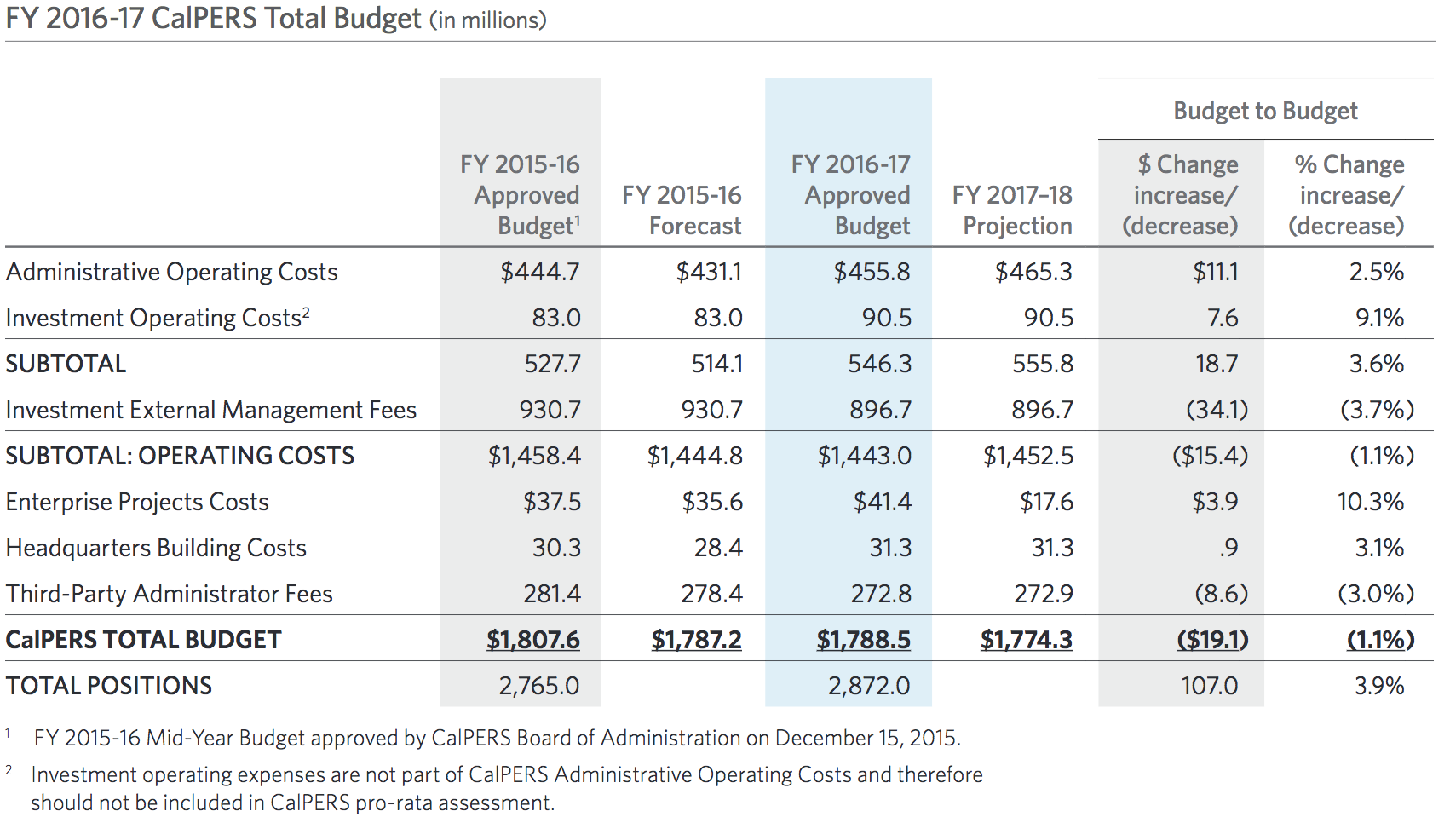
The S&P 500 in the last five years has increased 15 percent, while CalPERS in that same period has averaged a 6 percent gain. CalPERS reported a 0.61 percent net return on investments for the 12-month period that ended June 30, 2016. CalPERS spends millions of dollars every year on investment management fees. Someone is getting wealthy at taxpayers’ expense.

Political and social issues play into what it will invest in. It divested from RJ Reynolds not for monetary reasons, but because of political pressure. And, yet, the only reason CalPERS exists is to make money.

This is a huge organization with nearly 3,000 employees.
                                                                                                                                                                   Source: CalPERS

CalPERS with its current total market value of $321.83 billion isn’t making enough money to pay all of the retirees. It has a shortfall of more than $200 billion based on everyone in the system retiring at their retirement age.

The deficit isn’t completely the fault of poor investment choices. The agency along with state and local lawmakers share a tremendous amount of burden.

At what is now known as the apex of the funding level in 1997 CalPERS told everyone it was superfunded. This meant it had 120 percent of the money it needed to pay all the retirees/employees at that time. This was assuming nothing changed.

But things did change – some deliberate, some beyond most people’s control. The deliberate actions were to reduce the minimum age at which people could retire. Payments were even made retroactively. The percentage retirees would be paid also increased. Then investments went south with the dot com collapse. Also needing to be factored in is that people are living longer today compared to when CalPERS started in the 1930s, so those guaranteed paychecks keep being written.

History of CalPERS:
• 1932 – CalPERS was established as the State Employees’ Retirement System (SERS).
• 1939 – The state Legislature passed a bill that allowed counties, cities, and school districts to participate in SERS.
• 1962 – Health insurance began for SERS members with the passage of a law that was later amended to become the Public Employees’ Medical and Hospital Care Act.
• 1986 – The headquarters building now called Lincoln Plaza North was completed in Sacramento.
• 1992 – To avoid confusion with retirement systems in other states, the organization’s name was changed to California Public Employees’ Retirement System (CalPERS).
• 2005 – CalPERS expanded its headquarters to include the Lincoln Plaza East and West buildings, which achieved a gold LEED rating.
• 2013 – CalPERS board adopted set of Investment Beliefs to help guide investment strategy.
• 2014 – CalPERS surpassed $300 billion in total fund market value.
• 2014 – CalPERS board adopted set of Pension Beliefs to guide pension fund practices and decisions.
                                                             Source: CalPERS

The above combination was a recipe for disaster. It’s as though these factors have been percolating on some back burner and it’s just now that the pot is boiling over to the point no one is immune from the blistering effects.

According to the California Department of Finance, in 2016 taxpayers paid $5.4 billion for state employee pensions. CalPERS says this is 30 times more than what was paid before the pension law changes took effect in 2000.

It’s not the retirees or current employees’ fault this is happening. But it’s also not the taxpayers’ fault either, and they are the ones left footing the bill, which in turn means fewer tangible benefits – like improved roads, better facilities and lower fees.

The retirement agency likes to paint itself as this great organization. It sends out mailers to members about how everything is rosy. Those who pay into CalPERS or are drawing on their retirement all got a letter this spring saying things are just fine. What wasn’t included was a copy of the letter sent to their employers with the forecast saying that their contribution is going to double in five years.

Corruption is part of CalPERS’ legacy. It wasn’t that many years ago that the headlines were all about the financial scandal within the organization. One-time Stateline resident Alfred Villalobos conveniently killed himself in January 2015 just weeks before his federal trial on bribery and fraud charges was to start. He had been a deputy mayor in Los Angeles, and then was a CalPERS board member from 1993-95. Villalobos reportedly earned $50 million between 2005-09 as a middleman between CalPERS and private equity clients.

In May 2016, Federico Buenrostro Jr. was sentenced to 4½ years in prison for accepting more than $200,000 in bribes and trying to steer investments to help an associate. He did so while he was CEO of CalPERS from 2002-08.

CalPERS at the May 16 South Lake Tahoe City Council meeting was called “inept” by Austin Sass. And while the council as a whole is not thrilled with the bleak financial picture, only Brooke Laine said it might be time to get their butts down to Sacramento and give CalPERS an earful.

After the meeting Lake Tahoe News asked Sass and Wendy David: “Does the council intend to engage CalPERS in any way or any elected officials who might have some ability to address the CalPERS dilemma?” No response.

CalPERS says the responsibilities of its 13-member board “include setting employer contribution rates, determining investment asset allocations, providing actuarial valuations, and much more. However, the board does not have the authority to add, change, or delete benefits without the concurrence of the Legislature.”

The South Lake Tahoe council hasn’t written any letters to its state representatives or tried to engage them in any manner.

Why any member agency would enter into a contract it can’t change or back out of can only be answered by those who made the decision at that time.

CalPERS for the most part is run by former government employees who collect a CalPERS check. They have zero incentive to make changes even though their member agencies could eventually go bankrupt. It’s like the fox is protecting the hen house.

CalPERS issues a bill that has to be paid or else pensions are cut. It’s a non-negotiable contract. CalPERS would come collecting even if it meant a lawsuit.


Opinion: Rigging of the U.S. system

By Janine R. Wedel

Pundits often attribute Donald Trump’s success to right-wing “populism.” This conclusion is dangerously misleading. Trump’s rise is rooted firmly in his ability to make an old-fashioned word—“rigged”—work in surprisingly fresh ways.

Trump correctly diagnosed a feeling among working people that the system was rigged against them, and then leveraged that against his opponents in both parties.

As a social anthropologist who studies both “influence elites” and the workings of bureaucracy, I can help explain why this “rigging” resonates with so many regular people. I began my career in 1980s Poland studying how communist systems worked. In the past decade or so, I’ve experienced a nagging sense of déjà vu as Americans perceive a widening gap between how they expect the system to operate and how it really does.

I’ve seen this most clearly among the Trump supporters I encounter in rural Kansas, where I grew up, and rural upstate New York, where I’m a partner in a family business. They all say they are against the system because it’s rigged against the little guy at the bottom, even if they have little idea what to replace it with. They may not find him appealing, but Trump would at least “shake things up.”

The “system” goes well beyond the government. Whether it’s your bank, your doctor, public school, news sources, unions, or even your place of worship, all have posted staggering declines in confidence in recent decades. These institutions also are fundamentally different than they were at the time when public trust was first measured. A bank of today is not the bank of the 1970s, when you could get a mortgage by talking to the local lending officer with whom you could meet face-to-face. He might not meet your needs, but at least he had the authority to take into account your own circumstances and history in his decision. Today, this all goes by algorithm in some unseen office.

Ditto when I have a sinus infection and need to see a specialist. While I used to be able to call the doctor’s office directly, now I have to call a number that routes me through an incomprehensible phone tree and connects me with people who themselves have little authority. Similar changes have proliferated throughout our lives. Which explains why United initially barely apologized when a paying customer was dragged off a flight.  

You don’t have to spend much time punching through a phone menu to realize that no one, besides you, is incentivized to care if you get a mortgage, heal your sinus infection, or make your flight to Louisville. And, while you know you’re interacting with machines, the frustration, impersonality, and disaffection you feel feels like something I have experienced before: the daily disaffection that eventually led people under communism to revolt. Americans have recently lost power and become disconnected from community in ways that can’t entirely be explained by money or inequality.

In my research I’ve found that nearly every policy venue affecting our lives—from foreign policy to health care to the economy—has indeed been rigged to varying extents by elites shaping decisions to fit their own self-interested agendas.

For instance, the banking giant Goldman Sachs favored some of its powerful clients against others (including pension funds) in the notorious Abacus Deal of 2007. When the deal was discovered only one lower-level executive was punished and the company paid a fine that paled alongside its profits. Meanwhile, so many former executives from the company took positions in the administrations since the Bill Clinton era that the company is jokingly called “Government Sachs.”

The sense of pervasive rigging explains the groundswell of distrust that brought President Trump to power last fall. His constant references to Hillary Clinton’s private email server and problematic family foundation—raising the idea that she didn’t just escape the rules, but actually invented them to serve herself—resonated with many voters.

Ironically, in a mere 100-plus days, Trump has brought the very rigging he has railed against to a new level of blatancy: from Ivanka Trump using her position to promote her fashion line to packing his cabinet with bankers and billionaires with financial conflicts—all while starving parts of the bureaucracy through unfilled positions and budget cuts.

In dismantling and reorganizing governance, Trump is borrowing from the communist playbook: power and personality frequently trump process, formal position, bureaucracy, and elected bodies. He has tried to enfeeble pillars of democracy: civil liberties, a free press, an independent judiciary.

When your democracy doesn’t feel like a democracy, the system demands overhaul. Starving it will only lead to more distrust.  Public institutions need remaking; they need to re-deliver.

Janine R. Wedel is university professor in the Schar School of Policy and Government at George Mason University and the author of “UNACCOUNTABLE: How the Establishment Corrupted our Finances, Freedom and Politics and Created an Outsider Class.”


Kitchen fire damages South Tahoe duplex

One half of a duplex in South Lake Tahoe was severely damaged by fire on Tuesday.

Oil in a frying pan is the reported cause of the blaze.

It started in the afternoon of May 16 on Shepherds Drive in a two-story duplex. Firefighters said the smoke spread into the attic space.

“It’s imperative to watch what you’re cooking, have a fire extinguisher nearby and to be sure your smoke detector is working,” firefighters said.

— Lake Tahoe News staff report


1 in 3 can afford median-priced California home

By Mark Glover, Sacramento Bee
 
Only 32 percent of California households could afford to purchase the $496,620 median-priced Golden State home in the first quarter of 2017, according to a report issued Monday by the Los Angeles-based California Association of Realtors.

That marked the 16th consecutive quarter that the index has been below 40 percent and is near the mid-2008 low level of 29 percent.

In this year’s first quarter, CAR said a minimum annual income of $102,050 was needed to make monthly payments of $2,550 – including principal, interest and taxes – on a 30-year fixed-rate mortgage at a 4.36 percent interest rate for a median-priced home in the state.

Read the whole story


Cyclist dies after being hit by vehicle in SLT

A 64-year-old cyclist died Saturday night after being struck by a vehicle on Highway 50 in South Lake Tahoe.

The name of the victim and his hometown have not been released.

The cyclist and vehicle were both going west on the highway near Takela Boulevard at about 7:40pm May 13 when the bicyclist cut in front of the driver, according to police reports.

“He was in the travel lanes when he was struck,” Sgt. Brandon Auxier told Lake Tahoe News.

The cyclist was pronounced dead at Barton Memorial Hospital that night. It is not known if he was wearing a helmet.

The driver of the vehicle, who lives in South Lake Tahoe, sustained minor injuries.

Drugs and alcohol are not believed to be factors in the collision. Weather and road conditions also did not play into the fatality.

The investigation is ongoing.

— Lake Tahoe News staff report