Snippets about Lake Tahoe

·      Tahoe Improv Players will be at the Valhalla Boathouse on June 27, July 11, July 25 and Aug. 1 at 7:30pm. For tickets, to online.

·      Here is the El Dorado-Tahoe and Sierra roadwork schedules from Caltrans for the coming week.

·      Report Humboldt-Toiyabe National Forest road and/or trail damage to Leah Johnson at leahjohnson@fs.fed.us.

·      Dirty Cello, a blues-bluegrass ensemble, will be at the Valhalla Boathouse on June 21 at 7:30pm. Tickets range from $20-$35.

·      Douglas County Public Library in Minden will be closed May 29 for Memorial Day.


Kings Beach sets lineup for free concert series

Music on the Beach, the free concert series at Kings Beach State Recreation Area, kicks off June 30 from 6-8:30pm and will continue every Friday evening through Sept. 1, excluding Aug. 11.

Produced by North Tahoe Business Association, the 11th annual Music on the Beach will include nine free concerts over 10 weeks featuring a wide variety of music genres with local and regional performers.

Food will be provided by Red Truck, The Rub Shack, A Pop Above, Cheri’s Hand Dipped Ice Cream, Beef Jerky Etc., and Goodies Fresh Squeezed Lemonade. The North Tahoe Business Association will be serving Alibi Ali Works beer in addition to wine and soda. Outside alcohol and pets are prohibited.

Attendees are invited to bring low-back beach chairs and blankets.

For more information, go online.


Liberty discounts for use during non-peak periods

Liberty Utilities has information on its website about the new Time of Use (TOU) rates.

Residential and small/medium business customers who are willing to use less electricity during periods when total energy demand is highest (the peak), can save money by shifting their usage to times with lower rates. Liberty offers TOU rates to residential and small and medium commercial customers.

For people who can move most of their power consumption to off-peak times (10:01pm to 5pm in winter and 10:01pm to 10am in summer), live in a single-family dwelling that is the primary residence and use more than the baseline kWh (i.e., maximum amount of kWh allocated to your rate class; differs for winter and summer) may be a candidate for this discounted rate.

Electric vehicle TOU rates are available too.

In addition to discounted rates during off-peak, there are also lower mid-peak rates during the winter (7:01am-5pm).

For more details about the TOU rate program, go online.


Promotion of Nev. on TV, big screen in the works

By Richard N. Velotta, Las Vegas Review-Journal
 
The Nevada Commission on Tourism will collaborate with the Governor’s Office of Economic Development’s Nevada Film Office to promote the state through a medium that already has a sizable audience — television and the big screen.

Eric Priess, director of the office, told board members Wednesday that working with the commission should help attract tourists who want to see locations captured in movies filmed in Nevada while the commission’s distribution resources should help promote Nevada locations to filmmakers.

Priess said his office has developed an interactive film tourism map to guide visitors to famous film locations across the state. At the same time, the TravelNevada website can show off the diverse locations that offer picturesque lakes, spooky ghost towns, scenic highways, majestic mountains and glittery neon.

Read the whole story


North Shore cleanup volunteers being sought

On June 3, volunteers in Kings Beach, Tahoe Vista, Carnelian Bay and Crystal Bay will take to the streets to pick up trash.

Registration will be at 9am at Community House located at 265 Bear St. in Kings Beach. This registration location is for Carnelian Bay, Tahoe Vista, Kings Beach and Crystal Bay.

Last year, more than 3,100 pounds of garbage was collected at North Tahoe’s Clean Up Day.

Volunteers will be assigned specific locations. They will be provided with gloves, bags, and volunteer appreciation goodies, while supplies last. While cleaning up, volunteers that find “golden items” win prizes donated by local businesses. 

Supplies may also be picked up from May 30-June 2, 9am-5pm at North Tahoe Business Association office, 8401 North Lake Blvd., No. 203 in Kings Beach.


Star Guide: Sci-fi film festival returns to Reno

By Tony Berendsen

“In the final decade of the 21st century…men and women in rocket ships landed on the moon. By 2200 A.D., they had reached the other planets of our solar system. Almost at once there followed the discovery of hyper-drive through which the speed of light was first attained…and later greatly surpassed. And so at last, mankind began the conquest…and colonization of deep space.”

Those are the beginning lines of my favorite science fiction movie “Forbidden Planet,” a 1956 classic starring Leslie Nielsen on a mission to the main sequence star Altair. I have revisited the movie over and over again to experience an amazing science fiction adventure, to wonder about the mysteries of the cosmos, and the future of the human race.

For those of you, like me, that enjoy sci-fi movies, the second year of the biggest little science fiction film festival in the world “Sci-On!” begins June 1 at the National Automobile Museum in Reno.

The festival opens with a screening of the Dome Show “Seeing,” narrated by Neil deGrasse Tyson, and introduced by Melodi Rodrigue, UNR astrophysicist. Additionally, there will be virtual reality demos from “Apollo 11”, “The Martian,” “Star Trek,” and festival finalists from VR media makers around the world.

The festival continues on June 2 with live sci-fi readings, by scientists, educators, critics and artists at the UNR Knowledge Center, Wells Fargo Theater. Later in the day there will be showings of the International Student Film Finalists of Animated and live action shorts at the National Automobile Museum.

Paul McFarland, lead flight director of the Challenger Center of Northern Nevada, had this to say about the festival, “The Sci-On! International Film Festival grew out of a passion for science, science fiction, and filmmaking. We partnered with an international organization of filmmakers and the entries started pouring in — with outstanding animation and live action projects from over 24 countries. Many of these gems are five to 10 minutes long, with production quality equal to Academy Award-nominated short films.”

On June 3 the festival peaks with an exciting list of events, including the official opening of the Be the Astronaut exhibit, a science fiction panel discussion, viewing of live action short film finalists, and a new spacecraft simulator at the Challenger Learning Center will be christened the USS Roddenberry.  Attending the ceremony will be Rod Roddenberry, son of Gene Roddenberry and executive producer of a new “Star Trek” series, accompanied by his wife Heidi Roddenberry, president of the Roddenberry Foundation.

Members of the public are invited to join the Roddenberry’s for a luncheon to launch the exhibit and the first ever Nevada Space Center Hall of Fame Awards, with a screening of “Trek Nation” and Q&A following. Tickets are available online.

Proceeds from the film festival events go to help reconstruct the nonprofit Challenger Learning Center project at the National Automobile Museum, which is helping co-sponsor the festival, with support from the Renaissance Hotel in Reno.

Tony Berendsen runs Tahoe Star Tours. He may be reached at 775.232.0844 or tony@tahoestartours.com.


Bike safety a lesson for beyond the classroom

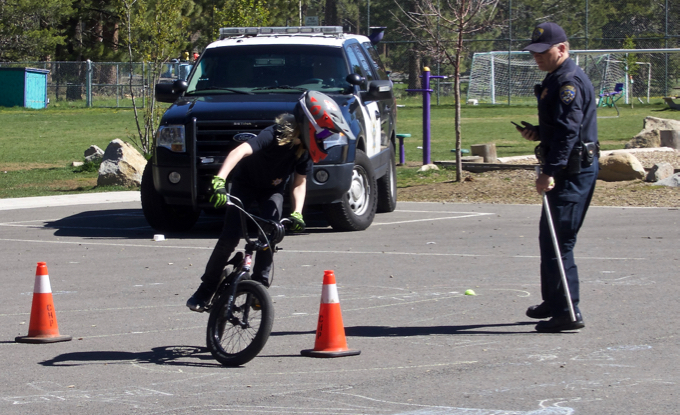
Charlie Baker makes his way through the obstacle course as CHP Officer Jeff Gartner times him. Photo/Kathryn Reed

By Kathryn Reed

If a stop sign isn’t enough to get the cyclist to stop, the tennis ball does the trick when it hits the tire. That ball represents a vehicle without the consequences of not following the rules of the road.

“The whole goal here is for kids to be safe through the summer,” Officer Jeff Gartner told Lake Tahoe News. California Highway Patrol officers were at Bijou Community School on May 19 for a bike rodeo and will be at the other Lake Tahoe Unified School District elementary schools before the end of the school year, with the goal of reaching all K-5 students.

This event is something officers try to do at the end of each school year as kids are more likely to be getting back on their bikes.

Using some of the painted lines on the blacktop and chalk for the course, the goal is to maneuver through without falling, colliding with others, and all the while obeying the signs.

Simone Sitchon practices staying in control. Photo/Kathryn Reed

“Something I learned is to control my bike and to go around turns slower so I’m not out of control,” Simone Sitchon told Lake Tahoe News. 

She is in Cynthia Pastore’s fifth-grade class. For Pastore, she sees events like this as a real benefit for the students – especially in a practical environment where they can practice what they are being taught.

Before students get on their bikes the officers do a quick inspection to make sure the brakes are working and the steering mechanism is good. They make adjustments if they can, but no unsafe bikes are allowed in the rodeo.

For those who didn’t have a bike, they share with friends. Officers even have a few helmets to hand out that the kids can keep.

At first the cyclists seem a bit wobbly and aren’t inside the lines. The extremely tight angles are like going through the hairpin turns at Emerald Bay in a car. Soon, though, the youngsters are getting a handle on how to adjust their speed, keep their balance and ride in a controlled manner.

The more experienced riders were timed through the course. Go outside the lines, knock a cone over or ignore a road sign and the cyclist was disqualified.

“This teaches kids how to not ride mindlessly,” Charlie Baker, who regularly rides his bike to school, told Lake Tahoe News. “There is some (awareness) to not cut in front of cars.”


Opinion: Suckering Americans is a hot growth industry

By Edward Balleisen

American capitalism has always provided openings for hucksters and outright swindlers.

For centuries, this society has been especially receptive to economic innovation and the strategies of wealth-seeking that so often accompany it. Openness to new technologies and new ways of doing business exacerbates information gaps between sellers and buyers.  Those gaps, along with the enthusiasm that comes with new products and investment vehicles, create opportunities for fraudulent promoters and the bait-and-switch brigade.

As the journalist Edward Smith noted in the 1920s: “Every social change, every new invention brings to life a fresh manner of separating the sucker and his money. It may be and usually is only a disguised evolution of an older swindle, but it is new to the victim and therefore effective.”

That said, the last few decades—the period since 1980—have seen a dramatic increase in the scale and breadth of American business fraud. Of course, Americans in earlier eras encountered fraudulent investment scandals, like the market manipulations at the Re brokerage firm (which came to light in the early 1960s), or the misrepresentations made by the National Student Marketing Corporation (in the early 1970s).  There also were egregious consumer frauds, such as the abusive mode of selling home heating systems by the Holland Furnace Company. But the worst of these episodes took place within medium-sized corporations, or on the fringes of the economy.

Today, fraud has become big business. In the last four decades, fraud cases running into the billions of dollars have become commonplace. So have allegations of marketing duplicity or false accounting against many of the largest corporations operating in the United States. Massive government contracting frauds roiled the defense industry in the 1980s and the healthcare industry the following decade. Consumer frauds have steadily targeted older Americans, first through telemarketing and now via the web.

During the late 1990s and early 2000s, accounting scandals rocked a series of major corporations, including Enron, WorldCom, and Sunbeam. Over the past decade, pyramid schemes such as those run by Bernard Madoff and Allen Stanford have bilked tens of thousands of investors. And in the run-up to the global financial crisis of 2008, the provision of marketing information throughout the entire chain of the American mortgage system became shot through with duplicity, with falsehoods embraced by appraisers, mortgage brokers, third-party loan assessors, underwriters, and distributors of derivatives.

This era of gargantuan fraud scandals is still with us. Even after the reality check of the most recent financial crisis, major fraud scandals keep happening: LIBOR rate-fixing; creation of myriad unauthorized accounts at a major nationwide bank, Wells Fargo; and another alleged billion-dollar pyramid scheme, Platinum Partners.    

What accounts for this dramatic growth in the magnitude of corporate deception? The post-1980 preference for deregulation has played a big role. Cuts to enforcement budgets have been a common theme in explanations of fraud episodes. So has the disinclination among policy-makers to impose regulatory constraints on newly emerging markets such as financial derivatives.  

A key premise among supporters of deregulation is that the reputational incentives created by markets will serve to check the rankest frauds. Corporations won’t go down the path of duplicity, this way of thinking presumes, because the long-term consequences of lost business can be so devastating. Unfortunately, the behavior of scores of corporations over the past few decades belies this comforting narrative. Companies have so decisively bought into the use of short-term incentives to structure compensation for employees and executives that it’s often hard for them to think much past the next quarter’s financial results.

After the 2008 financial crisis, American policy-makers placed a premium on containing marketplace duplicity. Most important, Congress created the Consumer Financial Protection Bureau (CFPB), with major duties: improving the flow of financial information to consumers, monitoring the operation of consumer credit markets, and bringing enforcement actions against businesses that engaged in unfair, deceptive, or abusive tactics. The CFPB has worked hard to simplify financial disclosures to consumers, and has clawed back almost $12 billion through a series of settlements with financial firms accused of wrongdoing. But in this same period, Congress also loosened disclosure requirements for many start-ups, a deregulatory move that has raised concerns about new opportunities for fraudulent promotion of new companies.

We now have an administration in Washington that trashes regulation of all sorts and appoints vehement opponents of regulation to run federal agencies. It’s not hard to imagine that enforcement budgets for consumer and investor protection will once again take a big hit, and that federal regulators will adopt a more forgiving posture toward dodgy marketing tactics.

Such policies are their own kind of sucker’s bet. If the Trump administration implements them, the long history of American business fraud suggests that we can look forward to more headlines about major corporations that have cooked their books or cheated their  customers.  When scandals of this sort accumulate, they have consequences beyond short-term economic losses. Indeed, they undermine the social trust that underpins our country, and healthy capitalism itself.

Edward Balleisen, the author of the recent book “Fraud: An American History from Barnum to Madoff,” is vice provost for Interdisciplinary Studies and Associate Professor of History and Public Policy at Duke University. 


More older couples are ‘shacking up’

By Paula Span, New York Times

In many ways, the life that Karen Kanter and Stan Tobin share in Philadelphia sounds entirely typical. Both 75, they happily see movies and plays together, visit children and grandchildren, try new restaurants (but avoid sushi).

He supported her through a successful breast cancer treatment years ago. She has been prodding him about putting on pounds, so he has returned to Weight Watchers.

Careful about financial and legal arrangements, they co-own their condo near the Museum of Art and a cottage in upstate New York. She has his power of attorney and health care proxy, and vice versa. But although they have been a couple since 2002 and have shared a home since 2004, they are not married. And among older adults, they have a lot of company.

The number of people over 50 who cohabit with an unmarried partner jumped 75 percent from 2007 to 2016, the Pew Research Center reported last month — the highest increase in any age group.

Read the whole story


$4.4M marketing push to sell a cooler, more fun Reno-Tahoe

By Jason Hidalgo, Reno Gazette-Journal

 For many who live outside of Reno, the Biggest Little City’s image typically bounces between being a poor man’s Vegas to that place with the bumbling lieutenant who wore short shorts on TV.

After securing more funding for its marketing efforts, however, the area’s leading convention and visitors’ bureau is gearing up for a big push to sell a more enticing image of the Reno-Tahoe region.

The Reno-Sparks Convention and Visitors Authority announced a new marketing effort, backed by what could end up being the biggest infusion of marketing dollars for a campaign in the organization’s history. Supporters of the new brand campaign — which focuses on three key Western markets and includes an online push for the rest of the nation — hope the initiative leads to increased visitor counts while erasing the less-than-flattering perceptions of the region, especially from people who live outside of the area.

BVK, a Milwaukee, Wis.-based marketing agency that was hired to craft the latest marketing initiative, cited several reasons for the problem during the RSCVA’s meeting in March.

Read the whole story