Predicting suicide is a difficult, complex challenge

By Joseph Franklin, The Conversation

Who is going to die by suicide? This terrible mystery of human behavior takes on particular poignance in the wake of suicides by high-profile and much-beloved celebrities Kate Spade and Anthony Bourdain. It is only natural that people want to know why such tragedies occur. Those closest to those who take their lives are often tormented, wondering if there is something they could have – or should have – known to prevent their loved one’s suicide.

As a scientist who has focused on this question for the past decade, I should have a pretty good idea of who is and isn’t going to die by suicide. But the sad truth is, I don’t. The sadder truth is, neither do any other suicide experts, psychiatrists or physicians. The sum of the research on suicide shows that it does not matter how long we’ve known someone or how much we know about them. In my research, my colleagues and I have shown that we can only predict who is going to die by suicide slightly more accurately than random guessing.

The need for answers

The fact that suicide is so hard to predict unfortunately took about 50 years for most scientists to appreciate. About the same time that this recognition became widespread a few years ago, a new hope emerged: a form of artificial intelligence called machine learning. As several research groups have demonstrated in recent years, machine learning may be able to predict who is going to attempt or die by suicide with up to 90 percent accuracy.

To understand why this is, and why we humans won’t ever be able to accurately predict suicide on our own, one needs to take a step back and understand a little more about the nature of human cognition, suicide and machine learning.

As humans, we love explanations that have two qualities. First, explanations should be simple, meaning that they involve one or a small number of things. For example, depression is a simple explanation for suicide.

Second, explanations should be determinate, meaning that there is one set explanation that accounts for all or most of something. For example, the idea that depression causes most suicides is a determinate explanation. This simple and determinate explanatory style is highly intuitive and very efficient. It’s great for helping us to survive, procreate, and get through our days.

But this style of thinking is terrible for helping us understand nature. This is because nature is not simple and determinate. In recent decades, scientists have come to recognize that nearly everything – from physics to biology to human behavior – is complex and indeterminate. In other words, a very large number of things combined in a complex way are needed to explain most things, and there’s no set recipe for most physical, biological or behavioral phenomena.

I know that this latter idea of indeterminacy is especially counterintuitive, so let me provide a straightforward example of it. The math equation X plus Y equals 1 is indeterminate. As humans, we instinctively try to find one solution to this equation (e.g., X equals 1, Y equals 0). But there is no set recipe for solving this equation; there are nearly infinite solutions to this equation. Importantly, however, this does not mean that “anything goes.” There are also near infinite values for X and Y that do not solve this equation. This indeterminate middle ground between “one solution” and “anything goes” is difficult for most humans to grasp, but it’s how much of nature works.

The sum of our scientific evidence indicates that, just like most other things in nature, the causes and predictors of suicide are complex and indeterminate. Hundreds, and maybe thousands, of things are relevant to suicide, but nothing predicts suicide much more accurately than random guessing. For example, depression is often considered to be an extremely important predictor of suicide. But about 2 percent of severely depressed people eventually die by suicide, which is only slightly higher than the 1.6 percent of people from the general United States population who eventually die by suicide. Such a pattern is consistent with complexity because it suggests that we must put a lot of factors together to account for suicide.

Empathy will always matter

So how should we put all of these factors together? One intuitive solution is to add many of these factors together. But even when summing hundreds of factors, this doesn’t work – prediction is still only slightly more accurate than random guessing.

A much better solution would be to somehow find an optimized combination of tens or even hundreds of factors. How can we do this? One promising answer is machine learning. In short, machine learning programs can process a large amount of data and learn an optimal combination of factors for a given task. For example, most existing machine learning studies have used data from electronic health records, spanning hundreds of factors related to mental health diagnoses, physical health problems, medications, demographics and hospital visit patterns. Results from several groups in recent years have shown that this approach can consistently predict future suicide attempts and death with 80-90 percent accuracy. Multiple groups are currently working on applying these algorithms to actual clinical practice.

One important thing to keep in mind is that there isn’t, and never will be, a single algorithm or recipe for suicide prediction. This is because suicide is indeterminate, much like the X plus Y equals 1 equation. There are likely near-infinite algorithms that could predict suicide with 80-90 percent accuracy, as a number of studies have shown. Research has already demonstrated that no particular factors are necessary for a good algorithm, and many different types of algorithms can produce accurate prediction. But again, this indeterminacy also means that there are near-infinite bad algorithms, too.

All of this research shows that suicide is unfortunately too complex and indeterminate for humans to predict. Neither I nor anyone else can accurately predict who is going to die by suicide or truly explain why a particular person died by suicide (this includes the suicide decedents themselves). Machine learning can do a much better job of approximating the complexity of suicide, but even it falls far short. Although it can accurately predict who will eventually die by suicide, it cannot yet tell us when someone will die by suicide. This “when” dimension of prediction is critical, and we are likely still many years away from accounting for it.

In the meantime, what can we humans do? While we don’t have the ability to know whether someone is going to die by suicide or not, we do have the ability to be supportive and caring. If you believe that someone may be struggling, talk with them and let them know about resources such as the National Suicide Prevention Lifeline (800.273.8255).

Joseph Franklin is an assistant professor of psychology, Florida State University.


Gambling addiction may follow national wave of sports betting

By Richard N. Velotta, Las Vegas Review-Journal

Advocates for responsible gaming are worried that addictive gambling behavior could balloon with the arrival of nationwide sports wagering.

And the state lawmakers who could make a difference by requiring the implementation of new programs aren’t doing much to help.

“With the exception of New Jersey, none of the states that have either drafted bills or moved forward, including Delaware, have come close to adopting even one of our recommendations,” said Keith Whyte, executive director of the National Council on Problem Gambling, based in Washington.

Read the whole story


Environmental measures were big winners in Calif.

By Paul Rogers, Bay Area News Group

Most voters already know that Gavin Newsom and Dianne Feinstein — who easily advanced to the November general election in their races for governor and U.S. senator — were among the big winners in Tuesday’s California primary election.

But there’s another group also popping the champagne this week: environmentalists.

Across California and the Bay Area, environmental groups had one of their best elections ever. They won nearly every major race they contested, securing billions of dollars for Lake Tahoe, parks, beaches, water projects and public transportation, and at the same time helped kill plans to develop Silicon Valley hillsides and a proposal to change the way the state spends money from its greenhouse gas auctions.

Read the whole story


Road Beat: Kia Rio — maximum efficiency personified

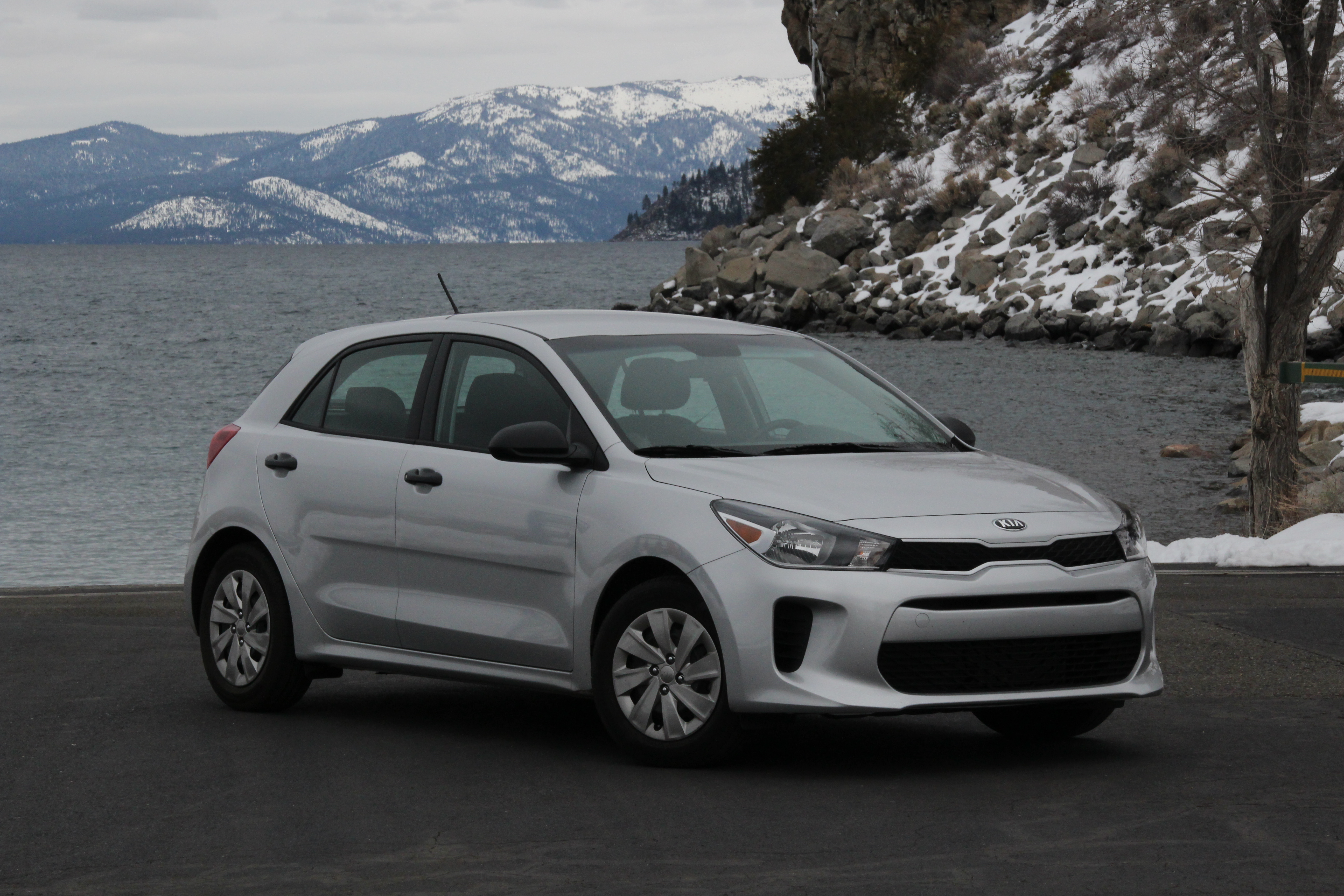
The 2018 Kia Rio five-door is a definite hybrid beater. Photos/Larry Weitzman

By Larry Weitzman

My car review this week is one of the least expensive economy cars for sale in the United States, the Kia Rio 5 door LX edition. It stickers for $15,290 with a six-speed auto cog swapper. If you like to shift, the sticker drops to just $14,200.

Both require the obligatory delivery charge of $895 for the boat, train and truck from Pesqueria, Mexico. Even the engine and transmissions originate in Mexico. If you are worried about build quality, don’t, it’s built like every other world car in an automated factory. My tester was bank vault tight.

Rio may be the ultimate commuter/economy car as will be explained. First while the standard Rio subcompact is 17- inches long riding on a long 102-inch wheelbase, the five-door hatchback version is a handy 160-inches long which is approaching the length of a Mini-Cooper. Both are a svelte 68-inches wide. Rio five-door is small on the outside. But inside interior volumes are 2 cubic feet shy of being classified by the EPA as a mid-size car. And it’s all wrapped in a pretty good looking, very well-proportioned body. It’s cute.

Powering up the Rio is a sophisticated 1.6L DOHC, 16 valve, direct injected inline four-cylinder engine that cranks out 130 hp at 6,300 rpm and a commensurate 119 pounds of twist peaking at 4,850 rpm. My version had a torque converter six-speed automatic cog-swapper in place of the standard and less expensive six speed manual driving the front wheels.

Specifications
Price $15,095 to about $20,000
Engine
1.6L DOHC, 16 valve, Direct injected inline four cylinder 130 hp @ 6,300 rpm
119 lb.-ft. of torque @ 4,850 rpm
Transmissions
Six-speed manual
Six-speed torque converter automatic
Configuration
Transverse mounted front engine/front wheel drive
Dimensions
Wheelbase 1,011.6 inches
Length 160.0 inches
Width 67.9 inches
Height 57.1 inches
Track (f/r) 60.0/60.2 inches
Ground clearance 5.5 inches
Fuel capacity 11.9 gallons
Cargo capacity (rear seats up/down) 17.4/32.8 cubic feet
Passenger volume 90.5 cubic feet
Steering lock to lock 2.77 turns
Turning circle 33.46 feet
Wheels Steel/5.5X15 inches
Tires 185/65X15
Weight 2,714 pounds
Performance
0-60 mph 8.26 seconds
50-70 mph 4.43 seconds
50-70 mph uphill 7.58 seconds
Top speed Does anyone really care?
Fuel economy 28/35/32 mpg city/highway/combined. Expect 34-35 mpg in rural/suburban driving, 47 mpg on a level highway at (California) legal speeds.

When Kia arrived in the United states some 25 years ago, its only model was the 1.5L, 79 hp Sephia which couldn’t get to 60 mph in 12 seconds even pointed downhill. Now, this foot shorter Rio will literally rocket to that benchmark of 60 mph from a stop in a quick 8.26 seconds. Who said extreme economy/commuter cars can’t be fun and quick? Passing performance is also good with a 50-70 mph simulated pass requiring just 4.43 seconds and the same run up a steep grade (6-7 percent) will slow that time down about three seconds to 7.58 seconds. Interestingly, these numbers are virtually the same as the Toyota Corolla tested last week (8.31, 4.58, 7.66 seconds).

But while it slightly outperforms the Corolla, it returns significantly better fuel economy. EPA says expect 28/35/32 mpg city/highway/combined. However, my tests revealed much better fuel economy with a two-way level highway run returning an average of 47.3 mpg and my round trip from Placerville to Carson City via Highway 50 yielding an average of 42.5 mpg. Overall, I averaged about 34 mpg. The point being that these numbers, the highway mileage and round-trip numbers are within 5 mpg of a hybrid. It also has a hybrid size small 11.9-gallon fuel tank.

 So how does the Rio handle? A one-word answer would be good. It comes with steel wheels (15 x 5.5 inches) and hubcaps, 185/65 rubber and aa torsion beam rear suspension, but its electric power steering rack is a very quick 2.77 turns lock to lock. It has a turning circle of just 33 feet and it weighs just 2,715 pounds meaning the mass that needs to change directions is on the minimal side, so Rio handles quite sporty in a benign fashion with no vices. It feels good in the twisties and its attitude remains flat. Rio can be rowdy.

Ride quality is quite quiet and smooth. Noise sources are subdued as the engine spins just 2,300 rpm at 70 mph while there is little if any tire noise and no wind noise. You will forget that this is an extreme economy car. More on that later.

Safety isn’t compromised as well as all important acronyms are present, even though only the front brakes are discs. Rears are drums, but remember the fronts do 80 percent of the stopping (unless you predominantly drive in reverse), so the brakes are strong and powerful. About the only thing missing from its safety complement is the rear-view backup camera, but a slight upgrade will net you that anyway which I will discuss later. Headlights are good on high and low beam.

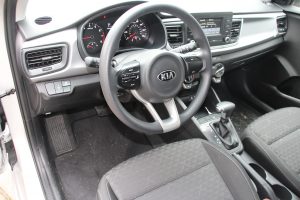
Inside is a comfortable interior, seats are good and the instrument panel is complete with a trip computer being flanking by a tack and speedo. Most of the interior is hard surfaced (what do you expect for $15K?), but it has a decent sound and HVAC system. Best of all its easy to use. It has plug-ins for charging your stuff.

Rear seating is not bad and behind the rear seats, this mini-CUV holds over 17 cubes and with them folding it grows to about 33 cubes. Unbelievable for a 160-inch ride.

Unfortunately, my LX is a bare bones tester with no power windows, mirrors, Bluetooth, cruise, keyless entry and rear backup camera. However, if you opt for the “S” model one trim grade up for just a paltry $1,110 (or a $16,400 sticker), you get everything I mentioned. Or in other words a well-equipped vehicle with all the modern conveniences. Everything you need and nothing you don’t, making the “S” version of the Rio 5 door perhaps the best value in a commuter/economy car in the USA and it’s made in North America.

Rio is about $5,000-$6,000 less than the cheapest hybrid. Rio certainly outperforms the cheap hybrid and returns within about 5-7 mpg. So, it you drive 15,000 miles a year, the hybrid will save you about 80 gallons of gas, certainly no more than 100 gallons, or in other words, even in high priced California that amounts to about $300 a year, which doesn’t even pay for the extra capitalization costs of the hybrid. Rio makes a whole lot of dollars and sense.

Larry Weitzman has been into cars since he was 5 years old. At 8 he could recite from memory the hp of every car made in the U.S. He has put in thousands of laps on racetracks all over the Western United States.


Letter: The politics of VHRs in S. Lake Tahoe

To the community,

The recent election results in Palm Springs in support of vacation rentals and against the anti-VHR crowd should be the death nail to the hysteria brought to local governments. These selfish local activists have zero interest in the economic lives of their neighbors and the economic well being of the South Lake Tahoe community. 

Jim Morris

Where do we go from here? Do not support the re-election of the following members to the City Council? These members put the cap on vacation rentals and the $1,000 parking fines on the books against our property owners and tourist guests. These people do not deserve a single vote. They include former Mayor Austin Sass, leader of the anti-VHR group; Jason Collin, Sass’s lackey and ineffective council member; and Mayor Wendy David who relied on a flawed, city paid $75,000 study to impose Draconian regulations to property owners and guests. And lastly, Tom Davis who has been so ineffective in recusing himself from crucial VHR discussions and votes due to his minority interest in a property management company in South Lake Tahoe. 

Over 150 property owners are waiting for permits and trying to provide a preferred family accommodation for tourist visitors to South Lake Tahoe. The city is losing over 10 percent in tax or approximately $350,000 plus millions of dollars in sales tax and economic benefits to local businesses by not allowing owners to exercise private property rights.

The city’s own VHR statistics show that vacation renters are not the problem that was projected by selfish locals who didn’t want to hear a car door close or the sounds of the wheels of a suitcase on the sidewalk. Less than 20 percent of VHR complaints are verified by the police department who are responding within 10 minutes on average. Plus, the city has overstaffed its community service department by over 400 percent to 500 percent to investigate one to two incidents per day out of 1,400 vacation rentals citywide.  See VHR complaints

Please let your opinions be known to the good hard working residents of South Lake Tahoe and replace the City Council in November. Vote “no” against both ballots effecting vacation rentals in South Lake Tahoe’s November election.  More to come on why the Sustainable Community Alliance is detrimental to the community.

Jim Morris, president of Lake Tahoe Accommodations


Snippets about Lake Tahoe

·      Lights on the Lake is a 25-minute fireworks shows on July 4 shot off from near Edgewood Tahoe. The show will begin at 9:45pm, with simulcast on radio stations KRTL–93.9-FM and KOWL-AM 1490.

·      Starting June 11, CalFire will suspend all burn permits for outdoor residential burning within the state responsibility area of Amador, El Dorado, Sacramento and Alpine counties.

·      Here are the El Dorado-Tahoe and Sierra roadwork schedules from Caltrans for the week.

·      South Tahoe High School sports medicine students were recognized for their dedication, knowledge and willingness to help other STHS athletes. They are Riley Turner—sports medicine student of the year; Hannah Voorhees—exemplary sports medicine student of the year; and Ally Sullivan—student trainer of the year.


Federal cannabis bill would help businesses get banking

By Kimberly Veklerov, San Francisco Chronicle
 
A bipartisan effort in Congress to ease federal restrictions on cannabis, which President Trump said Friday he is inclined to support, would solve a few of the biggest problems facing the nascent industry in California, experts say.

Most important, they say, the bill introduced Thursday — which gives states the authority to create their own marijuana laws — would open the door to banking for businesses by declaring that cannabis activities that comply with state rules do not constitute “trafficking” and their proceeds, therefore, are not the fruits of illegal transactions.

“It’s a really elegant solution,” said Hezekiah Allen, executive director of the California Growers Association, an advocacy group for hundreds of marijuana farmers, business owners and patients in the state. “It doesn’t go all the way, but it does alleviate some of the day-to-day challenges we face.”

Read the whole story


Upgrades coming to North Shore beach

Placer County Board of Supervisors last week approved $413,000 in upgrades for North Lake Tahoe’s popular Speedboat Beach.

Improvements will include a permanent restroom to replace existing port-a-potties, reconstruction of the wooden staircase that provides access to the beach from Harbor Avenue, a new beach overlook, walkway improvements and signage.

The signage will include a welcome sign, an interpretive sign describing the local ecosystem and a regulations panel to identify beach rules.

The cost of the project also includes preservation of a complex drainage system to reduce sediment into Lake Tahoe, a new retaining wall and custom metal fabrication for the flight of stairs.

Construction is expected to begin in late July or early August and be completed in October.

Parking is still expected to be limited during the summer. TART’s bus stop on Highway 28 at the Tahoe Biltmore shelter is the closest to Speedboat Beach’s Harbor Avenue access road.


Blood drive in South Lake Tahoe

South Tahoe Association of Realtors is partnering with United Blood Services to host a blood drive on June 19.

Everyone is invited to stop by the office and donate between 9am and 1pm. The office is at 2307 James Ave., South Lake Tahoe.

Donors may reserve a time slot . Drop-ins are also welcome. To save time on the day of the blood drive, go online to complete the required form.


Grand jury wants EDC to better deal with CalPERS

Updated 8:45am:

By Kathryn Reed

From the El Dorado County Grand Jury report that was released last week one might conclude only one entity in the county has an issue with CalPERS.

This would be because the grand jury only investigated El Dorado County. It didn’t touch on the two cities in the county – South Lake Tahoe and Placerville – or utility, fire and other special districts that have obligations to the state retirement system. And if the grand jurors had wanted to take it a step further, they could have delved into CalSTRS, the teachers’ retirement system.

Jurors did not explain why the county was the target of the investigation.

Here are the findings from the grand jury:

·      The unfunded CalPERS liability for El Dorado County is $346 million as of July 2016.

·      El Dorado County pays annual CalPERS payments monthly, resulting in interest charges payable to CalPERS.

·      El Dorado County pays only the minimum amount due to CalPERS; it does not make additional payments to reduce the UAL [Unfunded accrued liability.]

·      El Dorado County has an established policy to set aside additional funding for post-employment benefits, but not specifically for CalPERS obligations.

·      Historically, El Dorado County has not provided information to the public about its CalPERS obligation in a way that clearly illuminates the scope of the pension obligation.

The grand jury recommended increasing contributions to CalPERS to pay down the debt, and creating a dedicated trust just for that purpose.

There were no suggestions as to where this added money would come from.

It is not true that the county has not provided information about the issue. CalPERS has been an agenda topic for supervisors, and is part of the annual budget discussions. Plus, the auditor annually provides information about CalPERS.

Lake Tahoe News has written about the county’s CalPERS quagmire as well.

The county also isn’t alone in having to contend with obligations that keep escalating. Unfunded liability is an issue for every public agency that is part of the system.

“I have read the report. I have not studied the report. I am in general agreement with the report. I have been bringing this issue to the supervisors and the public for years. (CEO) Don Ashton has discussed this matter with the supervisors for the past two years,” county Auditor Joe Harn told Lake Tahoe News. “I am glad that the grand jury is bringing this matter to the supervisors’ and the public’s attention again now. It is important to note that this problem is a statewide problem, not just an El Dorado problem.”

Supervisor Sue Novasel told LTN, “I agree with their assessment concerning the CalPERS obligation. Our CAO has been very proactive in identifying and addressing this issue. He specifically spoke at length about these issues during our town hall budget talks that we held throughout the county. We have already placed millions of dollars into a special reserve fund for the underfunded retirement system and we plan to identify more as our budget for 2017-18 is developed this month.”

It will be the supervisors who must come up with a response to the grand jury per state law. The topic will be on a future agenda.

“Overall, the grand jury report appears to be balanced and fair, highlighting the current board is taking significant steps to set aside funding for future year CalPERS payments and funding for a pensionable trust. However, as the report highlights CalPERS costs will continue to be a significant challenge that will influence other policy decisions in the future and it is critical for county leadership to continue to explore a variety of options in how to handle these cost increases,” CAO Don Ashton told Lake Tahoe News.