Road Beat: 2017 Hyundai Elantra Sport, emphasis on Sport
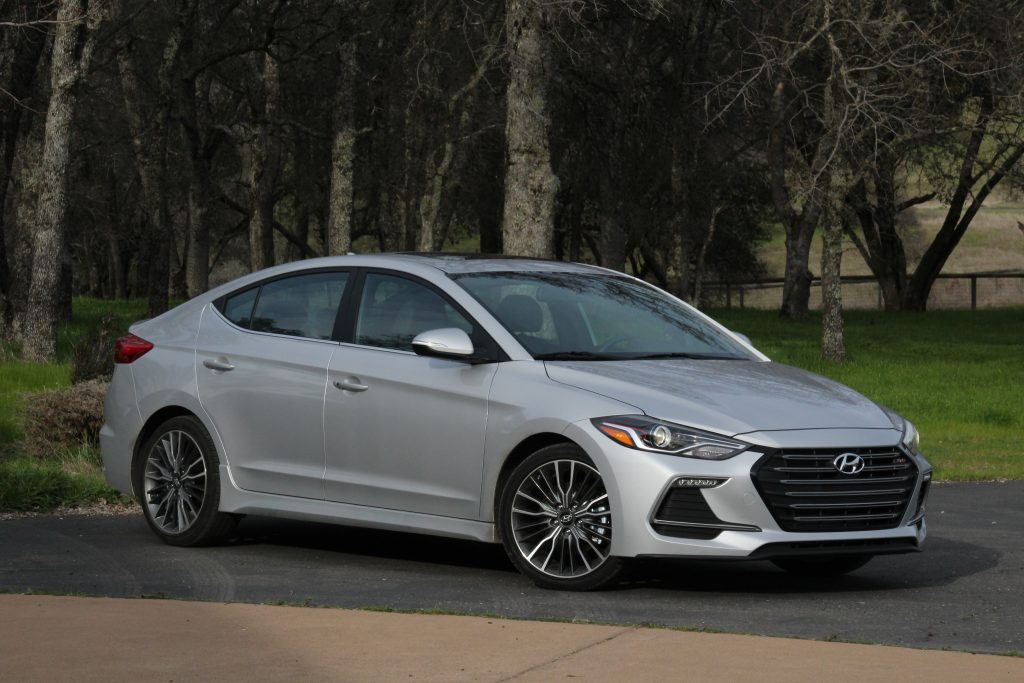
The Hyundai Elantra Sport is fun to drive. Photos/Larry Weitzman

By Larry Weitzman

Most new vehicles with a sport designation are in name only, but not the Hyundai Elantra Sport, which actually means something with respect to the car so named. The Elantra is a highly competitive, grown-up quality compact and the Sport version definitely adds to the driving experience with a more engaging, dynamic feel.

Instead of just adding dress up “sporty” items like red stitching, aluminum pedal applications and better seat bolstering, this Sport adds a whole lot more. First, is the thick, leather flat bottom steering wheel, a pleasure to hold, a more business like gauge cluster and a black headliner. But even more important is the Sport drivetrain and significant steering and suspension upgrades.

The Elantra body is in its best rendition yet, sleek, sporty and defined by its aggressive front grille and slick top line (its only 56 inches high). It is a great looking car with a length of 180 inches and a width of 71 inches also giving it a wide stance.

Powering the Elantra Sport is a high-powered version of the 1.6L direct injected turbo inline DOHE, 16 valve four, knocking down 201 hp at 6,000 rpm and 195 pounds of twist from an off idle 1,500 to 4,500 rpm. This is unquestionably the most powerful Elantra ever. Standard is a six-speed manual but for about a grand more you can get it with a seven-speed dual clutch auto cog-swapper. I would go with the seven-speeder even though my tester was an unbelievably smooth pure manual six-speeder. The DCT gets a four mpg higher EPA fuel economy rating. The manual tranny was so smooth, most up shifting could be down without the clutch.
Specifications
Price $21,650 to about $26,110
Engine
1.6L DOHC, 16 valve direct injected turbo inline four 201 hp @ 6,000 rpm,
195 lb.-ft. of torque at 1,500-4,500 rpm
Transmission
Six speed manual
Seven-speed dual clutch automated manual
Configuration
Transverse mounted front engine/front wheel drive
Dimensions
Wheelbase 106.3 inches
Length 179.9 inches
Width 70.9 inches
Height 56.5 inches
Track (f/r) 60.8/61.4 inches
Ground clearance 5.5 inches
Fuel capacity 14.0 gallons
Trunk capacity 14.4 cubic feet
Passenger cabin volume 95.8 cubic feet
Weight 3,042-3,131 pounds
Steering lock to lock 2.6 turns
Turning circle 34.78 feet
Wheels 18 inch alloys
Tires 225/40X18
Coefficient of drag 0.31
Performance
0-60 mph 6.47 seconds
50-70 mph 3.04 seconds
50-70 uphill 4.11 seconds
Top speed Well into triple digits
Fuel economy EPA rated at 22/30/25 (manual) 26/33/29 (automatic) mpg city/highway/combined. Expect 30-34 mpg in rural country driving with some stop and go. 39 mpg on the highway at legal speeds.

Suspension gets more than just a few tweaks like increased spring and shock rates, a rear stab bar (regular Elantras get front stab bars already, but the Sport front stab bar is thicker) and an entirely new rear suspenders going from a semi-independent coupled torsion beam to a fully independent multilink system. But there is more. Sport also gets a new exhaust system. It is the best sounding four banger in its market class. I didn’t know it until it drove away from my home, as inside it’s still very quiet. But Sport will certainly let the person you are passing the Sport is something special.

How quick and special; the Sport will scamper from 0-60 mph in 6.47 seconds. The DCT might break into the fives. Fifty to 70 mph simulated passing runs on a level highway required just 3.04 seconds and up a steep grade only slowed that time by a second to a miniscule 4.11 seconds with all runs being done in third gear. This is about the quickest compact ever tested by the Road Beat, a car with a base price of $21,650. Throttle response is amazing after 1,500 rpm, even in six gear when it will accelerate without much complaint. Very flexible. It is also one of the quietest and smooth four bangers ever encountered. And as mentioned it makes beautiful music on the outside. This sports absolutely rocks. It’s a box stock car that would be a blast on a racetrack. More on that below.

Sport is an economy vehicle as well even though the EPA numbers say otherwise at a 22/30/25 mpg city/highway/combined rating. In my first 180 miles of driving a fill-up showed the Sport achieved 29.4 mpg and that included all performance testing (at least two dozen full throttle runs) and a trip over the Sierras via Highway 50 to Carson City. The mileage for the round trip was 37.6 mpg. At 70 mph on a level highway the Sport averaged 38.6 mpg and a round trip from Placerville to Roseville with moderate stop and go driving and no mileage on a freeway, the Elantra Sport average 34.7 mpg. I would think the DCT would average about three more mpg. No guilt for this high-performance driver.

Handling is also spectacular. You already know about the trick suspension. Wheels are 18 inch alloys shod with big, wide 225/40 series rubber. Add to that one of the best electric steering racks with incredible off and on center feel and an almost like hydraulic feel that is super quick at 2.6 turns lock to lock. Turn in is extremely quick and it responds with cat-like reflexes. Nothing like having great roll control, communicative steering and copious rubber on the ground. Sport gives you all that in spades with light weight (3,042 pounds) and when you couple that with big, down low power, Sport would be a blast on a racetrack. It makes weekday commuting fun and your weekend track days better. All in one package in which you will never have to buy that expensive fuel at the race track. A full tank might outlast your tires. I have had a Genesis Coupe on the track with a 201 hp four banger turbo engine and I think this Elantra Sport would be its equal, easily.

And then there is the firm ride quality, helped by its bank vault like structure. While supple and compliant, it is extremely well controlled, making the ride feel on the firm side, but a good firm, my kind of firm. While I talked before of its raucous exhaust, it is very quiet inside. The engine spins a high 2,700 rpm at 70 mph so it has good six gear power, a seventh gear dropping that to say 2,300 rpm might even make the cabin more serene and improve highway mpg by an mpg or two. But even at 2,700 rpm in sixth gear, there is no engine, road or wind noise.

Safety of course also makes the Elantra Sport a first place car with all the acronyms including blind-spot detection with the $2,400 package. Brakes are four wheel discs (enlarged front ventilated with one foot rotors) and they are powerful with a strong pedal.

Another first place for this Sport is in the leather interior and well bolstered seats with red stitching everywhere. Nice. The seats are manually adjustable, however. The exclusive Sport instrument binnacle is a nice touch with a big tach/speedo and center info system. The center stack is a model of simplicity and the NAV system with the Premium Package and bigger eight-inch screen is a great addition.

Trunk is a large 14.4 cubic feet and while the Sport looks like it might have a hatchback design, it isn’t. The rear seat is quite usable and comfortable for two, less so for three.

Pricing for this well-equipped Sport begins at a modest $21,650 plus $835 for the boat ride from Ulsan, South Korea. The Premium package, which I recommend, adds another $2,400 and the carpeted floor mats adds another $135 bringing the total damage to a very reasonable $25,010. If you opt for the seven speed dual clutch automated manual, which I would also do, that will add another $1,100. This is the best Elantra yet and easily contends as the best compact right up there with the Mazda 3. Elantra Sport is a truly fun economical driver that can save you money during the week providing superb, fun transportation while also giving you some real weekend exhilaration.

Larry Weitzman has been into cars since he was 5 years old. At 8 he could recite from memory the hp of every car made in the U.S. He has put in thousands of laps on racetracks all over the Western United States.



Snippets about Lake Tahoe

·      Nevada residents and visitors are invited to discover Nevada State Parks on June 10. Park visitors will receive free day use admission and free fishing (no license required) at all of Nevada’s 23 State Parks.

·      Friends of Hope Valley’s annual workday is June 10 starting at 9am. Meet at Pickett’s Junction. On July 11 the Back Forty will play for a Friends of Hope Valley benefit concert at Sorensen’s Resort. Cost is $10.

·      Yamakai Fish and Sushi Co. opens the Village at Northstar on June 16.

·      Lake Tahoe Hard Rock’s parking lot will be transformed into an off-road sporting experience for the FMX motocross event on July 22.

·      A retired Washoe County Sheriff’s Office K9 passed away from medical complications last weekend. K9 Ben, who retired in 2014, died with his partner retired Deputy Cole Bunyard was by his side.


Lightning sparks small blaze in Carson Valley

Lightning on early evening of May 29 started a wildland fire in the Fay-Luther Canyon in the Carson Valley.

It was contained to less than an acre. No structures were threatened.

Smoke from the fire could be seen from quite a ways away.

— Lake Tahoe News staff report


Letter: Kirkwood workers help at Bread & Broth

To the community,

On May 8, Emily Davis, Kirkwood Mountain Resort Human Resources supervisor, experienced her first Adopt A Day volunteer stint at a Bread & Broth Monday meal. 

“It was such a wonderful and fulfilling experience giving back to the community like this,” was Davis’ description of setting up and serving a healthy and hearty dinner to grateful guests.  “This was our first time here and we are all sincerely impressed by the quality of service and immense dedication the team here has. Thank you all for all you do.”

The B&B volunteers are dedicated and hardworking, and they thoroughly enjoy having AAD sponsor crews join them who are just as hardworking and dedicated as they are.  On May 8 the Kirkwood AAD sponsor crew included Davis and fellow Kirkwood team members Greg Carlson, senior HR manager; Elizabeth Day, recruiting manager; and Rebecca Del Pozo, recruiter. B&B would like to thank this crew for their incredible assistance and acts of kindness to all of the evening dinner guests.

Thank you also to the Vail EpicPromise Grant Program for funding the AAD hosted by Kirkwood Mountain Resort on May 8. The EpicPromise Grant Program is responsible for funding many wonderful programs in the Lake Tahoe south shore and B&B appreciates being one of the recipients of grant funds which sponsors monthly Adopt A Days throughout the year.  

Carol Gerard, Bread & Broth


Domestic abuse higher in Nev. than national average

By Camalot Todd, Las Vegas Sun

Every 9 seconds a woman in America is beaten or assaulted.

Nevada consistently ranks high in deaths related to domestic violence. In 2016, there were at least 24, according to the Nevada Coalition to End Domestic and Sexual Violence. The year before, 43 victims lost their lives.

Those numbers are alarming even without contrast. Roughly 44 percent of women and 33 percent of men living in the state experienced some form of violence at the hands of an intimate partner, according to the most recent National Intimate Partner and Sexual Violence Survey. The national rate for women is about 1 in 4, and for men it’s 1 out of every 9.

Read the whole story


Tahoe-area climber summits Everest without oxygen

Adrian Ballinger of Olympic Valley stands atop Mount Everest on May 27. Photo/Adrian Ballinger and Emily Harring

By Benjamin Spillman, Reno Gazette-Journal

Tahoe-area climber Adrian Ballinger on Saturday joined elite club of people who climbed to the top of Mount Everest without using supplemental oxygen.

It was Ballinger’s seventh time to the top of the mountain and his first without using supplemental oxygen. He attempted a non-oxygen climb last year but suffered hypothermia and stopped just 300 meters from the peak. 

Only 200 people have summited Everest without oxygen according to Eddie Bauer, a Ballinger sponsor.

Read the whole story


Woman injured rock climbing on South Shore

By Sacramento Bee

What started as a fun Memorial Day weekend rock-climbing outing in the Sierra took a scary turn for a couple and their dog on Sunday that ended in a helicopter rescue.

As the trio began climbing the base of Luther Rock just south of Lake Tahoe, the man, identified only as John, gave the dog a boost onto a ledge, but it began sliding toward the edge, the California Highway Patrol reported in a news release. The woman, Michelle Powell, 27, tried to push the dog back, in the process losing balance and falling backward.

Read the whole story


Cloud seeding may increase near Lake Tahoe

Cloud seeding would ideally increase water flowing over Slab Creek Dam. Photo/SMUD

By Joann Eisenbrandt

Cloud seeding over the upper portion of the American River watershed from Fresh Pond to Twin Bridges in El Dorado County may be expanding next winter.

Sacramento Municipal Utility District (SMUD) is having a public meeting in Strawberry on June 1 to discuss its plans to increase the cloud seeding area of its Upper American River Project (UARP) from 190 square miles to approximately 400 square miles for the 2017-18 wet season. The expanded cloud seeding area would include small portions of Placer, Amador and Alpine counties, but the majority would take place in El Dorado County over mainly U.S. Forest Service land.

Not everyone supports cloud seeding. Questions have been posed regarding the safety of the silver iodide used in the process, its effects on plant life and especially on fish and aquatic wildlife in affected areas. Others dispute whether cloud seeding really enhances snowfall at all. Some believe it takes away needed snow or rainfall from areas downwind of the seeded area.

Not a new idea

SMUD began cloud seeding in El Dorado County in 1968. The goal of the Upper American River Project is to augment snowfall and subsequent snow melt. The increased spring flows of water into its system of storage reservoirs and hydroelectric power plants would meet the electric power needs of the Sacramento area’s growing population. SMUD estimates its cloud seeding efforts have increased snowfall in this targeted area by an average of 3 to 10 percent.

Last winter, SMUD actually ceased its cloud seeing operations mid-winter due to the record snowfall produced by Mother Nature. But as the recent drought years have shown, that’s not always the case. SMUD believes cloud seeding is of value in wet and dry years.

The project does not require state or local permits or approvals, but it does require the preparation of an environmental document under the California Environmental Quality Act (CEQA) to analyze any potential environmental impacts. This document, a mitigated negative declaration, has been prepared. The 30-day public review period ends on June 16. During this time, comments from public agencies and individuals are gathered and then included into the final document which is then voted on by the SMUD board of directors. Thursday’s meeting in Strawberry is part of this process of gathering public input.

Recreation opportunities are offered at SMUD reservoirs like Loon Lake. Photo/SMUD

How cloud seeding works

Cloud seeding goes back to the 1940s after a discovery by the General Electric laboratories in Schenectady, N.Y., about how snowflakes form. As Dudley McFadden, principal civil engineer at SMUD, explains, “When a cold winter storm is actively producing snow which is falling to the ground, some of the moisture in the cloud remains in liquid form, even way up in the sky where it is below freezing. So, instead of turning into snowflakes and dropping to the ground, the moisture stays in the cloud … ice crystals require a tiny solid particle to attach to in order to start forming a snowflake. Every snowflake you would find on the ground has microscopic particles which formed a base for the water to freeze into the snowflake.”

Once all the natural microscopic particles in the cloud have been used up, there is still enough moisture in the cloud to form more snowflakes. That’s where silver iodide comes in. Microscopic particles of silver iodide inserted into the clouds give the remaining sub-freezing moisture in the cloud something to adhere to and create additional snowflakes.

The Upper American River Project

Why is SMUD generating power for Sacramento residents through a project situated mainly in El Dorado County? “The hydropower project is partly on federal land, owned by all Americans and not by residents of a particular city or county,” McFadden told Lake Tahoe News. The economy of El Dorado County is interconnected with Sacramento, and the rest of California and Northern Nevada. We are all interdependent and work together on our American River watershed to provide food, housing, and quality of life for everyone living here.”

SMUD has an entire system of reservoirs and hydroelectric plants in El Dorado County’s Upper American River watershed. It received permission in 1957 from the Federal Energy Regulatory Commission (FERC) to build this system with a 50-year license. A second 50-year license was granted in 2014. The expanded cloud seeding project will focus on the watersheds of Ice House, Union Valley and Loon Lake reservoirs, the South Fork American River watershed that drains to Slab Creek Reservoir and their associated hydropower facilities. The cloud seeding “season” runs from November 15, 2017, through April 15, 2018.

When SMUD began establishing this power generation system, most of El Dorado County was open land. As McFadden explains, “SMUD and the capital city wanted to grow and recognized the water resources available in the mountains. It had the money and the ambition. It is federal land, national forest land.”

Basically, they got there first.

The hydropower generated by the UARP (Upper American River Project) provides from 15 to 20 percent of the energy supplied by SMUD to its customers. It generates clean power and helps them avoid using “peaker plants” during high usage peak summer periods in the middle of the day. These are power-generation plants that stand ready to be used as needed, but are operated by natural gas which is as McFadden terms it, “the negative side of the emissions spectrum.”

Public benefits are mandated under SMUD’s FERC license. Their system provides boating and other recreation opportunities on Sierra Nevada lakes as well as whitewater rafting in Coloma. As part of the current license, SMUD will set aside 30,000 acre-feet of water and hold it in storage in their Union Valley Reservoir to be released for customers in El Dorado Irrigation District’s service area during drought conditions.

Here is a map of the project area.

The mechanics of cloud seeding

Silver iodide is dissolved in a flammable solution or combined with other flammable solids to produce “seeding flares” which are then burned. They release microscopic silver iodide aerosol streams into the atmosphere. These “silver iodide ice nuclei” then fuse at below-freezing temperatures with the moisture in the clouds. SMUD dispenses these silver iodide nuclei either with remotely controlled or mobile ground-based units, or from aircraft. SMUD usually does cloud seeding for about 10 storms in an average winter. Storms to seed are selected based on wind direction, wind speed and cloud characteristics, including how much precipitation they are predicted to produce. There are controls built in to avoid cloud seeing during major storm events or when there are avalanche warnings. Cloud seeding already in progress can be stopped quickly if needed.

Does it work?

SMUD estimates that cloud seeding will increase snowfall by an average of 3 to 10 percent. Opponents of cloud seeding dispute that. McFadden admits, “We can’t directly prove it.” There is no way to say how much snowfall seeded clouds would have produced on their own. McFadden added that SMUD believes numerous tests in the field and in lab settings across the country prove that it does.

Critics point to the dangers of messing with Mother Nature’s balance in the atmosphere between evaporation and precipitation. Cloud seeding in one area, they say, may lead to a decrease in rainfall or snowfall in areas downwind of the seeded area. This would increase the chance of drought conditions and high fire danger in such areas. SMUD disagrees, stating, “Although cloud seeding increases the amount of precipitation in the target area, it has not been found to reduce naturally occurring precipitation in downwind area. Clouds continually regenerate and release only a portion of their moisture in rainfall or snowfall.”

Is it safe?

SMUD believes cloud seeding is safe. McFadden explained that silver iodide is insoluble in water and is not bio-reactive if ingested by aquatic wildlife or by humans. He compared it to a microscopic grain of sand which just passes through an organism but does not react with it or form any other potentially harmful compounds. There are a number of endangered or protected species in the cloud seeding target area. There is no danger to fish or wildlife, SMUD’s environmental document concludes, because silver iodide’s small accumulations in soil or vegetation would not be above natural background levels.

Not everyone agrees. Concerns expressed by Texas rancher, Johnny Micou, in an article for ranches.org back in 2003, is representative of the concerns heard from many over silver iodide’s safety both then and now. “To effectively monitor the levels of silver toxicity, at the very minimum, water samples should be taken on a monthly basis from every dam, creek … and other water capture places in the respective district while cloud seeding is being conducted. Also, soil samples should be taken. If private land or public health is compromised, then the program should be held liable … the question is not that is cloud seeding harmful, but how harmful.”

Excessive exposure to chemical compounds of silver by humans can produce a condition called argyria—a grayish-blue discoloration of the skin. Whether or not the amount of silver iodide dispersed during cumulative seasons of cloud seeding can produce such levels or is toxic to humans and wildlife, remains in dispute. An April 11, 2016, article by Christian Cristiano in Los Angeles City Watch, expresses the general unease of cloud seeding opponents. “In spite of claims that the long-term effects of this procedure are said to be harmless,” he says, “it still feels like we are something of test subjects in the area of cloud seeding.”

The SMUD board of directors will consider approval of the environmental document for expanded Upper American River Project at its Sept. 21, 2017, meeting in Sacramento.  More information on the June 1 meeting in Strawberry, on the overall project or on how to submit comments is available from SMUD by contacting Jerry Park at 916.732.7406 or jerry.park@smud.org.


Opinion: When Pac-Man started a national media panic

By Michael Z. Newman

In the early 1980s, spurred by the incredible popularity of Atari, Space Invaders and Pac-Man, everyone seemed to be talking about video games, if not obsessively playing them. A 1982 cover of Time magazine screamed “GRONK! FLASH! ZAP! Video Games are Blitzing the World!” If you turned on the radio that year you’d likely hear “Pac-Man Fever,” a Top 40 hit by Buckner & Garcia. Children begged their parents to buy them an Atari for Christmas or to give them a few quarters to drop in Pac-Man’s coin slot. Hollywood movies like “Fast Times at Ridgemont High” presented the video arcade as a quintessential teenage hangout.

Decades later they give off a more innocent retro cool vibe, but arcade video games were treated as objects of urgent fascination and concern when they were new. Kids regarded them as the ultimate playthings and competed to master them and set the high score, or the record for longest time playing Asteroids. Some grown-ups enjoyed them too. Many in positions of authority expressed fears about harmful effects of the electronic amusements and wanted to ban them or regulate their use.

Other adult authorities saw video games not just as diversions or toys, but as essential tools for training young people for a future of high-tech, computerized work and leisure. A magazine story framed the issue as one of essential education in the technology of tomorrow: “Is it somehow more valuable to learn Missile Command than to learn English?”

This moment in the history of pop culture and technology might have seemed unprecedented, as computerized gadgets were just becoming part of the fabric of everyday life in the early ’80s. But we can recognize it as one in a predictable series of overheated reactions to new media that go back all the way to the invention of writing (which ancients thought would spell the end of memory). There is a particularly American tradition of becoming enthralled with new technologies of communication, identifying their promise of future prosperity and renewed community. It is matched by a related American tradition of freaking out about the same objects, which are also figured as threats to life as we know it.

The emergence of the railroad and the telegraph in the 19th century, and of novel 20th-century technologies like the telephone, radio, cinema, television and the internet were all similarly greeted by a familiar mix of high hopes and dark fears. In “Walden,” published in 1854, Henry David Thoreau warned that, “we do not ride on the railroad; it rides upon us.” Technologies of both centuries were imagined to unite to unite a vast and dispersed nation and edify citizens, but they also were suspected of trivializing daily affairs, weakening local bonds, and worse yet, exposing vulnerable children to threats and hindering their development into responsible adults.

These expressions are often a species of moral outrage known as media panic, a reaction of adults to the perceived dangers of an emerging culture popular with children, which the parental generation finds unfamiliar and threatening. Media panics recur in a dubious cycle of lathering outrage, with grownups seeming not to realize that the same excessive alarmism has arisen in every generation. Eighteenth and 19th- century novels might have caused confusion to young women about the difference between fantasy and reality, and excited their passions too much. In the 1950s, rock ’n  roll was “the devil’s music,” feared for inspiring lust and youthful rebellion, and encouraging racial mixing. Dime novels, comic books, and camera phones have all been objects of frenzied worry about “the kids these days.”

The popularity of video games in the ’80s prompted educators, psychotherapists, local government officeholders, and media commentators to warn that young players were likely to suffer serious negative effects. The games would influence their aficionados in the all the wrong ways. They would harm children’s eyes and might cause “Space Invaders Wrist” and other physical ailments. Like television, they would be addictive, like a drug. Games would inculcate violence and aggression in impressionable youngsters. Their players would do badly in school and become isolated and desensitized. A reader wrote to the New York Times to complain that video games were “cultivating a generation of mindless, ill-tempered adolescents.”

The arcades where many teenagers preferred to play video games were imagined as dens of vice, of illicit trade in drugs and sex. Kids who went to play Tempest or Donkey Kong might end up seduced by the lowlifes assumed to hang out in arcades, spiraling into lives of substance abuse, sexual depravity, and crime. Children hooked on video games might steal to feed their habit. Reports at the time claimed that video kids had vandalized cigarette machines, pocketing the quarters and leaving behind the nickels and dimes.

Nowhere was this more intense than in Mesquite, Texas, a suburb of Dallas where regulation of video arcades became a highly publicized legal affair. The city barred children under 17 from the local Aladdin’s Castle emporium unless accompanied by a parent or guardian. Officials also refused the arcade chain a license to open a new location in a shopping mall on the grounds that the owner was connected with “criminal elements.” Bally, which owned Aladdin’s Castle, filed suit against Mesquite. The case made its way through the courts until 1982, when the Supreme Court sent the matter back to the appellate court, effectively dodging an opportunity to establish young people’s right to play video games in arcades. In a New York City case of the same year, a court ruled that the municipality could regulate games to curb noise and congestion, finding that games were not a form of protected speech under the First Amendment.

Such cases, among others, were not really about banning or restricting access to video games, however much some adults despised them. Millions of games were in people’s homes by 1982, and no legal action could remove them. Rather, these efforts sought to regulate the behavior of America’s teenagers, whose presence annoyed adults who objected to their hanging around, maybe skipping school, making fast remarks at passersby, maybe attracting the wrong element, making noise, littering, maybe drinking or smoking dope, and basically being teenagers. Some towns, like Marlborough, Mass, and Coral Gables, Fla., managed to keep arcade games out altogether, and others, like Morton Grove, Ill., managed to prevent arcade openings by enforcing ordinances that forbade businesses from operating more than a certain number of coin-operated machines.

There was a flipside to the freaking out about games and youth, a counterpoint to the panicked discourses that greeted the soaring popularity of the new amusements. Many commentators, particularly social scientists with a skeptical view of the moralizing, sky-is-falling crowd, saw great potential benefits in video games, which they identified as cutting-edge technology. Many observers of American society in the 1970s and 1980s had recognized a large-scale shift from an industrial to a post-industrial economy, from work in factories to work in offices, from manufacturing to knowledge and service labor. Among other technologies, electronics and particularly computers were facilitating this shift.

Video games were computerized playthings, often the first introduction to electronics and computers young people received, and they could provide a new form of training in the tools of tomorrow’s workplace, the optimists maintained. It was clear that children were learning from the games—how to master them, but also how to interact with digital electronics and computer interfaces. These were “powerful educational tools.” Some kids who were devoted to playing computer games might graduate to programming, making the pastime an introduction to making software. Several news items in the early ’80s profiled kids who sold a video game they had programmed at home, thereby teaching themselves not just technical skills but entrepreneurialism. A California teenager named Tom McWilliams, whose parents refused to buy him a computer of his own, sold his game Outpost for $60,000. An NBC News story on March 8, 1982, noted that now they call him “Tommy McMillions.”

Somehow, a generation of teenagers from the 1980s managed to grow up despite the dangers, real or imagined, from video games. The new technology could not have been as powerful as its detractors or its champions imagined. It’s easy to be captivated by novelty, but it can force us to miss the cyclical nature of youth media obsessions. Every generation fastens onto something that its parents find strange, whether Elvis or Atari. In every moment in media history, intergenerational tension accompanies the emergence of new forms of culture and communication. Now we have sexting, cyberbullying, and smartphone addiction to panic about.

But while the gadgets keep changing, our ideas about youth and technology, and our concerns about young people’s development in an uncertain and ever-changing modern world, endure.

Michael Z. Newman is an associate professor at the University of Wisconsin-Milwaukee.  His book, “Atari Age: The Emergence of Video Games in America” (MIT Press) was released in February.


Hidden horror of school sex assaults

By Robin McDowell, Reese Dunklin, Emily Schmall and Justin Pritchard, AP

BRUNSWICK, Maine — Chaz Wing was 12 when they came after him. The classmates who tormented him were children, too, entering the age of pimples and cracking voices.

Eventually, he swore under oath, the boys raped him and left him bleeding, the culmination of a year of harassment. Though Chaz repeatedly told teachers and administrators about insults and physical attacks, he didn’t report being sexually assaulted until a year later, launching a long legal fight over whether his school had done enough to protect him.

Chaz’s saga is more than a tale of escalating bullying. Across the U.S., thousands of students have been sexually assaulted, by other students, in high schools, junior highs and even elementary schools — a hidden horror educators have long been warned not to ignore.

Relying on state education records, supplemented by federal crime data, a yearlong investigation by the Associated Press uncovered roughly 17,000 official reports of sex assaults by students over a four-year period, from fall 2011 to spring 2015.

Read the whole story